Can a community stop fracking?

Photo courtesy creative commons by Helen Slottje

Mari Margil and Ben Price have a detailed article in Yes! magazine this month about Pittsburgh’s recent ban on natural gas drilling, which uses the “fracking” or hydraulic fracturing technique. Pittsburgh is the first major city in the US to ban corporations from natural gas drilling.

The ordinance has a direct impact on Pittsburgh, but as they point out, its implications go much further:

Provisions in the ordinance eliminate corporate “personhood” rights within the city for corporations seeking to drill, and remove the ability of corporations to wield the Commerce and Contracts Clauses of the U.S. Constitution to override community decision-making.

Community decision making is essential in this arena for two reasons: First, exemptions to the Clean Water Act and the Clean Air Act for the oil and gas industry, expanded even further in 2005, mean that the burden of proof is now on communities to prove that any drilling practice is unsafe. This, it’s essential that communty decision making be supported and seen as the proper venue for judging the value of any drilling. Second, no individual landowner can have much impact on the drilling. The horizontal drilling methods mean that the fracking can proceed, regardless of landowner approval. All the landowner can do is decide to forego any royalties. This effectively grants all power to the corporation doing the drilling.

This issue hits home for me, since Fort Worth has been a major site for fracking (Smith, 2010). Although the oil and gas industry has asserted that fracking does not pollute underground water supplies or air quality, does not cause earthquakes, and is all in all a benign way to produce clean energy, it’s difficult to accept the assertions when they continually seek exemptions to EPA review and refuse to release data on the chemicals and procedures they use.

References

Jane Addams Conference on Social Entrepreneurship

I just learned, too late I’m afraid, about the Jane Addams Conference on Social Entrepreneurship to be held in Uppsala, November 18-19. It’s organized by the department of Sociology at Uppsala University in cooperation with the Nobel Museum, Stockholm.

You may like to look at the conference program, even if you can’t pop over to Sweden for a couple of days. It’s interesting to see the level of interest in Jane Addams (also John Dewey and WIlliam James) here in Sweden. In many other places in Europe, I’ve seen more interest in the more analytical approach represented by Charles Sanders Peirce (e.g., Kaiserlslautern, Germany) or the language focus represented by Richard Rorty (Cluj-Napoca, Romania), among those working in pragmatism.

Searching for trolls in Skurugata

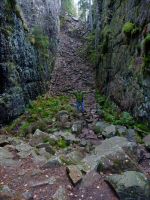
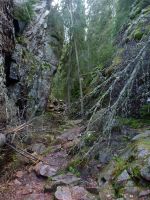
It is generally understood that Trolls, when their territory is encroached upon by mankind, withdraw to some more secluded place. So when Eksjo was built, those that dwelt in that vicinity moved to Skurugata, a defile between two high mountains whose perpendicular sides rise so near to each other as to leave the bottom in continual semi-darkness and gloom (Hofberg, 1890).

It’s also generally understood that humans venture into the lair of trolls at their peril, and wise ones know not to walk defenseless into bottomlands of “continual semi-darkness and gloom.” But we knew of the troll ways and were not about to follow the path that the hunter Pelle Katt did in Hofberg’s fairy tale.

A Swedish friend asked why we were going to Småland, as if searching for relatives were the only thing to do there. We’ve learned there is much more, including visiting 12th century Romanesque churches and meeting local people over coffee afterwards, exploring lush forests with gorgeous lakes, taking walks in well-designed parklands, looking at quaint, red wooden farmhouses, and walking through villages with winding, cobblestone streets. But we were intrigued by the descriptions of Skurugata, which seemed of a different order of things.

Skurugata is about 13 km NE of Eksjö. To get there, we drove past lovely little farms with red houses and barns, cows, and piles of logs from the abundant woods.

The walk to Skurugata itself started off simply enough, a winding path through the woods, with moss-covered rocks and ferns. But it soon descended into a narrow ravine, with straight granite sides. At times, there was little more than 20 feet separating the sides, which rose to 50 feet and more. The walking was a bit tricky, since the rocks were moss-covered and slick from rain. There was also some climbing and descending that benefitted from the use of hands.

It was easy to imagine getting a foot caught in a crevice or losing one’s balance on an unstable stone. But the most dangerous part was neither the trolls nor the rocks, but the sheer beauty that made it hard to focus on walking carefully. The camera was shock-proof, but not my head.

Hofberg’s tale made me more sympathetic to trolls than I’d been before. Being forced out of one’s home is never good, even if it’s to a place as beautiful as Skurugata. He relates that every year a whole battalion of Småland grenadiers would march through Skurugata, beating drums and blowing horns, and occasionally firing volleys. Who knows how the poor trolls suffered through that! And Pelle Katt was no saint either.

We tried not to add to the troll’s’ misery, although we did intrude on what seems like a sacred space and took pictures that only hint at its beauty.

[Double-click on any photo to enlarge it.]

References

Hofberg, Herman (1890).  Swedish fairy tales. Chicago: Belford-Clarke.

A view on learning in Go:

My meetings here at Göteborg University have been held in the School of Pedagogy, which sits in three buildings, labeled, fittingly for an education school, as A-B-C.

But someone showed some imagination, and managed to start my brain spinning, by giving each hus a more lyrical name. I know the dictionary definitions, but I still can’t quite pull these names into a unified whole. Perhaps a Swedish colleague can help?

Hus A, the largest, is named Utsikten, which means “view.” That’s very appropriate, as its windows look out on the beautiful canal with its trees and walkways. The building is trilobite shaped. Its curves mean that each window has a different view. I think of the label as suggesting that we need to look out at the world.

Hus B is named Åsikten. This can also be translated as “view,” but here, I think it means point of view, or opinion. It reminds us that when we examine the world, we all see different things.

Finally, Hus C is named insikten, meaning “insight.” So, we have a view, a point of view, and an insight. Is it saying that as we consider our own view, then that of others, as in Peirce’s community of inquiry, that we develop insight? Or, does it mean that learning involves looking both outward and inward, then recognizing the fallibility of all knowledge? Does insight here really mean reflection, as we find in the water of the canal?

Or, is all of this just playing with the root sikt, and the untranslateablity in order to drive English speakers crazy? I suspect the latter, as I see Göteborg becoming Go:teborg on street signs, and then just Go:. But regardless of the deeper meanings I’m missing, this is just one of the many charming things I’m finding everywhere we look in Go:.

Persian night in Göteborg

We just had an amazing evening in an Iranian restaurant.

Vida La Vida (formerly Coffee Dance) at Fjärde Långgatan 48 Linnaeus, Göteborg, is a small, but imaginatively decorated place that plays an important role in the local art scene. The eponymous Vida is the multitalented owner and for us this evening, a very charming host.

We were invited to enjoy music and dinner at Vida La Vida by Bernardo Borgeson, an Ecuadorian/Swedish filmmaker, who has directed many critically acclaimed documentaries and short films. He’s also worked with marginalized youth to tell their own stories through film. These are often quite powerful and disturbing films.

We shared a small table with Bernardo’s friend. The only other table was a large one with Vida’s Iranian family and their friends, several of whom were visiting from the U.S.

Various individuals performed on the tar, daf, and other instruments, and sang songs such as Dele Divane and Soltane Ghalbha. The singing was beautiful, almost hypnotic. Many of the songs convey a sadness and sense of longing or loss, even if one doesn’t undertand the words.

There was also a lot of group singing, which we were invited to join, with song sheets showing the Farsi words in a Latin alphabet. All of this occurred as we enjoyed an excellent dinner of salmon, fresh vegetables, and good Persian bread.

The large group included a young couple about to be married. There was also a woman celebrating her birthday, so we sang happy birthday in Farsi (Tavalodet Mobarak), Swedish (Ja, må du leva), and English. They brought us into all parts of the evening, which went on for several hours, and included an excellent dinner plus birthday cake.

Need I add that this was not what we had expected in Göteborg? The evening was topped off by a walk home in which we saw ladybugs, witches, and skeletons. The intensity of the evening at Vida La Vida made us forget that it was Halloween here!

Turkey’s Village Institutes

One of the goals I had for my recent trip to Turkey was to learn more about the Village Institutes (Köy Enstitüleri) there. I knew that they represented an innovative approach to expanding opportunities for learning, but that they had come to an abrupt end in the late 1940’s.

I’d read several articles about the Institutes (see below), and also knew that they had been influenced by John Dewey’s report on the Turkish educational system, but I wanted to hear firsthand from Turkish people who had been involved with the Institutes, or had studied them from a Turkish perspective.

The Village Institutes were created to meet a serious educational need. In 1928 (the year of the introduction of the Latin script in Turkey), 82.5 per cent of men and 95.2 per cent of women were illiterate. For 13.6 million people, there were only 4,894 elementary schools and most of those were in the towns, not the villages where most of the people lived (Vexliard & Aytac, 1964).

Between 1939 and 1946 twenty-one co-educational boarding schools were built to prepare primary school teachers. Much of the construction work was done by pupils and teachers. Youth of both sexes, aged twelve to sixteen, who had completed a five-year village primary school, qualified for admission. Their education was free following a pledge to teach in an assigned village for twenty years after graduation.

The duties of the new teachers included:

  • primary education
  • adult education in the villages
  • raising the cultural level of the villages through the distribution of books, educational programs, radio, and vocal, dance, & instrumental music education; the photo above (by George Pickow/Three Lions/Getty Images), shows Turkish teenagers in an Institute presenting a mass concert on the saz, the Turkish national instrument
  • promoting progressive agricultural techniques in the fields, the orchards, and kitchen gardens; the raising of  livestock; rural handicrafts such as ironwork, carpentry, leather work, mechanics, and electricity
  • instruction for adults in child-rearing, housekeeping, needlework
  • the creation and development of rural cooperatives

The graduates of the Institutes were to return to their villages as leaders and reformers. Teachers, students, and villagers in general were to learn practical skills, mostly related to their agricultural economy, new tools for life, and general education.

The Institute approach embodied ideas of Ataturk, Dewey, and others such as integrating theory and practice, focusing on the underserved, working across institutions, and a systemic approach to building a stronger society. Classical education was to be combined with practical abilities and applied to local needs.

The Institutes had a major impact, and many people regret that they were shut down. But there was resistance against this secular and mixed education. Some feared that it would educate ‘the communists of tomorrow,’ a damning statement during the Cold War. Traditionalists questioned the coeducational and secular aspects. Powerful landlords did not appreciate the goal of educating children who could ask “Why?” questions. There were also questions about the organization and preparation of the teachers. By 1953 the Village Institutes had been completely shut down.

I heard strong statements from people who knew about the Institutes and decried their closing. An artist we met, who had been born during the Institute period, said “They killed the Turkish children! They murdered Turkey’s future!”

Others were more reserved, but still felt that a crucial opportunity had been lost. There are estimates of major losses for Turkey in terms of general literacy and economic development still being felt today because of the closings.

From the little I know, it appears that the Village Institutes demonstrated a successful model for education that could be applied anywhere after suitable adjustment for local needs. I’d like to learn more, and have many questions.

For example, all the photos I’ve seen show only (or mostly) young men, even though the Institutes were coeducational. How did the young men and women get along? How did they each experience the Institutes? The graduates would now be in their 80’s. How do they think about that experience today? What did their training mean for the villages where they went to teach?

How do the Village Institutes compare to other grassroots, community-based education initiatives, such as the school at Weedpatch Camp in California, Foxfire, the Misiones Pedagogicas (village literacy program in Spain, which was shut down by Franco), Paulo Freirean projects in many countries, Paseo Boricua, the Reggio Emilia Approach, or the school set up by the schoolboys of Barbiana?

Perhaps most importantly, could or should the Institutes be revived? Or, are there principles we can derive from them that would be valuable for the more urban populations of today?

References

Ata, Bahri (2000). The influence of an American educator (John Dewey) on the Turkish educational system. Turkish Yearbook of International Relations (Milletlerarası Münasebetler Türk Yıllığı), 31. Ankara: Ankara Üniversitesi.

Bilgi, Sabiha, & Özsoy, Seckin (2005). John Dewey’s travelings into the project of Turkish modernity. In Thomas S. Popkewitz (ed.), Inventing the modern self and John Dewey: Modernities and the traveling of pragmatism in education (pp. 153-177). New York: Palgrave Macmillan.

Dewey, John (1983). Report and recommendations upon Turkish education. In Jo Ann Boydston (ed.), The Middle Works: Essays on Politics and Society, 1923-1924. Vol. 15 of Collected Works. Carbondale: Southern Illinois Press.

Eğrikavuk, Işil (2010, April 9). Anniversary marks unfinished story of Turkish village schools. Hürriyet Daily News.

Stirling, Paul (1965, 1994). Turkish village. Canterbury, UK: Centre for Social Anthropology and Computing, University of Kent at Canterbury.

Stone, Frank A. (1974). Rural revitalization and the Village Institutes in Turkey: Sponsors and critics. Comparative Education Review, 18(3), 419–429.

Uygun, Selçuk (2008, November). The impact of John Dewey on the teacher education system in Turkey. Asia-Pacific Journal of Teacher Education, 36(4), 291–307.

Vexliard, Alexandre, & Aytac, Kemal (1964). The Village Institutes in Turkey. Comparative Education Review. 8(1), 41-47.

Wolf-Gazo, Ernest (1996). John Dewey in Turkey: An educational mission. Journal of American Studies of Turkey, 3, 15-42.

Yılmaz, Omer (1977). Schools for developing countries: The Turkish Village Institutes. Educational Planning, 3(4), 72–80.

Train blogging

I’m typing this while riding on the X 2000, SJ´s electric train, travelling quietly at up to 200 km/h (125 mph). We just had a delicious meal, including “easy beer” and surprisingly good coffee.

Thanks to the SJ site for the photos, which represent very well what we’re seeing, both outside and inside the train, except that the train is full.

Our journey to Göteborg will take less than 3 hours for the 398 km, exactly on the schedule. It’s a beautiful, modern train, with comfortable seats, good leg room, sockets for radio and music, electric power outlets, and full access to fast wifi, which makes this post possible.

SJ stands for Statens järnvägars, as explained on the SJ website:

Soon it will have been 150 years since the first train from Statens järnvägars (SJ) departed from Gothenburg central station. On arrival ecstatic passengers could testify to how they had ”been thrown forward” at 30 kilometres an hour.

Our fellow passenger across the aisle explained that this is not the best time to visit Sweden, but I have to differ. The weather is great for walking, and on this train journey, we’re seeing quaint old farmhouses, interesting little towns, spruce forests, birch tree stands, and occasionally, glorious fall foliage.

Stopping in Stockholm

We’ve stopped in Stockholm for three nights on the way to Göteborg University and the University of Borås. The weather is very pleasant, with temperatures just above 0°C or 35°F. The sun sets shortly after 5 pm.

I’ve been working each morning, so I haven’t had much time to explore. But here’s a gallery of a few sights we’ve enjoyed.

We did have a good walk through the parks of Ladugårdsgärdet and Kungliga Djurgården. Several of the photos below are from that walk.

On the way, we visited the excellent Etnografiska museet (Museum of Ethnography). Their permanent exhibition, “Bringing the World Home,” presents Swedish explorers such as Carl Linné, A. E. Nordenskiöld, Sten Bergman, and Sven Hedin, who helped create the European image of the “other.”

Double click on any photo below to see a larger version:

World Universities Congress, Çanakkale

Last week I attended the World Universities Congress in Çanakkale, Turkey, organized by Çanakkale Onsekiz Mart University. The theme was new aims and responsibilities of universities in the context of globalization.

It was a fascinating and worthwhile event. Conferences like this are intrinsically interesting because of the venue and the assemblage of attendees from around the world.

The sessions highlighted the special role that Turkey plays in the world today, as a bridge between East and West, Christianity and Islam, modern and traditional, Europe and Asia. When you consider Turkey’s neighbors (Greece, Bulgaria, Georgia, Armenia, Iran, Iraq, Syria, and just across the water, Romania, Ukraine, Russia, Lebanon, Cyprus, Israel, Egypt, Libya), it’s clear that Turkey’s success is essential for all of us.

But there were also a number of excellent sessions and discussions interesting in purely academic terms. For example, in a panel I was on, I learned about a community/university project led by Arzu Başaran Uysal (stage right in the photo) to build playgrounds in Çanakkale. Although the setting was quite different, the course of the project reminded me of many of ours in community informatics. I presented on Youth Community Informatics and co-presented on our GK-12 project.

Çanakkale Onsekiz Mart University, or ÇOMÜ, went all out, offering cultural events including music, dancing, tours to Troy and Gallipoli, just across the straits, and a dinner where we saw börek made.

Börek is a baked or fried filled pastry, made of thin flaky yufka dough and filled with cheese, meat, or vegetables. Originating in Central Asia, it’s become popular every place we went in Turkey.

We stayed at ÇOMÜ’s beautiful Dardanos guest house, situated on the shore of the Dardanelles, the straits that connect the Black Sea to the Mediterranean. We could watch the sun setting over Gallipoli every evening, as in the photo above.

[Thanks to Del Harnisch for the second and third photos here.]

Adatepe Olive Oil Museum

Heading north from Izmir towards Çanakkale, we came to the Adatepe Olive Oil Museum, in Küçükkuyu. Again, we were the sole visitors at a very interesting site.

The museum is a restored soap factory designed to display artifacts related to olive culture. It’s the only one in Turkey devoted to the history of olive oil production. The museum extracts oil by traditional cold-press methods in its factory and stores the oil for families in the area.

We saw huge granite mills for grinding olives, various tools for pruning and olive picking, baskets for carrying olives, and earthenware jars for olive oil storage.

There are also amphoras from sunken ships of early Mediterranean trade (which never made it to the Bodrum symposium). There are displays of various tools for making olive oil soap, charts of the annual cycle of olive production, maps showing the spread of olives from Syria westward, and writings in Jewish, Christian, and Islamic sacred texts.