US suppresses minimum wage in Haiti, and more

The release of 1,918 Haiti-related diplomatic cables by WikiLeaks this summer reveals details of US involvement in Haiti from 2003 to present. Unfortunately, the cables support the historical pattern, just adding in disturbing details. If there is any good news here, it’s of a rare example of responsible journalism. The Nation is collaborating with the Haitian weekly newspaper Haïti Liberté on a series of groundbreaking articles about US and UN policy toward Haiti, which are based on those cables.

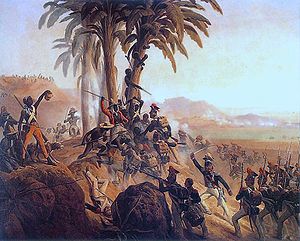
Revolution in Saint Domingue

Revolution in Saint Domingue

The pattern goes back at least to the earliest days of the 19th century, when President George Washington, a slave owner, had Secretary of State Thomas Jefferson grant the first significant foreign aid of the United States to the slave owners in Haiti in a failed effort to suppress the slave revolution there. Following the success of that revolution, the US enforced a diplomatic and trade embargo against Haiti until 1862. From 1915 to 1934 the U.S. imposed a military occupation ostensibly to stabilize the country and keep out Europeans, but also to shape Haiti into a profitable neo-colony.

As popular resistance to occupation grew, the U.S. withdrew and shifted its support from 1957 to 1986 to the fascist Duvaliers, father and son, and their Tonton Macoutes paramilitaries. After suffering from years of bloody military coups and massacres of protesters, Haiti elected Jean-Bertrand Aristide by a landslide in 1990. Aristide called the mass movement that put him into power Lavalas (“torrent” in Kreyòl). His election succeeded despite the millions that the US gave to his opponent, Marc Bazin, a former World Bank Official. In 1991 a US-backed military coup deposed Aristide as president. René Préval replaced Aristide in 1996, but Aristide was re-elected later, replacing Préval in 2001.

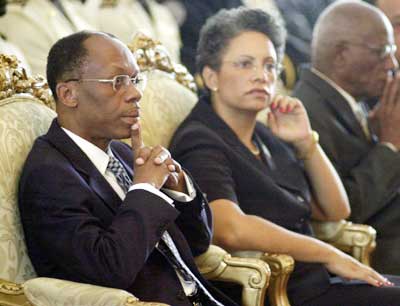
Jean-Bertrand Aristide & Mildred Trouillot Aristide

Jean-Bertrand Aristide & Mildred Trouillot Aristide

The newly released cables pick up the details from 2003 on. Because Aristide had disbanded the army in 1995, it was difficult for the U.S. and its allies to organize a coup. On Feb. 29, 2004,  U.S. Special Forces kidnapped Aristide and his spouse, Mildred Trouillot Aristide, taking them to the Central African Republic.

The cables also show how the US, the European Union, and the United Nations supported Haiti’s recent presidential and parliamentary elections, despite the exclusion of Lavalas, Haiti’s largest political party. They agonized a bit about sponsoring an election that would exclude the majority party from participating, about “emasculating” the country, but decided to push through the sham election because so much was invested already in the neocolonial relationship with Haiti.

The US embassy noted that Haiti would save $100 million a year under the terms of  the Caribbean oil alliance with Venezula, called PetroCaribe. The savings would be earmarked for development in schools, health care, and infrastructure. US Ambassador Janet Sanderson immediately set out to sabotage the deal. She noted that the embassy started to “pressure” Haitian leader Préval from joining PetroCaribe, saying that it would “cause problems with [the US.]” As major oil companies, such as ExxonMobil and Chevron, threatened to cut off ties with Haiti, Sanderson met to assure them that she would pressure Haiti at the “highest levels of government.”

Haiti garment workers

Haiti garment workers

Meanwhile, contractors for Fruit of the Loom, Hanes and Levi’s worked closely with the US Embassy to block a minimum wage increase for Haitian garment workers. In a June 10, 2009 cable to Washington, Ambassador Sanderson argued, “A more visible and active engagement by Préval may be critical to resolving the issue of the minimum wage and its protest ‘spin-off’—or risk the political environment spiraling out of control.” After Préval negotiated a deal to create a two-tiered minimum wage—one for the textile workers at $3/day and one other industrial workers at about $5/day, the US Embassy was displeased. David E. Lindwall, deputy chief of mission, said the $5/day minimum “did not take economic reality into account.” It was just a populist measure aimed at appealing to “the unemployed and underpaid masses.”

Think about this when you buy underwear or jeans. The artificially low price you pay, which killed the North American textile industry, goes to pay for shipping, marketing, high executive salaries, and industry profits, with practically nothing for the people who slave to make the clothes. But if you live in the EU or especially in the US, you can know that your government continues to work to maintain those low prices, and resists appealing to the “unemployed and underpaid masses.”

Think about the manipulations of the democratic process in Haiti when people ask why the rest of the world fails to see the wisdom and the glory of Western democracy.

Think also about how much of this has been covered in your local newspaper, or on television and radio news.

Costs of war

As rightist ideologues push the US towards a debt crisis in order to maintain tax breaks for the rich, it’s worth reflecting on the costs of recent wars in Afghanistan and Iraq.

A sizable chunk of the $14 trillion owed by the US government comes from those wars. Costs of War, a recent report from the Eisenhower Research Project at Brown University (directed by Neta C. Crawford and Catherine Lutz), estimates the cumulative economic cost of the wars as up to $4 trillion.

What has this spending accomplished? While it was promised that the US invasions would bring democracy, both Afghanistan and Iraq continue to rank low in global rankings of political freedom and high in rankings of corruption. US-supported warlords continue to hold power in Afghanistan and Iraqi communities are more segregated by gender and ethnicity than before the war.

The project’s findings show that the $4 trillion is only one of the costs:

  • A conservative count of war dead, in uniform and out, is 225,000. The armed conflict in Pakistan, in which the U.S. funds, equips, and trains the Pakistani military, has now taken as many lives as the one in Afghanistan.
  • Almost 8 million people have been displaced indefinitely and are living in grossly inadequate conditions.
  • The wars have been accompanied by erosions in civil liberties at home and human rights violations abroad.
  • The ripple effects on the US and world economy have been significant, including job loss, interest charges on the national debt, and cuts to funding for scientific development, education, and health care.

Alternatives to war were barely considered. A Rand report on 268 groups using terror tactics (How Terrorist Groups End: Lessons for Countering al Qa’ida, by Seth G. Jones and Martin C. Libicki) showed that several approaches have been much more effective than military responses at eliminating future attacks. 40% of the groups were eliminated through intelligence and policing methods; 43% ended their violence as a result of peaceful political accommodation; 10% ceased their violent activity because they had achieved their objectives; and only 7% were defeated militarily.

The lesson here is not that we should default on the debt because much of it was money we shouldn’t have spent. Doing so will just misery to misery. Instead, this is a time for a compromise on the budget that includes acknowledging what’s already been spent, cutting future spending, eliminating dysfunctional tax deductions, and implementing truly progressive tax rates. In a stagnant economy, there is a strong case for increased spending, not on wars, but on infrastructure and jobs that would actually reduce the debt in the long run.

But whatever other lessons we might draw about the budget, there is a lesson that resorting to violence costs everyone in the end.

Why is there such tax phobia?

I’ve never met anyone who wishes their taxes were higher. Some taxes are a nuisance, like the few cents extra on a cup of coffee, and some are burdensome, like the Social Security tax on low wage earners. But most of us recognize that national defense, health care, good schools, roads, and parks, and so on, are accomplished best when we pull together.

Taxes are a means to enable our Nation to work for a common good, for widely shared goals. So, why is there is a phobia today about any tax increase? Part of the explanation may lie in a major misunderstanding about wealth in the country.

Most people believe that Warren Buffet should pay more in taxes than his receptionist does. Even he thinks that he should pay more (in fact, he pays less). People support that position even if it effectively redistributes wealth. In fact, most of us believe that we’d all be slightly better off if poor people and middle-class people had more money, even if that meant that the very rich had a little less.

Michael Norton and Dan Ariely have done some research on these issues. They found that Americans drastically underestimate the level of wealth inequality in the US. Americans know that there’s a range of wealth, but they don’t realize just how rich the rich really are, and how poor the poor really are. So, they think that the wealth distribution is more even, or equitable, than it really is. Not only that, their ideal would be even more equitable than the current situation, imagined or real.

Norton and Ariely’s data indicate that the richest quintile of Americans own 84% of all wealth, while people in their survey estimated that the top quintile owns just 59%. Conversely, they think that the low income groups have more wealth, when in fact the wealth of the bottom two quintiles doesn’t even register on the chart.

Distribution of wealth in the US

Distribution of wealth in the US

Putting this another way, no group (Democrats, Republicans, rich, poor, men, women) wants a country as unjust as the one they think we have. But the one they think we have is at least more just than the one that we do have. Some think we should have total equity; some want a wealth distribution more like Sweden’s. Only 10% want what we actually have. And yet, we’re willing to risk a default and economic catastrophe in order to make the US even more unjust.

Modest changes in income and estate tax rates and closing of tax loopholes would go a long way toward addressing the National budget deficit and reducing the debt. We’d still have a wealth distribution more unequal than that of other first world nations and more unequal than we really want. But it would be a step towards making everyone pay their fair share.

Not doing that doesn’t mean that we all walk away to tax-free heaven. Instead, it means that the lower quintiles bear an even larger burden through reduction in social services and regressive taxes, such as local sales taxes and social security taxes on wages (which are designed to tax low wage earners the most).

It’s clear why there’s a phobia about tax increases. It’s not about any tax, but about the type of tax and who should pay. The people pulling the strings are the ones who like the fact that they control most of the wealth and are quite happy to keep the burden on those least able to pay. They’re afraid that they might have to pay their share.

The real question is why everyone else seems content to go along.

References

Norton, Michael I., & Ariely, Dan (forthcoming). Building a better America – one wealth quintile at a timePerspectives on Psychological Science.


Replicating

This could help with a house move. All you need to do is

  1. Scan everything you own in the old house, including the car and piano;
  2. Save the scan files on your laptop;
  3. Move, remembering to bring the laptop;
  4. Print it all out again once you’re in the new house.

This would not only save on moving costs, but would also simplify the decision process regarding what’s worth moving.

If you needed to modify something, you’d need to do that at a Community Fab Lab, such as the one at the University of Illinois, which

is equipped with commercially available rapid prototyping manufacturing equipment, such as a laser cutter for carving out 2D and 3D structures; a precision milling machine for 3D molds or circuit boards and a larger one for making furniture or larger parts; rapid prototyping equipment for 3D printing with plastic; a sign cutter for creating graphics or plotting flexible electronic circuits; and electronic assembly tools.

Volunteer and youth in the Fab Lab (U Illinois I-STEM photo)

Volunteer and youth in the Fab Lab (U Illinois I-STEM photo)

People of the rebus

Camp family, 1900

Camp family, 1900

If you’re curious about the rebus baby announcement––Who sent it? Who was the baby? Who was Dorothy?, this may help a little.

Camp family, legend

Camp family, legend

The picture to the left (click to enlarge it) is of the Camp family, around 1900. In the center is Samantha Ann Harris Camp (11), who was known to the others in the photo as “Grandma.” She was born in southern Pennsylvania on July 3, 1835. When she was one year old, her family went down the Ohio by flatboat, then up the Mississippi and Illinois to the beautiful area of Sharp’s Landing, not far from where I’ve done some youth media work in Beardstown and Virginia.

Sharp's Landing area, by JaySRT4

Sharp's Landing area, by JaySRT4

Samantha Harris taught school in Vermont, Illinois, then married Sterling P. Camp and moved with him to his farm in Walnut Grove. They had five children: Thomas (5) William (12), John R. (21), Frank (1), and Anna (13), who surround her in the photo. They later moved to Bushnell. John R. Camp became Editor of The Bushnell Record, the local weekly.

Unfortunately, Sterling died young. One consequence was that Samantha outlived him by more than 40 years and had to raise the five children mostly on her own. She died on January 10, 1913, thirteen years after this photo was taken in front of their family residence in Bushnell.

By the time of the photo, Samantha’s son William had married Jennie Daniels (4), who came from Spokane. Their children were John (20), Glanville (19), and Dorothy (18).

Fannie Daniels (not shown) was one of Jennie’s siblings, the others being Minnie, Annie, and Willie. As far as I know, none of them married or had children. (Aunt) Fannie was the one who created the rebus for Dorothy, about five years after this photo.

What did Dorothy think of it? Did she decode it on her own? Was Fannie in the habit of making rebuses for her nieces and nephews? The Camp family seemed adept at producing offspring; why not the Daniels? How did William from rural Illinois connect with Jennie in Spokane? I need to find a flatboat and go back in time to find out.

Tau Day, 2011

Happy Tau Day! Today is June 28, or 6/28 in the US date format, and τ = 6.283185307179586…

There’s a movement of sorts to use τ (which is equal to 2π), instead of the more familiar π. π is the ratio of the circumference, C, of a circle to its diameter, D.

π = C / D

τ proponents say that since a circle is defined as the set of points a fixed distance (the radius, r) from a given point, a more natural definition for the circle constant would use r:

τ = C / r

This of course makes τ equal exactly to 2π. One might well ask, “What’s the big difference?” τ advocates say simply, “π is wrong.” By this, they don’t mean that it’s wrong to say:

C / D = 3.14

That equation is wrong mathematically, just as any calculating device is wrong because it has to approximate π. Neither π, nor τ can be expressed as a simple fraction (or as a terminating or repeating decimal). But the argument here is not about approximations. It’s that π is wrong pedagogically: π is a confusing and unnatural choice for the circle constant. The confusions run through all sorts of statements about circles, angles, statistical and physical relationships.

The full reasons for using τ are explained in Bob Palais’s article P Is Wrong and in Michael Hartl’s The Tau Manifesto, which is

dedicated to one of the most important numbers in mathematics, perhaps the most important: the circle constant relating the circumference of a circle to its linear dimension. For millennia, the circle has been considered the most perfect of shapes, and the circle constant captures the geometry of the circle in a single number. Of course, the traditional choice of circle constant is π—but…π is wrong. It’s time to set things right.

Michael Blake has created a musical interpretation of τ up to 126 decimal places. It maps τ to musical notes, and sounds quite nice:

A rebus baby announcement

In these times, we hear about family events through cell phones, Facebook, Twitter, and for a few old-timers, email. I got to meet a new grand-nephew that way just last week.

Chloe & Bishop

But that wasn’t always so. I came across an older technology while we were cleaning up our attic. It’s a rebus announcing Sunny Baby Jim, with at least 230 cut-outs from newspapers and magazines pasted onto a continuous roll of brown wrapping paper. It not only announces the baby, but also provides a glimpse into life in the US in 1905.

The paper for the rebus has become brittle and is starting to crumble. Some of the cut-outs are faded.I decided I should photograph it and decode it before it disintegrates completely.

It’s probably from my Great-Great-Aunt Fanny in Spokane, writing to my Grandmother, Dorothy in 1905. See whether you can decode it. The images aren’t very clear in the small versions, but should be more readable if you click each one to enlarge it.

There’s a scrap cityscape of Spokane, which probably came first. So, I think the first part says,

Spokane

Dear Little Dorothy,

I send you a puzzle to make you laugh.

It is raining cats, dogs, and babies.

The babies shown include the Gold Dust Twins, mascots for Gold Dust Washing Powder. Those racial caricatures were wisely phased out, but not for another 50 years.

Aunt Fanny goes on to ask:

Would you like to hear about the new baby in this house? He weighs nine pounds and sleeps all night, that’s the way babies grow. When he smiles we call him Sunny Jim Baby.

Then, there’s a comment about babies in general, and some local news:

Before babies sleep and after babies sleep, they eat, all the time.

I have a new pair of shoes and they hurt my feet and corns.

We got awakened one night. A shot was heard around the house. We called two policemen and he ran away.

How is Grandmother? I am getting so fat.

Spokane is soon to have a circus. [There’s then a six-frame comic strip set in a circus ring.]

While looking up information on that circus, I learned that a steel bridge with power wires for streetcars and overhead lighting was constructed over the Spokane River Gorge after the wooden bridge burned in 1890. The new bridge vibrated badly, and in 1905 the National Good Roads Association declared it unsafe. The Ringling Brothers Circus elephants refused to cross it. It was replaced in 1911.

The closing of the rebus reports some national news:

It is time for a bath and bed.

Love to the whole damn family.

PS: Teddy Roosevelt is in Colorado. [He went bear hunting there in 1905.]

Your Aunt [Fanny]

I don’t know how long we can keep the original of the rebus, thus this post to preserve it in a limited way. But it’s held up surprisingly well after 106 years, especially since it had not been cared for, just tossed into boxes in attics or garages. Will we be able to read this blog post as well in the year 2117?

Thanks, Aunt Fanny for your fascinating artwork. I suspect that few aunts (or uncles) today could or would invest the time to make such a detailed token of love for their niece.

The ‘Invisible’ Forces of Haiti

Elizabeth Pierre-Louis

Elizabeth Pierre-Louis

I heard a very impressive lecture yesterday titled, “The ‘Invisible’ Forces of Haiti—How Can Books and Culture Help the Reconstruction Process,” from Elizabeth Pierre-Louis, library program coordinator at the Fondation Connaissance et Liberté (FOKAL), Haiti. There should soon be links to a video recording and the text from the summary.

The talk reminded me of  the devastation of the Haiti earthquake. As bad as the 1989 Loma Prieta earthquake in California was, the recent earthquake and tsunami in Japan was many times worse than that in terms of deaths and homes destroyed. But the Haiti earthquake was many times worse than Japan’s with as many as 300,000 killed and 1.5-2 million homeless. The current cholera epidemic shows that even a terrible situation can become worse.

Haiti has neither the money nor the technical expertise to recover, and half of the people are under age 21 (some sources say half are under 18). It’s also one of our closest neighbors, and many of its problems are directly traceable to the US’s unquestioning support for the Duvaliers’ dictatorship that robbed the country of what little it had. Last year, the world pledged $5 billion in aid, which was not nearly enough, but then delivered on only a third of that.

It’s inspiring, and humbling, to see how Haitians continue to live, to create, and to work together in spite of challenges no one should have to face alone.

An old English dinner

deer at birdbath

deer at birdbath

With all the snow, it’s felt like a storybook Christmas time.

The deer are regular visitors. They have to resort to holly leaves, which is not their favorite, because they’ve eaten everything else in the yard that is now, or ever was green.

home at Christmas time

home at Christmas time

We’ve been sledding and Emily and Stephen went caroling twice. They also cooked an old English dinner, in the traditional style. However, I should add, “traditional” here requires you to take Harry Potter as your source.

Harry Potter menu

click to see the full menu

The Harry Potter Restaurant’s December Feast started with Warm and Hearty Mulligatawny Soup, followed by Brussels Sprouts with Chestnuts and Mashed Parsnips. The libation was Pumpkin Juice and we finished off with Blancmange. It was a delicious meal, perfectly appropriate for a snowy December evening.

You can see the menu below left.