Hoffmann’s feverish dreams

E. T. A. Hoffmann

E. T. A. Hoffmann

One doesn’t just read, but rather descends, into the tales of Hoffmann. Sir Walter Scott must have agreed when he judged that Hoffmann didn’t need literary criticism as much as he needed medical assistance:

It is impossible to subject tales of this nature [referring to “The Sand-man”] to criticism. They are not the visions of a poetical mind; they are scarcely even the seeming authenticity which the hallucinations of lunacy convey to the patient; they are the feverish dreams of a light-headed patient.

Lunatic he may be, but somehow Hoffmann manages to convey essential truths through his grotesque tales and drawings.

The Nutcracker

The Nutcracker

In conventional stories, a character has an identity that we learn about as events unfold. Often that identity develops or evolves, but generally, we at least know whom we’re talking about. Supernatural elements, if they appear, may be hard to explain, but we can usually distinguish them from the ordinary. There’s typically some sort of resolution, which gives us a semblance of coherence.

Hoffmann is quite different. Writing two centuries before post-modernism, Hoffmann turns the rules inside out. Neither we as readers, nor the characters, nor, as I suspect, Hoffmann himself, always know whether a given event is real or imagined. Is it an hallucination, a metaphor, a dream, or a supernatural occurrence? Is the kobold we encounter an independent entity, or simply a buried aspect of some character’s personality? Is this one a person, or a doll that the character assumes is alive? Is some occurrence the dream of a character, of Hoffmann, or one that we forgot that we’d been having and now can’t eliminate from our thoughts?
The Tales of Hoffmann

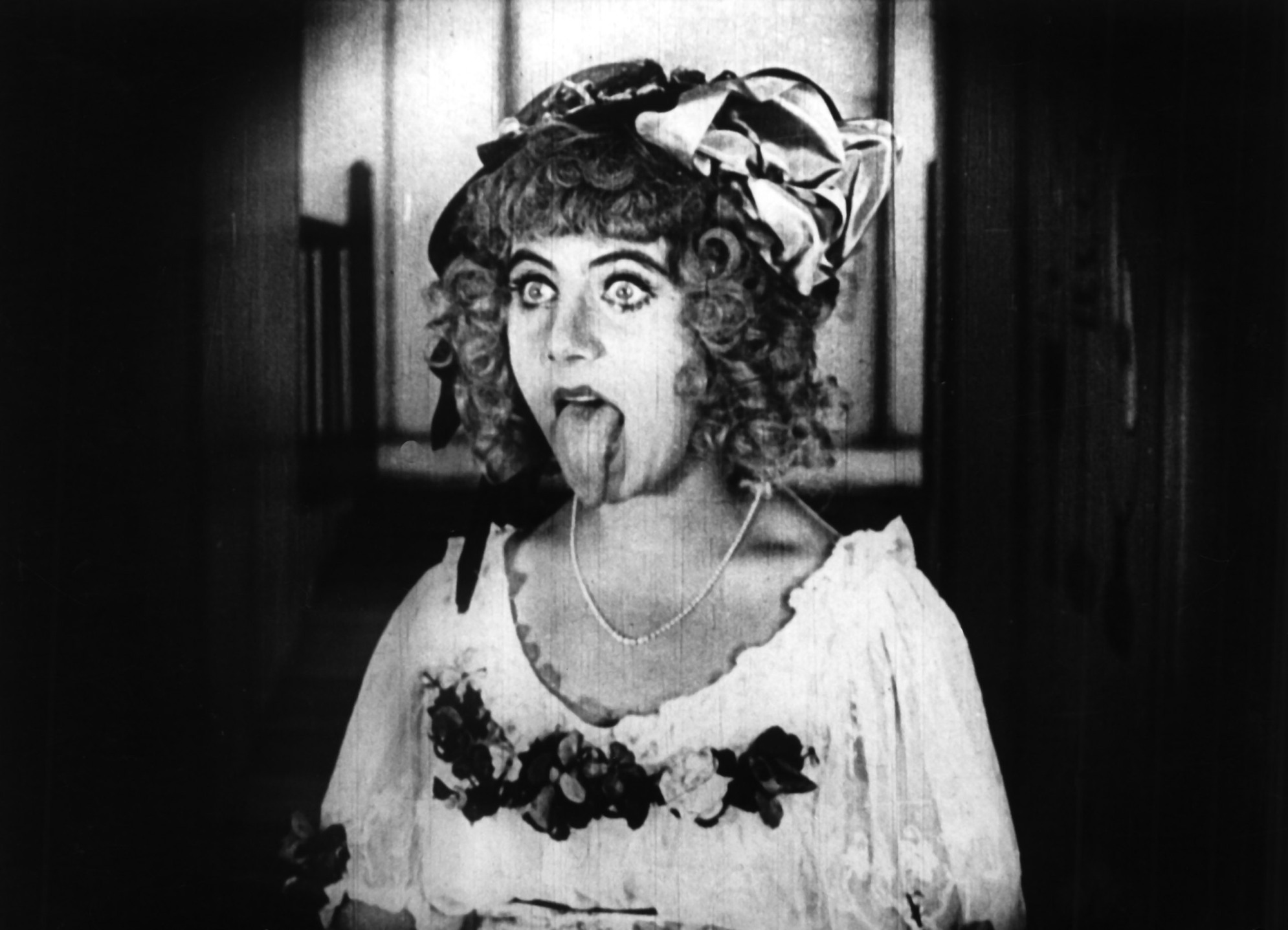
Spalanzani & Coppélius in “Tales of Hoffmann”

Combining rich, believable realism with extravagant fantasy, Hoffmann gets the reader to probe deep into the story, whatever the reader imagines that to be. He challenges Aristotle’s Poetics by offering only the beginning and the middle, but not the end, or resolution: He shows us that it’s a disservice to a good story to bring it to an end; the reader should be allowed to carry it onward.

In one of his best stories, The Golden Flower Pot, We struggle along with Anselmus to make sense of a world that doesn’t make much sense. The Archivarius tells him,

the gold-green snakes, which you saw in the elder-bush, Herr Anselmus, were simply my three daughters; and that you have fallen over head and ears in love with the blue eyes of Serpentina the youngest, is now clear enough.

The elder-bush, then a snake, now becomes the love of his dreams:

The Student Anselmus felt as if he now merely heard in plain words something he had long dreamed of, and though he fancied he observed that elder-bush, wall and sward, and all objects about him were beginning slowly to whirl around, he took heart, and was ready to speak; but the Archivarius prevented him; for sharply pulling the glove from his left hand, and holding the stone of a ring, glittering in strange sparkles and flames before the Student’s eyes, he said: “Look here, Herr Anselmus; what you see may do you good.”

It’s painfully obvious what Anselmus should not do, yet, he does. We as readers follow obediently and disastrously, learning along the way the preposterousness and the tragedy of romanticism from one its major initiators.

The Doll (DIe Puppe)

The Doll (DIe Puppe)

Thanks to these features, Hoffmann’s stories invite a variety of interpretations on multiple levels. The nutcracker may be Napoleon and the seven-headed mouse king, his seven cabinet members. But they may also be Hoffmann’s critique of romanticism, or a manifestation of buried aspects of the personalities of Clara and Fritz. Or, maybe they’re just idle fantasies, and Hoffmann has seduced the reader into unveiling his own psychic disturbances.

Ernst Theodore Wihelm Hoffmann is best known by his pen name, E. T. A. Hoffmann (Ernst Theodor Amadeus Hoffmann). But if my experience and that of a few friends is any guide, he’s not known well known by any name today, at least in the US beyond scholars of German romanticism, and certainly not anywhere near what his contributions deserve.

Some people are familiar with Offenbach’s The Tales of Hoffmann, an opera based on Hoffmann’s short stories with him as the main protagonist, or with the Powell and Pressburger film. Fewer still know that Tchaikovsky’s ballet The Nutcracker was inspired by Hoffmann’s “The Nutcracker and the Mouse King.” That may be due to the fact that the sweet Christmas performances of the ballet lack the disturbing edge that Hoffmann works into all of his stories.

Kapellmeister Kreisler

Kapellmeister Kreisler

But I didn’t know that Hoffmann’s stories inspired many other famous works of music and film (e.g., Alfred Hitchcock, Bergman’s Fanny and Alexander); that his writings were a major influence on Edgar Allen Poe, Nikolai Gogol, Charles Dickens, Charles Baudelaire, George MacDonald, Fyodor Dostoevsky, Franz Kafka, Jorge Luis Borges, Robertson Davies, Alexandre Dumas, père, and even Sigmund Freud and Carl Jung; that he wrote the first (Western) detective story, a novella (Mademoiselle de Scudéri); that his stories are the basis for much of modern gothic, ghost, sci-fi, and other genres; that he was arguably the first romantic composer in music, inspiring Robert Schumann and others; that his music and literary criticism were major influences on romanticism; or that he was an accomplished sketch artist, political satirist, and philosopher.

Worth getting to know. Just be careful about those dreams.

References

Hoffmann, E. T. A. (1967). The best tales of Hoffmann (edited with an Introduction by E. F. Bleiler). New York: Dover.

Scott, Sir Walter (1827). On the supernatural in fictitious composition. The Foreign Quarterly Review, I(1), 60-98.

Veronica Robles at the Methodist Church

Veronica Robles

Veronica Robles

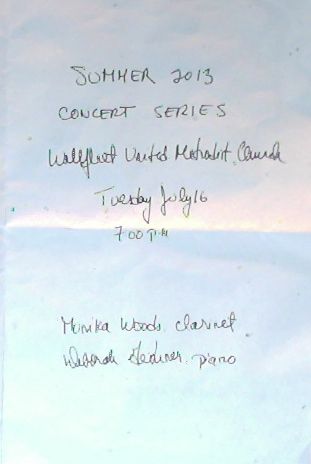
I had a very enjoyable evening thanks to Veronica Robles, who performed Saturday for a Habitat for Humanity fund-raiser at the Wellfleet United Methodist Church.

Her show was a great introduction to the dance, costumes, songs, language, and histories of different states in Mexico, including Michoacán, Jalisco, and Chiapas. Robles is co-producer and host of the popular Telemundo show – “Orale con Veronica (Let’s Go with Veronica)”. You can hear samples of her music on the Orales website.

A major goal of hers has been to connect Latino families with social services and programs. She co-developed the Latino Art and Culture Initiative at Centro Latino de Chelsea and founded Dance, Camera, Action! at the Charlestown Boys and Girls Club. She has six CD’s out and recent appearances at Lincoln Center and Carnegie Hall.

Veronica is a natural teacher, who takes her show to public schools in Boston and beyond, promoting arts, diversity, and cultural understanding. She performs with authentic outfits from different regions. The performances are interactive, with group singing and opportunities to dress up and learn dances. There was much amusement at some of the clumsy volunteers, such as myself.

Mariachi in Wellfleet might seem at first to be an odd fit. But it worked surprisingly well and made a nice addition to life here.

See Best bets things to do this weekend | CapeCodOnline.com.

Green oats in June

An Irish day on Cape Cod: It began with a 5K walking race along Nantucket Sound in South Yarmouth (Cape Cod Irish Village Road Race). At the conclusion of the race we enjoyed Irish music at the Irish Village. Unfortunately, any loss to our waistlines from the race was fully counteracted by hamburgers and pints of stout.

The day ended with listening to Celtic Sojourn on WGBH. That program featured a beautiful poem by Patrick Kavanagh, which is appropriate for Mother’s Day, or for remembrance on any loved one.

But I don’t read the poem as being only about remembrance; it’s more about valuing the “earthiest” aspects of all our daily interactions–walking “together through the shops and stalls and markets” or among the “green oats in June.” Kavanagh reads the poem in the video below.

When we lived in Dublin in 2007-08, I remember walking many times along the beautiful Grand Canal, which was near our apartment. You can see a statue of Kavanagh there (“The Crank on the Bank”). It’s also shown in the slide show and below.

The bronze Kavanagh is sitting on a bench as the flesh and blood one once did. It was inspired by his “Lines written on a Seat on the Grand Canal, Dublin”:

O commemorate me where there is water
canal water preferably, so stilly
greeny at the heart of summer. Brother
commemorate me thus beautifully.

If you were to visit Dublin, I recommend sitting beside him to contemplate the people walking by, the ever-present swans, and the stilly, greeny water.

Patrick Kavanagh, Royal Canal

Patrick Kavanagh, Royal Canal

In Memory of My Mother

by Patrick Kavanagh

I do not think of you lying in the wet clay
Of a Monaghan graveyard; I see
You walking down a lane among the poplars
On your way to the station, or happily

Going to second Mass on a summer Sunday–
You meet me and you say:
‘Don’t forget to see about the cattle–‘
Among your earthiest words the angels stray.

And I think of you walking along a headland
Of green oats in June,
So full of repose, so rich with life–
And I see us meeting at the end of a town

On a fair day by accident, after
The bargains are all made and we can walk
Together through the shops and stalls and markets
Free in the oriental streets of thought.

O you are not lying in the wet clay,
For it is harvest evening now and we
Are piling up the ricks against the moonlight
And you smile up at us — eternally.

The phoenix in the attic

The May Harper’s has another good essay by Lewis H. Lapham. “Ignorance of things past: Who wins and who loses when we forget American history” is a compendium of great quotes about history, spiced with his own novel insights.

It seems surprisingly easy to slip into dichotomies about the past. As Dickens wrote in A Tale of Two Cities, 

It was the best of times, it was the worst of times, it was the age of wisdom, it was the age of foolishness, it was the epoch of belief, it was the epoch of incredulity, it was the season of Light, it was the season of Darkness, it was the spring of hope, it was the winter of despair, we had everything before us, we had nothing before us, we were all going direct to heaven, we were all going direct the other way.

Our idealized construction of the past then leads us to simplistic views of the present and even more cartoonish views of the future and what to do next. The US Presidential campaign is filled with examples of this, few of which bear repeating.

Cambridge Public Library

Cambridge Public Library, Past, Present, Future

Lapham shows some ways around dichotomous thinking about the past. One of those dichotomies is between the view of history as a detailed, and verifiable account of past events with little room for interpretation and of history as a consensual hallucination. He shows that history requires both careful attention to detail and continual reconstruction.

Most importantly, Lapham makes an effective case for the idea that history is necessary for a critical, socially engaged intelligence in the time in which we live. This means history that grows out of meticulous study of the details, openness to counter-intuitive or disturbing ideas, and investigation of the gremlins that don’t fit our preconceptions. He cites Faulkner’s “The past is never dead. It’s not even past” (Requiem for a Nun), on the way to showing how making sense of the past is part and parcel of making sense of the present.

We use the present to construct our past, just as we use our past to construct our present. For Lapham, then, the past is the phoenix in the attic. No matter how we engage with it, our uses of history shape what is to come. As he puts it,

History is work in progress, a constant writing, and rewriting as opposed to museum-quality sculpture in milk-white marble.

This doesn’t mean anything-goes relativism. Instead, it is a call to realize that who we are and who we may become are inseparable from who we have been. Unfortunately, that realization seems lacking, and the desire to learn is all too meagre for the needs of today.

The New Jim Crow

US incarceration timeline

US incarceration timeline

In his now classic analysis of the criminal justice system (The Crime of Punishment, 1966), Karl Menninger wrote, “I suspect that all the crimes committed by all the jailed criminals do not equal in total social damage that of the crimes committed against them.” That was at a time when the number of people in the US who were in jail or prison amounted to around 300,000. Today, that number is well over two million. The US has the highest documented incarceration rate in the world, well ahead of the #2 jailer, Russia, or that of many regimes considered to be dictatorships, police states, backward regimes, failed states, or otherwise democracy-challenged.

In a piece originally published in and recently updated for TomDispatch, “The New Jim Crow: How the War on Drugs Gave Birth to a Permanent American UndercasteMichelle Alexander writes,

The New Jim Crow

The New Jim Crow

If you take into account prisoners, a large majority of African American men in some urban areas have been labeled felons for life. (In the Chicago area, the figure is nearly 80%.) These men are part of a growing undercaste — not class, caste — permanently relegated, by law, to a second-class status. They can be denied the right to vote, automatically excluded from juries, and legally discriminated against in employment, housing, access to education, and public benefits, much as their grandparents and great-grandparents were during the Jim Crow era.

I just finished reading her book, The New Jim Crow: Mass Incarceration in the Age of Colorblindness (The New Press, 2010), which piles on the stunning and depressing statistics. But the book does much more than to amplify a sorry state of affairs that most of us know about, but rarely talk about. Several points came through strongly for me:

  • Through actual case stories, the book shows what these numbers mean for the felons for life, their families, their communities, and our democracy. In many cases the people so labeled are innocent, coerced into a plea bargain, or at most convicted of a minor crime.
  • Those who subsequently become subject to legalized second-class citizenship are disproportionately African American. Large numbers are convicted of drug crimes, even while their White counterparts are bigger users and sellers of drugs.
  • The mechanism by which this happens is a maze of laws and court rulings, which have severely compromised civil rights for all of us, even though their impact is primarily on people of color. One more item was added to the maze this week, when the Supreme Court ruled 5-4 that correctional officials may without cause, strip-search a person arrested for the most minor offense. Albert W. Florence was strip-searched twice after being wrongly detained over a traffic fine. Florence said at the time, “It was humiliating. It made me feel less than a man. It made me feel not better than an animal.”
  • The interlocking system including bias, laws, police procedures, courts, prison industry jobs and profits, has created a shameful justice system, far worse than the one lamented by Menninger.
Michelle Alexander

Michelle Alexander

Alexander says that she had several specific audiences in mind for the book. One is “people who care deeply about racial justice, but who for any number of reasons do not yet appreciate the magnitude of the crisis faced by communities of color as a result of mass incarceration. In other words, I’m writing this book for people like me, the person I was 10 years ago.” Another was for people “lacked the facts and data to back up their claims” about how the criminal justice system was operating as a third mode of racial caste making (following first slavery, then Jim Crow). I felt I fit in both of those camps, and fortunately not in the third, that of people trapped in the system.

Following her work on an ACLU racial justice project, Alexander says “I had come to suspect that I was wrong about the criminal justice system. It was not just another institution infected with racial bias but rather a different beast entirely…Quite belatedly, I came to see that mass incarceration in the United States had, in fact, emerged as a stunningly comprehensive and well-disguised system of racialized social control that functions in a manner strikingly similar to Jim Crow.”

Coming to appreciate that system in a deeper way makes the book powerful for me. It doesn’t in any way try to excuse crime, or to lay the blame for it on lack of employment, poor education, or inadequate housing, as many liberals might do. Nor does it link the injustice of the system to individual bias per se. Furthermore, it debunks accounts of individual responsibility, moral failure, or familial inadequacy as some conservatives might propose. Instead, it shows how the system operates, how it developed and grew, and why it will be so hard to change. Yes, better Supreme Court justices matter, but they won’t dismantle the system. Affirmative action is helpful, but it’s far from a solution. All of those explanations for crime and incarceration matter, too, but they’re not the central narrative.

The book is disturbing, and depressing at times. It cannot be said to end on a happy note, but in the last section, “All of Us or None,” there is at least a vision of what could make a difference. Alexander calls for a conversation on race in which “us” means “all of us,” or as Martin Luther King said, that a shift was needed from civil rights (interpreted simply as rights for those who are dispossesed) to human rights.

This means, among other things that

Whites should demonstrate that their silence in the drug war cannot be bought by tacit assurances that their sons and daughters will not be rounded up en masse and locked away. Whites should prove their commitment to dismantling not only mass incarceration, but all of the structures of racial inequality that guarantee for whites the resilience of white privilege. (p. 244)

The book closes with an excerpt from James Baldwins’s letter to his nephew in The Fire Next Time. That entire letter is worth reading and re-reading many times, but I’ll just end here with a small excerpt from that excerpt:

this is the crime of which I accuse my country and my countrymen, and for which neither I nor time nor history will ever forgive them, that they have destroyed and are destroying hundreds of thousands of lives and do not know it and do not want to know it…It is the innocence which constitutes the crime…They are, in effect, still trapped in a history which they do not understand; and until they understand it, they cannot be released from it…those innocents who believed that your imprisonment made them safe are losing their grasp of reality…And if the word integration means anything, this is what it means: that we, with love, shall force our brothers to see themselves as they are, to cease fleeing from reality and begin to change it.  For this is your home, my friend, do not be driven from it; great men have done great things here, and will again, and we can make America what America must become.

A house concert with RUNA

Moving to Wellfleet, I wondered whether I’d be trading cultural life for nature. With the National Seashore, ocean and bayside beaches, 17 ponds in Wellfleet alone, walking and biking trails, forest and dunes, I was prepared to make that trade, assuming that we’d seek out music, art, and so on, in Boston or other places. But the reality has been the opposite. Yes, the natural world feels especially close at hand, but cultural events seem more, not less accessible.

I do miss the human diversity of the university or the large city, but there’s been more on that score than I expected. In terms of public events, we’ve been to many galleries and art shows, enjoyed the Saturday Tea and Music concerts in the Wellfleet Public Library, book talks, and just saw the Blind Boys of Alabama in the recently renovated Provincetown Town Hall.

About a week ago we attended a wonderful house concert by RUNA, a Celtic music group. They’re an international ensemble comprising vocalist Shannon Lambert-Ryan, guitarist Fionán de Barra, percussionist Cheryl Prashker, and fiddler Tomoko Omura. They play both traditional and more contemporary Celtic songs and instrumental pieces from Ireland, Scotland, Canada, and the US.

The performances were excellent. I especially enjoyed the traditional songs, but some of the more recently composed ones, too. The video here is not from the concert we attended, but we did hear Fionnghuala there.

Vivir y ayudar a vivir

Vida/SIDA

Vida/SIDA

The mural on the front of Vida/SIDA in Chicago includes the phrase, “vivir y ayudar a vivir” (to live and help to live). That’s very appropriate for a health clinic, but it’s really the motto for everything done in the Paseo Boricua community. The idea is that in order to build a healthy community, people need to move beyond “live and let live,” which can mean “live for myself and to hell with you.” The more expansive motto, “vivir y ayudar a vivir,” can be seen there on murals, brochures, websites, and coffee cups.

I know that other groups have used the same phrase, but I’ve never been sure of its origin. Some people attribute it to Orison Swett Marden, a 19th century writer associated with the New Thought Movement. He founded Success Magazine and wrote extensively on how our thoughts influence our actions and experiences.

The Voice of Industry

The Voice of Industry

The general idea is of course much older. For example, the Jain Center of Cincinnati Dayton has an historical marker asserting that the motto of Jainism is “live and let live and help others to live.” And Jainism dates at least from the 6th century BC, if not earlier.

More recently, both in the course of events, and in my own discovery process, I came across The Voice of Industry, a labor newspaper published from 1845-48. It was founded by the Lowell Female Labor Reform Association. An article from November 14, 1845, “Live -Let Live -Help Live,” gives one of the clearest and earliest explanations of the phrase that I’ve seen. Basically, it says that there are three sorts of people: those who take for their motto live regardless of others, those who adopt live and let live, and those who say live and help others to live.

I’d like to hear about other sources, or uses, of the phrase.

Almost counting herring

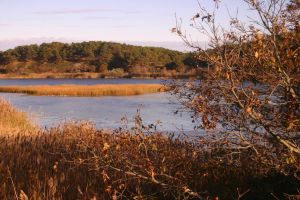
Black Pond, Wellfleet

Black Pond, Wellfleet

Because of the warm winter on Cape Cod this winter, the alewives are returning early to the local rivers. Alewives are a type of herring. They’re anadromous, meaning that they live in the ocean, but swim up freshwater streams to spawn.

Their population is declining in New England, so the River Herring Network organizes herring wardens and volunteers (called “monitors”) to assess their numbers during the spring run. The counts go on for two months, with volunteers assigned specific times each week to count.

field test kit

field test kit

Locally, the count is connected with efforts by the Friends of Herring River to restore that river to something akin to its condition before the Chequessett Neck Road Dike was installed and the surrounding wetlands were developed.

Susan got the official training for the count, so she’s the real Monitor, but I went along as a volunteer for the volunteer. I guess you could say that I was an Unofficial Herring River Estuary Alewife Monitor Assistant (UHREAMA).

water temperature

water temperature

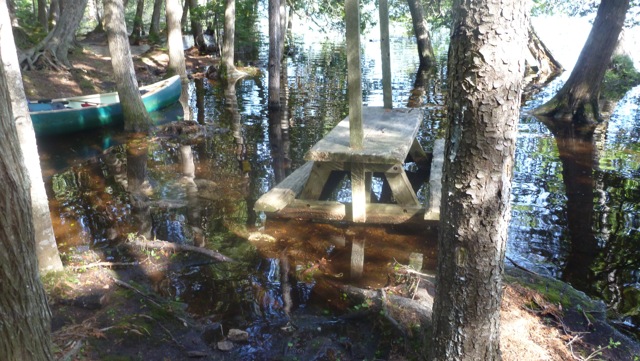
We decided to cycle to the site for our first scheduled count. It’s only a half hour away, but has some good hills and soft sand paths to make the cycling interesting. We passed Black Pond and a friend’s house on the way. You can these and other photos at photos from the count.

The official count site is at a beautiful bend in the tiny Herring River, with a fallen willow marking the spot and serving as a convenient shelf for the field test kit. Byu the way, there are many Herring Rivers. This is the one in Wellfleet.

Here’s the data for our first foray:

  • Time: 9:07- 9:17 am
  • Air temperature 12 ºC
  • Water temperature: 13 ºC

Unfortunately, the number that matters most is this one:

  • Number of herring: 0

Somewhere else, this bridge over the Herring River would be seen as in need of a little repair, but here, it’s just a reminder of the alliance between culture and nature in the National Seashore area. That alliance isn’t without its problems, as we can see in the decline of the Herring River and its herring, but at least there’s an effort to try to make it work.

Progressive Education: Past, Present and Future

I’ve agreed to serve as guest editor for a Special Issue of the International Journal of Progressive Education (February, 2013, Vol 9 – No 1). Here’s the Call for Manuscripts:


The International Journal of Progressive Education (IJPE) plans a special issue on “Progressive Education: Past, Present and Future.” We invite submissions of proposals for articles.

This issue is timely given current debates about the purpose and form of education in an era of rapid technological change, globalization, demographic and political shifts, and growing economic inequities. It asks, “What have we learned about pedagogy that can support democratic, humanistic, and morally responsible development for individuals and societies?”

Background and Scope

Progressive education is a pedagogical movement that emphasizes aspects such as learning by doing, student-centered learning, valuing diversity, integrated curriculum, problem solvingcritical thinking, collaborative learning, education for social responsibility, and lifelong learning. It situates learning within social, community, and political contexts.

In the US, progressive education is often seen as beginning with the work of Francis Parker. It was promoted by the Progressive Education Association from 1919 to 1955, and reflected in the educational philosophy of John Dewey. The movement has continued through efforts to promote project-based learning, whole language, hands-on learning in mathematics and science, and by organizations such as the Progressive Education Network (PEN). More broadly, it is linked with efforts to promote critical pedagogy and democratic education. Recently, the core ideas appear in the social justice youth development model.

But as an approach to pedagogy, progressive education is in no way limited to the US. The ideas grew out of work in other countries, and can be traced back to the earliest theories of teaching and learning. Some other examples may be useful to consider: In France, the Ecole Moderne, developed from the work of Célestin Freinet, showing how to realize the social activism side of progressive education. Loris Malaguzzi and the Reggio Emilia approach to early childhood education are another manifestation, demonstrating among other things the importance of art in learning. Paulo Freire’s work in Brazil on critical literacy, later extended to many other countries, is another contemporary example, one that emphasizes the political as well as the pedagogical. Similarly, influenced by his experiences in South Africa, Mahatma Gandhi developed a conception of basic education that resonates with progressive education. It was concerned with learning generated within everyday life, relied on cooperation among individuals, and aimed at educating the whole person, including moral development.

It is worth noting that progressive education invariably seeks to go beyond the classroom walls. Thus, the work of Jane Addams and others at Hull House to work with new immigrants might be considered as progressive education, even if it is not situated within a traditional school. Myles Horton and the Highlander Folk School focused on social activism with adults, but a case can be made for their work as exemplifying the progressive education ideals. Similarly, there is much work in museums, libraries, community and economic development, online collaboration, and other areas of informal education that may express progressive education more fully than what we see in schools today. The issue is not restricted to any one educational level, e.g., K-12 or university. Articles may focus on formal or informal learning in any setting, including online.

Themes for the Special Issue

The special issue will develop these and related ideas, considering both the past successes and failures of progressive education, as well as current work and future possibilities. Authors are invited to develop and justify their own definitions for progressive education and not to be limited by official statements.

Articles that show how ideas have evolved will fit well the purpose of the special issue: What has progressive education been? What is it today? What could it become? However, some articles may focus on particular approaches as exemplars of challenges or opportunities for progressive education. Others may focus on the historical or philosophical basis for progressive education. Critiques of progressive education in general, or of particular efforts to realize it are welcome.

There are no limitations regarding age or grade level, or area of the curriculum. To the contrary, articles that can develop connections across the curriculum, across ages or settings, may fit best with the progressive education spirit.

Articles should include the author(s) conception of progressive education as well as a justification for why the particular examples or issues chosen fit within that conception. Some articles may focus on progressive education as it was enacted in early 20th century US, but those that broaden that view in productive ways are strongly encouraged as well.

Schedule and Submission Guidelines

The issue will contain:

  • An editorial highlighting key themes and briefly summarizing the articles;
  • Six-eight articles (~6000 words each) incorporating a range of perspectives on progressive education;
  • Reviews of recent books on progressive education (~600 words each).

Submission of proposals for articles: March 15, 2012. These should consist of a proposed title and a synopsis of no more than 200 words.  The proposals will be considered by the editorial board, and a selection made to ensure a balanced range of content.

Invitation to submit full article: April 15, 2012. A limited number of articles will be commissioned by this date.

First submission by selected authors: June 22, 2012. All submissions will be subject to a review by the editorial board. Submissions should follow the guidelines at http://www.inased.org/ijpesi.htm.

Feedback and requests for revisions:  September 15, 2012. The editorial board will request any needed revisions by this date.

Final submissions:  November 20, 2012.

Final copy to press: January 6, 2013.

Publication: The special issue will appear in IJPE on February 2, 2013, Volume 9 – Number 1. We are also planning a book publication.

The International Journal of Progressive Education (IJPE) (ISSN 1554-5210) is a peer reviewed journal sponsored by the International Association of Educators and in part by the Graduate School of Library and Information Science at the University of Illinois. It is published three times a year: February, June, and October, in both print and online versions.

All submissions and questions should be directed to:

Bertram (Chip) Bruce
Professor Emeritus, Library & Information Science
Email: chip@illinois.edu
Post: 130 Daniels Drive, Wellfleet, MA 02667, USA

Parallel universes

The Sunday Doonesbury strip nailed the problem:

The 400 richest families in America now hold as much wealth as the bottom 50% of the country combined!

So, in the midst of an economic crisis, how do our leaders (nearly every Republican and most of the Democrats, including the President) make use of this information?

They celebrate two things:

  1. Cut that “waste” in government, especially the bit going to spending on job training, education, food, housing, and healthcare for that no-good 150 million, and
  2. Absolutely, under no circumstances, allow any new taxes, especially on those 400 families, who provide so much for the rest of us.

There is an parallel universe, one with people just like us, an economic downturn, and people out of work. But there are two differences: People there believe that increased spending now is actually vital to get the economy going, put people to work, and in the long run actually reduce the deficit. (This by the way is the view of most economists, liberal or conservative in both of these universes.) So, point #1, austerity now, is considered an extremely dumb and ill-timed idea.

Second, those people think that the short-term deficit and the long-term debts are very real problems that need to be addressed intelligently and comprehensively. That means management of spending, but also fair contributions from all, including what middle class we have left and even those 400 families. They don’t believe that all of the economic sacrifice ought to fall on the bottom 50%. So, point #2, no new taxes ever, is also viewed as a wacky idea.

In that parallel universe, people would like to

  1. Get the economy going.
  2. Develop a thoughtful plan for revenues and spending, one that involves shared commitment from all.

Is that parallel universe possible?