Canoeing to sanity?

More and more do we realize that quiet is important to our happiness. In our cities the constant beat of strange and foreign wave lengths on our primal sense beats us into neuroticism, changes us from creatures who once knew the silences to fretful, uncertain beings immersed in a cacophony of noise which destroys sanity and equilibrium. –The Singing Wilderness, 1956, by Sigurd F. Olson

Sigurd F. Olson

Sigurd F. Olson

Sigurd F. Olson was an author who sparked the environmental movement of the 1960s and 70s. It is now 60 years since he wrote The Singing Wilderness, where he talked how wilderness helps us become “aware with our entire beings rather than our senses.” Even then, he realized how modern life can destroy our “sanity and equilibrium.’

Olson spent most of his life in the Ely, MN area. For more than thirty years, he worked as a canoe guide during the summer months in the Quetico-Superior country, then taught and wrote about natural history, ecology, and outdoor life. He helped draft the Wilderness Act of 1964, as well as to establish Voyageurs National Park in northern Minnesota, Alaska’s Arctic National Wildlife Refuge, and Point Reyes National Seashore in California.

As a culmination of his half century of effort, full wilderness status was granted to the Boundary Waters Canoe Area Wilderness (BWCAW) in 1978. The combined region of contiguous lakes and forests comprising the BWCAW, Superior National Forest, Voyageurs National Park and Ontario’s Quetico and La Verendrye Provincial Parks is called the “Quetico-Superior country”, or simply the “Boundary Waters.”
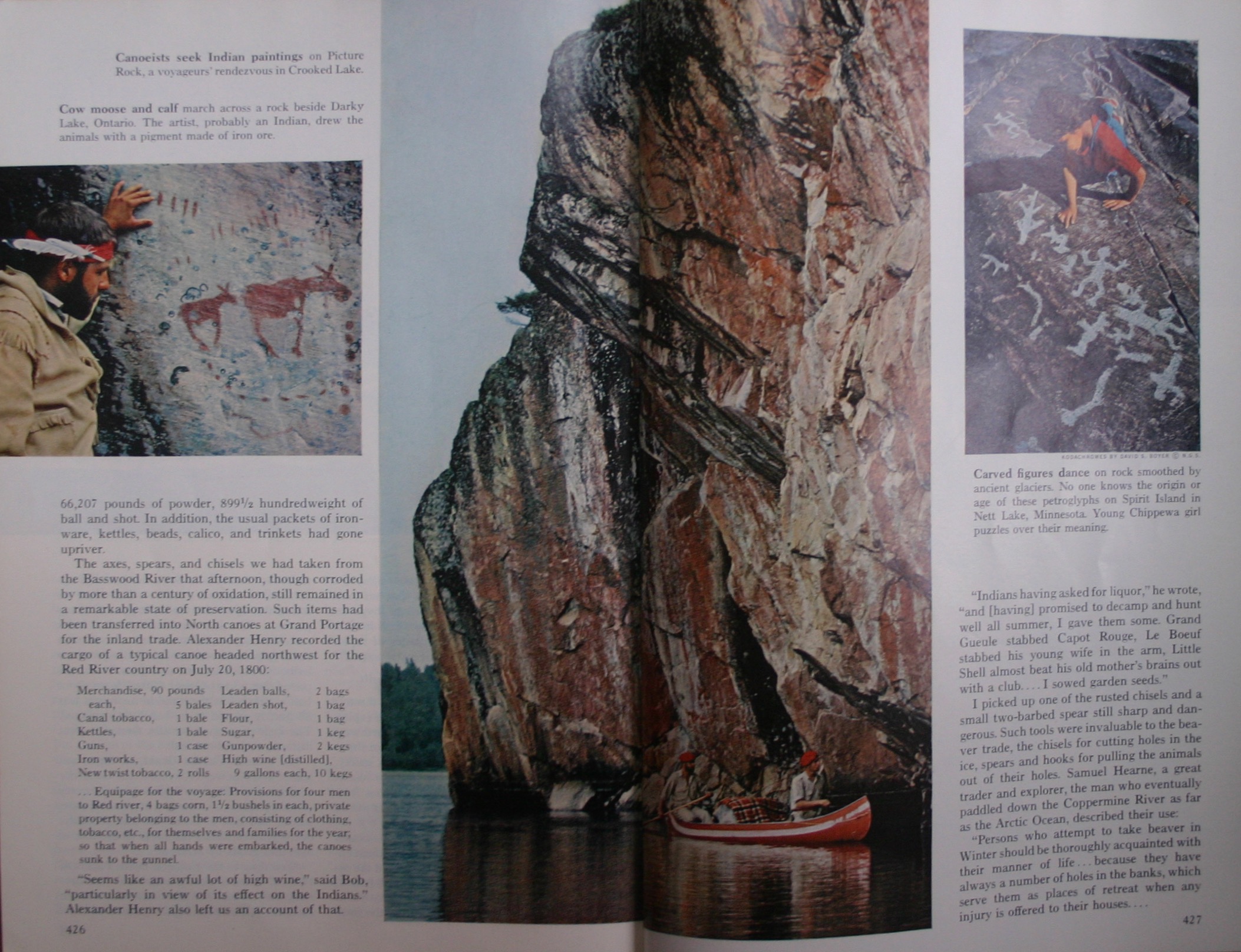
Picture rocks on Crooked Lake

Picture rocks on Crooked Lake

Is it crazy to do something crazy in order to become less crazy, to seek to restore that sanity and equilibrium? Susan and I are about to set out on an adventure that should be fun, enlightening, challenging, even joyful, but which I question in my saner moments.

Back in 1963, I found that quiet beauty on a two-week trip to Quetico Provincial Park in the southern part of NW Ontario. As I wrote,

It was a wonderful trip in many ways. We stayed up most of one night watching a rare display of the Aurora Borealis, which filled the sky for hours. The sun was shining, the fishing was good, and there was great singing, story-telling, and endless argument about the meaning of life around the campfires.

However, the trip ended in disaster, as you can read in the post linked above. Coincidentally, Olson wrote about the area in a National Geographic article, “Relics from the rapids,” which appeared the very month we returned from that trip. Although I’ve canoed nearby, I’ve never been back to Quetico itself and certainly not to the Picture Rocks where the disaster occurred, until now.
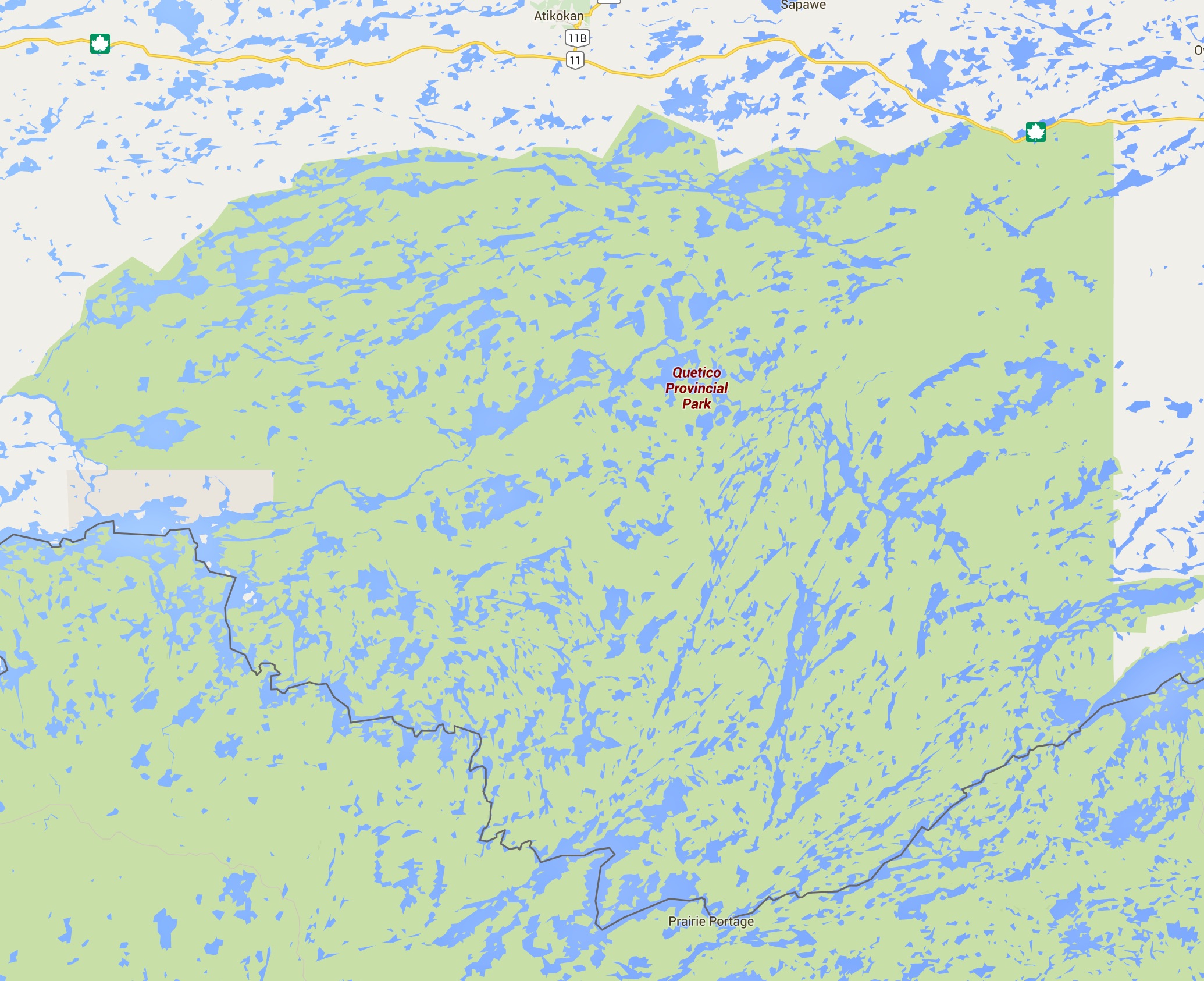
Quetico Provincial Park, with 2000 lakes

Quetico Provincial Park, with 2000 lakes

There are several reasons to advise against a return to Quetico at this time. As I get closer to the day I wonder whether it’s wise to revisit the site of the disaster. Beyond that, I find that I’ve somehow grown older over the past 53 years. I hear that lakes can take longer to paddle across, that portage trails are steeper, and that nights are colder than when one is 16. On a messageboard I saw this about one of our planned portages from someone probably much younger:

The Side Lake to Sarah one known as “Heart Attack Hill” did me in but it was hot, I was low on water, and I had too much gear. I remember laying down at the top and seriously thinking that I could die. It’s rough.

The quiet beauty of Quetico derives in part from the fact that there are no trucks to move your gear. There’s also no wifi, no cell phone signal, no motorized boat craft, no flights overhead, no buildings or pavement, and no prepared campsites. Those features are 99% heavenly, and only worrisome if you choose to worry.

The major concern we have is that we’re going at the start of the season. Guidebooks suggest that June and July are uncrowded, but have more mosquitoes; August and September are warmer with fewer bugs, but more competition for good campsites. No one talks about May, because it’s too cold and the ice may not be out. Even the Canadian ranger stations are closed.

Minnesota II kevlar canoe

Minnesota II kevlar canoe

In their April 19 “dispatch” from BWCAW, Amy Freeman and Dave Freeman show photos of sled dogs, a snowman, and frozen lakes. This is from the year they’re spending there, which is south of Quetico and possibly a degree or two warmer. We’ve been told that the ice should be out on most lakes by the time we start and the day that this post should appear (May 4). I’m too charitable to think that that optimism on the ice forecast reflects the outfitter’s desire not to have to return our deposit!

Nevertheless, we’re committed to the trip. We’ll be renting new equipment, including a Wenonah Minnesota II kevlar canoe. We’re relying on a good outfitter in Ely (Piragis). We have maps, long underwear, extra socks, compass, signal mirror, and poison ivy lotion. Could anything go wrong?

Stay tuned for Part 2, when we return.


Tales & Trails

Yet these sweet sounds of the early season,
And these fair sights of its sunny days,
Are only sweet when we fondly listen,
And only fair when we fondly gaze.
There is no glory in star or blossom
Till looked upon by loving eye;
There is no fragrance in April breezes
Till breathed with joy as they wander by.

Heidi Clemmer and Marisa Picariello

Heidi Clemmer and Marisa Picariello, creators of Cape Cod Eco-Tales

In his 1857 poem, An Invitation to the Country, William Cullen Bryant celebrates the joys of April. But more specifically, he invites his daughter Julia to return for a visit:

Come, Julia dear, for the sprouting willows,
The opening flowers, and the gleaming brooks,
And hollows, green in the sun, are waiting
Their dower of beauty from thy glad looks.

For Bryant, the sweetness of nature appears only when we “fondly listen” and its beauty only when we “fondly gaze.” At first glance, he contradicts Keats, who had told us that unheard melodies are sweeter. But actually not, since both call for our loving eye to be part of the beauty we see. Both poets conveniently conclude that it’s the poetic imagination that imparts real meaning to what we see or hear.

L1140375In any case, the idea of bringing our gaze to nature is central to the Tales & Trails: Nature Walks for Young Explorers program, sponsored by the Wellfleet Conservation Trust (WCT).

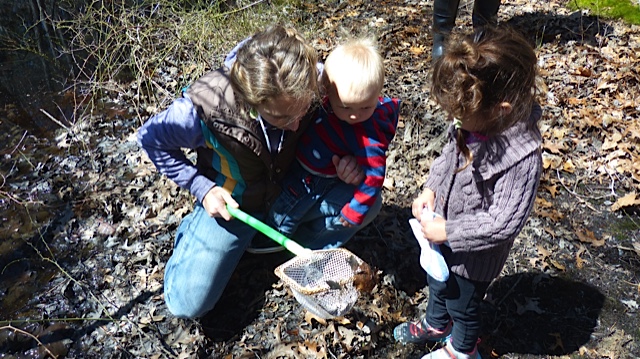
I was lucky enough to go along on the latest walk last Wednesday along an ephemeral pond beside the Walker Trail. It was a beautiful April day with clear skies and fresh breezes. There were no fragrances other than fresh clean air. We heard, or rather interacted with, Vernal Pool Visitors, and compared it to what we observed.

Walks through some of Wellfleet’s conservation areas are led by Heidi Clemmer, author of a new series of nature books for children called Cape Cod Eco-Tales. After 21 years as an elementary school teacher, Heidi retired and began to focus on teaching children about nature in informal, specifically, natural settings. She launched Eco-Tales with illustrator and collaborator Marisa Picariello. The target audience is children aged 6-9 and their families, but everyone from infants to those well into the their quatrième âge enjoy it.

Each walk focuses on a different ecosystem and is paired with one of the books in the series. Children explore the ecosystem, hear a corresponding nature story read by the author and illustrator, and then create their own souvenir of the experience in art, writing, or photography. The event combines fellowship, keen observation, story-telling, art, experiencing the beauty of Wellfleet’s conservation lands, speculation about science, and learning.

41Hk2UPq4FL._SX398_BO1,204,203,200_Last fall, Heidi led a trip to Hamblen Park, where she read from her book Salt Marsh Secrets. There will be five more walks this year. Next up is “Heathland Habitat” in May, followed by“Barrier Beach Bums” in June, “White Cedar Swamp Gang” in September, “Tidal Flat Friends” in October, and “Dune Dwellers” in November (more information).

Tales & Trails is funded by WCT and supported in part by a grant from the Wellfleet Cultural Council. Wellfleet Conservation Trust is a non-profit organization established in 1984 to assist and promote the preservation of natural resources and rural character of the town of Wellfleet. There is no cost to participate in Tales & Trails, but advance registration is required. To inquire about the walks, email Heidi Clemmer.


L1140437

Walker Trailhead

Walker Trailhead

Namskaket Creek

On the day after Christmas Stephen and I decided to venture out. Seeing no snow, we did the best we could by a short canoe trip on Namskaket Creek in Brewster.

To get to the creek, we made a short portage on the Cape Cod Rail Trail. Another option would have been to launch in the bay at Skaket or Crosby Lane beach.

The whole journey, including a PB&J lunch, took only four hours, with about half of that paddling. It was still a bit of an adventure, since it wasn’t easy to find our way through the salt marsh and occasionally we had to fight the wind. But the weather was perfect and the birds were joyous. The mix of forest, marsh, beach, briny water and ocean was unbeatable.

East Coast adventure

After the bustle of Taipei, Taiwan, it’s refreshing to explore the East Coast of Taiwan.

Coastal rock formations, gorges, waterfalls, mountains, and other natural wonders are interlaced with signs of still vibrant indigenous cultures. I saw Formosan rock macaques, boars, and countless birds and butterflies in the wild.

This slideshow requires JavaScript.

The Canoe of Theseus

Not long after I was born, the Chestnut Canoe Co. in Fredericton, New Brunswick built a 17′ 2″ Prospector model canoe. Chestnut was a leading builder of wood-and-canvas canoes, which unfortunately failed with the onslaught of inferior aluminum, fiberglass, and rubberized plastic imitations.

The Prospector design is awesome. With no keel, wide ribs, and high gunwales, it can tackle whitewater that flips kayaks and rafts. It can carry two large people and a summer’s worth of gear, or as many as four adults without swamping. It’s quiet, strong, beautiful, and easy to paddle. It can take a sail or motor. And it’s light enough to carry on a portage trail. No design is perfect, and no canoe can meet all needs, but this one comes very close.

I wrote earlier about the restoration of the particular Chestnut Prospector that owns me. Today, we took the aging Prospector out for a paddle. Looking at it, I can enjoy the new canvas with its new brick red paint and new decals. There are new brass fittings to replace those that had corroded over sixty plus years. There are two new ribs and a new portage yoke, many new screws, and new varnish.

Restoring or replacing?

It feels like a new canoe. However, the remaining parts though serviceable for now, show signs of age, and might need to be replaced in a future restoration. Is it simply a fixed up old canoe? Or, is it a new one? Could a time come when I’d no longer feel that it’s the same canoe that Chestnut built in 1954?

Being a bit older myself, I note that I carry replacement parts, and have lost some parts from the original. And while my entire set of body cells may not turnover every seven years, cells are dying and being replaced all the time. What does it mean for something to be “the same,” when that something is changing constantly?

When Theseus returned from his successful mission to slay the minotaur, the grateful Athenians pledged to honor Apollo by maintaining his ship in a seaworthy state forever. Any wood that wore out or rotted would be replaced. Over centuries, the original parts were replaced many times. Had they kept their promise? Plutarch writes:

The ship wherein Theseus and the youth of Athens returned from Crete had thirty oars, and was preserved by the Athenians down even to the time of Demetrius Phalereus, for they took away the old planks as they decayed, putting in new and stronger timber in their places, insomuch that this ship became a standing example among the philosophers, for the logical question of things that grow; one side holding that the ship remained the same, and the other contending that it was not the same.

Is it the same ship? If not, when did it become something else? If it looks and functions more as it did in the beginning, is it more the original than if it’s not repaired? Centuries later, Thomas Hobbes introduced a further puzzle, wondering what would happen if the original planks could be located and used to build a ship. If one could assemble the old planks and other parts, would that be more the original? Which ship, if either, would be Ship of Theseus?

The shakedown cruise

We took the new/old canoe out today on Gull, Higgins, and Williams Ponds. I can tell that it creaks a bit and the wood is more brittle than it once was, but so am I.

Nevertheless, it tracked as well as it ever did and handled an occasionally stiff breeze very well. The September sky was beautiful, the trees are just beginning to turn, and the birds are busy all about.

I know that I change over the years, sometimes noticeably from day to day. Can I remain the same person? Can I become someone new?

The old Prospector is still the canoe I’ve known and loved for many years. In many ways it’s a new canoe, but it still serves as the magic vessel it’s always been.

Newfoundland diary: Bottle Cove

York Harbour

York Harbour

I had intended to write a Newfoundland diary, but the onslaught of beautiful rocky coasts, wildflowers and butterflies, fragrant forests of balsam fir, moose and caribou, seabirds, icebergs, quaint fishing villages, lighthouses, Paleoeskimo archeology, world renowned geological sites, challenging hikes with gorgeous views, tundra, friendly people, widely divergent regional dialects, and more has distracted me.

This is beginning to look more like a five-day report, maybe a quinquery? Even now, I feel that I’m just highlighting a few of many rich experiences.

Bottle Cove

Bottle Cove

It wasn’t just the overload of rich experiences. The problem began on the first full day. We had arranged to stay in a cabin in York Harbour, on the central west coast, not far from Corner Brook. The cabin was on the seacoast, with a view of mountains and islands. That would have been difficulty enough.

However, the next day we ventured to Bottle Cove. It’s a fishing village with a population of just 10 people, but deservedly has its own Wikipedia entry. Two of those ten were very good friends who welcomed us with treats, including cheeses and homemade beer.

Trail's End, named by Captain Cook

Trail’s End, named by Captain Cook

The cove is aptly named, given its narrow mouth, but apparently it’s actually an Anglicization of the French bateau, from its days as a French fishing village.

The surrounding terrain is part of the Appalachian Mountains. That’s the justification for including the trails in the area in the International Appalachian Trail system.

We had a beautiful walk to the headland named Trail’s End by Captain Cook, when he first explored the area. The trails are suffused with wildflowers, beautiful mushrooms, and interesting rock formations.

The rocks are mostly ophiolites, meaning they came from the oceanic crust and the upper mantle of ancient seas.  They were uplifted and exposed above sea level, often on top of shale and other continental crustal rocks. A prevalent and striking example are the green serpentinites. We saw them in walks around Bottle Cove and also at the nearby Cedar Cove, another beautiful, but quite different formation.

View from the headland

View from the headland

After a day in the Bottle Cove area I was in a mixed state, exhilarated from the beauty and good experiences, but depressed by the thought that everything to come would be a let-down.

Embracing vInes

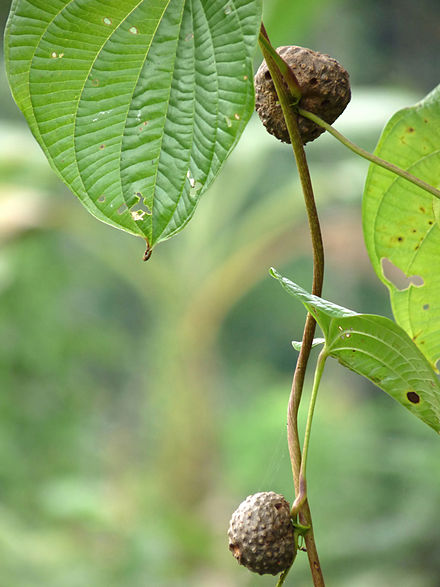
Celastrus orbiculatus (Oriental bittersweet)

Celastrus orbiculatus (Oriental bittersweet)

When Celastrus orbiculatus grows by itself, it forms thickets; when it is near a tree or shrub, the vines twist themselves around the trunk. The encircling vines have been known to strangle the host tree to death … All parts of the plant are poisonous. –Wikipedia, Celastrus orbiculatus

Oriental bittersweet continues to spread on Cape Cod, along with poison ivy, Virginia creeper, and English ivy. We now have kudzu, which used to be primarily in the American South.

Climate change is making poison ivy grow faster, bigger and meaner. Rising atmospheric levels of carbon dioxide and higher temperatures are to poison ivy what garbage is for rats, dormant water is for mosquitoes and road kill is to buzzards. –Templeton (2013)

Vines are spreading everywhere–lianas in Panama and air potato in Texas, which grows 8 inches a day. New York is releasing thousands of harmful Asian weevils as the only way to combat the relentless mile-a-minute vine. It’s happening all over the planet. Whether we like it or not, vines are embracing us, our walls and fences, and our trees.

Dioscorea bulbifera (air potato)

Dioscorea bulbifera (air potato)

Vines are increasing in many places because of forest fragmentation and habitat destruction. They’re also benefitting globally from increased CO2 in the atmosphere and global warming. Since they sequester less carbon than the trees they replace do, they then contribute to the growth of CO2. It’s a vicious cycle. Trees, but also ferns and other plants are at risk.

If you’ve ever walked through the jungle, you’ll know it can be surprisingly dark down on the forest floor. You see trees soaring up all around. You’re creating a dense canopy overhead. And climbing toward that canopy, snaking up the trees are the vines.

Now it may seem peaceful in there, but what you’re witnessing in very slow motion is a fight to the death: a fight between the trees and their old rivals, the vines. It’s a battle as old as the forests themselves. Now, scientists say the vines are winning. –Science Friday, NPR

Toxicodendron radicans, poison ivy

Toxicodendron radicans, poison

Vines can be quite beautiful. Grape vineyards have developed on the Cape, to what I’d consider to be a good end. BougainvilleaCampsis (trumpet vine), Wisteria can be beautiful. Lathyrus odoratus (sweet pea) and Passiflora edulis (passionfruit) have delicious fruits. Even poison ivy provides forage for many animals and the fruits are popular with birds (who help spread it around).

Vines aren’t all bad, Maybe we should embrace them back.

But we may have to say good bye to the trees. And they were nice to have around, too.

References

First encounters with snow

Preparing to face the snow

Preparing to face the snow

OK, I confess.

All those about me were complaining about the never-ending snow and what accompanied it: bitter winds coming off the ocean ice, people trapped in their homes, snowplows closing off newly shoveled driveways, while burying or knocking over mailboxes, falling on the ice, roofs collapsing, and such. Meanwhile, I prayed for it to continue. I wanted it to be here for my family from Austin who were to visit during spring break.

Front yard

Front yard

They had never seen snow before, at least not of this magnitude. But they prepared as well as they could.

We prepared for the visitors as well. I had stored some clean snow in the freezer for making snow ice cream, just in case the outside quality wasn’t up to standard. We had sleds, extra hats and mittens, and topped off the propane tank. We’d also made a list of indoor activities–the Brio train, the dollhouse, piano, rummy for indoors for inside the house; the visitor centers at the National Seashore’s Salt Pond site and at the Audubon sanctuary, to get out in case of freezing rain.

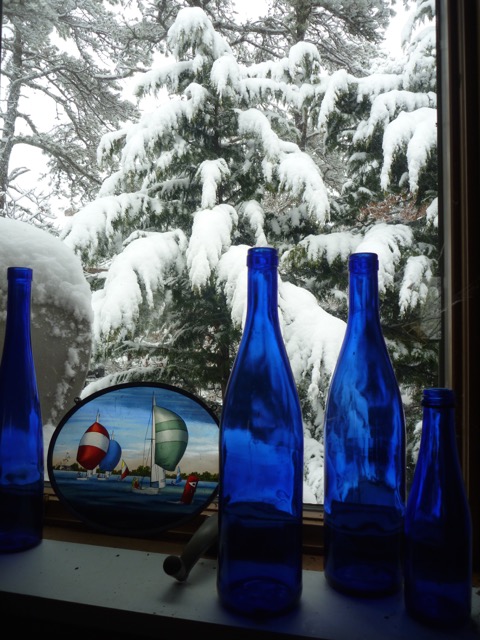
Out the garage window

Out the garage window

When they came, we took full advantage of the snow. we had snow ice cream in the classic vanilla as well as the maple syrup varieties. We made snow angels and devilish snow balls.

We made a snow dog (aka Ripley), when our planned snow man didn’t cooperate. We also got to see how much fun it is for a three-year-old boy to jump on top of a snow dog and scatter the snow in all directions. And how annoyed his six-year-old sister can be whenever he does something like that.

Frozen Ripley

Frozen Ripley

And we went sledding. There were awards for being the first to go beyond the end of the run into the sand road, for going furthest off the main track, for unintentionally going down backwards, for getting buried the deepest in a drift, and for screaming the loudest.

The visit was wonderful for me, although way too short.

Testing out the equipment

Testing out the equipment

Now that we’ve completed it, I’d like to amend my earlier call for lots of snow. It’s still beautiful to see, but it makes it hard to walk in the woods without snowshoes or skis. I’m starting to tire of putting out a special bin for mail with the mailbox packed in ice. I sympathize with the friend who’s decided to move after five weeks of being shut in. So, let’s have a few more days of sledding or skiing, then move on to another season.

Walk to Ptown

Ever since moving to the Cape, I’ve wanted to walk to Provincetown. It wasn’t because of the Wampanoag people, or other early explorers and settlers who wrote about the area, such as Gosnold, Champlain, the Pilgrims, or Thoreau. It was simply that I wanted to connect with the land and sea in a way that walking does, more than riding in a car or bus, or even on a bicycle.

Yesterday, Emily, Stephen, and I managed to do it–what turned out to be 35,000 of my steps.

We walked out the front door, down the hill to Wellfleet center, across route 6, past the ponds of Herring, Williams, Higgins, Slough, Horse Leach, and Round. Then we split up, with Stephen taking the beach walk along the Cape’s backside while Emily and managed the brambles on the dune ridge. We met up again at Ballston Beach, where Emily took a break, having carried the pack the entire way. Stephen and I continued on the beach past Long Neck Beach to a spot between the abandoned North Truro Air Force station and Highland Light. At that point we turned west to cross the Cape to the Bay side. From there it was a straight shot north to Provincetown, where we met up with Emily and Susan and had a lovely early dinner.

This slideshow requires JavaScript.

Wildlife in Wellfleet

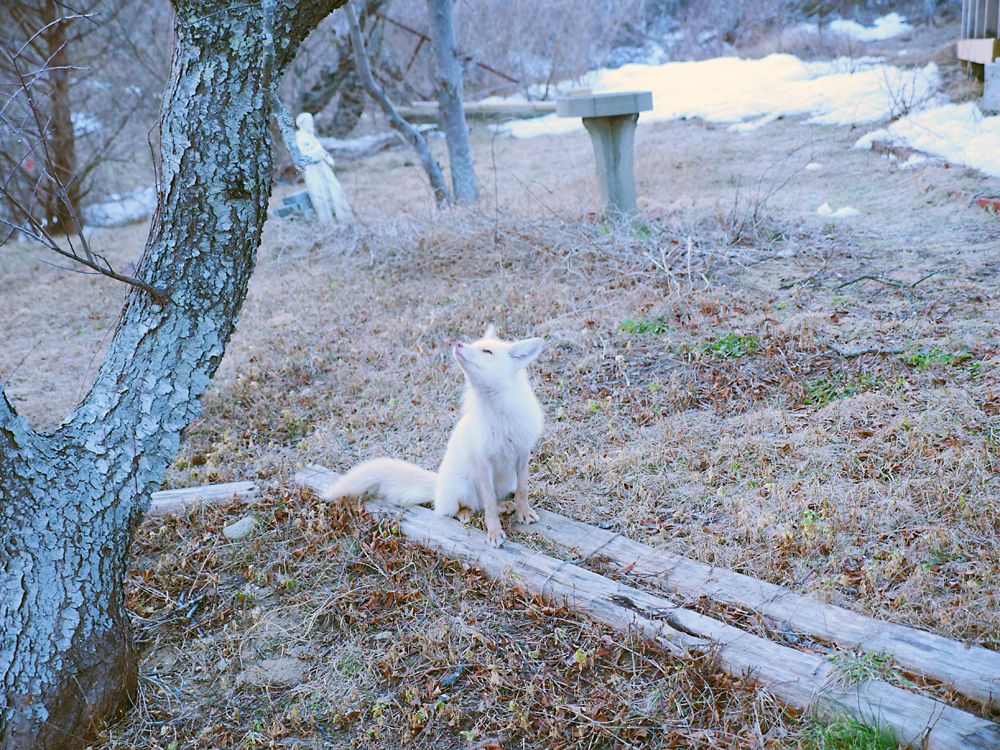
White fox, Truro, by Desmond  Tetrault

White fox, Truro, by Desmond Tetrault

We’re fortunate in Wellfleet to have frequent interactions with wildlife.

We’ve always had many birds around the house, but are now likely to have more since we just set up a bird feeder. Even though it’s late in the season, some chickadees and American goldfinches have been happy to discover that. The goldfinches seem like a different species from the bright yellow ones we saw in the spring mating season.

Birds that live near the water here, such as loons, mergansers, gulls, and gannets have also been feasting. Last week the water temperature dropped suddenly, resulting in the stunning of many small fish. The birds were happy to scoop up the unexpected bounty, so they’re very visible near shallow waters.

Blurry fox, Wellfleet marina

Blurry fox, Wellfleet marina

A more unusual visitor is the white fox. We know of two now, one residing in Wellfleet and one in Provincetown. We saw the Wellfleetian at the pier last night. It was as interested in us as we were in it. The quick smartphone photo doesn’t show much, but at least you can see that the eyes are not red as they would be for an albino fox. This condition is called leucistic. See also A fox of a different color in Provincetown – Gate House.

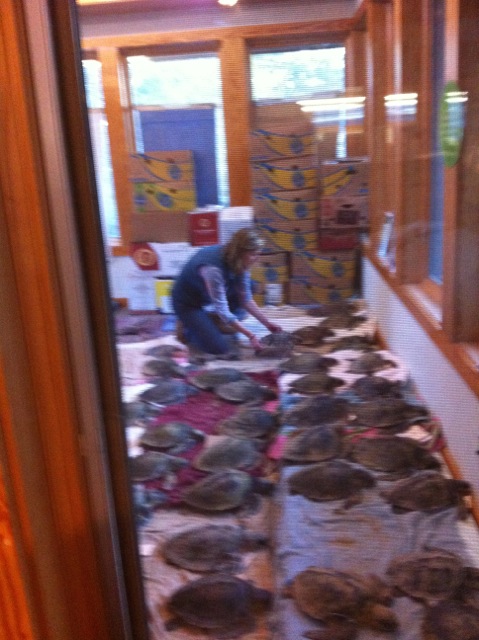
Turtle rescue at Mass Audubon

Turtle rescue at Mass Audubon

The same cold snap that stunned the fish and pleased the birds was a disaster for the sea turtles. Hundreds of turtles in Cape Cod Bay have been washed ashore. Most are endangered Kemp’s ridley sea turtles or leatherback turtles, and one is the largest loggerhead turtle ever to come ashore in Massachusetts (300 pounds, 3 feet long). About a thousand have been rescued and taken to the Massachusetts Audubon Society’s Wellfleet Bay Wildlife Sanctuary, and later to the Animal Care Center in Quincy.