I’ve been impressed by the public transport in Turkey.
Turkish Airlines was named the Best Airline in Europe for the third year in a row by customers in the 2013 World Airline Awards. That’s not surprising. The first thing I noticed was that I could fit my knees in.
Don’t be a traffic monster
If you’re not 6’4″ you may not appreciate the difference between having 90% of the space you need and 100+%, but believe me, not having room for 10% of your thighs is a problem. In addition to that 10%, the airline offered drinks, snacks, and a good meal, even on the short flight from Bucharest to İstanbul.
Chessboard
The buses are also very good. City buses run frequently, are clean and comfortable. We’ve been using a bus to the suburban area which takes about 40 minutes. It’s always on schedule and easy to use. The long-distance bus from İstanbul to Çanakkale includes a ferry ride. It has snack service, comfortable seating, even wifi and on-demand movies.
A line of black pawns
Two white rooks, standing guard
However, I’m not a fan of the street trafik (traffic), especially not as a pedestrian. Motorcycles are a special nuisance, going without regard for walkers or cars, or even the street/sidewalk distinction. There are signs telling people, “Don’t be a ‘traffic monster,” but the monsters are illiterate, so that doesn’t help much.
A commercialized bishop
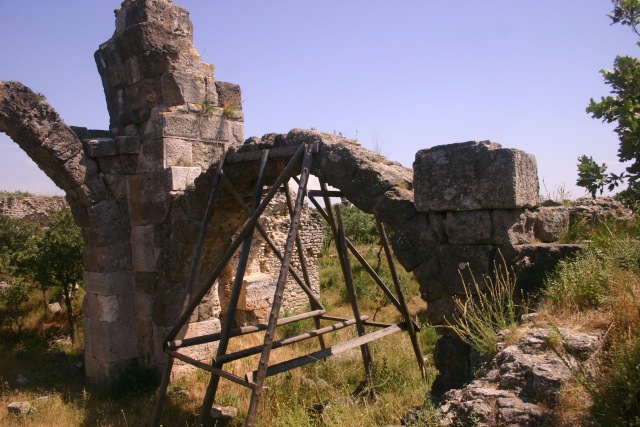
There may be a solution. The key was seeing the giant chess boards outside our apartment in Dardanos. They’re tiled spaces big enough for a person on each square. Then, I saw the bollards, which discourage at least the larger cars and trucks from driving on the sidewalks.
I began to study the bollards first as a survival skill. Before long, I realized they were all chess pieces and that I was immersed in a giant chess game. There were the familiar pieces, such as pawns, bishops, and rooks, but in addition, the traffic monsters, and the targets, otherwise known as people.
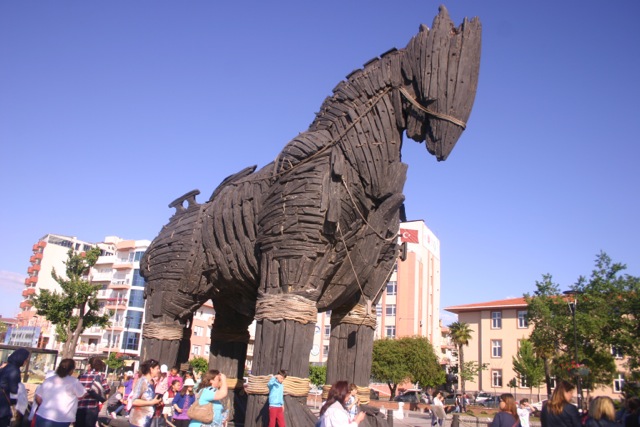
Kordon horse, from the movie
Çanakkale is not far from Troy. So, one of its attractions is a Trojan horse, which stands guard along along the kordon (beach front). The Çanakkale horse is all the more famous because it was the one used in the movie Troy. Brad Pitt, a lead actor, donated it to the town after the movie was filmed. Perhaps my chess game against the trafik could be aided by a knight on that horse.
The goal of this game is to stay alive, fighting the odds for this technique of population control. This means relying whenever possible on the chess pieces. Unfortunately in Çanakkale, it also means being careful about where and when to stop to view the beautiful Dardanelles, the flowers, and the fascinating life on the kordon.
İstanbul is a city of contradictions––part Europe and part Asia, part ancient empire and part modern democracy, part bustling metropolis and part quiet byways. It’s hurtling toward the future with modern buildings, massive construction projects, and crushing traffic, but it’s also a city filled with its history, which is to a large extent the history of much of the world.
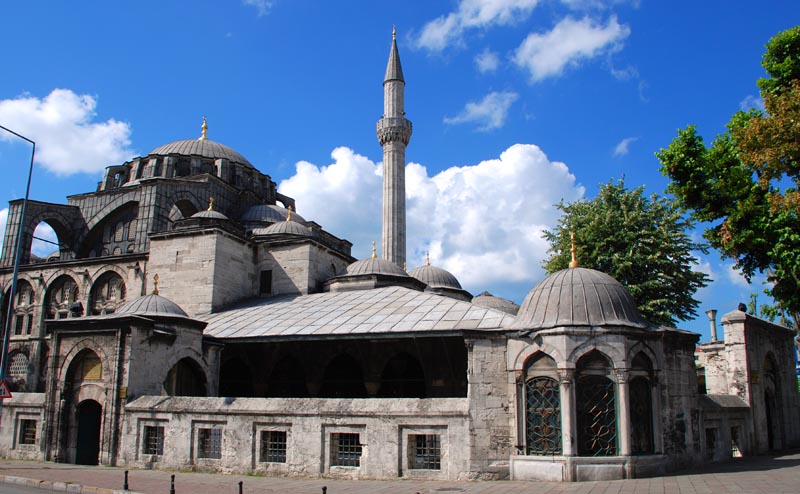
Today we saw some of the latter. We visited the Kılıç Ali Paşa complex, including a camii (mosque), a medrese (seminary), a hamam (bath), a türbe (tomb), and a çeşme (fountain). It’s in Tophane, which is part of the Beyoğlu district, on the shore of the Bosporus. It was built by Kılıç Ali Paşa, following the design of the great architect Mimar Sinan. Sinan was 90 when he began the project and 98 when he finished.
Kılıç Ali Paşa Camiii dome
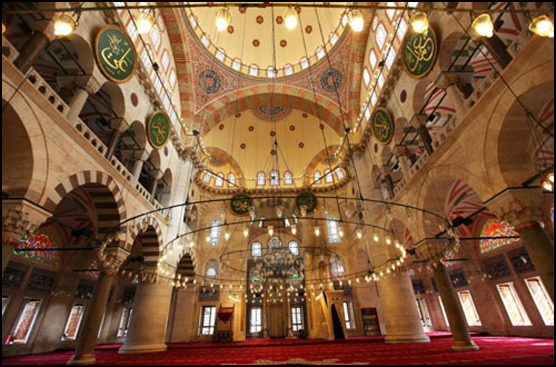
It’s beautiful inside and out. It shows one of Sinan’s specialities, a massive structure, which is surprisingly delicate and full of light. There are 247 windows including 24 for the central dome. Try the virtual tour.
One legend about the site is that when Kılıç Ali Paşa decided to endow a mosque, he applied for a grant of land. The Grand Vezier said: “Since he is the admiral, let him build his mosque on the sea.” Kılıç Ali Paşa brought in rocks and built the mosque on an artificial island connected to the mainland by a narrow causeway. The complex is now well inland, since the sea was filled during the construction of a modern port.
Another legend is that Miguel de Cervantes was a forced worker at the construction of the complex during his enslavement, like the character in Don Quixote.
The Museum of Innocence, 83 cabinets, one for each chapter
We also saw The Museum of Innocence. Orhan Pamuk created it, based on the museum in his novel of the same name. He calls it “a declaration of love to the city of İstanbul.”
Visiting the museum is like experiencing an alternate reality version of the book. You read or listen from the book as you view the exhibits, which are described in the book. The cabinets are numbered to correspond to the chapters, so it’s a museum about a book, a book about a museum, and a multimedia creation about life in İstanbul. The cleverness of it all is fun and doesn’t get in the way (though almost) of Pamuk’s thoughtful, melancholic writing.
Tarihi Cumhuriyet Meyhanesi
Tonight we had dinner at Tarihi Cumhuriyet Meyhanesi, where Atatürk used to eat. It feels like eating in a restaurant from the 1920’s. The walls are covered with photos and news articles from its 150 year existence.
The concept of World Englishes has been much studied by groups such as the International Association for World Englishes (IAWE), including my own colleagues at the University of Illinois. They consider localized English in global contexts, how it’s spoken and written, along with pragmatic factors such as appropriate use and intelligibility.
When traveling, I notice these issues frequently on a very personal level. For example, one day we were waiting for the elevator (i.e., lift) in a hotel in İstanbul. A couple of people from Munich came up to us to ask about the hotel. We described our room, and then began to talk more generally. They then asked where we were from and were surprised to hear that it was the US. They had judged by our accent that we were from the UK.
Norwegian Star
In this case, I don’t think the confusion was due to our having British accents. Instead, it was from having enough interactions with speakers of various World Englishes that we had unconsciously muted our marked US accents, especially my Texas talk. That possibly more subdued and more clearly articulated dialect has proved necessary in travel and work with international colleagues.
Another example arose later the same day. A different couple approached us on a sidewalk, with one saying in a strong Arkansas accent, “Are y’all cruise people?” What was interesting then is that we were marked by appearance as possible cruise people without having said a word, an example of non-verbal language. Moreover, Susan couldn’t understand them, but I, who had grown up in a neighboring country, could.
We had to confess that we weren’t cruise people, but we were able to tell them where their ship was docked. It was a 2000 passenger Norwegian cruise ship about three blocks away. I’m not sure that it was the Norwegian Star, but it was one that looked similar to the one shown here. In any case it was hard to miss, but we were happy to help them find their way home.
It’s fun to visit the famous sites when traveling, even if only to see all the diverse people coming to see those same sites. But What I tend to remember and value most are the unplanned, mundane, and more local adventures.
On Friday in Bucharest, there was one such involving worms. I was speaking at the aptly named “Friday meeting” at the university. The topic of planning in teaching (exploring the important sites?) came up and I had to share a story that Jack Easley, a math and science educator, had told.
Discovering worms
Jack had been working in a second grade class, guiding a six week long unit on weather. Pupils learned about clouds, precipitation, storms, weather measurement, agriculture, and other such important topics, taught, I’m sure in a creative and engaging way. On the last day, it was raining outside until just before the class ended. Jack knew that there might be a rainbow. Viewing that could be an exciting culmination for the unit.
He took the class outside, preparing to discuss the visible light spectrum, refraction, moisture in air, and others such topics. But the pupils weren’t interested. While Jack was looking up, they were looking down at the closer and and more ordinary. He was a latter day Thales at risk of falling into a well while gazing at the stars. The children’s observations of the worms led them to ask, “Why do worms come out of the ground after a rain?”
Soil, plants, worms
Jack started to answer, then realized that he didn’t really know. So he asked the students to write down their question for scientists at the university. It turned out they had many ideas, but didn’t really know, either. A few days later a long article came out in the New York Times, saying that this was an important question for science and for agriculture, but the answer wasn’t simple. Even today, there is a lot to say about why earthworms surface after rain?. Jack saw that the pupils became most excited about their own question, which in turn was more like the science that scientists do.
Catalina Ulrich, a professor at the University of Bucharest, and my host, appeared to be quite excited by this little story. She pulled out her smartphone to show photos (shown here). Just the day before she had been observing in a crèche (preschool), where the children had been fighting over a bike. But then, one of them discovered a worm. Like Jack’s students, these even younger ones saw that soil and worms were more interesting and more attractive than whatever else they had been doing, and than many people might think.
That evening, we had dinner at the home of Claudia Șerbănuță. I needed a toilet break, and as is my habit, couldn’t avoid looking at the reading material there. Right on top was Doreeen Cronin’s Diary of a Worm.
The book describes the world from a worm’s point of view. For example, in the beginning, it tells you the three rules about worms that you must never forget. The third rule is “Never bother Daddy when he’s eating the newspaper.” When I came out, I asked Claudia’s children about the book. Could they tell me the three things we must always remember?
They grew quite excited and shouted out the third rule in unison. When I asked about the others they weren’t so sure. The other two have something to do with how worms live, the making of soil, the interdependence of life, or global food supply. I couldn’t remember them either.
My venue was ideal. Set at one end of a small performance hall, there was a new Yamaha grand piano, similar to the one shown here. There were plenty of chairs, but no actual people listening. There was a nice view of trees and the rest of UNMB outside the fourth-floor windows.
On the wall was a poster advertising the George Enescu annual international music festival. As one of the world’s best modern composers, Enescu was also an outstanding violinist, pianist, and conductor. The poster displayed his image looking directly at my seat at the piano.
I decided to start with Beethoven’s Sonata No. 31 in A♭, Opus 110. I’ve been working on this one for a long time. It’s very challenging for me, although there are moments when I can play it well enough to get lost in the beauty of the music.
Universitatea Națională de Muzică din București
When I started I couldn’t help but notice Enescu’s stare. According to Wikipedia/Vincent d’Indy, if Beethoven’s works were destroyed, Enescu could reconstruct them all from memory. Would he approve of my feeble efforts? Was it an insult to his memory to be playing that beautiful sonata in front of him?
As I began to play, these thoughts disturbed me. Then I heard Enescu say, “why are you paying attention to me? You should focus on Beethoven, even more on this particular piece.” I turned back to the music, but other thoughts interfered. The score was backlit by the sunlight through the windows; the bench didn’t seem to be adjusted right; I wondered whether I should have had coffee first. Enescu spoke up again: “Yes it’s a wonderful spring day in Bucharest, but you want to play this sonata. Forget the light, the bench, the coffee. Leave it behind and feel the music.”
I knew that he knew I was missing notes, stretching the rhythm, and phrasing in ways Beethoven never imagined. It must have pained his musical ear, if not his musical soul. But he knew, as I’m beginning to learn, that with practice those things can improve. What mattered was to bring my full attention to the music.
I plodded along, trying to ignore all the distractions. Then it happened.
Maybe it was because I realized this was just between Beethoven, Enescu, and me. No one else was there. The wonderful venue didn’t matter. And Enescu had made it clear he wasn’t relevant either. For the first time, I really began to hear the music. I played the entire sonata beginning to end. Forget the fact that my tempo was about a third of Enescu’s and that the list of “areas for improvement” would be longer than War and Peace.
Enescu helped me, just for a moment, to go from struggling to experiencing. I think of his lifelong passion of music, and what it must have meant to him to feel that kind of loss of self and immersion in music as he both traversed and added to the repertoire.
We don’t have any further performances scheduled at the Conservatory on this trip. I’m sorry if you missed it!
The video clip (1978) is of Enescu’s Romanian Rhapsody N° 1 Op 11, with Sergiu Celibidache conducting the Bucharest George Enescu Philharmonic Orchestra at the Romanian Athenaeum.
to have a better Romania, the governance must be closer to the citizens and their needs. And because “all politics is local”, we need empowered citizens and strong NGOs to get involved, to get mobilized, to write petitions, to participate at public meetings, to contribute to the policy making or even to protest in the streets.
I was fortunate to meet on Tuesday with CeRe staff and to see some of their community projects in action. CeRe employs an interesting and highly effective community organizing methodology. Although it is based on the specific situations of Bucharest today, its work is a model for community action anywhere.
Favorit Cinema
A relatively small project, but one that makes a big difference in people’s lives, illustrates CeRe’s process well. Portions of a neighborhood were separated by a dangerous alleyway, with broken pavement, trash, poor lighting, and unpredictable traffic. Children had to traverse this to get to school.
In an initial phase, community organizers from CeRe went door-to-door in the neighborhood. Some citizens identified one or more problems in addition to the alley, others none at all. A consensus emerged that repair of the alley was a high priority that appeared amenable to solution.
Citizens organized to specify the problem, to propose concrete solutions, and pressure city officials for action. CeRe advised and facilitated, but was deliberately not the primary actor. The goal was to address the immediate problem, but more importantly, to nurture long-term participation in civic processes.
Playground 1
Eventually, the alley was cleaned and paved. Bollards were installed to restrict traffic, lighting was added, and what turned out to be a final obstacle, two trash bins were added. You can see the alley as it exists today in the photo. It’s a safe place to play or to move between sections of the neighborhood.
In another project, citizens designated Favorit, an abandoned cinema, as a blighted site that could become a neighborhood cultural center. They have secured the abandoned building and devised plans for redevelopment. The local council has allocated money for the center and is working with the neighborhood to make it a reality. In this case, the cultural center is still a vision, one that requires continued discussion within the community and with officials to specify its shape and goals.
Playground 2
One of the most impressive projects I saw was a playground, which obviously meets major needs for people of all ages. Citizen action demonstrated both those needs and how a broken down park could be used. Young people marked equipment there with green ribbons for good condition, yellow for needs repair, and red for needs disposal.
The community managed to get city officials to visit the site in person. Children played a role: They jumped up and down, creating dust, thus making evident the need for a cleaner, safer playground surface.
Inquiry cycle
CeRe has come to recognize that learning is a key aspect of what they do. Although they didn’t conceive it as inquiry-based learning, they (and I) now consider it to be an excellent example of that. The process involves the initial ask (a cere) by the door knockers and then the citizens, the investigation of the community issues (a investiga), the creation of potential solutions (a crea), discussions in the community and with city officials (a discuta), and reflection on the results and the process (a reflectă).
The process isn’t linear, and often entails stepping back, moving sideways, or redirecting energies to achieve the goals. Along the way, citizens learn not only about the specific problem, but also about working together, listening to each other, making decisions together, being a team, compromising, negotiating, discussing issues productively, and understanding the laws and municipal government.
It was nearly two centuries ago (1830) that Frédéric Chopin came to Paris. There, he met Franz Liszt and other musicians; he also began his famous relationship with George Sand.
In Paris, he discovered the Pleyel piano, his lifetime favorite, and performed his first and last concerts at Salle Pleyel, which remains a major, active concert hall.
Chopin’s waltz on a Pleyel
It’s beyond presumptuous to put myself in that tradition, but still, there’s something very pleasant about playing one of Chopin’s a minor waltzes on a Pleyel in Paris. The piano is new; it’s so shiny that you can see the reflection of the Père Lachaise cemetery (where both Chopin and Pleyel are buried) from across the street.
This apartment has a good collection of Chopin, Bach, Debussy, and other classical composers. There’s a late 19C edition of Beethoven’s Sonatas, as well as Monty Python, Frank Sinatra, and Jacques Brel. There’s even a guest book, specifically for musicians, which was provided by a previous guest in the apartment.
In 1971, I was fortunate to see an excellent play at Wyndham’s Theatre in London. It was Abelard and Heloise, by Ronald Millar. Keith Mitchell and Diana Rigg(!) had the title roles. The play was moving and the acting was superb. I can still visualize scenes, not so much from the stage setting, which was fine, but because the story caught my imagination.
Under the pretext of study we spent our hours in the happiness of love, and learning held out to us the secret opportunities that our passion craved. Our speech was more of love than of the books which lay open before us; our kisses far outnumbered our reasoned words. –Abélard
Over the years I would read whatever I could find by or about Héloïse d’Argenteuil and Peter Abélard, including biographies, fictionalized accounts, children’s stories, poetry, song, and of course the letters themselves. I saw several movie versions, some better than others. I began to learn how the story had inspired copies, re-mediations, satires, and endless allusions in a wide variety of artforms.
Père Lachaise Cemetery from apartment
Héloïse had seen this coming, with her own perceptive reflections on pictures, letters, talk, and physical presence. For example,
If a picture, which is but a mute representation of an object, can give such pleasure, what cannot letters inspire? They have souls; they can speak; they have in them all that force which expresses the transports of the heart; they have all the fire of our passions, they can raise them as much as if the persons themselves were present; they have all the tenderness and the delicacy of speech, and sometimes even a boldness of expression beyond it. –Héloïse
My obsession with the topic became worse in 2004, when we lived not far from Notre-Dame de Paris, where Abélard had studied and taught. I found an English translation of Régine Pernoud’s book in a used book store. Pernoud lists Héloïse first, which makes sense. Abélard was a great orator and writer, one we might revere even more if most of his works hadn’t been destroyed for his heresies. Yet, Héloïse (a great scholar herself) is the one who makes their story come alive, whether you interpret it as a love story, a theological debate, an example of 12th C patriarchy, or an invention of later writers. His letters are fascinating to read, but hers leap to the heights of the written art, even in translation from the original Latin.
One thing that comes through in every retelling is the tragedy of it all. There is of course the castration and the subsequent separation of Héloïse and Abélard. But there is also the tangible agony of struggles between possibility and reality, spirituality and desire, trust and betrayal. Their love always entailed suffering with happy moments that became recollections before they were fully realized. Even their son Astrolabe appears as a shadow of a world they imagined, but never had.
Monument to Abelard & Héloïse
Later, when their connection was only through letters, Héloïse seeks a way to share the loss, to find meaning in the emptiness:
Let me have a faithful account of all that concerns you; I would know everything, be it ever so unfortunate. Perhaps by mingling my sighs with yours I may make your sufferings less, for it is said that all sorrows divided are made lighter. –Héloïse
You can read one version of this in Alexander Pope’s poem, Eloisa to Abelard. Eloisa is in anguish over her powerful feelings for Abélard, especially as manifested in her dreams:
Black Melancholy sits, and round her throws A death-like silence, and a dread repose: Her gloomy presence saddens all the scene, Shades ev’ry flow’r, and darkens ev’ry green, Deepens the murmur of the falling floods, And breathes a browner horror on the woods.
She realizes that Abélard, now as a eunuch who is free from the “contagion of carnal impurity” cannot return her feelings even if he wants to. And so she begs, not for forgiveness, but for forgetfulness.
How happy is the blameless vestal’s lot! The world forgetting, by the world forgot. Eternal sunshine of the spotless mind! Each pray’r accepted, and each wish resign’d;
Today, one can walk near Père Lachaise cemetery on rue Pierre-Bayle. Bayle was a 17C philosopher. Where Abélard committed the heresy of seeing reason as a path to faith, Bayle advocated a separation between the spheres of faith and reason. He wrote about Héloïse and Abélard in his Historical and Critical Dictionary, a forerunner of the encyclopedias. One can also walk on the rue du Repos, which, were it not for the cemetery wall, would lead directly to where they lie in “repose” at their monument.
Héloïse d’Argenteuil
Cynics will point out that the monument was placed there in 1817 simply as a marketing ploy to convince Parisians to be buried among the famous; that the bones of the famous lovers are probably at the Oratory of the Paraclete, or the church of Nogent-sur-Seine, or most likely, just lost; that their love, if it existed at all, was no more than an expression of medieval structures of religious oppression, patriarchy, abuse of position, class, and power; and that the famous letters themselves were a literary concoction made long after the actual events.
Abélard would disdain these worldly concerns, and urge the cynics, along with Héloïse to
Strive now to unite in yourself all the virtues of these different examples. Have the purity of virgins, the austerity of anchorites, the zeal of pastors and bishops, and the constancy of martyrs.
But Héloïse would know that “the truth is more important than the facts.” She’d recognize that the Père Lachaise monument shows their eternal love, which endured politics, religion, castration, and even Abélard’s pomposity and coldness. She’d also see that just like Keats’s youth, they can never touch, so encased in granite, their suffering also endures forever.
The Social Frontier was a radical journal, which saw the school as an agent of social change. It was published at Teachers College for six years, starting in 1934. After that it was sponsored by the Progressive Education Association and changed its title to Frontiers of Democracy. The final issue was published in 1943.
The writers and editors for Social Frontier / Frontiers of Democracy (SF/FD) were dedicated to creating a more open society, one in which democratic participation was not simply a slogan, but a living reality. That meant expanding educational opportunities, increasing access, developing critical, socially-engaged citizens (where “citizen” means any resident), and involving all in what Dewey called the process of authority.
I’m sure the SF/FD writers would be pleased to know that the Teachers College Record and the Gottesman Libraries are “re-releasing the journal both because of its historical importance and because of its continued relevance to educators today.” The collection has been digitized and presented on a well-designed web page.
SF/FD writers would applaud the recognition of its continuing value. They would quickly understand the web as a new means for increasing access and accomplishing more of the democratic mission that they had undertaken. They would envision that teachers, parents, administrators, politicians, and the ordinary citizen as well, would certainly have some means for convenient access.
Along with that they would of course recognize the need to recover costs and to value the labor required to publish and distribute texts. But it’s hard to imagine that they would be pleased to know that the very journal they had established “to lead educators in the building of an enlightened America” (Harold Rugg) is effectively off limits to most of the people they hoped to reach, despite the new technological affordances.
How many individuals will choose to subscribe to TCRecord simply in order to access SF/FD? Even people at other universities willing to pay the appropriate costs, and current subscribers to TCRecord, are excluded since the institutional subscription does not include SF/FD.In the midst of information overload, the apparently modest terms can be off-putting: “The introductory rate of $20 is available for a limited time…Your membership will automatically renew every 365 days…No refunds are offered for early cancellation.” I suspect that at best many will decide to look at the print version if and when it’s available to them, and resign themselves to being unable to share any findings more widely with the very audience that the journal envisions.
Rugg’s books and the progressive education movement in general suffered from rightwing attacks through the late 1930’s into the McCarthy era. Today the movement suffers more from indifference and a lack of understanding of the issues involved. A paywall for a relatively obscure journal that ceased publication over 70 years ago does little to help. I assume that TC or TCRecord has full copyright, but it’s worth noting that the journal was sponsored for half its life by the Progressive Education Association (as Frontiers of Democracy), and as such only in part by TC.
In the final issue, Rugg says, “Our treasured American way of life is in great danger, not only from menacing fascists and false patrioteers, but primarily because our people, standing baffled and bewildered on the threshold of abundance are unable to bring about such a life.” Much the same could be said today; it’s a pity that the opportunity to further dialogue on these issues has been lost. As too often happens, a good project with a noble purpose undermines its own agenda, for apparently petty reasons.
Temple Bar is an area with narrow, cobbled streets on the south bank of the Liffey in central Dublin. It’s famous the world over for its lively nightlife, but that’s not high on my list of reasons to visit it. There are better places in Dublin to experience Irish food and music, ones where you’re more likely to encounter people who actually live in Ireland. However, the area does offer much that’s special, such as the Irish Film Institute.
One that we just discovered is The Icon Walk, a project of The Icon Factory. It’s located just off Fleet Street, along Aston Place, Bedford Lane, and Price’s Lane. Local artists have transformed the lanes into an open air gallery of Irish culture. It’s recently been awarded approval as a UNESCO City of Literature site.
Someone described the Walk as a twenty minute activity, but it deserves more than that. There’s a great collection of photographs, drawings, paintings accompanying sayings of famous writers and artists, descriptions of moments in the history of sports, movies, fashion, and more.
Arriving at the Playwrights section, we read,
Around 1610, Shakespeare wrote the “The Tempest” and retired to Stratford on Avon where he died in 1613. Queen Elizabeth I having completed the conquest of Ireland was dead. The last of the great leaders, O’Neill and O’Donnell were gone to Spain and Ulster planted with Crown subjects.
Between 1613 and the War Of independence in 1922, which won back self rule for most of Ireland, no play of real merit was written in the English language by anyone other than by an Irish-born writer.
The selected icons–Samuel Beckett, Brendan Behan, Sean O’Casey, George Bernard Shaw, John Millington Synge, and Oscar Wilde–won’t be enough to convince everyone of that claim, but their collective oeuvre is amazing.
Along the walk, you can see many great images produced by a wide variety of artists. A few of those are on the website, but the majority are visible only on the walk itself. They’re best seen that way, in any case, in the context of the other artworks and Temple Bar itself.
One of the best parts for me was the individual quotes, both from writer’s works and from their lives. For example, we read,
Beckett went on to live with an older woman who was not exactly a barrel of laughs. She took the phonecall that informed them of Samuel’s Nobel Prize. “This is a disaster, our lives are ruined” she responded.
In the eighties, Beckett was invited to Germany to direct “Waiting For Godot”. When presented with the script which he had not read in many years he exclaimed; “This thing needs a good edit”.
John Hume, third from left
(Again, however, most of these texts exist only on the walls. I hope there will be an exhibition book at some point.)
One thing I learned was that in 2010 John Hume was chosen in an RTÉ survey as Ireland’s Greatest. He was also the winner of the Nobel Peace Prize (1998), the Gandhi Peace Prize, and the Martin Luther King award. He had modeled his own work for equality in citizenship on that of Gandhi and King. Unfortunately, his peaceful work was disrupted by violence and the “troubles” began. Hume became a leading figure in the civil rights movement in the late 1960s. Through speeches, marches, hunger strikes, dialogues, and long-term negotiations, Hume was behind many of the developments and agreements toward peace in Ireland, and later for European unity.
You can get a sense of the walk from the video below (only part of which is in English):