

The piano
On Thursday, I was able to practice piano at the National University of Music Bucharest (UNMB).
My venue was ideal. Set at one end of a small performance hall, there was a new Yamaha grand piano, similar to the one shown here. There were plenty of chairs, but no actual people listening. There was a nice view of trees and the rest of UNMB outside the fourth-floor windows.
On the wall was a poster advertising the George Enescu annual international music festival. As one of the world’s best modern composers, Enescu was also an outstanding violinist, pianist, and conductor. The poster displayed his image looking directly at my seat at the piano.
I decided to start with Beethoven’s Sonata No. 31 in A♭, Opus 110. I’ve been working on this one for a long time. It’s very challenging for me, although there are moments when I can play it well enough to get lost in the beauty of the music.
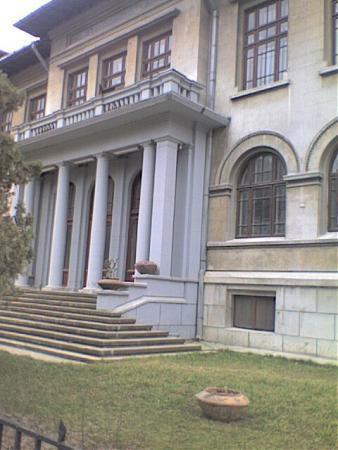
Universitatea Națională de Muzică din București
When I started I couldn’t help but notice Enescu’s stare. According to Wikipedia/Vincent d’Indy, if Beethoven’s works were destroyed, Enescu could reconstruct them all from memory. Would he approve of my feeble efforts? Was it an insult to his memory to be playing that beautiful sonata in front of him?
As I began to play, these thoughts disturbed me. Then I heard Enescu say, “why are you paying attention to me? You should focus on Beethoven, even more on this particular piece.” I turned back to the music, but other thoughts interfered. The score was backlit by the sunlight through the windows; the bench didn’t seem to be adjusted right; I wondered whether I should have had coffee first. Enescu spoke up again: “Yes it’s a wonderful spring day in Bucharest, but you want to play this sonata. Forget the light, the bench, the coffee. Leave it behind and feel the music.”
I knew that he knew I was missing notes, stretching the rhythm, and phrasing in ways Beethoven never imagined. It must have pained his musical ear, if not his musical soul. But he knew, as I’m beginning to learn, that with practice those things can improve. What mattered was to bring my full attention to the music.
I plodded along, trying to ignore all the distractions. Then it happened.
Maybe it was because I realized this was just between Beethoven, Enescu, and me. No one else was there. The wonderful venue didn’t matter. And Enescu had made it clear he wasn’t relevant either. For the first time, I really began to hear the music. I played the entire sonata beginning to end. Forget the fact that my tempo was about a third of Enescu’s and that the list of “areas for improvement” would be longer than War and Peace.
Enescu helped me, just for a moment, to go from struggling to experiencing. I think of his lifelong passion of music, and what it must have meant to him to feel that kind of loss of self and immersion in music as he both traversed and added to the repertoire.
We don’t have any further performances scheduled at the Conservatory on this trip. I’m sorry if you missed it!
The video clip (1978) is of Enescu’s Romanian Rhapsody N° 1 Op 11, with Sergiu Celibidache conducting the Bucharest George Enescu Philharmonic Orchestra at the Romanian Athenaeum.


 I was fortunate to have a visit with youth planners at the
  What I saw is part of
 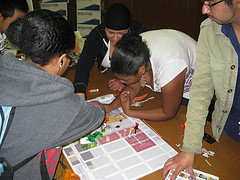 Sarah Van Wart from the UC Berkeley I School was my guide. She and two undergrads, Arturo and Sarir had been leading the high school students in a community planning exercise. They first examined their current situation, using dialogue, photos, and data. They then considered alternatives and how those might apply to a planned urban development project.
  The development will include schools, housing, a park, and community center, but the questions for city planners, include “How should these be designed?” “How can they be connected?” “How can they be made safe, useful, and aesthetically pleasing?”
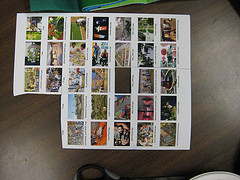
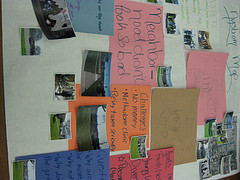
 On the day I visited, the youth had already developed general ideas on what they’d like to see in the development. Now they were to make these ideas more concrete through 3-D modeling. Using clay, toothpicks, construction paper, dried algae, stickers, variously colored small rocks, and other objects, they constructed scale models of the 30 square block development. One resource they had was contact sheets of photos of other urban environments. They could select from those to include as examples to emulate or to avoid.
 I was impressed with the dedication and skill of the leaders of the project, including also the teacher, Mr. G. But the most striking thing was how engaged the young people were. I heard some healthy arguing about design, but I didn’t see the disaffection that is so common some high schools today.
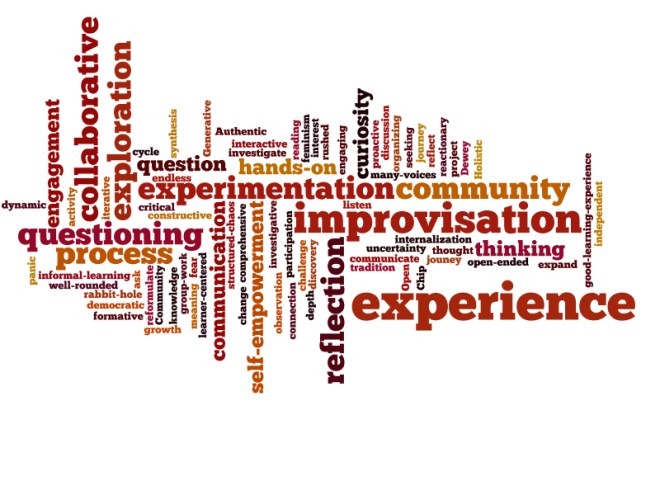
  My only regret is that I wasn’t able to follow the process from beginning to end. But from the rich, albeit limited, glimpse I had, the project is an excellent way to engage young people in their own communities, to use multimedia for learning and action in the world, and to learn how to work together on meaningful tasks. It’s a good example of
 Chip's journey