Personal geography: Walking

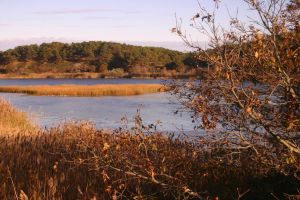
Lake Silvaplana

Lake Silvaplana

In Die Götzen-Dämmerung (Twilight of the Idols), Friedrich Nietzsche writes that his best ideas come from walking:

On ne peut penser et ecrire qu’assis [One cannot think and write except when seated] (G. Flaubert). There I have caught you, nihilist! The sedentary life is the very sin against the Holy Spirit. Only thoughts reached by walking have value.

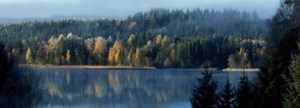
An important example of this for Nietzsche was his concept of the eternal recurrence of the same events. It occurred to him while he was walking in Switzerland in the woods around Lake Silvaplana, when he was inspired by the sight of a large, pyramidal rock. His inner life as writer and philosopher could not be separated from his embodied life as a person who spent hours walking in beautiful spots in Europe.

Why does it require the direct connection reached through walking to embrace an idea like eternal recurrence? Why not just use a map? Reading a book, map, diagram, photo, movie, etc. can be a powerful experience. Why can’t we have the same insights without being there? And what is the relation between reading a text  about a phenomenon and experiencing it more directly?

A philosophy of walkingJohn Dewey addresses this dichotomy in The Child and the Curriculum:

The map is not a substitute for a personal experience. The map does not take the place of an actual journey…But the map, a summary, an arranged and orderly view of previous experiences, serves as a guide to future experience; it gives direction; it facilitates control; it economizes effort, preventing useless wandering, and pointing out the paths which lead most quickly and most certainly to a desired result. Through the map every new traveler may get for his own journey the benefits of the results of others’ explorations without the waste of energy and loss of time involved in their wanderings–wanderings which he himself would be obliged to repeat were it not for just the assistance of the objective and generalized record of their performances.

Sunset on the Dardanelles

Sunset on the Dardanelles

I’ve been thinking along these lines while reading, A Philosophy of Walking, by Frédéric Gros. The book is a pleasure to read (though not while walking). It intersperses Gros’s observations with accounts of other great walkers such as Rimbaud and Nietzsche. Gros writes,

By walking, you escape from the very idea of identity, the temptation to be someone, to have a name and a history … The freedom in walking lies in not being anyone; for the walking body has no history, it is just an eddy in the stream of immemorial life.

Curiously, the anomia and ahistory of walking, its “freedom,” is what allows the walker to connect to a greater degree with history, geography, and ideas in general. This has become even more evident to me during our stay in Turkey.

To be continued…


A diet of worms

It’s fun to visit the famous sites when traveling, even if only to see all the diverse people coming to see those same sites. But What I tend to remember and value most are the unplanned, mundane, and more local adventures.

On Friday in Bucharest, there was one such involving worms. I was speaking at the aptly named “Friday meeting” at the university. The topic of planning in teaching (exploring the important sites?) came up and I had to share a story that Jack Easley, a math and science educator, had told.

Discovering worms

Discovering worms

Jack had been working in a second grade class, guiding a six week long unit on weather. Pupils learned about clouds, precipitation, storms, weather measurement, agriculture, and other such important topics, taught, I’m sure in a creative and engaging way. On the last day, it was raining outside until just before the class ended. Jack knew that there might be a rainbow. Viewing that could be an exciting culmination for the unit.

He took the class outside, preparing to discuss the visible light spectrum, refraction, moisture in air, and others such topics. But the pupils weren’t interested. While Jack was looking up, they were looking down at the closer and and more ordinary. He was a latter day Thales at risk of falling into a well while gazing at the stars. The children’s observations of the worms led them to ask, “Why do worms come out of the ground after a rain?”

Soil, plants, worms

Soil, plants, worms

Jack started to answer, then realized that he didn’t really know. So he asked the students to write down their question for scientists at the university. It turned out they had many ideas, but didn’t really know, either. A few days later a long article came out in the New York Times, saying that this was an important question for science and for agriculture, but the answer wasn’t simple. Even today, there is a lot to say about why earthworms surface after rain?. Jack saw that the pupils became most excited about their own question, which in turn was more like the science that scientists do.

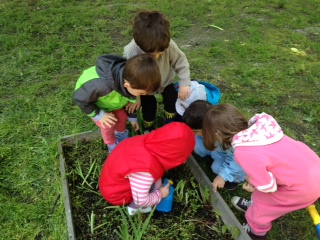
Catalina Ulrich, a professor at the University of Bucharest, and my host, appeared to be quite excited by this little story. She pulled out her smartphone to show photos (shown here). Just the day before she had been observing in a crèche (preschool), where the children had been fighting over a bike. But then, one of them discovered a worm. Like Jack’s students, these even younger ones saw that soil and worms were more interesting and more attractive than whatever else they had been doing, and than many people might think.

Doreeen Cronin Diary of a WormThat evening, we had dinner at the home of Claudia Șerbănuță. I needed a toilet break, and as is my habit, couldn’t avoid looking at the reading material there. Right on top was Doreeen Cronin’s Diary of a Worm.

The book describes the world from a worm’s point of view. For example, in the beginning, it tells you the three rules about worms that you must never forget. The third rule is “Never bother Daddy when he’s eating the newspaper.” When I came out, I asked Claudia’s children about the book. Could they tell me the three things we must always remember?

They grew quite excited and shouted out the third rule in unison. When I asked about the others they weren’t so sure. The other two have something to do with how worms live, the making of soil, the interdependence of life, or global food supply. I couldn’t remember them either.

Lac-Mégantic: beauty and death

Tread softly because you tread on my dreams –W.B. Yeats

284px-Mont-Mégantic-2About six weeks ago, Susan and I canoed in Maine, then made a brief excursion into Québec.

Nature around Mont Mégantic

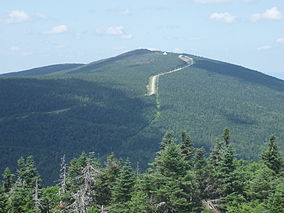
We planned to visit the area around Mont Mégantic, a monadnock about 15 km north of the border. It’s in the middle of the Parc national du Mont-Mégantic and is the terminus of the Sentiers Frontaliers, a hiking trail that connects with the Cohos Trail in the US, which runs north from Crawford Notch, NH to the border. The trail is in a beautiful area, and represents an even more beautiful cooperation among volunteers on both sides of the border, who are working to make ways to enjoy, but tread softly, in the forests and rivers.

Image 1The treasuring of the environment is even more evident there because the Mont Mégantic Observatory is the first site to be recognized as an International Dark-Sky Reserve. Lighting within a 50 km radius is strictly controlled to minimize the impact of artificial lighting on astral observations and on wildlife. Again, international cooperation will be needed to sustain the dark sky, but already a rare resource has been created in which both professionals and amateurs can enjoy seeing the Milky Way and know that at least in this one small region respect and love for nature prevails.

Down the grade into Lac-Mégantic

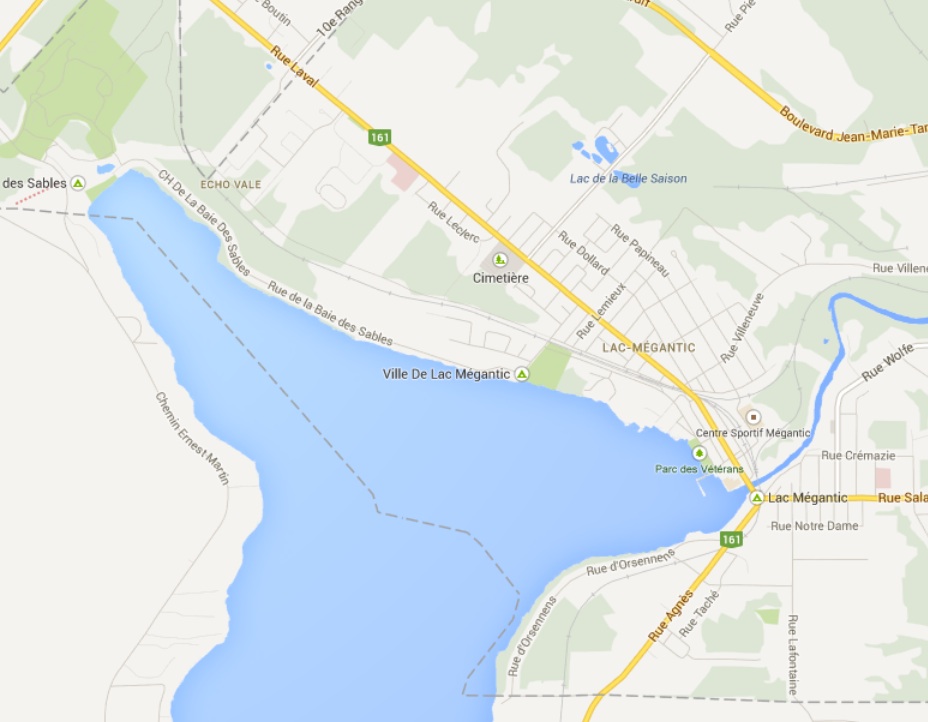
lac-meganticWe came to the Mégantic area from the east, and actually slightly north, having visited Saint-Georges. Traveling on back roads we reached the village of Nantes, at a small elevation and a few miles from Lac Mégantic.

From there we descended into to the beautiful lakeside town of Lac-Mégantic, following the little used rail line along Rue Laval. We walked for a while around the town and in the parc des Vétérans. If we had not had a B&B reservation, we might have stayed longer to enjoy the lake and the small town atmosphere, which fit so well with what we knew about the peace with nature in that region. But unlike so many who have suffered there, we were fortunate to be away when disaster struck.

On July 5, a Montreal, Maine and Atlantic Railway train engine near Nantes caught fire. That fire was extinguished and the train was left unattended, parked on the line. Hours later it rolled down the grade towards Lac-Mégantic, derailed, exploded, and turned the town into an inferno. There were soon photos of the physical destruction, but accounting for deaths has been slow due to the extreme destruction.

The cost of cheap energy

Aujourd’hui, nous sommes tous des citoyens de Lac-Mégantic.

The story has moved to the back pages of US media, even as the death toll has risen to 38, with many still unaccounted for. As awful as some more publicized recent bombings, explosions, fires, plane crashes, etc. in North America have been, this disaster is already more deadly than all of those combined.

Lac-Mégantic explosionOf course, the tragedy might not have affected me so much if I hadn’t felt some kinship with the area. But it has made me both sad and angry. It’s impossible to imagine how people can cope with the loss of loved ones and the destruction of their town.

I’m glad that people are asking questions, starting with some basic ones such as: Why was a train with 70 full tanker cars left unattended? and Why weren’t the brakes set?

It’s good that some are moving on to bigger questions: Why do Canada and the US still carry 70% of oil using a tanker car design that was deemed unsafe over 20 years ago? Why is it allowed to send dangerous cargo on regional (Class II) rail networks, which have fewer safety mechanisms and less thorough safety checks?

Maine lawmakers noted recently that “in the last year alone, crude oil shipments have increased fifteen times over” and “there have been three derailments of trains carrying hazardous materials in Maine just during the last six months.”

For some people, the answer to all of these questions is to build more pipelines, which destroy the environment more when they rupture, but may kill fewer people directly. The rail disaster will also give support to defenders of nuclear power, e.g., the aging Pilgrim, Mass. plant that uses the same design as the Fukishima reactor and strangles any possible escape route from Cape Cod. Others might call for renewable energy, which still needs to be transported at great environmental cost.

I wish that there were a moment when we might ask: Why must we design our society around cheap energy? Must every politician in every party declare that cheap gasoline is their first priority? Would it be so awful to minimize the loss of life and environment, and possibly even lessen the imperative for war? Is “cost” only what we see on a bill for goods and services?

Could we reduce energy use so that areas such as Mégantic could remain unspoiled, or at least less spoiled? And that no Lac-Mégantic would ever experience such a disaster again?

Citizen Science in Wellfleet

Herring River estuary

Herring River estuary

The current habitat for communication between science and the public is dysfunctional. One need only look at the “debates” about climate change or disease prevention to see the problem.

Scientific findings are regularly misrepresented and sensationalized in the mass and social media. Even when well presented, those findings are ignored or distorted, attacked through faulty arguments, or tied to unsupported inferences. At its best, current science/public dialogue tends to be one-way, with the occasional enlightening article, book, or video, followed by public commentary. This rarely serves to deepen  understanding, much less lead to enhanced inquiry.

State of Wellfleet Harbor Conference 
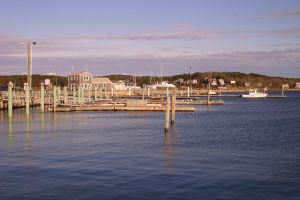
Wellfleet marina

Wellfleet marina, note osprey nest, upper left

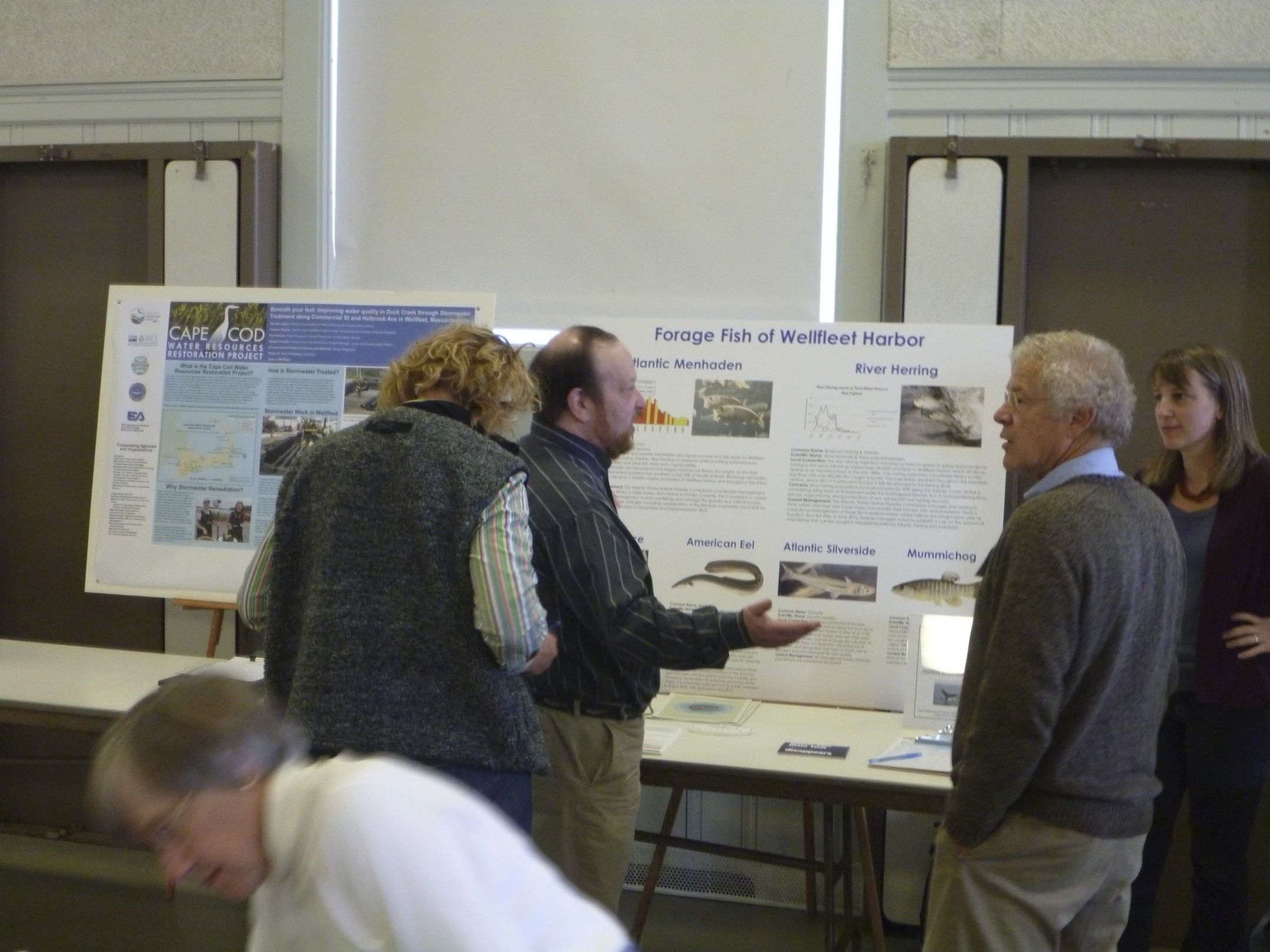
The 10th Annual State of Wellfleet Harbor Conference held yesterday at the Wellfleet Elementary School represents an alternative to that typical dysfunctional science/public relationship. One refreshing note was an effort by scientists to explain not only the results, but also the assumptions, methods, and theories behind them. People asked about the selection of factors to study, or about habitat assessment in tidal river versus bay sites, not to discredit a finding, but to understand more about how results were achieved. The conference was itself a small data point for the case that ordinary citizens can engage in science-based discussions, given enough time and well-crafted presentations, displays, videos, and other materials.
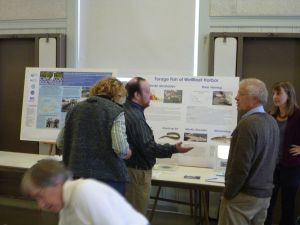
Poster session

Poster session

You can see from the schedule that there was a wide variety of presentations and posters. There was talk about dolphin mass strandings, bathymetry, auditory evoked potential, sentinel species, estuaries, cross-shore sediment transport, salt marsh backup, turtle gardens, terrapin clutches, brumation, eutrophication, cultching, winter/spring blooms, quahog seed, anoxic shellfish, temperature-dependent sex determination, anthropogenic effects, and many other topics related to the diverse ecosystems of the Outer Cape.

There were some good videos from the Friends of Herring River and the International Fund for Animal Welfare (IFAW). Brian Sharp complemented the latter with a talk and a tour of the IFAW van used for marine mammal rescues. This was especially salient given the mass strandings of dolphins in Wellfleet Bay in the early part of the year.
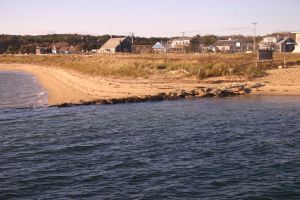
Mayo Beach, with groin

Mayo Beach, with groin

These presentations emphasized the interconnectedness of ecosystems, with humans as an integral part. Mark Borrelli from the Provincetown Center for Coastal Studies talked about how groins and revetments prevent local beach erosion, e.g., to protect a house, but shift the erosion elsewhere. Thus, they are simply “erosion relocation structures.” Sarah Martinez from the Mass Audubon Wellfleet Bay Wildlife Sanctuary presented a poster on the consequences for horseshoe crabs of their use as bait for conch and eels. Moreover, the revetments that relocate beach erosion also disturb the spawning, much of which occurs above the high tide mark.Vincent Malkoski from the Massachusetts Division of Marine Fisheries spoke about the data on horseshoe crab fisheries. These findings have led to harvesting closures for five days around the new and full moons in May and June to allow lunar spawning. Diane Murphy from the Cape Cod Cooperative Extension and Woods Hole Sea Grant spoke on the relation between oyster and clam growth and the wide variety of habitats they find in Cape Cod Bay.

Avoiding Either/Or Thinking 
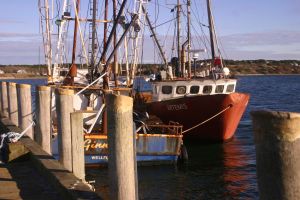
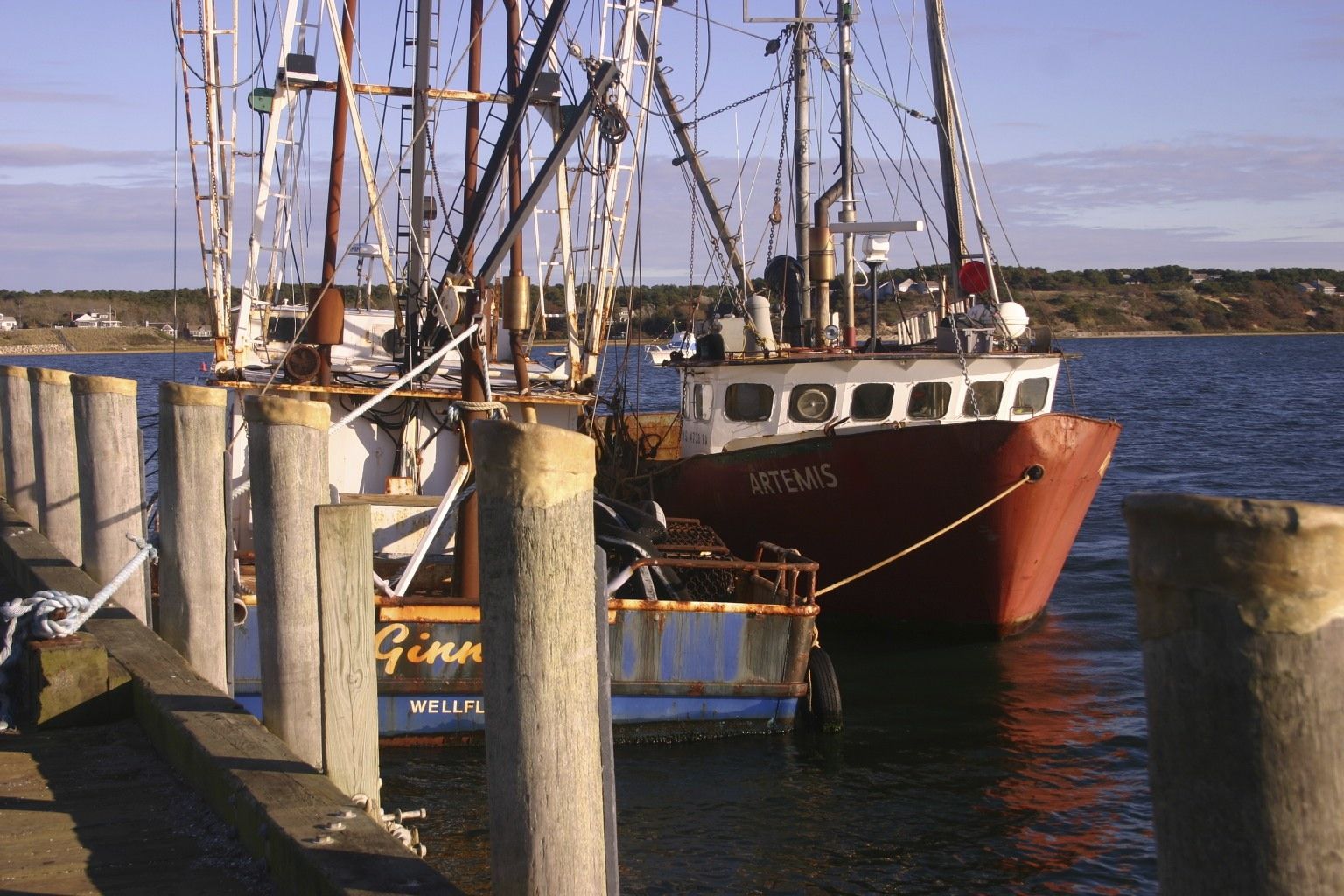
Fishing boats

Fishing boats

One consequence of creating the forum in this way was that discussions avoided the either/or kind of thinking often expressed in mainstream media. For example, although most of the participants shared deep commitments to preserving natural environments and generally opposed rampant development, I heard statements such as “you can’t say that dredging is always bad or good; the decision is about choices and values.” There would then be productive dialogue that critiqued human-made alterations of the shoreline, estuaries, ponds, and so on, but acknowledged values others might hold for commerce, recreation, or housing. Zero-based planning  is no longer an option in the Wellfleet area: Every change today, even one that seeks to undo earlier construction, interacts with a myriad of alterations over centuries and can have unintended consequences for the environment.
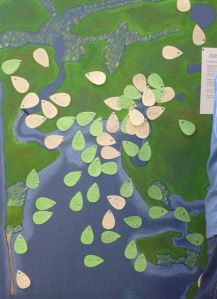
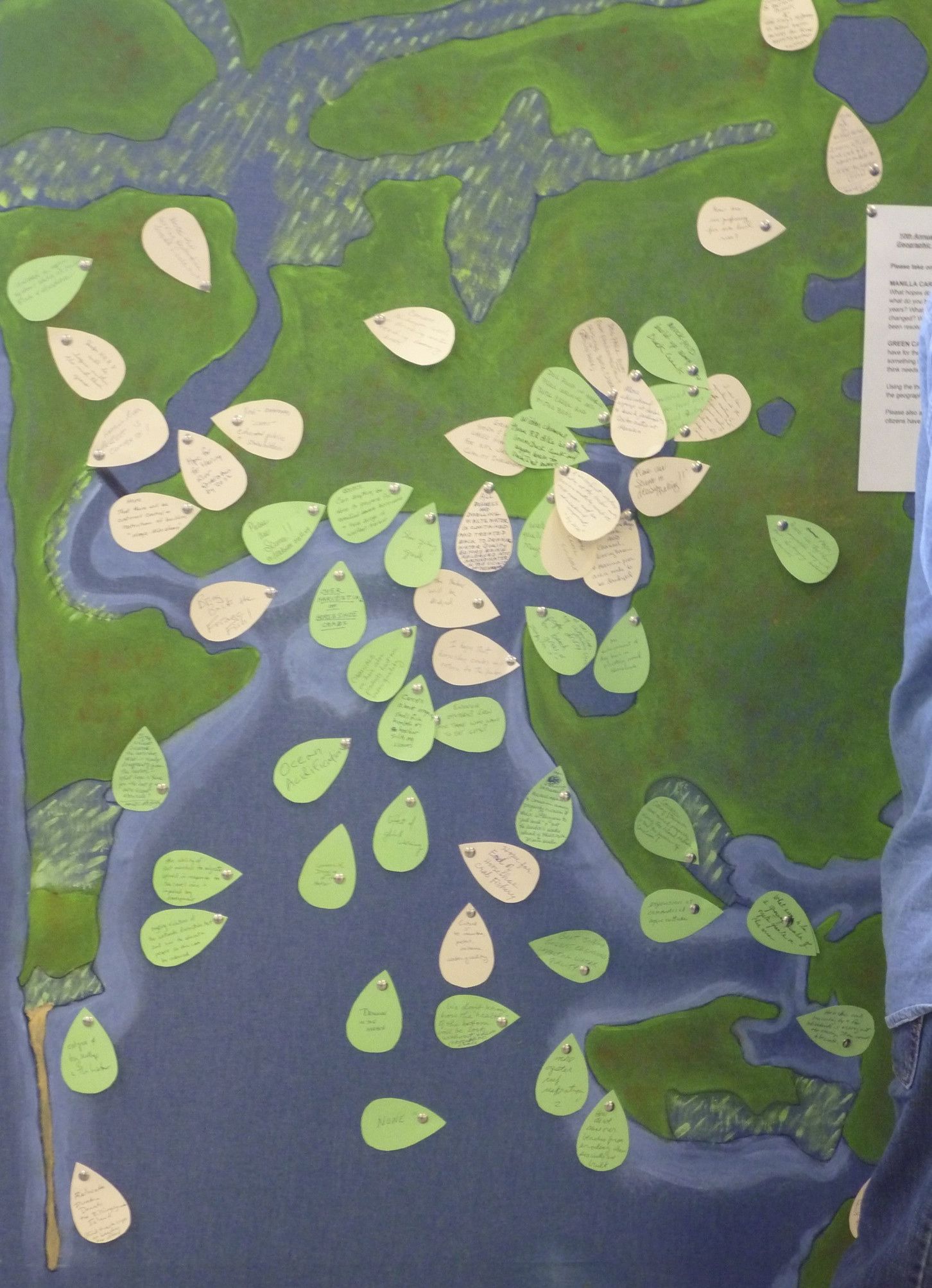
Interactive map

Interactive map

Multilogue

Through Q/A, posters, and ample time for informal discussion, the conference fostered one to many, many to one, and many to many conversations among participants including scientists in the same and other disciplines, students, and general public. There was an interactive map on which people could write their hopes and concerns and peg them to a geographic spot. The map activity will be continued at the library to solicit input from those who did not attend the conference. I saw numerous examples of scientists taking seriously the concerns or knowledge of the public.

This was perhaps enhanced by the fact that many of the projects involve direct citizen science participation , e.g., the river herring count, the horseshoe crab spawning assessment, terrapin sightings, and the dolphin rescues. Others involve coordination with local activist organizations, such as the Wellfleet Conservation Trust.

Some were of special relevance to those involved in commerce, such as oyster farmers. Jessica Smith and Barbara Brennessel from Wheaton College had an interesting poster on a study of genetic diversity among hatchery versus reef oysters, showing, as one might expect, a greater diversity for the reef oysters. This provides indirect support for seeding oyster beds with pelagic, rather than hatchery, veligers. Some oyster farmers still collect these wild larvae for seeing their beds, despite the method being considered slower, difficult, and old-fashioned. A quahog farmer of 30 years was able to add comments about changes over three decades that was missing from most of the shorter-term scientific studies.

Sustainability
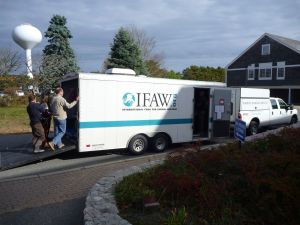
IFAW van

IFAW van

Perhaps a meeting like this requires a supportive habitat such as Wellfleet in order to thrive, just as the terrapins, horseshoe crabs, eels, dolphins, ospreys, and other creatures do. Would it fail to survive elsewhere?

Richard Lewontin points out in The Triple Helix that no organism can survive without a supportive environment, but also that no living environment exists without organisms. In this case, the conference organism succeeds because of the town environment, but also shapes it to become more supportive of exactly the kind of discussion heard today.

The conference was well-organized with good snacks, including clam chowder. I came away with a renewed appreciation for the special beauty of Wellfleet, but also sadness about what we’ve done to destroy this, and so much else of the natural world. The fact that a conference such as this is so rare punctuates that sadness. How much did you hear from political candidates or mass media this year about protecting the environment we all live in and depend upon?

Small but good things are worth preserving. I hope to make the conference an annual event.

Green oats in June

An Irish day on Cape Cod: It began with a 5K walking race along Nantucket Sound in South Yarmouth (Cape Cod Irish Village Road Race). At the conclusion of the race we enjoyed Irish music at the Irish Village. Unfortunately, any loss to our waistlines from the race was fully counteracted by hamburgers and pints of stout.

The day ended with listening to Celtic Sojourn on WGBH. That program featured a beautiful poem by Patrick Kavanagh, which is appropriate for Mother’s Day, or for remembrance on any loved one.

But I don’t read the poem as being only about remembrance; it’s more about valuing the “earthiest” aspects of all our daily interactions–walking “together through the shops and stalls and markets” or among the “green oats in June.” Kavanagh reads the poem in the video below.

When we lived in Dublin in 2007-08, I remember walking many times along the beautiful Grand Canal, which was near our apartment. You can see a statue of Kavanagh there (“The Crank on the Bank”). It’s also shown in the slide show and below.

The bronze Kavanagh is sitting on a bench as the flesh and blood one once did. It was inspired by his “Lines written on a Seat on the Grand Canal, Dublin”:

O commemorate me where there is water
canal water preferably, so stilly
greeny at the heart of summer. Brother
commemorate me thus beautifully.

If you were to visit Dublin, I recommend sitting beside him to contemplate the people walking by, the ever-present swans, and the stilly, greeny water.

Patrick Kavanagh, Royal Canal

Patrick Kavanagh, Royal Canal

In Memory of My Mother

by Patrick Kavanagh

I do not think of you lying in the wet clay
Of a Monaghan graveyard; I see
You walking down a lane among the poplars
On your way to the station, or happily

Going to second Mass on a summer Sunday–
You meet me and you say:
‘Don’t forget to see about the cattle–‘
Among your earthiest words the angels stray.

And I think of you walking along a headland
Of green oats in June,
So full of repose, so rich with life–
And I see us meeting at the end of a town

On a fair day by accident, after
The bargains are all made and we can walk
Together through the shops and stalls and markets
Free in the oriental streets of thought.

O you are not lying in the wet clay,
For it is harvest evening now and we
Are piling up the ricks against the moonlight
And you smile up at us — eternally.

A house concert with RUNA

Moving to Wellfleet, I wondered whether I’d be trading cultural life for nature. With the National Seashore, ocean and bayside beaches, 17 ponds in Wellfleet alone, walking and biking trails, forest and dunes, I was prepared to make that trade, assuming that we’d seek out music, art, and so on, in Boston or other places. But the reality has been the opposite. Yes, the natural world feels especially close at hand, but cultural events seem more, not less accessible.

I do miss the human diversity of the university or the large city, but there’s been more on that score than I expected. In terms of public events, we’ve been to many galleries and art shows, enjoyed the Saturday Tea and Music concerts in the Wellfleet Public Library, book talks, and just saw the Blind Boys of Alabama in the recently renovated Provincetown Town Hall.

About a week ago we attended a wonderful house concert by RUNA, a Celtic music group. They’re an international ensemble comprising vocalist Shannon Lambert-Ryan, guitarist Fionán de Barra, percussionist Cheryl Prashker, and fiddler Tomoko Omura. They play both traditional and more contemporary Celtic songs and instrumental pieces from Ireland, Scotland, Canada, and the US.

The performances were excellent. I especially enjoyed the traditional songs, but some of the more recently composed ones, too. The video here is not from the concert we attended, but we did hear Fionnghuala there.

Almost counting herring

Black Pond, Wellfleet

Black Pond, Wellfleet

Because of the warm winter on Cape Cod this winter, the alewives are returning early to the local rivers. Alewives are a type of herring. They’re anadromous, meaning that they live in the ocean, but swim up freshwater streams to spawn.

Their population is declining in New England, so the River Herring Network organizes herring wardens and volunteers (called “monitors”) to assess their numbers during the spring run. The counts go on for two months, with volunteers assigned specific times each week to count.

field test kit

field test kit

Locally, the count is connected with efforts by the Friends of Herring River to restore that river to something akin to its condition before the Chequessett Neck Road Dike was installed and the surrounding wetlands were developed.

Susan got the official training for the count, so she’s the real Monitor, but I went along as a volunteer for the volunteer. I guess you could say that I was an Unofficial Herring River Estuary Alewife Monitor Assistant (UHREAMA).

water temperature

water temperature

We decided to cycle to the site for our first scheduled count. It’s only a half hour away, but has some good hills and soft sand paths to make the cycling interesting. We passed Black Pond and a friend’s house on the way. You can these and other photos at photos from the count.

The official count site is at a beautiful bend in the tiny Herring River, with a fallen willow marking the spot and serving as a convenient shelf for the field test kit. Byu the way, there are many Herring Rivers. This is the one in Wellfleet.

Here’s the data for our first foray:

  • Time: 9:07- 9:17 am
  • Air temperature 12 ºC
  • Water temperature: 13 ºC

Unfortunately, the number that matters most is this one:

  • Number of herring: 0

Somewhere else, this bridge over the Herring River would be seen as in need of a little repair, but here, it’s just a reminder of the alliance between culture and nature in the National Seashore area. That alliance isn’t without its problems, as we can see in the decline of the Herring River and its herring, but at least there’s an effort to try to make it work.

Searching for trolls in Skurugata

It is generally understood that Trolls, when their territory is encroached upon by mankind, withdraw to some more secluded place. So when Eksjo was built, those that dwelt in that vicinity moved to Skurugata, a defile between two high mountains whose perpendicular sides rise so near to each other as to leave the bottom in continual semi-darkness and gloom (Hofberg, 1890).

It’s also generally understood that humans venture into the lair of trolls at their peril, and wise ones know not to walk defenseless into bottomlands of “continual semi-darkness and gloom.” But we knew of the troll ways and were not about to follow the path that the hunter Pelle Katt did in Hofberg’s fairy tale.

A Swedish friend asked why we were going to Småland, as if searching for relatives were the only thing to do there. We’ve learned there is much more, including visiting 12th century Romanesque churches and meeting local people over coffee afterwards, exploring lush forests with gorgeous lakes, taking walks in well-designed parklands, looking at quaint, red wooden farmhouses, and walking through villages with winding, cobblestone streets. But we were intrigued by the descriptions of Skurugata, which seemed of a different order of things.

Skurugata is about 13 km NE of Eksjö. To get there, we drove past lovely little farms with red houses and barns, cows, and piles of logs from the abundant woods.

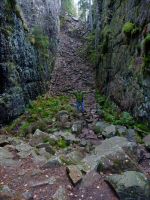
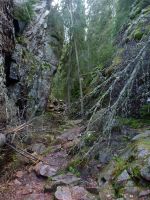
The walk to Skurugata itself started off simply enough, a winding path through the woods, with moss-covered rocks and ferns. But it soon descended into a narrow ravine, with straight granite sides. At times, there was little more than 20 feet separating the sides, which rose to 50 feet and more. The walking was a bit tricky, since the rocks were moss-covered and slick from rain. There was also some climbing and descending that benefitted from the use of hands.

It was easy to imagine getting a foot caught in a crevice or losing one’s balance on an unstable stone. But the most dangerous part was neither the trolls nor the rocks, but the sheer beauty that made it hard to focus on walking carefully. The camera was shock-proof, but not my head.

Hofberg’s tale made me more sympathetic to trolls than I’d been before. Being forced out of one’s home is never good, even if it’s to a place as beautiful as Skurugata. He relates that every year a whole battalion of Småland grenadiers would march through Skurugata, beating drums and blowing horns, and occasionally firing volleys. Who knows how the poor trolls suffered through that! And Pelle Katt was no saint either.

We tried not to add to the troll’s’ misery, although we did intrude on what seems like a sacred space and took pictures that only hint at its beauty.

[Double-click on any photo to enlarge it.]

References

Hofberg, Herman (1890).  Swedish fairy tales. Chicago: Belford-Clarke.

Train blogging

I’m typing this while riding on the X 2000, SJ´s electric train, travelling quietly at up to 200 km/h (125 mph). We just had a delicious meal, including “easy beer” and surprisingly good coffee.

Thanks to the SJ site for the photos, which represent very well what we’re seeing, both outside and inside the train, except that the train is full.

Our journey to Göteborg will take less than 3 hours for the 398 km, exactly on the schedule. It’s a beautiful, modern train, with comfortable seats, good leg room, sockets for radio and music, electric power outlets, and full access to fast wifi, which makes this post possible.

SJ stands for Statens järnvägars, as explained on the SJ website:

Soon it will have been 150 years since the first train from Statens järnvägars (SJ) departed from Gothenburg central station. On arrival ecstatic passengers could testify to how they had ”been thrown forward” at 30 kilometres an hour.

Our fellow passenger across the aisle explained that this is not the best time to visit Sweden, but I have to differ. The weather is great for walking, and on this train journey, we’re seeing quaint old farmhouses, interesting little towns, spruce forests, birch tree stands, and occasionally, glorious fall foliage.

Islamic Science and Technology Historical Museum

Yalikavak, Turkey

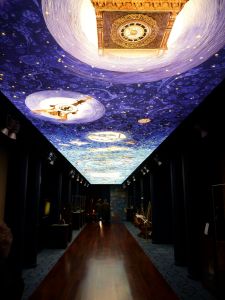
Our last stop in Istanbul was at the İstanbul Islâm Bilim ve Teknologi Tarihi Müzesi (Museum for the History of Science and Technology in Islam) in the Eminönü district. It’s a wonderful museum, displaying centuries of achievements in geography, navigation, astronomy, mathematics, music, optics, chemistry, chronometry, historiography, medicine, military, civil engineering, and other disciplines.

I was told in school that the period when most of these discoveries and creations occurred (9th-16th century CE) was called the Dark Ages, a time of fear, superstition, lack of progress, even regression from the Classical era. Then the Classical learning was miraculously rediscovered and expanded during the Renaissance. And of course, like many things I learned in school, it was partly true.

But the fact is that while great scientific and technical accomplishments were happening in the Islamic world, much of Christian Europe languished in these areas, not completely, but to a large extent in comparison. Islamic scholars maintained and extended the Classical learning, and incorporated additional ideas from Greek, Byzantine, Indian, Judaic, and other traditions. They not only advanced learning considerably, but did so by listening to and learning from other cultures.

Long before Roger Bacon, they articulated and promoted experimental science, and they wrote about inductive or scientific methods long before Francis Bacon. They studied the circulation of blood before William Harvey, and made many other medical advances. But the exhibits do not take a “who did it first?” approach; instead, they emphasize the continuity of learning, across time and across cultures.

The Ages were not Dark everywhere, and the Renaissance in Europe was not autonomous; it was dependent upon and grew organically from an Islamic culture that valued learning in all its forms.

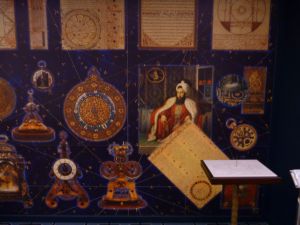
The Museum displays fascinating astrolabes, glassware, maps, globes, medical instruments, ships, an elephant clock, and many other artifacts. I’ve never seen such an assemblage anywhere, and these are beautifully presented and explained with multilingual text and video. Scientists, mathematicians and other scholars, such as Muhammad ibn Mūsā al-Khwārizmī, Ibn Sena (Avicenna), Geber, Al-Jazari are featured.

That’s why it was both surprising and a bit depressing to see how few people came to the exhibits. I counted five total visitors during the entire time that we were there, Make that seven if I include Susan and me. There were about fifteen staff and guards. Of course, it’s been open only two years.

İstanbul offers tough competition for any museum. World Heritage sites like the Topkapi Palace nearby, the Sultanahmet Cami (Blue Mosque), and Hagia Sophia are just a few of those within easy walking distance, each offering jaw-dropping sights. But those also offer long lines and crowded viewing. It’s difficult to fully appreciate the Topkapi dagger while being shoved along in a crowd. The Museum for the History of Science and Technology in Islam offers a different and equally important view of Islamic culture, one that I suspect is not well known by many within or outside of Islam,

The Museum is housed in the Has Ahırlar (Imperial Stables) complex now in Gülhane Park. This area was once the outer garden for the Topkapı Palace during the days of the Ottoman Empire.

The working instruments and other objects were constructed by the Institute for the History of Arabic-Islamic Science at the Johann Wolfgang Goethe University, Frankfurt, based on illustrations and descriptions in textual sources, and to some extent, on surviving original artifacts. There is a similar exhibit there under the direction of Fuat Sezgin. The İstanbul museum is a joint project of the Ministry of Culture and Tourism, the Scientific and Technological Research Council of Turkey (TÜBİTAK), the Turkish Academy of Sciences (TÜBA), the İstanbul Metropolitan Municipality, and Goethe University.