
 In the early 1980’s, the Quill in Alaska project was a great adventure in learning about stories, writing, computers, classrooms, Alaska village life, bush travel, and much more. Although the temperatures were often -20˚F or below, stories from that time are burned deep in my brain. I learned that stories relate our lives, but that they also shape our lives, and create endless stories to follow.
 One involved a kind of networking that shows the value of being there, even in our time of electronic communications. As I recall, on a cold, snowy day in March, I had boarded a De Havilland Beaver, similar to the one shown above, to fly from Chevak to Bethel, at the head of Kuskokwim Bay. I may have been the only passenger for that short nonstop flight.
Shortly after takeoff, the pilot announced that we’d be making an unscheduled stop to pick up passengers in Scammon Bay, a village on a point jutting out into the Bering Sea. The propellers had scarcely stopped spinning when a young couple boarded. We started talking. I shared some stories about my travels to small villages around Alaska and they told me why they were flying to Bethel. They had just married, and were on their honeymoon to the big city (pop. 3000).
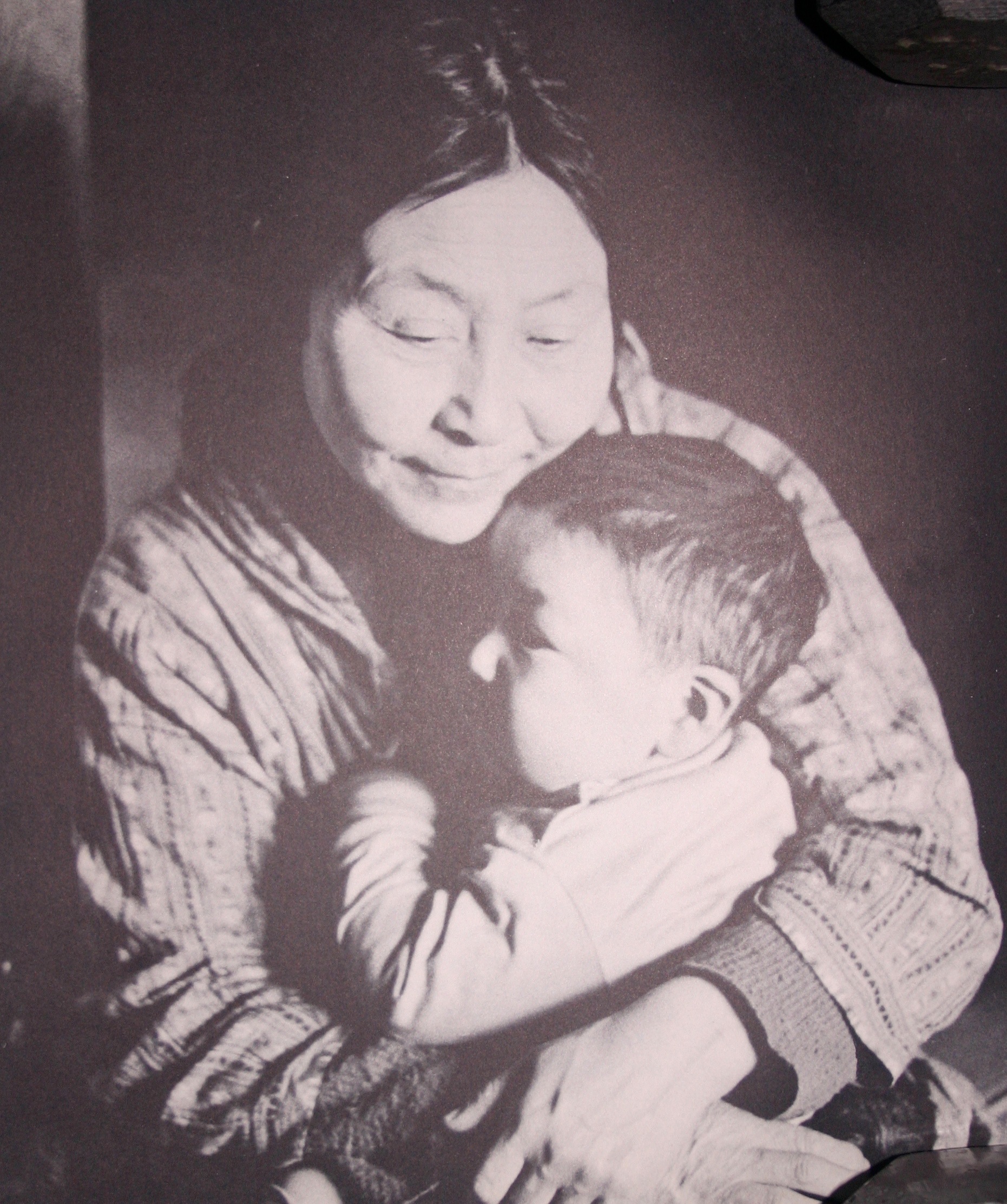 I asked them whether they knew of Aylette Jenness. She’s a writer of children’s books, photographer, and anthropologist, and more, a good personal friend. In the 1960’s Aylette had lived in Alaska in their very village for a year and a half. Based on her experiences there, she wrote a wonderful book, Dwellers of the Tundra: Life in an Alaskan Eskimo Village, with beautiful photos by Jonathan Jenness.
They were too young to have met Aylette, but they knew of her, and they cherished the book she wrote about their village. The young man asked me whether I remembered a photo of a woman in the book holding a young child. I said yes, it was one of my favorites in the book. He then stunned me by saying: “That woman is my mother, and that baby is me.”
 We talked the rest of the flight. When I returned to Cambridge, the first thing I had to do was to tell Aylette that story, about how the characters in her book had a continuing life and were now old enough to get married and fly to Bethel. She was fascinated and immediately said: “I have to go back!”
She soon returned to their village, one generation, and more than 20 years later. Being the writer and photographer she is, wrote a second book: In Two Worlds: A Yu’pik Eskimo Family (1989).
 This time, the book was co-authored, with Alice Rivers, a Scammon Bay resident, shown on the left here with Aylette on the right. The change in authorship reflects both changes in the way we write about others and Aylette’s own deepening connection with the people there.
The title reflects changes, too. It uses the name Scammon Bay residents themselves use, Yu’pik, not just a broad category, like Eskimo, and everyone is more conscious of living in multiple worlds. The people and Scammon Bay are now identified by name. The books make vivid for me my time in Alaska, even though my stay in Scammon Bay itself was probably just 15 minutes.
And the photos are now by Aylette. They’re sharper than in the first book, less dreamy and more reflective of the many facets of life in modern, yet still traditional, Alaskan villages—the two worlds.
It’s now been another generation, and time for more stories and another Scammon Bay book. In the Introduction to In Two Worlds, Alice and Aylette ask: “maybe one of Alice’s daughters will write that one. Mattie? Sarah? How about it?”
I don’t think the books are still in print, but you can easily find good quality used copies online.
 Gesa Kirsch recently pointed me to John R. Stilgoe’s, Outside lies magic: Regaining history and awareness in everyday places. It’s a refreshing call for becoming more aware of the ordinary world around us. Stilgoe urges us not only to walk or cycle more, but also to use the advantages of those modes of transport to see the world that we usually ignore.
 The chapters—Beginnings, Lines, Mall, Strips, Interstate, Enclosures, Main Street, Stops, Endings—lie somewhere between prose poems, history lessons, and sermons about the everyday. They remind me of John McDermott’s summary that John Dewey “believed that ordinary experience is seeded with possibilities for surprises and possibilities for enhancement if we but allow it to bathe over us in its own terms” (1973/1981, p. x).
 He shows the value of a camera, despite the lament that “ordinary American landscape strikes almost no one as photogenic” (p. 179). He recognizes the dread of causal photography (‘why are you photographing that vacant lot?’), but ties it to “deepening ignorance” (p. 181). This ignorance makes asking directions dangerous: People question us back, ‘Why do you want to know?’
 The always controversial
  Recently, the Board has considered reviving the reputation of Senator Joseph McCarthy, to portray him as an American hero. They also debate the Biblical underpinnings of the nation’s founding, the superiority of America, and its divine ordination.
 Today is the 125th anniversary of the birth of Arthur Mitchell Ransome. He was an English author and journalist, who is best known for writing the Swallows and Amazons series of children’s books.
 Coot Club, the fifth book in the series, was published in 1934. BBC produced a
  HOUSEBOAT FOR RENT
 We came to know the boats of Coot Club: the Hullabaloo’s motorboat, the Teasel, the dinghy, and esepcially, the childrens’s pirate boat, the Death and Glory. The Death and Glory is described as “an old black ship’s boat, with a stumpy little mast and a black flag at the masthead.” It’s rowed with oars or propelled by a “grey, ragged, patched old lugsail, far too small for the boat.”
 Several years ago, I read Schopenhauer’s porcupines: Dilemmas of intimacy and the talking cure: Five stories of psychotherapy, by Deborah Anna Luepnitz.
 Schopenhauer presents his parables as telling us just how life is, but Luepnitz takes this one in a constructive way. She shows through five case studies how we all have simultaneous needs and fears for intimacy, thus creating a dilemma for full living. As she puts it (p. 19):
 Chip's journey