Tromboncini strombazzaree

The tromboncini have welcomed August with a fanfare. And now, they’re threatening to take over.

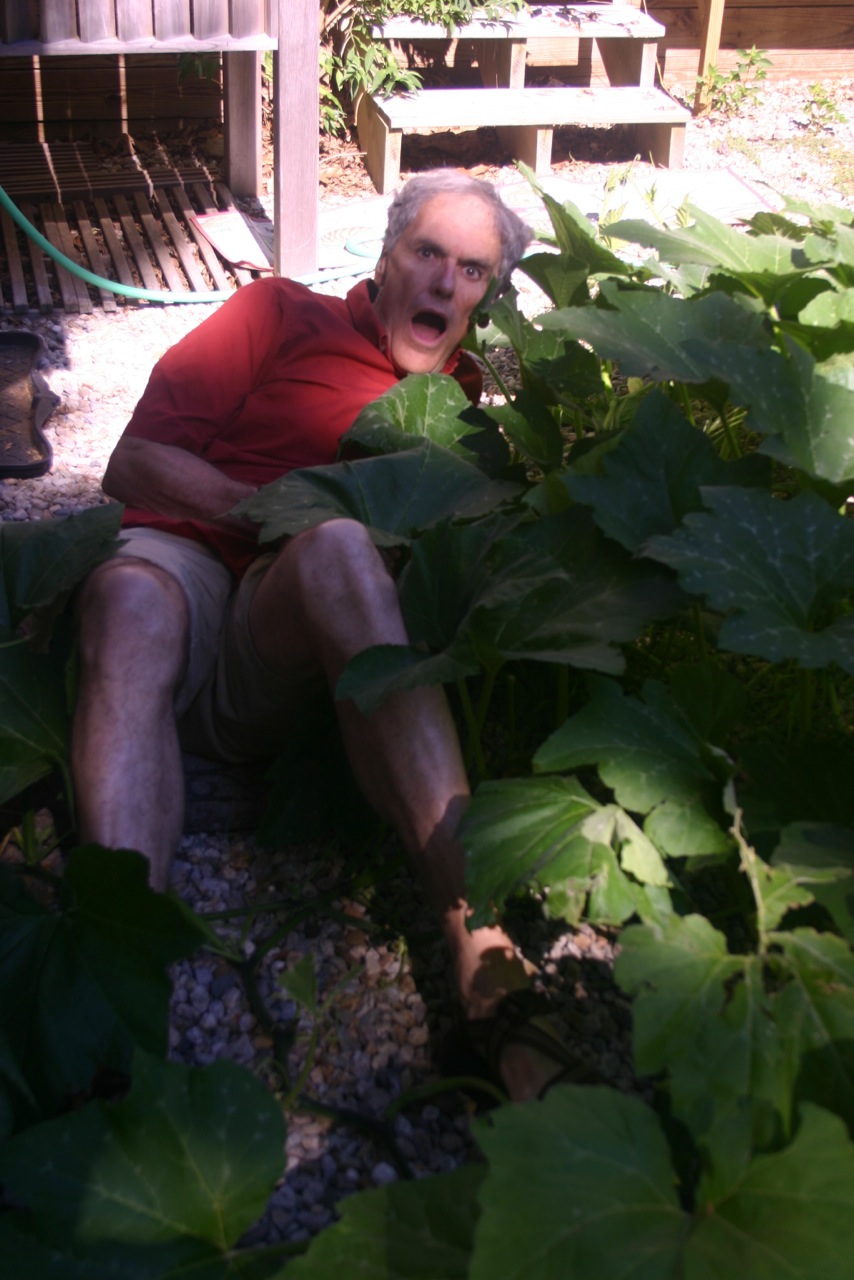
Invasion of the squash

Invasion of the squash

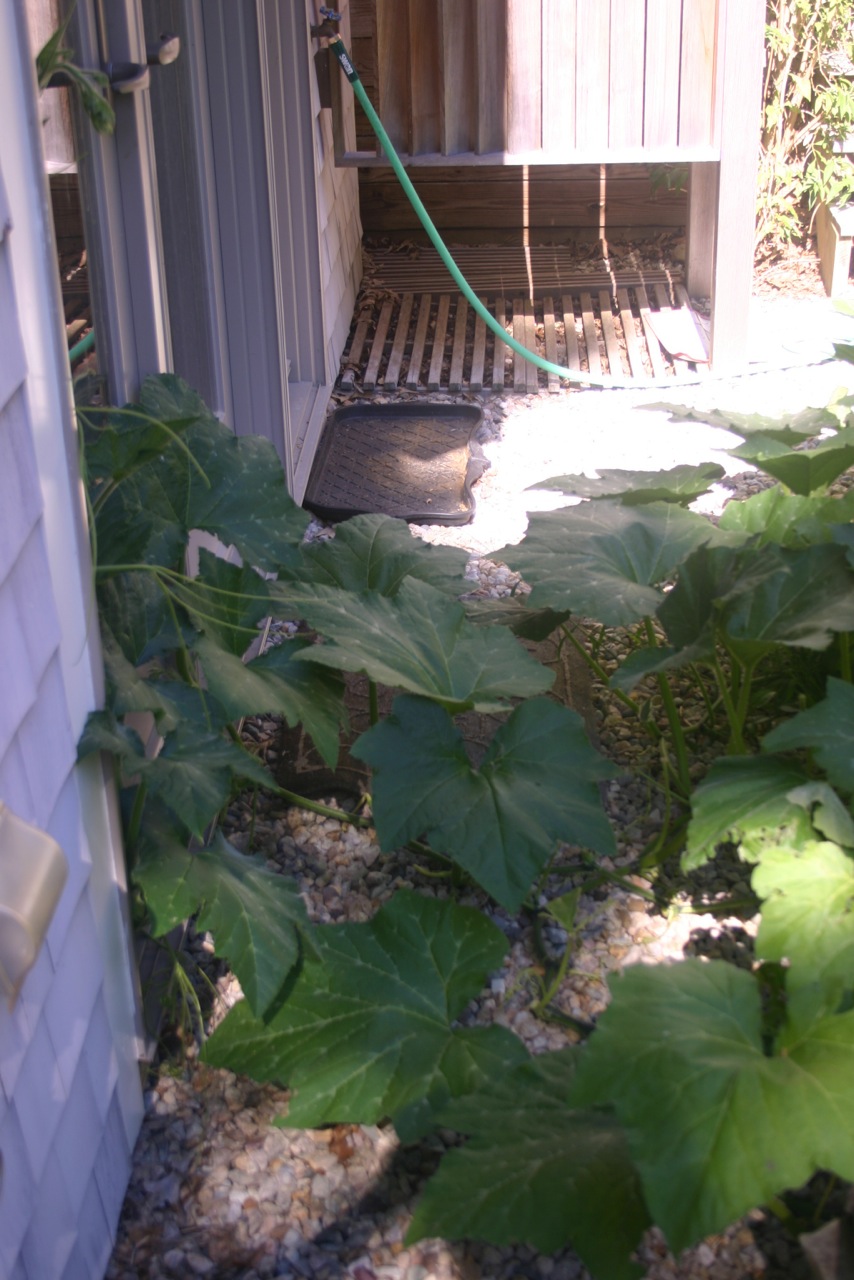
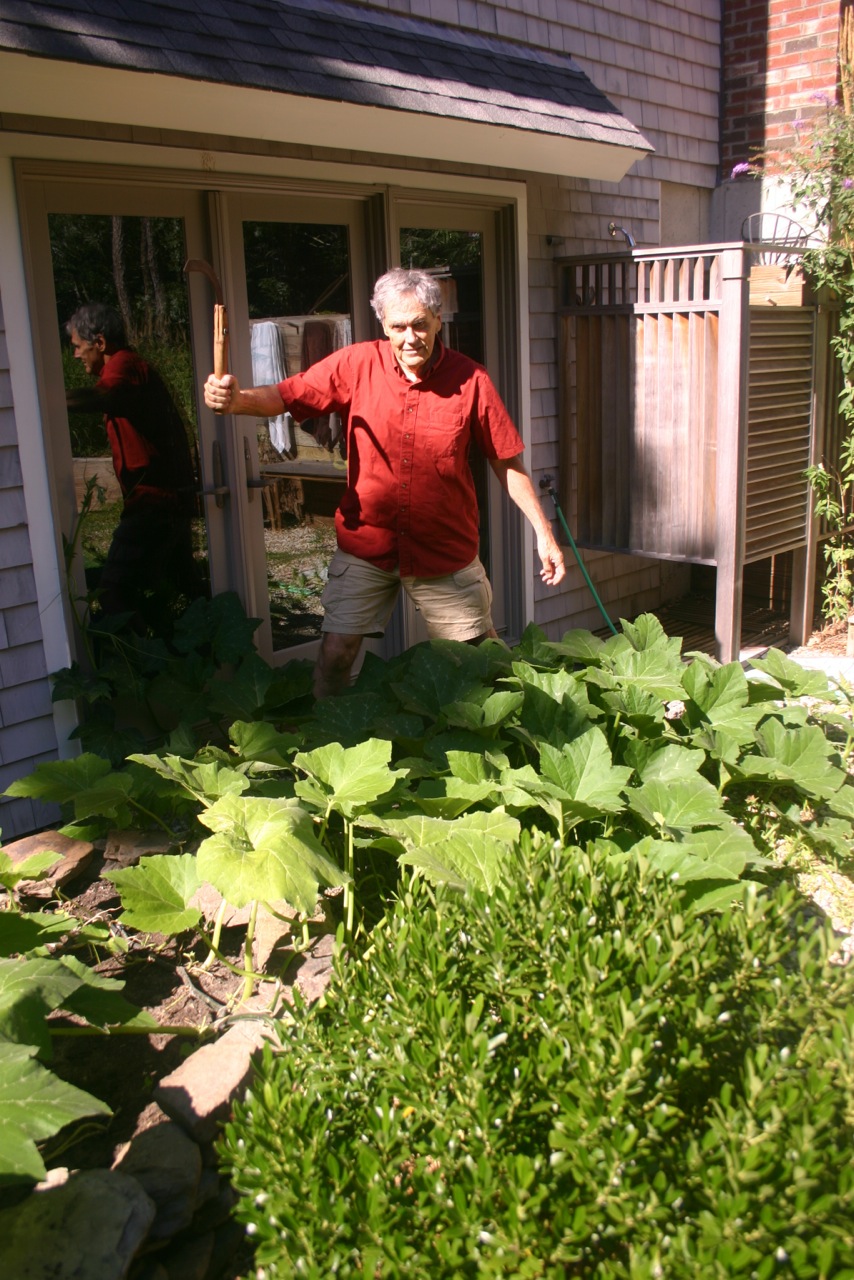
Thanks to starter plants from Daniel Dejean, we now have vines encroaching on our house.

Vines attacking house

Vines attacking house

But the fruits of the plant are delicious, tastier than zuchinni. They’re huge, enough to feed the army we’ll need to defend the house against the vines.

Squash love

Squash love

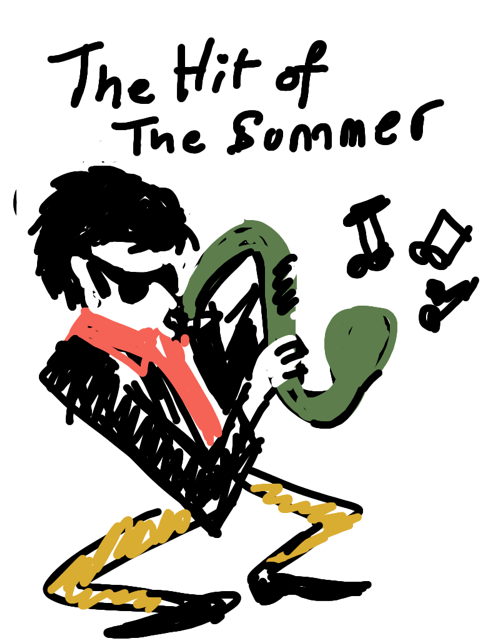
As Daniel says, and illustrates, it’s the “hit of the summer.”

Tromboncino and tomato

Tromboncino and tomato

The hit of the summer

The hit of the summer

Squash fashion, by Daniel Dejean

Squash fashion, by Daniel Dejean

Trombones become harps, by Daniel Dejean

Trombones become harps, by Daniel Dejean

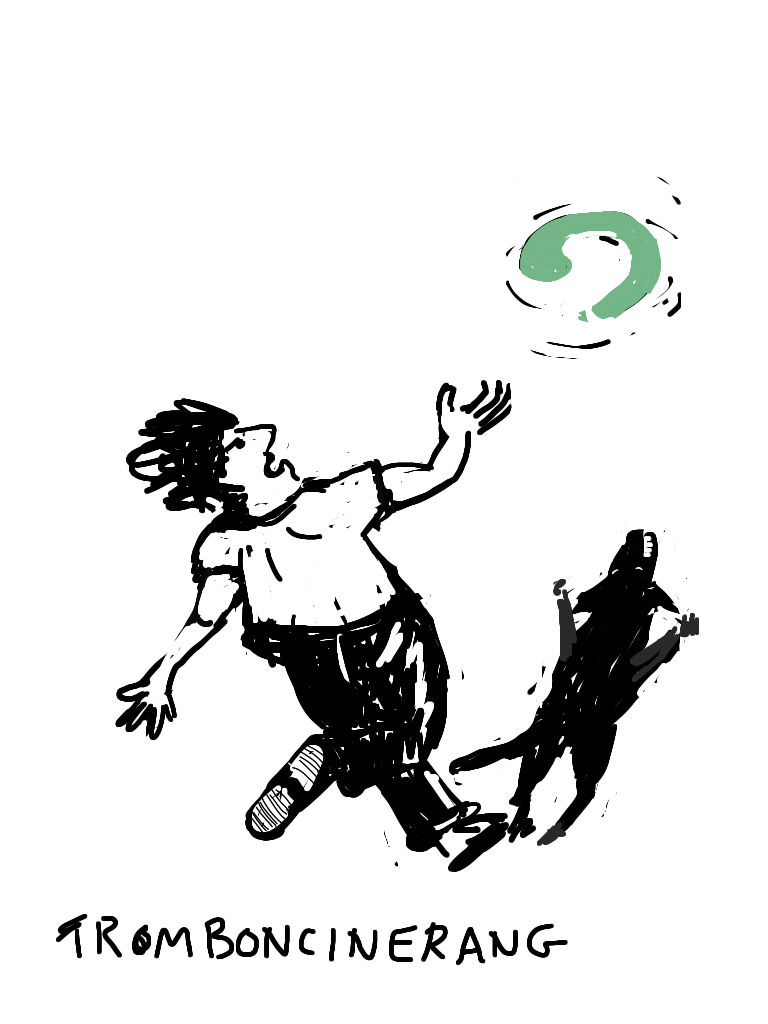
Tromboncinerang

Tromboncinerang

Tromboncino forest

Tromboncino forest

Is resistance futile?

Is resistance futile?

Lac-Mégantic: beauty and death

Tread softly because you tread on my dreams –W.B. Yeats

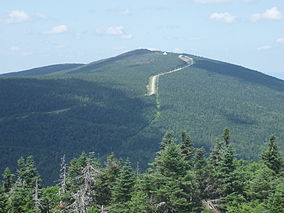
284px-Mont-Mégantic-2About six weeks ago, Susan and I canoed in Maine, then made a brief excursion into Québec.

Nature around Mont Mégantic

We planned to visit the area around Mont Mégantic, a monadnock about 15 km north of the border. It’s in the middle of the Parc national du Mont-Mégantic and is the terminus of the Sentiers Frontaliers, a hiking trail that connects with the Cohos Trail in the US, which runs north from Crawford Notch, NH to the border. The trail is in a beautiful area, and represents an even more beautiful cooperation among volunteers on both sides of the border, who are working to make ways to enjoy, but tread softly, in the forests and rivers.

Image 1The treasuring of the environment is even more evident there because the Mont Mégantic Observatory is the first site to be recognized as an International Dark-Sky Reserve. Lighting within a 50 km radius is strictly controlled to minimize the impact of artificial lighting on astral observations and on wildlife. Again, international cooperation will be needed to sustain the dark sky, but already a rare resource has been created in which both professionals and amateurs can enjoy seeing the Milky Way and know that at least in this one small region respect and love for nature prevails.

Down the grade into Lac-Mégantic

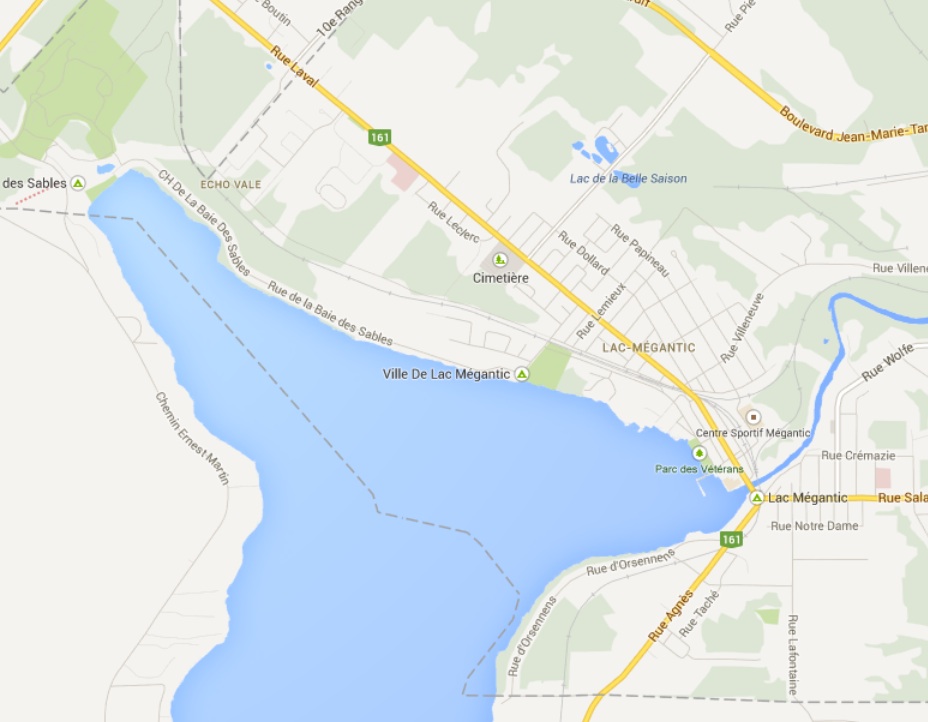
lac-meganticWe came to the Mégantic area from the east, and actually slightly north, having visited Saint-Georges. Traveling on back roads we reached the village of Nantes, at a small elevation and a few miles from Lac Mégantic.

From there we descended into to the beautiful lakeside town of Lac-Mégantic, following the little used rail line along Rue Laval. We walked for a while around the town and in the parc des Vétérans. If we had not had a B&B reservation, we might have stayed longer to enjoy the lake and the small town atmosphere, which fit so well with what we knew about the peace with nature in that region. But unlike so many who have suffered there, we were fortunate to be away when disaster struck.

On July 5, a Montreal, Maine and Atlantic Railway train engine near Nantes caught fire. That fire was extinguished and the train was left unattended, parked on the line. Hours later it rolled down the grade towards Lac-Mégantic, derailed, exploded, and turned the town into an inferno. There were soon photos of the physical destruction, but accounting for deaths has been slow due to the extreme destruction.

The cost of cheap energy

Aujourd’hui, nous sommes tous des citoyens de Lac-Mégantic.

The story has moved to the back pages of US media, even as the death toll has risen to 38, with many still unaccounted for. As awful as some more publicized recent bombings, explosions, fires, plane crashes, etc. in North America have been, this disaster is already more deadly than all of those combined.

Lac-Mégantic explosionOf course, the tragedy might not have affected me so much if I hadn’t felt some kinship with the area. But it has made me both sad and angry. It’s impossible to imagine how people can cope with the loss of loved ones and the destruction of their town.

I’m glad that people are asking questions, starting with some basic ones such as: Why was a train with 70 full tanker cars left unattended? and Why weren’t the brakes set?

It’s good that some are moving on to bigger questions: Why do Canada and the US still carry 70% of oil using a tanker car design that was deemed unsafe over 20 years ago? Why is it allowed to send dangerous cargo on regional (Class II) rail networks, which have fewer safety mechanisms and less thorough safety checks?

Maine lawmakers noted recently that “in the last year alone, crude oil shipments have increased fifteen times over” and “there have been three derailments of trains carrying hazardous materials in Maine just during the last six months.”

For some people, the answer to all of these questions is to build more pipelines, which destroy the environment more when they rupture, but may kill fewer people directly. The rail disaster will also give support to defenders of nuclear power, e.g., the aging Pilgrim, Mass. plant that uses the same design as the Fukishima reactor and strangles any possible escape route from Cape Cod. Others might call for renewable energy, which still needs to be transported at great environmental cost.

I wish that there were a moment when we might ask: Why must we design our society around cheap energy? Must every politician in every party declare that cheap gasoline is their first priority? Would it be so awful to minimize the loss of life and environment, and possibly even lessen the imperative for war? Is “cost” only what we see on a bill for goods and services?

Could we reduce energy use so that areas such as Mégantic could remain unspoiled, or at least less spoiled? And that no Lac-Mégantic would ever experience such a disaster again?

Summer clarinet and piano

Photos courtesy of Luz Zambrano

Photos courtesy of Luz Zambrano

Like the TARDIS, Wellfleet seems bigger on the inside. The array of activities seems impossible for a town its size.

Last night I saw that the array was not just in quantity, but in quality as well. Monika Woods on clarinet and Deborah Geithner on piano offered a concert worthy of any featured event in a major city. The full house, the standing ovation, and the encore were testament to the beautiful music.

coverIt is easy to understand why Monika was the first prize winner at the Cape Cod Symphony Orchestra Soloist competition this year. You can listen to one of her performances here.

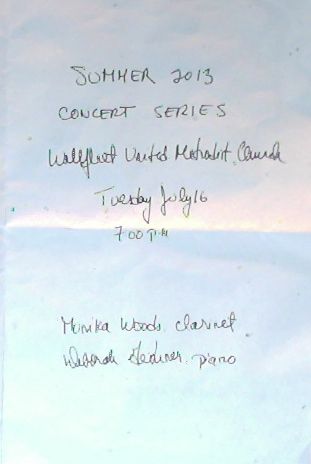
The programme yesterday evening featured Bach, Schumann, Saint-Saëns, Vaughn Williams, and Massenet. Every piece was a pleasure to hear, not something I’d say about many concerts. The feeling of a special event is enhanced by the fact that each attendee’s copy of the programme is individually penned, as is Deborah’s tradition.

The Saint-Saëns Clarinet Sonate in E-flat major, Op. 167, which he composed in his 86th and last year of life, was a highlight that elicited wows and bravos. The Allegretto first movement was especially ethereal and welcomed when its theme returns in the fourth movement. The piece as a whole was captivating.

The Sonate showed off the dialogue of clarinet and piano, as did Massenet’s Méditation from the opera Thaïs (Andante Religioso). That was another very moving selection. but it’s futile to make too much of any one piece, since every offering was excellent.programme

It was no surprise that the audience would demand an encore. The reward was Este a székelyeknél (Evening in the Village), by Béla Bartók. It’s a simple, lyrical piece, with two contrasting themes, which balance beautifully.

Drawing on elements from Transylvanian folk songs, Este a székelyeknél completed the evening’s theme of familiar, entrancing melodies, revealed by great composers and two great performers.

Monika Woods & Deborah Geithner

Monika Woods & Deborah Geithner

The concert was part of the Summer 2013 Concert Series at the Wellfleet United Methodist Church. This series has been a big plus for the community, drawing in people even while it’s still light enough for beach-going. The sanctuary last night was filled with nearly 100 concert goers.

Bow Trip

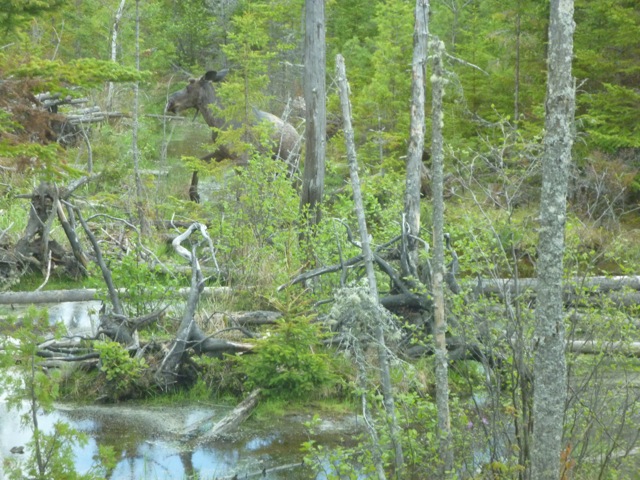
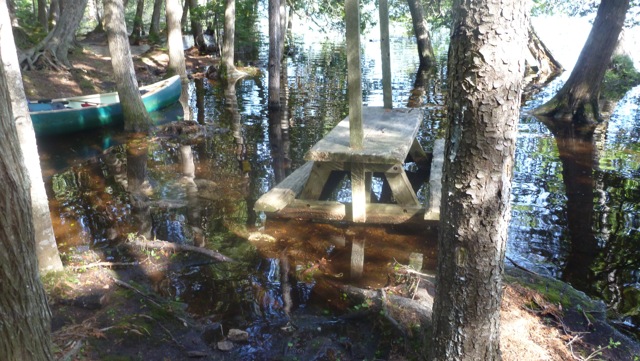
The Bow Trip, near Jackman, Maine, has to be near the top of any list of great canoe adventures. It’s usually completed in only three days, or just one without camping gear, but it packs in lakes dotted with islands, hidden bays, squiggly peninsulas, and watchful mountains, balsam fir forest with beech and birch tree stands, bogs, wildflower gardens, and giant boulders. There are loons, cormorants, moose, and bears. At this time, the white trillium is in bloom, along with many other wildflowers.Image

We just finished the circuit, starting from the outlet of the Moose River on Wood Pond, crossing Attean Pond, portaging to Holeb Pond, then down Holeb Stream to the Moose again, and back to Attean. A nice feature is that one can put in at various places and return to the starting point, in our case, a rustic cabin on Wood Pond.

The Bow Trip calls for flatwater river and lake paddling, rips and falls, lining, carries, eddy turns, and even sliding canoes down an incline or pushing under fallen trees. We had a scare when we rounded a turn under the one bridge, an old railroad trestle, to discover a downed power line. Parts of it were in the water, and it rose up to ensnare canoes.

Image

There are always surprises on a trip like this. We timed ours to be at the cusp of the transition from black fly to mosquito season, managing to have plenty of both. But they had to wait their turn behind the gnats and midges.Image

In our case, the big surprise was the high water. It made pull-outs and camping challenging. The portage trails looked more like streams than pathways. Our Tripper canoe has somehow gained weight over the years so that flipping it overhead while standing in muck and swatting flies seemed less fun than it once did. Because of the high water, we managed to run Camel Rips without noticing it and Attean Falls, which usually requires a carry.Image

We heard and saw birds everywhere. I unwound a little, floating down the lovely river, rediscovering muscles and bones I’d forgotten about. The clouds were a fantastic and ever-changing background to the lush Maine forest. The rips and falls were exhilarating. Image

The Bow Trip is a special treat, a highlight of the Northern Forest Canoe Trail. We were alone most of the way, seeing a friendly group from the Maine School of Science and Mathematics at a couple of points, but mostly enjoying alone a precious resource that some people know well, but most will never experience.

See additional photos from our Bow Trip.

Citizen Science in Wellfleet

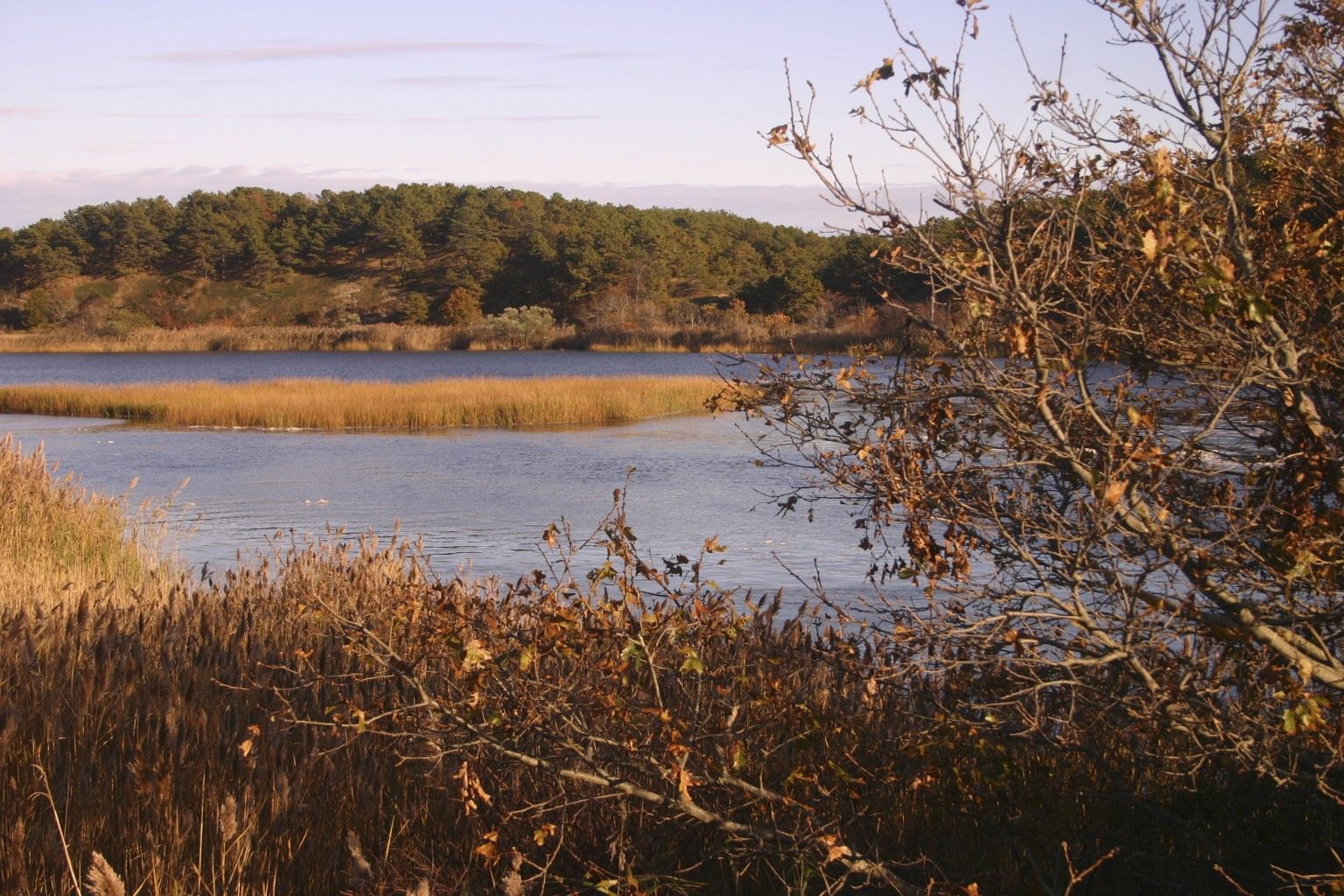
Herring River estuary

Herring River estuary

The current habitat for communication between science and the public is dysfunctional. One need only look at the “debates” about climate change or disease prevention to see the problem.

Scientific findings are regularly misrepresented and sensationalized in the mass and social media. Even when well presented, those findings are ignored or distorted, attacked through faulty arguments, or tied to unsupported inferences. At its best, current science/public dialogue tends to be one-way, with the occasional enlightening article, book, or video, followed by public commentary. This rarely serves to deepen  understanding, much less lead to enhanced inquiry.

State of Wellfleet Harbor Conference 

Wellfleet marina

Wellfleet marina, note osprey nest, upper left

The 10th Annual State of Wellfleet Harbor Conference held yesterday at the Wellfleet Elementary School represents an alternative to that typical dysfunctional science/public relationship. One refreshing note was an effort by scientists to explain not only the results, but also the assumptions, methods, and theories behind them. People asked about the selection of factors to study, or about habitat assessment in tidal river versus bay sites, not to discredit a finding, but to understand more about how results were achieved. The conference was itself a small data point for the case that ordinary citizens can engage in science-based discussions, given enough time and well-crafted presentations, displays, videos, and other materials.

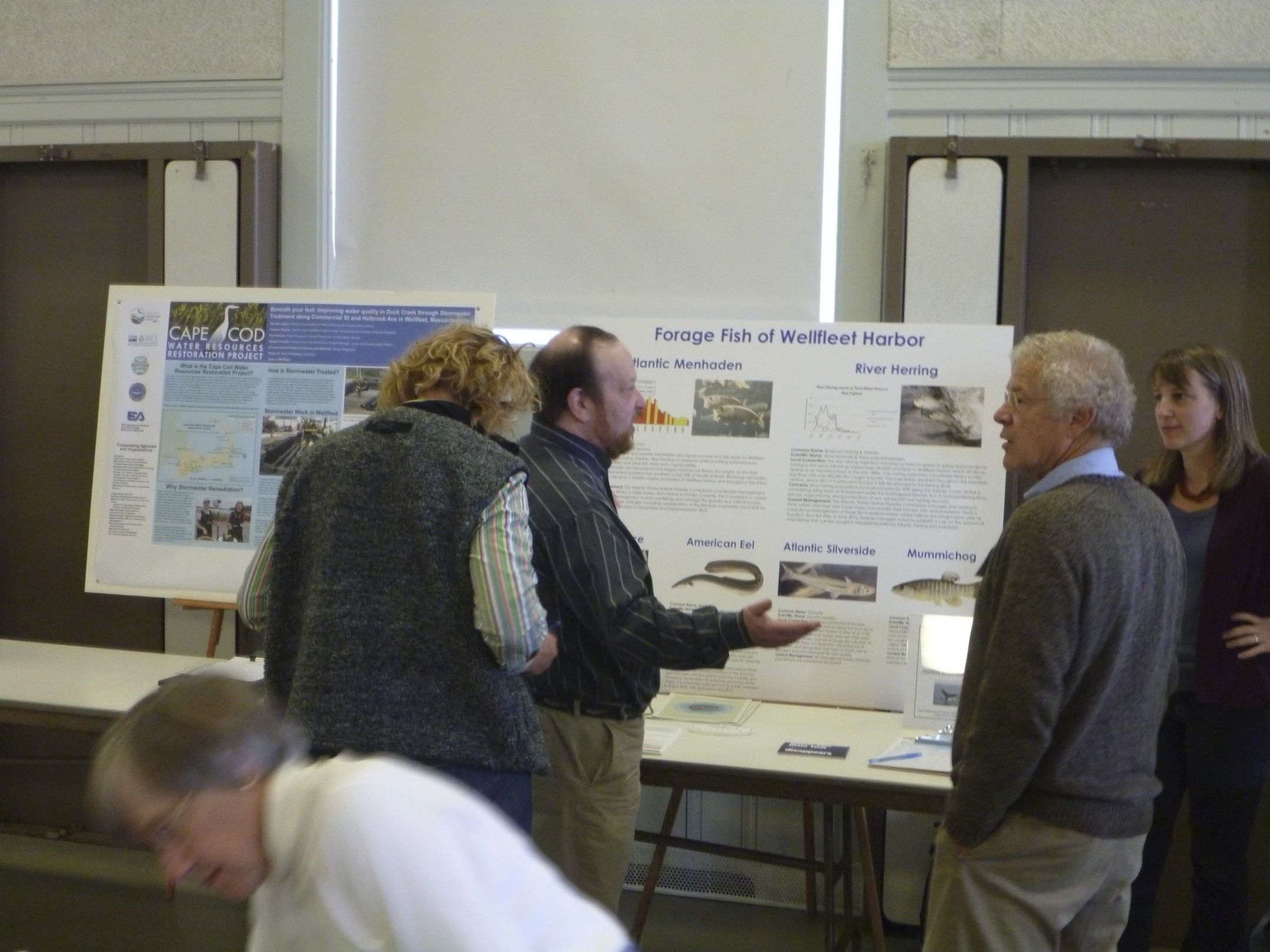
Poster session

Poster session

You can see from the schedule that there was a wide variety of presentations and posters. There was talk about dolphin mass strandings, bathymetry, auditory evoked potential, sentinel species, estuaries, cross-shore sediment transport, salt marsh backup, turtle gardens, terrapin clutches, brumation, eutrophication, cultching, winter/spring blooms, quahog seed, anoxic shellfish, temperature-dependent sex determination, anthropogenic effects, and many other topics related to the diverse ecosystems of the Outer Cape.

There were some good videos from the Friends of Herring River and the International Fund for Animal Welfare (IFAW). Brian Sharp complemented the latter with a talk and a tour of the IFAW van used for marine mammal rescues. This was especially salient given the mass strandings of dolphins in Wellfleet Bay in the early part of the year.
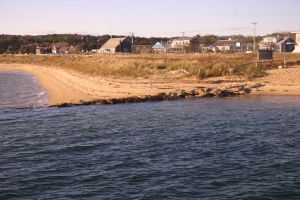
Mayo Beach, with groin

Mayo Beach, with groin

These presentations emphasized the interconnectedness of ecosystems, with humans as an integral part. Mark Borrelli from the Provincetown Center for Coastal Studies talked about how groins and revetments prevent local beach erosion, e.g., to protect a house, but shift the erosion elsewhere. Thus, they are simply “erosion relocation structures.” Sarah Martinez from the Mass Audubon Wellfleet Bay Wildlife Sanctuary presented a poster on the consequences for horseshoe crabs of their use as bait for conch and eels. Moreover, the revetments that relocate beach erosion also disturb the spawning, much of which occurs above the high tide mark.Vincent Malkoski from the Massachusetts Division of Marine Fisheries spoke about the data on horseshoe crab fisheries. These findings have led to harvesting closures for five days around the new and full moons in May and June to allow lunar spawning. Diane Murphy from the Cape Cod Cooperative Extension and Woods Hole Sea Grant spoke on the relation between oyster and clam growth and the wide variety of habitats they find in Cape Cod Bay.

Avoiding Either/Or Thinking 
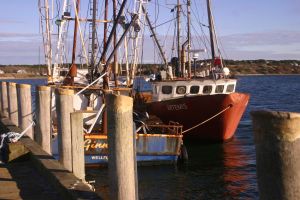
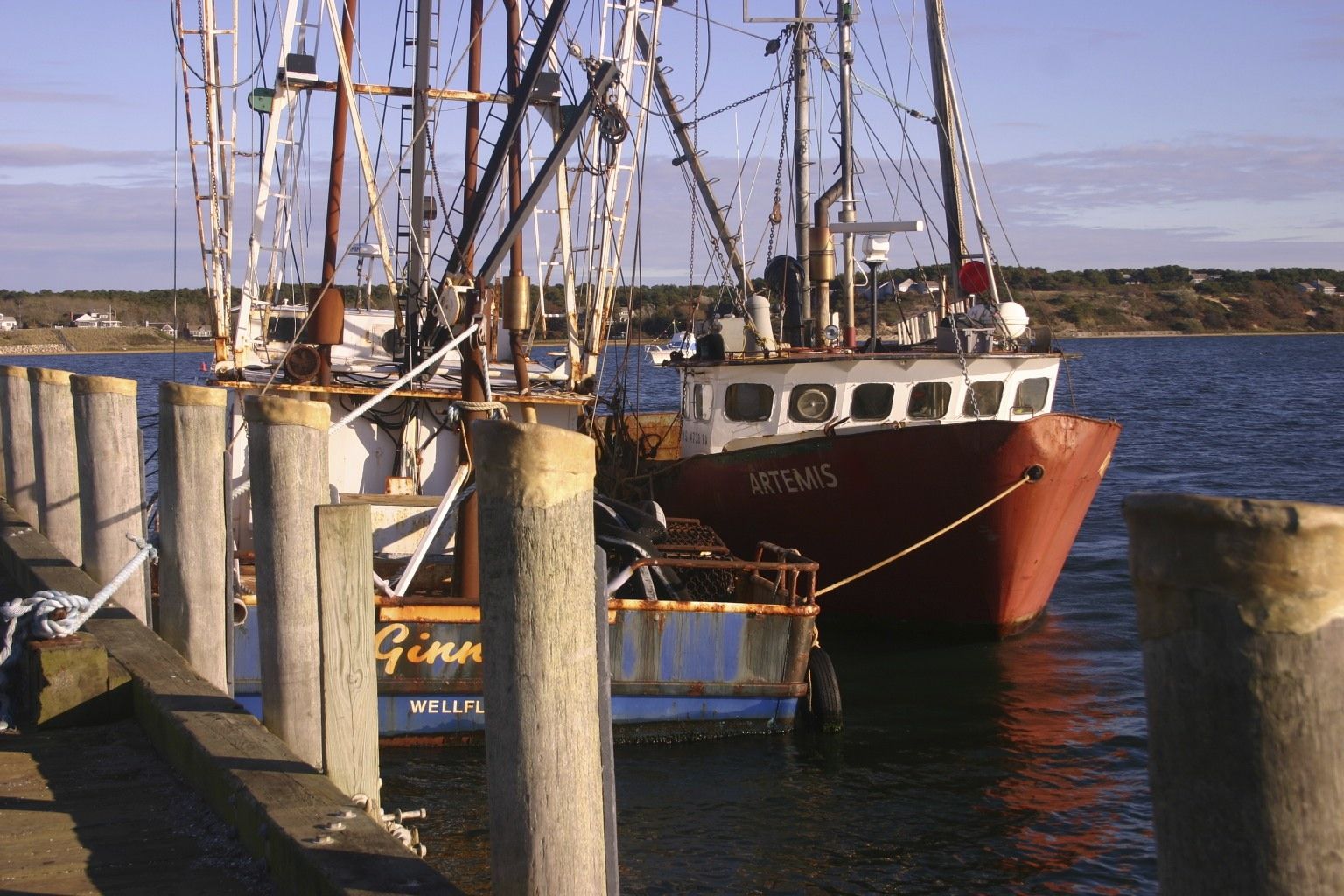
Fishing boats

Fishing boats

One consequence of creating the forum in this way was that discussions avoided the either/or kind of thinking often expressed in mainstream media. For example, although most of the participants shared deep commitments to preserving natural environments and generally opposed rampant development, I heard statements such as “you can’t say that dredging is always bad or good; the decision is about choices and values.” There would then be productive dialogue that critiqued human-made alterations of the shoreline, estuaries, ponds, and so on, but acknowledged values others might hold for commerce, recreation, or housing. Zero-based planning  is no longer an option in the Wellfleet area: Every change today, even one that seeks to undo earlier construction, interacts with a myriad of alterations over centuries and can have unintended consequences for the environment.
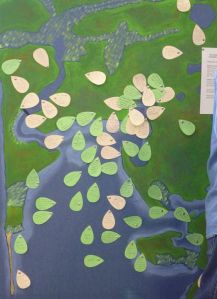
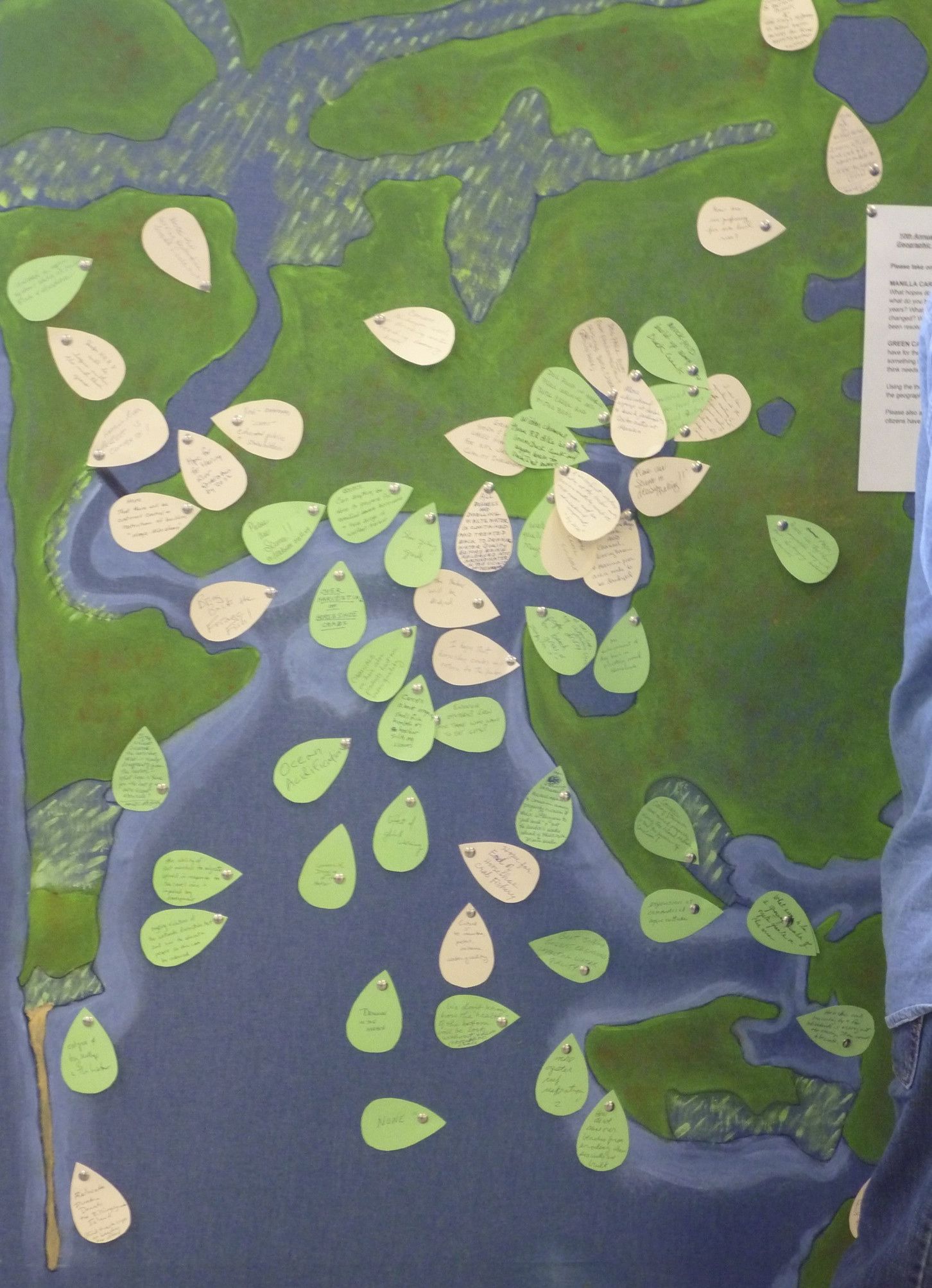
Interactive map

Interactive map

Multilogue

Through Q/A, posters, and ample time for informal discussion, the conference fostered one to many, many to one, and many to many conversations among participants including scientists in the same and other disciplines, students, and general public. There was an interactive map on which people could write their hopes and concerns and peg them to a geographic spot. The map activity will be continued at the library to solicit input from those who did not attend the conference. I saw numerous examples of scientists taking seriously the concerns or knowledge of the public.

This was perhaps enhanced by the fact that many of the projects involve direct citizen science participation , e.g., the river herring count, the horseshoe crab spawning assessment, terrapin sightings, and the dolphin rescues. Others involve coordination with local activist organizations, such as the Wellfleet Conservation Trust.

Some were of special relevance to those involved in commerce, such as oyster farmers. Jessica Smith and Barbara Brennessel from Wheaton College had an interesting poster on a study of genetic diversity among hatchery versus reef oysters, showing, as one might expect, a greater diversity for the reef oysters. This provides indirect support for seeding oyster beds with pelagic, rather than hatchery, veligers. Some oyster farmers still collect these wild larvae for seeing their beds, despite the method being considered slower, difficult, and old-fashioned. A quahog farmer of 30 years was able to add comments about changes over three decades that was missing from most of the shorter-term scientific studies.

Sustainability

IFAW van

IFAW van

Perhaps a meeting like this requires a supportive habitat such as Wellfleet in order to thrive, just as the terrapins, horseshoe crabs, eels, dolphins, ospreys, and other creatures do. Would it fail to survive elsewhere?

Richard Lewontin points out in The Triple Helix that no organism can survive without a supportive environment, but also that no living environment exists without organisms. In this case, the conference organism succeeds because of the town environment, but also shapes it to become more supportive of exactly the kind of discussion heard today.

The conference was well-organized with good snacks, including clam chowder. I came away with a renewed appreciation for the special beauty of Wellfleet, but also sadness about what we’ve done to destroy this, and so much else of the natural world. The fact that a conference such as this is so rare punctuates that sadness. How much did you hear from political candidates or mass media this year about protecting the environment we all live in and depend upon?

Small but good things are worth preserving. I hope to make the conference an annual event.

Hoffmann’s feverish dreams

E. T. A. Hoffmann

E. T. A. Hoffmann

One doesn’t just read, but rather descends, into the tales of Hoffmann. Sir Walter Scott must have agreed when he judged that Hoffmann didn’t need literary criticism as much as he needed medical assistance:

It is impossible to subject tales of this nature [referring to “The Sand-man”] to criticism. They are not the visions of a poetical mind; they are scarcely even the seeming authenticity which the hallucinations of lunacy convey to the patient; they are the feverish dreams of a light-headed patient.
Lunatic he may be, but somehow Hoffmann manages to convey essential truths through his grotesque tales and drawings.

The Nutcracker

The Nutcracker

In conventional stories, a character has an identity that we learn about as events unfold. Often that identity develops or evolves, but generally, we at least know whom we’re talking about. Supernatural elements, if they appear, may be hard to explain, but we can usually distinguish them from the ordinary. There’s typically some sort of resolution, which gives us a semblance of coherence.

Hoffmann is quite different. Writing two centuries before post-modernism, Hoffmann turns the rules inside out. Neither we as readers, nor the characters, nor, as I suspect, Hoffmann himself, always know whether a given event is real or imagined. Is it an hallucination, a metaphor, a dream, or a supernatural occurrence? Is the kobold we encounter an independent entity, or simply a buried aspect of some character’s personality? Is this one a person, or a doll that the character assumes is alive? Is some occurrence the dream of a character, of Hoffmann, or one that we forgot that we’d been having and now can’t eliminate from our thoughts?

The Tales of Hoffmann

Spalanzani & Coppélius in “Tales of Hoffmann”

Combining rich, believable realism with extravagant fantasy, Hoffmann gets the reader to probe deep into the story, whatever the reader imagines that to be. He challenges Aristotle’s Poetics by offering only the beginning and the middle, but not the end, or resolution: He shows us that it’s a disservice to a good story to bring it to an end; the reader should be allowed to carry it onward.

In one of his best stories, The Golden Flower Pot, We struggle along with Anselmus to make sense of a world that doesn’t make much sense. The Archivarius tells him,

the gold-green snakes, which you saw in the elder-bush, Herr Anselmus, were simply my three daughters; and that you have fallen over head and ears in love with the blue eyes of Serpentina the youngest, is now clear enough.

The elder-bush, then a snake, now becomes the love of his dreams:

The Student Anselmus felt as if he now merely heard in plain words something he had long dreamed of, and though he fancied he observed that elder-bush, wall and sward, and all objects about him were beginning slowly to whirl around, he took heart, and was ready to speak; but the Archivarius prevented him; for sharply pulling the glove from his left hand, and holding the stone of a ring, glittering in strange sparkles and flames before the Student’s eyes, he said: “Look here, Herr Anselmus; what you see may do you good.”

It’s painfully obvious what Anselmus should not do, yet, he does. We as readers follow obediently and disastrously, learning along the way the preposterousness and the tragedy of romanticism from one its major initiators.

The Doll (DIe Puppe)

The Doll (DIe Puppe)

Thanks to these features, Hoffmann’s stories invite a variety of interpretations on multiple levels. The nutcracker may be Napoleon and the seven-headed mouse king, his seven cabinet members. But they may also be Hoffmann’s critique of romanticism, or a manifestation of buried aspects of the personalities of Clara and Fritz. Or, maybe they’re just idle fantasies, and Hoffmann has seduced the reader into unveiling his own psychic disturbances.

Ernst Theodore Wihelm Hoffmann is best known by his pen name, E. T. A. Hoffmann (Ernst Theodor Amadeus Hoffmann). But if my experience and that of a few friends is any guide, he’s not known well known by any name today, at least in the US beyond scholars of German romanticism, and certainly not anywhere near what his contributions deserve.

Some people are familiar with Offenbach’s The Tales of Hoffmann, an opera based on Hoffmann’s short stories with him as the main protagonist, or with the Powell and Pressburger film. Fewer still know that Tchaikovsky’s ballet The Nutcracker was inspired by Hoffmann’s “The Nutcracker and the Mouse King.” That may be due to the fact that the sweet Christmas performances of the ballet lack the disturbing edge that Hoffmann works into all of his stories.

Kapellmeister Kreisler

Kapellmeister Kreisler

But I didn’t know that Hoffmann’s stories inspired many other famous works of music and film (e.g., Alfred Hitchcock, Bergman’s Fanny and Alexander); that his writings were a major influence on Edgar Allen Poe, Nikolai Gogol, Charles Dickens, Charles Baudelaire, George MacDonald, Fyodor Dostoevsky, Franz Kafka, Jorge Luis Borges, Robertson Davies, Alexandre Dumas, père, and even Sigmund Freud and Carl Jung; that he wrote the first (Western) detective story, a novella (Mademoiselle de Scudéri); that his stories are the basis for much of modern gothic, ghost, sci-fi, and other genres; that he was arguably the first romantic composer in music, inspiring Robert Schumann and others; that his music and literary criticism were major influences on romanticism; or that he was an accomplished sketch artist, political satirist, and philosopher.

Worth getting to know. Just be careful about those dreams.

References

Hoffmann, E. T. A. (1967). The best tales of Hoffmann (edited with an Introduction by E. F. Bleiler). New York: Dover.

Scott, Sir Walter (1827). On the supernatural in fictitious composition. The Foreign Quarterly Review, I(1), 60-98.

Veronica Robles at the Methodist Church

Veronica Robles

Veronica Robles

I had a very enjoyable evening thanks to Veronica Robles, who performed Saturday for a Habitat for Humanity fund-raiser at the Wellfleet United Methodist Church.

Her show was a great introduction to the dance, costumes, songs, language, and histories of different states in Mexico, including Michoacán, Jalisco, and Chiapas. Robles is co-producer and host of the popular Telemundo show – “Orale con Veronica (Let’s Go with Veronica)”. You can hear samples of her music on the Orales website.

A major goal of hers has been to connect Latino families with social services and programs. She co-developed the Latino Art and Culture Initiative at Centro Latino de Chelsea and founded Dance, Camera, Action! at the Charlestown Boys and Girls Club. She has six CD’s out and recent appearances at Lincoln Center and Carnegie Hall.

Veronica is a natural teacher, who takes her show to public schools in Boston and beyond, promoting arts, diversity, and cultural understanding. She performs with authentic outfits from different regions. The performances are interactive, with group singing and opportunities to dress up and learn dances. There was much amusement at some of the clumsy volunteers, such as myself.

Mariachi in Wellfleet might seem at first to be an odd fit. But it worked surprisingly well and made a nice addition to life here.

See Best bets things to do this weekend | CapeCodOnline.com.

Green oats in June

An Irish day on Cape Cod: It began with a 5K walking race along Nantucket Sound in South Yarmouth (Cape Cod Irish Village Road Race). At the conclusion of the race we enjoyed Irish music at the Irish Village. Unfortunately, any loss to our waistlines from the race was fully counteracted by hamburgers and pints of stout.

The day ended with listening to Celtic Sojourn on WGBH. That program featured a beautiful poem by Patrick Kavanagh, which is appropriate for Mother’s Day, or for remembrance on any loved one.

But I don’t read the poem as being only about remembrance; it’s more about valuing the “earthiest” aspects of all our daily interactions–walking “together through the shops and stalls and markets” or among the “green oats in June.” Kavanagh reads the poem in the video below.

When we lived in Dublin in 2007-08, I remember walking many times along the beautiful Grand Canal, which was near our apartment. You can see a statue of Kavanagh there (“The Crank on the Bank”). It’s also shown in the slide show and below.

The bronze Kavanagh is sitting on a bench as the flesh and blood one once did. It was inspired by his “Lines written on a Seat on the Grand Canal, Dublin”:

O commemorate me where there is water
canal water preferably, so stilly
greeny at the heart of summer. Brother
commemorate me thus beautifully.

If you were to visit Dublin, I recommend sitting beside him to contemplate the people walking by, the ever-present swans, and the stilly, greeny water.

Patrick Kavanagh, Royal Canal

Patrick Kavanagh, Royal Canal

In Memory of My Mother

by Patrick Kavanagh

I do not think of you lying in the wet clay
Of a Monaghan graveyard; I see
You walking down a lane among the poplars
On your way to the station, or happily

Going to second Mass on a summer Sunday–
You meet me and you say:
‘Don’t forget to see about the cattle–‘
Among your earthiest words the angels stray.

And I think of you walking along a headland
Of green oats in June,
So full of repose, so rich with life–
And I see us meeting at the end of a town

On a fair day by accident, after
The bargains are all made and we can walk
Together through the shops and stalls and markets
Free in the oriental streets of thought.

O you are not lying in the wet clay,
For it is harvest evening now and we
Are piling up the ricks against the moonlight
And you smile up at us — eternally.

The phoenix in the attic

The May Harper’s has another good essay by Lewis H. Lapham. “Ignorance of things past: Who wins and who loses when we forget American history” is a compendium of great quotes about history, spiced with his own novel insights.

It seems surprisingly easy to slip into dichotomies about the past. As Dickens wrote in A Tale of Two Cities, 

It was the best of times, it was the worst of times, it was the age of wisdom, it was the age of foolishness, it was the epoch of belief, it was the epoch of incredulity, it was the season of Light, it was the season of Darkness, it was the spring of hope, it was the winter of despair, we had everything before us, we had nothing before us, we were all going direct to heaven, we were all going direct the other way.

Our idealized construction of the past then leads us to simplistic views of the present and even more cartoonish views of the future and what to do next. The US Presidential campaign is filled with examples of this, few of which bear repeating.

Cambridge Public Library

Cambridge Public Library, Past, Present, Future

Lapham shows some ways around dichotomous thinking about the past. One of those dichotomies is between the view of history as a detailed, and verifiable account of past events with little room for interpretation and of history as a consensual hallucination. He shows that history requires both careful attention to detail and continual reconstruction.

Most importantly, Lapham makes an effective case for the idea that history is necessary for a critical, socially engaged intelligence in the time in which we live. This means history that grows out of meticulous study of the details, openness to counter-intuitive or disturbing ideas, and investigation of the gremlins that don’t fit our preconceptions. He cites Faulkner’s “The past is never dead. It’s not even past” (Requiem for a Nun), on the way to showing how making sense of the past is part and parcel of making sense of the present.

We use the present to construct our past, just as we use our past to construct our present. For Lapham, then, the past is the phoenix in the attic. No matter how we engage with it, our uses of history shape what is to come. As he puts it,

History is work in progress, a constant writing, and rewriting as opposed to museum-quality sculpture in milk-white marble.

This doesn’t mean anything-goes relativism. Instead, it is a call to realize that who we are and who we may become are inseparable from who we have been. Unfortunately, that realization seems lacking, and the desire to learn is all too meagre for the needs of today.

The New Jim Crow

US incarceration timeline

US incarceration timeline

In his now classic analysis of the criminal justice system (The Crime of Punishment, 1966), Karl Menninger wrote, “I suspect that all the crimes committed by all the jailed criminals do not equal in total social damage that of the crimes committed against them.” That was at a time when the number of people in the US who were in jail or prison amounted to around 300,000. Today, that number is well over two million. The US has the highest documented incarceration rate in the world, well ahead of the #2 jailer, Russia, or that of many regimes considered to be dictatorships, police states, backward regimes, failed states, or otherwise democracy-challenged.

In a piece originally published in and recently updated for TomDispatch, “The New Jim Crow: How the War on Drugs Gave Birth to a Permanent American UndercasteMichelle Alexander writes,

The New Jim Crow

The New Jim Crow

If you take into account prisoners, a large majority of African American men in some urban areas have been labeled felons for life. (In the Chicago area, the figure is nearly 80%.) These men are part of a growing undercaste — not class, caste — permanently relegated, by law, to a second-class status. They can be denied the right to vote, automatically excluded from juries, and legally discriminated against in employment, housing, access to education, and public benefits, much as their grandparents and great-grandparents were during the Jim Crow era.

I just finished reading her book, The New Jim Crow: Mass Incarceration in the Age of Colorblindness (The New Press, 2010), which piles on the stunning and depressing statistics. But the book does much more than to amplify a sorry state of affairs that most of us know about, but rarely talk about. Several points came through strongly for me:

  • Through actual case stories, the book shows what these numbers mean for the felons for life, their families, their communities, and our democracy. In many cases the people so labeled are innocent, coerced into a plea bargain, or at most convicted of a minor crime.
  • Those who subsequently become subject to legalized second-class citizenship are disproportionately African American. Large numbers are convicted of drug crimes, even while their White counterparts are bigger users and sellers of drugs.
  • The mechanism by which this happens is a maze of laws and court rulings, which have severely compromised civil rights for all of us, even though their impact is primarily on people of color. One more item was added to the maze this week, when the Supreme Court ruled 5-4 that correctional officials may without cause, strip-search a person arrested for the most minor offense. Albert W. Florence was strip-searched twice after being wrongly detained over a traffic fine. Florence said at the time, “It was humiliating. It made me feel less than a man. It made me feel not better than an animal.”
  • The interlocking system including bias, laws, police procedures, courts, prison industry jobs and profits, has created a shameful justice system, far worse than the one lamented by Menninger.
Michelle Alexander

Michelle Alexander

Alexander says that she had several specific audiences in mind for the book. One is “people who care deeply about racial justice, but who for any number of reasons do not yet appreciate the magnitude of the crisis faced by communities of color as a result of mass incarceration. In other words, I’m writing this book for people like me, the person I was 10 years ago.” Another was for people “lacked the facts and data to back up their claims” about how the criminal justice system was operating as a third mode of racial caste making (following first slavery, then Jim Crow). I felt I fit in both of those camps, and fortunately not in the third, that of people trapped in the system.

Following her work on an ACLU racial justice project, Alexander says “I had come to suspect that I was wrong about the criminal justice system. It was not just another institution infected with racial bias but rather a different beast entirely…Quite belatedly, I came to see that mass incarceration in the United States had, in fact, emerged as a stunningly comprehensive and well-disguised system of racialized social control that functions in a manner strikingly similar to Jim Crow.”

Coming to appreciate that system in a deeper way makes the book powerful for me. It doesn’t in any way try to excuse crime, or to lay the blame for it on lack of employment, poor education, or inadequate housing, as many liberals might do. Nor does it link the injustice of the system to individual bias per se. Furthermore, it debunks accounts of individual responsibility, moral failure, or familial inadequacy as some conservatives might propose. Instead, it shows how the system operates, how it developed and grew, and why it will be so hard to change. Yes, better Supreme Court justices matter, but they won’t dismantle the system. Affirmative action is helpful, but it’s far from a solution. All of those explanations for crime and incarceration matter, too, but they’re not the central narrative.

The book is disturbing, and depressing at times. It cannot be said to end on a happy note, but in the last section, “All of Us or None,” there is at least a vision of what could make a difference. Alexander calls for a conversation on race in which “us” means “all of us,” or as Martin Luther King said, that a shift was needed from civil rights (interpreted simply as rights for those who are dispossesed) to human rights.

This means, among other things that

Whites should demonstrate that their silence in the drug war cannot be bought by tacit assurances that their sons and daughters will not be rounded up en masse and locked away. Whites should prove their commitment to dismantling not only mass incarceration, but all of the structures of racial inequality that guarantee for whites the resilience of white privilege. (p. 244)

The book closes with an excerpt from James Baldwins’s letter to his nephew in The Fire Next Time. That entire letter is worth reading and re-reading many times, but I’ll just end here with a small excerpt from that excerpt:

this is the crime of which I accuse my country and my countrymen, and for which neither I nor time nor history will ever forgive them, that they have destroyed and are destroying hundreds of thousands of lives and do not know it and do not want to know it…It is the innocence which constitutes the crime…They are, in effect, still trapped in a history which they do not understand; and until they understand it, they cannot be released from it…those innocents who believed that your imprisonment made them safe are losing their grasp of reality…And if the word integration means anything, this is what it means: that we, with love, shall force our brothers to see themselves as they are, to cease fleeing from reality and begin to change it.  For this is your home, my friend, do not be driven from it; great men have done great things here, and will again, and we can make America what America must become.