Rubber band chain adventures

Courtyard friends

Courtyard friends

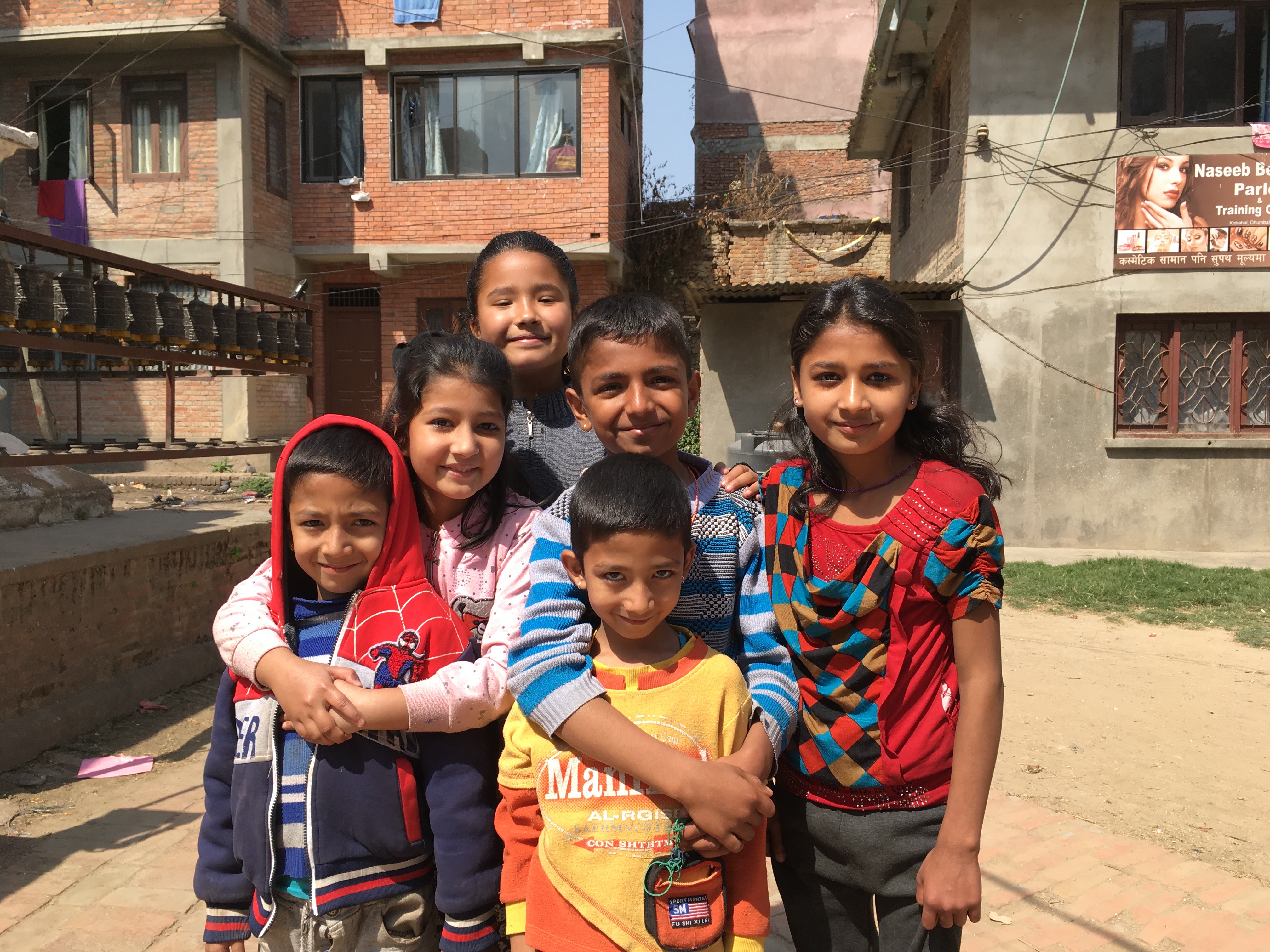
The six kids above are the ones I see most often in the courtyard. On Sunday they were shooting a rubber band chain onto the stupa. It was a good game except that the chains would hang up out of their reach.

They could climb the lower part of the stupa (left in the photo), but the upper part is a smooth dome. Also, there are many electric wires that can catch the chains. You can see some of those in the photo.

The children invited me to shoot one of the chains. I was a failure compared to any of them. But I had a super power, about four feet extra reach. So I climbed up to recover the captured chains.

When I asked to take a photo, the girl in red had just gotten on her bike and was about to ride off. She called out “Wait! Wait!” to be included.

This photo says a lot to me. Notice the arms around each of the twin boys. That’s very common here, as well as the mutual efforts to include everyone in the play, even me. Notice also the generous, but slightly mischievous smiles on each of their faces.

You can see one of the rubber band chains in the left hand of the 12 year-old boy.

As I left, I tried my very best Nepali, “Pheri bhe-ṭaūlah (see you later).” The oldest girl said essentially, “Huh?” I was saved by the same 12 year-old boy, who explained that I was trying to say “Pheri bhe-ṭaūlah.” They all smiled and waved goodbye, wondering what I could have been saying.

The photo is a large format. If you click twice on it, you can get a closer view.
National Botanical Garden

I had a wonderful day at the National Botanical Garden, about half an hour by motorized transport south of Patan, in Godawari. It lies below Mt. Phulchwoki (2715m), which is the highest peak in the Kathmandu valley. It’s an instant relief to be in a quieter place with cleaner air. Beyond that, the garden is a pleasant place to walk with many interesting specimens and layouts.

Some of the grounds are relatively wild and undeveloped, but most are organized into special gardens, such as a typical Nepali terrace garden, with a Nepali style stone tap at the top, a water garden, a fern garden, a Japanese garden, a rock garden, a lily garden, and a Conservation and Educational garden for students and scholars.

Posing for photos in the Japanese garden

A heavy load of greens

Family playing along the creek

Egret in the terrace area

School groups

Flowers and goats in the distance

The entry complex, with a pleasant, informal restaurant

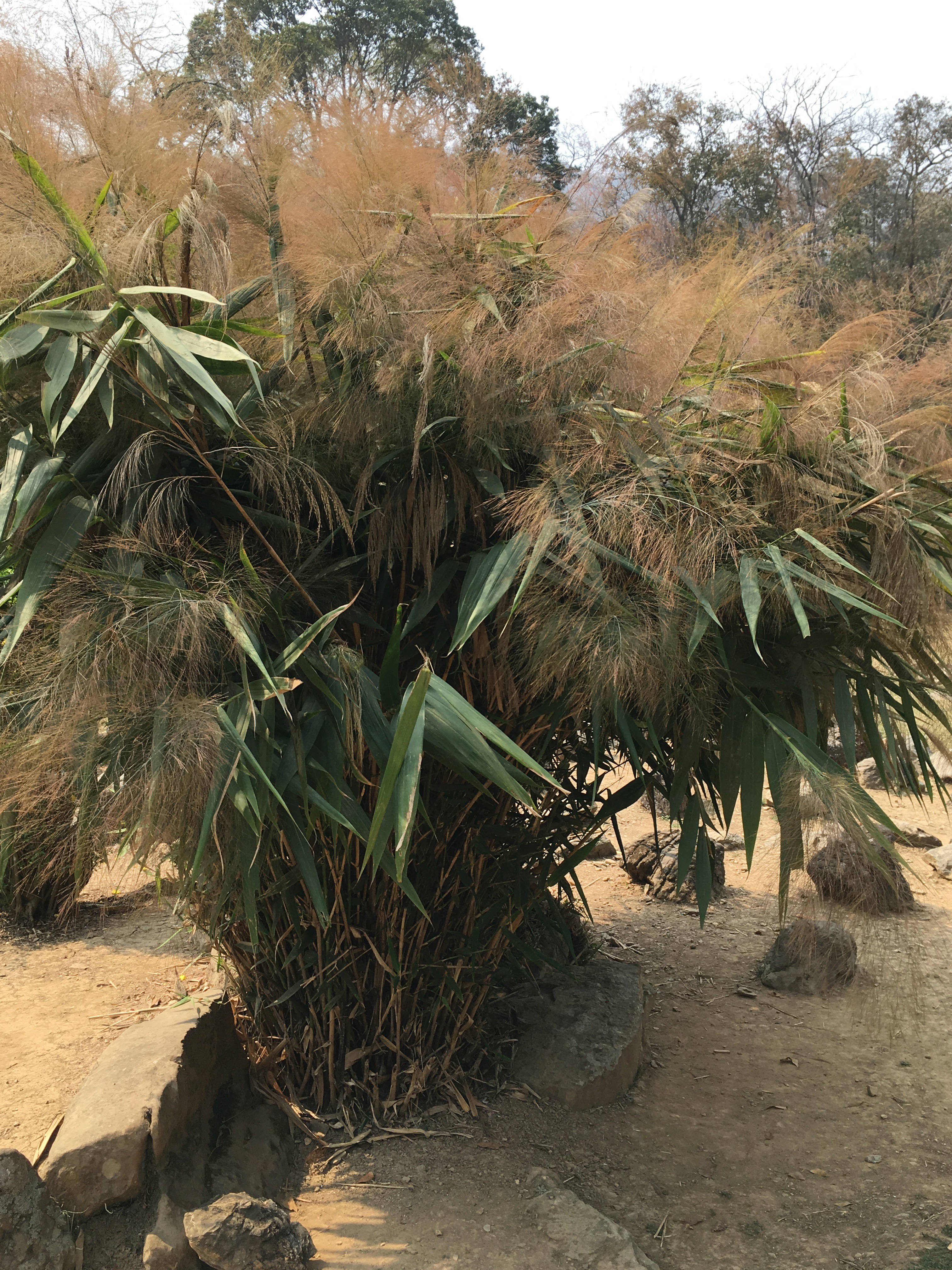
Nepalese broom grass (Thysanolaena); flowers used to make brooms

Old vines in an arbor

Small stream running through the Botanical Garden

Ornamental cabbage?

One of many special display buildings

Ang Zangbu’s Story

The cover of Zangbu’s Story, by Ang Zangbu Sherpa with Diane Scott, shows young Zangbu, a Sherpa boy, gazing at an airplane. Piloting a plane is to become his dream, but to achieve that he has to endure hardships few of us can imagine, and he needs to go to school.

The book describes this true journey. The illustrations by Malcolm Wells alone make it a classic.

His first school is a Sherpa school near Lukla, six hours from his home. It is expected that in two years he is to become the one in the family to learn to read and write, to hold important posts in the village, and to understand land deeds often used to steal land from illiterate Sherpas.

But it is not easy. He has no support at home, no mentor. He must work beforre and after school:

At sherpa school, grade 1

At Sherpa school, grade 1

He struggles not because he is lazy, but because he is working so hard-at pulling weeds and hauling manure in the fields. From the moment it is light until the school bell rings, then from the time he gets out of school until dark–work. But not schoolwork. That must be done, if it is done at all, by the dim light in his cousin’s single open room, where a place by the fire is assigned by age.

Zangbu’s story  is not about violent struggles with wolves, or imagined struggles with yetis, though there is some of that. It’s about growing up with hunger, hard work, and abuse rather than with toys and creature comforts. It’s about perseverance and the ability to learn from difficulty, not to become discouraged. It’s also a richly detailed account of the educational challenges for children in mountain villages in Nepal.

Although written for children, Zangbu’s Story is a book that could inspire and teach any adult as well.

Welcome to Nepal

Tourist Police NepalIt’s hard to imagine a more welcoming place than Nepal. People of all ages greet each other and visitors with a big smile accompanying a “Namaste.”

Tourists are still rare enough in many areas that little children are fascinated–staring, giggling, and waving. Their parents show then how to bring their hands together for “Namaste,” and get a big smile when you reciprocate.

There are welcome signs everywhere, on mats, doorways, posters, wooden carvings, and painted cloths. The signs are in Sanskrit (svāgatam) or Nepali (swagat cha), although those welcomes usually employ the Devanāgarī script (स्वागतम्).

There are also many welcomes in English. These often use two words, “wel come,” or hyphenation, “wel-come.”

Officialdom, even the police, also displays a welcoming attitude. Listen to the poem below, from a card distributed by the Tourist Police.

Always at your service

If you are lost or confused, we provide clarity.
If you are nervous or scared, we encourage strengthening your confidence.
If you need information, we provide them.
If you don’t know where to go, we guide you.

We are there when you need us.

Dial 1144.

Let us serve you.

A Morning Walk Through Time

The old railbed, 100 miles from Boston

At the start on Lecount Hollow Rd.

Peter Brannen’s Rambling Through Time is one of those attempts to make the universe comprehensible, which is fun to try but ultimately fails for me. It’s just too big for my brain.

Brannen uses geologist Robert Hazen’s model for a walk, in which each step represents a century back in time. Starting on NY’s Upper West Side, he can’t even get out of the building (the Hayden Planetarium) before he’s passed all of human history. So much for those who think 10,000 BC to the present is a long time! The walk continues at this pace to the Pacific Ocean, but still doesn’t reach the early Cambrian period, when multicellular life as we know it began. And doing that would still represent only 10% of the earth’s history.

At the start on Lecount Hollow Rd.

The old railbed, 100 miles from Boston

For our annual Imbolc walk (a few days late, on Feb 6), Daniel and I decided to pick up the pace. At Hazen’s speed we’d reach the appearance of grass by the end of the Cape Cod Rail Trail, but would not see the first large mammals, much less the dinosaurs, or anything else of interest. To get reptiles, fish, insects, trilobites, and so on, we need to go much faster. See [trail map].

The extended trail runs 25.7 miles, so we used that distance as the benchmark. We increased the pace by 100 times. That means that each step is a century of centuries (10,000 years) and each mile is 21 million years.

Frozen ephemeral pool

Frozen ephemeral pool

We’d need 50,000 steps to reach the early Cambrian. Maybe 60,000, or more if our stride flags near the end. But at this pace it would take just one step to cover all of human history (the wheel, agriculture, writing, pyramids, Buddhism, geology, the Beatles, etc.). The first humans show up at 1/4 mile, about 4 minutes into our 7 hour walk.

A view along the trail

A view along the trail

Starting the walk at LeCount Hollow Rd, 3 miles gets us to the Eastham border, which matches the KT extinction that wiped out most of the dinosaurs who didn’t have feathers or know how to fly. Somewhere in Orleans, Pangaea split up. It had formed 7 miles earlier in Harwich, before the great Permian extinction. Seymour Pond in Brewster/Harwich takes us to the first large reptiles and sharks. The South Dennis trailhead on Rt 134 gets us to the first vertebrates. At the new start of the trail in Yarmouth we see the first multicellular life of the types we know today. (There are earlier multicellular skeletons in our closet.)

Beautiful lichen

Beautiful lichen

If we had the time, Stamford, CT would take us back to the beginning of the earth. I suppose that we could adjust the pace so that the endpoint would be the Hayden Planetarium, but the arithmetic for that hurts my head.

  1. We started the walk this year a little after 7 on the morning of Tuesday, February 6 and finished 6.5 hours later. Our pace was around 3.5 mph. This was to the South Dennis trailhead at the start of the Silurian period

    Now we need to think about attempting the extended trail next year!

      1. 21 mya: Quartenary (1.6 mya), humans [Seashore HQ, Marconi area]
      2. 42 mya: Grande Coupure, Mongolian Remodeling [Fresh Brook]
      3. 63 mya: Tertiary (65 mya), large mammals, angiosperms, grass [Eastham border]
      4. 84 mya: late dinosaurs [Brackett Rd]
      5. 105 mya: similar to today, except with dinosaurs instead of people [Minister Pond, before Rt 6 crossing]
      6. 126 mya: [Samoset Rd, near Salt Pond]
      7. 147 mya: Cretaceous (144 mya), flowering plants [Gov. Prence Rd]
      8. 168 mya: [Orleans Rotary]
      9. 189 mya: Pangaea splits up [Orleans Center]
      10. 210 mya: Jurassic (208 mya), birds, dinosaurs are dominant, conifers [Namskaket Creek]
      11. 231 mya: [before Nickerson State Park, ℗]
      12. 252 mya: Triassic (245 mya), reptiles dominant, mammals, cycads [Linnell Rd]
      13. 273 mya:
      14. 294 mya: Permian (286 mya) [Long Pond Rd, Rt 137, ℗]
      15. 315 mya: [Sheep Pond]
      16. 336 mya: Pangaea forms [Seymour Pond, Black’s Pond]
      17. 357 mya: Carboniferous (360 mya), tree ferns, gymnosperms, large cartilaginous fish, reptiles [Hinckley’s Pond, ℗]
      18. 378 mya: [Katie’s Pond, after Rt 6]
      19. 399 mya: [Great Western Rd, after Bike Rotary]
      20. 420 mya: Devonian (408 mya), amphibians, land animals [Sand Pond, West Reservoir][/caption]
      21. 441 mya: insects, jawed fish, land plants
      22. 462 mya: Silurian (438 mya), terrestrial plants [South Dennis Trailhead, ℗]
      23. 483 mya:
      24. 504 mya:
      25. 525 mya: Ordovician (505 mya), vertebrates, algae flourish, bivalves
      26. 536 mya: Cambrian explosion (541 mya); first multicellular modern phyla, trilobites, fungi [Yarmouth trailhead, ℗]
      27. In the times of the old ones: Ediacaran life forms, green algae, cyanobacteria, bacteria, eukaryotes (2-3 bya), amino acids


Nature as curriculum: The Wellfleet Harbor Conference

Wellfleet Harbor

Wellfleet Harbor

The annual State of Wellfleet Harbor Conference was held at the Wellfleet Elementary School on November 4, 2017. See the schedule here.

This was a learning event throughout. Janet Reinhart started off with a reference to Wallace Nichols’s Blue Mind: The Surprising Science That Shows How Being Near, In, On, or Under Water Can Make You Happier, Healthier, More Connected, and Better at What You Do. Before we could become complacent about that, we began to see the many threats to the water around us.

Elizabeth McDougall (R) and coworkers from the Cape Cod National Seashore

Elizabeth McDougall (R) and coworkers from the Cape Cod National Seashore on estuarine restoration (water quality)

Continuing what’s now a 15-year tradition, the conference showed the complex connections among trout, whales, menhaden, horseshoe crabs, shellfish, seals, terrapins, sunfish, eel grass, phragmites, bacteria, protozoa, other living things, the land, sea, and air. Most notably, it considered the impact of these diverse aspects of nature on people. In every presentation or poster, we saw the major ways in which human activity affects other aspects of nature.

Presentations at WES

Presentations at WES

The Harbor conference is at once depressing and inspiring. It’s depressing as it details the many ways in which humans damage the beautiful world we inhabit, through greenhouse gas emissions causing global warming, increased storm activity, and sea level rise, pollution of many kinds, black mayonnaise, habitat destruction, and more. But it’s inspiring to see the dedication of people trying to preserve what we can, and to learn so much about the ecology of the unique region of Wellfleet Harbor.

Americorps workers helping serve Mac's clam chowder

Americorps workers helping to prepare Mac’s clam chowder for the lunch

The conference is billed as an opportunity to hear about the latest research, a task it fulfills admirably. Beyond that, I see it as nature school, or nature as curriculum. Participants, including volunteers, fishermen, students, town officials, and staff of the Mass Audubon, the National Park Service, the Center for Coastal Studies, and other organizations, come to report on what they have learned.

The sessions are not simply reports. For example, Geoffrey Day and Michael Hopper spoke for the Sea-Run Brook Trout Coalition. They’re studying the history of anadromous trout in the area and whether traditional runs could be restored. The research is part ecological, looking at the hydrology of Fresh Brook and part historical, using archival data. The presenter, Day, asked for listeners to share any family accounts they might have–letters, maps, and so on– which might document the conditions for the trout population from a century or more ago.

Inquiry in and for nature

Inquiry in and for nature

Whether for brook trout, or many other examples, investigation thus becomes collaborative, a community activity. Moreover, in each case, participants ask “what can be done?” Sometimes the answer is to create, which may be an aesthetic response, political dialogue, collective action for the environment– solar energy, harbor dredging, dam removal, pollution monitoring, and always, more research. Participants continue then to discuss and to to reflect on what they experience, thus enacting an inquiry cycle of learning.

You might find similar activities at many conferences. But the Harbor Conference stands out in terms of the collaborative spirit among presenters and audience and in the ways that knowledge creation is so integrated with daily experience and action in the world.

Poster on monitoring diamondback terrapins nesting on the Herring River

Poster on monitoring diamondback terrapins nesting on the Herring River

This learning was not in a school or a university; there were no grades or certificates of completion. There weren’t even “teachers” or “students” per se. However, by engaging with nature along with our fellow community members, we explored disciplines of history, politics, commerce, geology, biology, physics, chemistry, meteorology, and more. Nature itself became our curriculum guide.

Arab & Middle Eastern cinema festival

Taste of Cherry (1997) Trailer from Close-Up on Vimeo.

We’re enjoying another year of the Cape Cod Festival of Arab & Middle Eastern Cinema. This film festival was founded in 2012 by Rebecca M. Alvin, an independent filmmaker, professor of Film Studies at the New School, writer, and editor of Provincetown Magazine.

Alvin says that the festival addresses “a blind spot in the canon of film.” It includes works made by filmmakers of Arab and/or Middle Eastern descent living around the world. Most of these films are difficult for Americans to access. The films themselves go a long way on their own to foster cross-cultural understanding. Even so, the festival format enhances that by allowing interaction with the filmmakers and critics, and dialogue among the attendees.

Opening night in Chatham featured a Lebanese comedy (the first of the festival’s history), Assad Fouladkar’s Halal Love (and Sex). There was also a delicious spread of taboulli, satay, meatballs, ghorayeba, kunafeh, and more.

In Wellfleet, we saw Taste of Cherry by the Iranian filmmaker Abbas Kiarostami. Jamsheed Akrami, professor of film studies at William Paterson University, led a discussion of Kiarostami’s work and this film, which won the Palme d’Or at Cannes in 1997.

Iranian cinema is a thriving industry, making more than 100 films a year, Akrami points out. At the Oscars in February, the Iranian director Asghar Farhadi’s “The Salesman” won best foreign-language film. Yet the nation’s laws are stringent: Women are banned from singing and dancing in Iranian films. Any contact between men and women — hugging, even holding hands — is illegal.

It’s remarkable that some of these films were even made. For example, the government in Iran has imposed strict codes that force female characters to keep their hair covered even in the privacy of their homes, contrary to custom. There can be no touching of male and female characters, even if say, a mother and son playing the parts of a mother and son wanted to touch.

However, a focus on the censorship of the films would miss much larger themes. Along with interesting cultural differences, the festival shows the universality of the ways we relate to family, love, sex, work, death, war, and other life issues. They also dispel any simplistic notions that one might have about “the Arab” or “the Muslim.”

To take just one example, “Taste of Cherry includes major characters who are Afghan refugees from the war there, who claim to be unaffected by the Iran-Iraq war, an Azeri from a Turkish family who resides in Iran, and an Iranian Kurd. Moreover, while the characters are undoubtedly shaped by their backgrounds and experiences, these top-notch films show them as complex individuals, whom one can relate to beyond cultural differences.

The festival is a great addition to the cultural scene on Cape Cod. If more people could participate, it could go a long way towards improving understanding of the diverse world we live in.

Difference makers

It’s nice to have some good news coming out of the Middle East these days. In a low-key way, this video, Fark Yaratanlar – ÇABA-ÇAM (Difference Makers), shows what people can do to help build a better world. It’s from Ebru Aktan Acar, a colleague in Turkey.

The ÇABA Multi-Objective Early Childhood Education Center makes a difference for the lives of young children, for their parents, and for future teachers. It especially addresses the needs of low-income families, including refugees from Syria, Iraq, and Afghanistan.

Students in the university education program volunteer to work with the children, many of whom have suffered greatly from poverty and war. Most of those children would otherwise have little access to early education.

The Center is affiliated with Çanakkale Onsekiz Mart University. Preschool teacher candidates conducted neighborhood-based surveys and co-designed a model to expand early childhood education while transforming their own training into practice.  The first class opened in 2008. The program now offers a model that anyone could use and values that ought to remind all of us of how we could better interact with one another.

I was fortunate to interact with the children and teachers at ÇABA on several trips to Turkey. I also wrote a chapter for Ebru’s forthcoming book, Early Childhood Education: Major Themes: Ideas, Models, and Approaches. My contribution is about the work of Jane Addams. Although Addams is not generally listed among early childhood educators, such as Montessori or Froebel, Ebru recognized that Addams’s social justice agenda was key to a project like this, which conceives early childhood as holistic and community-based.

The book-tuk, libraries for all

Roaming Library, Kathmandu Post, Mar 17, 2017

Roaming Library, Kathmandu Post, Mar 17, 2017

I like to season my bad news with an occasional snippet of good news. One such is from an article in the Kathmandu Post, “The roaming library,” by Rhythm Sah, a grade 9 student in Biratnagar, Nepal. He attends high school about 250 miles east of the capital, Kathmandu.

Sah writes,

I had never thought that mobile libraries existed. That’s why when I saw the Book Bus in my school ground one early morning, I was amazed. The bus reached us after hundreds of kilometres of travel from the Capital. When the door on the side of bus opened, we saw well arranged rows of books inside…. The bus, also known as a roaming library, had wonderful books with poems, stories and novels. I looked at some beautiful novels and pretty picture books.

The Book Bus, one of two, was started with help from the American Embassy about three years ago. There’s also a book-tuk, with solar-powered wireless internet service. It was made by modifying a type of small, three-wheeled, electric van, called a Tempo, or more commonly, a tuktuk.

Sah continues,

The main aim of establishing such library is to build reading habit in the youth, to exchange culture and to improve English speaking and writing skills. The bus reaches different corners of the nation and teaches the students how to enjoy books. I was very happy when the bus came to the school and was saddened when it continued on with its journey. The bus has made my love for books even stronger and I cannot wait until it comes back!

Tempo electric van, Kathmandu

Safa Tempo electric van, Kathmandu

The provision of library services, including books, video, and internet can make a huge difference in a country like Nepal, where many people lack the most basic services. This is especially true in the countryside, but for many in the large cities as well. For an amount of money that doesn’t even register in the US budget, the US can provide Nepalis with tools they need for education, development, and peaceful progress. With relatively small expenditures of money and no endangerment of lives, we can do more to promote peace and stability in Nepal and elsewhere than we have with any of our recent, ill-conceived wars.

The cost of a single B-2 Spirit jet is ten times the sum of all US aid to Nepal, including for democracy and human rights, economic development, education, environment, health, peace and security, and humanitarian assistance (such as earthquake relief). That jet is just one small piece of a military budget larger than those of the next seven countries–China, UK, Russia, France, India, Japan, Saudi Arabia, and Germany combined. And yet, with already the largest military budget in the world, the President has proposed a huge increase in US military spending. The increase alone is about the size of Russia’s entire defense budget.

The new budget includes draconian cuts for library and museum services in the US and for similar programs abroad. Even if the cuts were justified, the savings from those programs would go only a small way toward funding the military increase. Whether one is concerned about ensuring a peaceful world, about spending taxpayer money wisely, about economic growth, about reining in the National debt, about creating opportunities for young people, or helping those in dire need, this is the wrong path to take.

Cutting programs such as the mobile libraries in Nepal reduces cross-national understanding and promotes instability that costs far more in the long run.

I hope that Sah and his friends can take advantage of the book bus and the book-tuk as long as they last.

Walking the Cape Cod Rail Trail

Cape Cod Rail Trail

Cape Cod Rail Trail

Shortly after dawn on Sunday, Daniel Dejean and I set out to walk the Cape Cod Rail Trail (CCRT), not just to walk on the trail, but to go the entire 22.3 miles.

I like to walk long distances at a brisk pace, but I was worried about going with an accomplished marathoner, one who would probably be bored with my pedestrian pace. But Daniel seemed quite happy to walk instead of run.

In the beginning we had the trail to ourselves. Perhaps others were deterred by the hour or the temperature just below freezing? In any case, it was heavenly. We enjoyed the exercise, the views, and the conversation. For equipment, we took along one not-smart phone and a fancy watch that didn’t work.

Taccuino Sanitatis

Taccuino Sanitatis

For six hours, we saw a side of Cape Cod that you miss completely if all you know is Route 6, the beaches, or the residential streets. Since the trail is elevated, it offers a better view than that afforded by many forest trails. We saw natural wetlands and cranberry bogs, salt marshes, meadows, forest, creeks, the bay, and the back sides of houses, churches, and businesses. There’s a winery that I didn’t know about.

We talked about what we each liked and didn’t like about life on Cape Cod, music, art, movies, growing up, religion, Borges, Deleuze, Piaget, and OULIPO. We also had good stretches of silence, just listening to the birds and the wind, or walking without listening at all. Amazingly, we avoided the political discussions that seem to dominate the ordinary day.

A long walk imbues your body with a rhythm that offers peace and balance. We joked about Daniel’s fancy electronic watch, which told us all kinds of things, but seemed incapable of  communicating the time of day. We saw it as very postmodern, or perhaps Buddhist, in its rejection of our chopped up daily lives.

Setting out

Setting out

Our overall pace was 3.6 mph. That’s faster than Google walks, but still fairly relaxed. Around 17 miles we each began to feel the stress on our bodies. Daniel revealed that he feels the stress at the same point when running a marathon. It’s interesting that it occurs at the same distance, but of course half the time when running.

As the sun rose, we began to see more people. There were people walking their four-legged masters, babies in strollers, people in wheelchairs, couples, groups, and solitary walkers. Each of them were experiencing a slice of Cape Cod that is hard to find in any other way.

I don’t know that any of them planned to walk the entire route as we did, but I’m sure they each felt some degree of balance as articulated by Taccuino Sanitatis. This is an 11C Arab medical treatise by Ibn Butlan of Baghdad which sets forth the essential elements for well-being, including balance of activity and rest, food, fresh air, and state of mind. Daniel pointed me to that.

Before the railroad came, Cape Cod was accessible only by boat or stagecoach. Passenger rail service from Boston to Provincetown started in 1873 and became a major factor in the Cape’s growth as a summer resort area. But when the car bridge over Cape Cod Canal opened in 1935, passenger rail service soon came to an end. The cars were a boon for tourists and tourist services, but they also began to destroy much of what makes the Cape so special. Residents and visitors who see the Cape mostly from their cars or selected recreational areas miss a lot.

The rail corridor was purchased by the Commonwealth in 1976. A portion of that was converted to a rail trail, which now runs from South Dennis to Wellfleet with side trails going off to Chatham and other areas. Daniel’s uncommunicative watch told us that the trail on the rail bed was a way to step back in time, to connect to some of that earlier Cape Cod life, and to experience a more balanced way of life.