Democratic Education: Finding Hope in Challenging Times

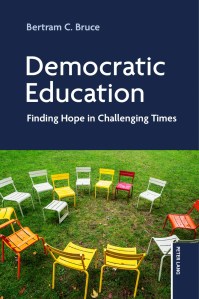
My latest book has just been published. It’s Democratic Education: Finding Hope in Challenging Times.

Here’a an excerpt:

This book opens with a quote from John Dewey’s 1938 essay, “Democracy and Education in the World of Today.” In that essay, Dewey calls on us to educate “the youth of the country in freedom for participation in a free society.” He points out that the “anti-democratic states of Europe … take seriously the formation of the thoughts and minds and characters of their population for their aims and ideals.” The same could be said of anti-democratic forces within the United States today. They take seriously, and act, by taking over school boards, regimenting curricula, banning books from school libraries, and even working to fire individual teachers. They operate at multiple levels, from the individual classroom to national test services and educational publishers.

The political action occurs through multiple forms of schooling as well. The charter school movement began as a better way to meet the needs of low-income and minority students, specifically as an alternative to troubled urban schools. It is becoming essentially a mechanism to provide public funding for private schools, often representing residential segregation by class and race. Private and religious schools, which often promote only limited democracy, are flourishing, promoting ideologies that may afford little opportunity for democratic education. The concerted effort to promote anti-democratic ideology also occurs through the public schools, which have become a political battleground as different sides vie to select or control superintendents, curriculum developers, and local curricula. It occurs through informal education, such as 4-H, scouts, museums, and libraries. And, it occurs through colleges and universities, which increasingly are under fire for their programs and how they deal with freedom of speech.

All too often, advocates of democracy fail to, as Dewey advocates, “take as seriously the preparation of the members of our society for the duties and responsibilities of democracy.” Their focus is on national or state politics, not the painstaking work of local democracy. Even at the national level, education seems less urgent than many other issues. But urgency is not the same as importance. As parents know, young people move ever so rapidly into adulthood, with jobs, families, and civic engagement, including voting. Moreover, in the long run, democracy can only be maintained by the young, not by laws, rules, regulations, amendments, hard-fought court appointments, Presidents, or other mechanisms. If we want to keep democracy we must keep democratic education.

In a landmark legal case, a precursor to Watergate, Judge Damon Keith ruled that the Government could not wiretap U.S. citizens without a warrant. He famously wrote, “Democracies die behind closed doors.” In just five words, Keith captured an essential aspect of democratic education: A democracy requires that citizens not be kept in the dark. Education can illuminate that space. The Washington Post adapted Keith’s saying for its motto: “Democracy dies in darkness.”

Democracy is the means to practice intelligent moral inquiry together, bringing light, and seeking solutions to common problems. It enables democratic education while requiring democratic education as its foundation. That education is training for communal life, a democratic way of living. It enables democracy while being dependent upon it. Thus, democracy and democratic education reinforce and shape one another; they are mutually constituted. Even in the darkest times, we can work to make them stronger.

Learning is fundamental to our humanity. It occurs beyond the formal classroom—in the workplace, in the home, online, in libraries and museums. It is essential to our enterprises, whether political, social, or intellectual. There is no reasonable way to separate discussion of democracy from education. We need critical, focused, and compassionate understanding of education, not quibbles about mechanical procedures. That highlights the importance of democratic ed-u cation, especially education with democracy, in which students learn democracy through their work on democratic practice.
Democratic Education in the 21st Century: Symposium Update

Guest Editor: Chip Bruce

Schools editor: Andy Kaplan

This symposium shares ways to think about democratic education in today’s world, and how we should plan for the future. How should issues such as indigenous people’s rights, racism, women’s rights, authoritarian governments, the concentration of wealth, the climate crisis, pandemics, and more make us analyze, discuss, and work to create democratic education?

We highly encourage submissions from classroom educators at all levels, from educators outside the United States, and from educators associated with alternative schools or informal learning.

Our initial call for papers in February 2022 led to proposals by almost 40 educators from all over the world. We held two zoom workshops for contributors over the past summer, which led to exciting manuscript submissions. The submissions include articles about teacher education for democracy, a ninth grade program devoted to the dreams and hopes of its students, and a social justice program for pregnant and parenting teenagers. These three articles will appear in the Spring 2023 issue of Schools, marking the first of what promises to be a robust and ongoing symposium.

Manuscript preparation

Interested authors should submit a one-page prospectus describing what their project entails. This is to determine appropriateness and balance for the special issue. We anticipate a mix of empirical and theoretical contributions. Completed manuscripts will undergo the usual Schools: Studies in Education review process before final acceptance.

Articles should be a maximum of 8000 words (25 double-spaced pages). Please follow the Schools style guide.

There is a possibility of a follow-on book publication based on revised versions of the articles, after publication in Schools.

Deadlines

For consideration in the Fall 2023 publication:

  • April 15, 2023: final manuscript deadline
  • May 1, 2023: editors’ review of the manuscript sent to author
  • June 1, 2023: outside review of the manuscript
  • July 1, 2023: final revised copy

For consideration in the Spring 2024 publication:

  • February 15, 2023: one-page prospectus for your proposed article
  • March 15, 2023: response to the prospectus
  • October 15, 2023: final manuscript to be considered for the Spring 2024 issue
  • October 31, 2023: editors’ review of the ms.
  • November 30, 2023: outside review of the ms.
  • December 31, 2023: final, revised copy

Democratic Education in the 21st Century (An updated call for papers)

Guest Editor: Bertram (Chip) Bruce

Editor of Schools: Studies in Education: Andy Kaplan

In an age of climate disasters, extreme income inequality, conspiracy theories, anti-democratic movements, segregated schooling, pandemic, and more, the need for democratic education has never been greater, but it may also seem less viable than ever. Classics such as John Dewey’s Democracy and Education are still relevant, but invite us to re-invent education for today.

The symposium

Schools: Studies in Education, published by the University of Chicago Press, is hosting a symposium on this topic to celebrate the journal’s twentieth anniversary. The mission of Schools is to present inquiry into the subjective experience of school life. Unique among academic journals of education, Schools features articles by and about the daily life of classrooms, descriptions and reflections on the meaning of what happens when learning actually occurs. 

To celebrate our twentieth year of publication, this symposium shares ways to think about democratic education in today’s world, and how we should plan for the future. How should issues such as indigenous people’s rights, racism, women’s rights, authoritarian governments, the concentration of wealth, the climate crisis, pandemics, and more make us analyze, discuss, and work to create democratic education?

We highly encourage submissions from classroom educators at all levels, from educators outside the United States, and from educators associated with alternative schools or informal learning.

Our initial call for papers in February 2022 led to proposals by almost 40 educators from all over the world. We held two zoom workshops for contributors over the past summer, which led to exciting manuscript submissions. The submissions include articles about teacher education, a ninth grade program devoted to the dreams and hopes of its students, an after school leadership program for Black teenagers, and a social justice program for pregnant and parenting teenagers. Some or all of these articles will likely appear in the first of what promises to be a robust series of an ongoing symposium.

Manuscript preparation

Interested authors should submit a one-page prospectus describing what their project entails. This is to determine appropriateness and balance for the special issue. We anticipate a mix of empirical and theoretical contributions. Completed manuscripts will undergo the usual Schools: Studies in Education review process before final acceptance.

Articles should be a maximum of 8000 words (25 double-spaced pages). Please follow the Schools style guide.

There is a possibility of a follow-on book publication based on revised versions of the articles, after publication in Schools.

Deadlines

For consideration in the Fall 2023 publication:

  • December 15, 2022: one-page prospectus for your proposed article
  • January 15, 2023: response to the prospectus
  • April 15, 2023: final manuscript deadline
  • May 1, 2023: editors’ review of the manuscript sent to author
  • June 1, 2023: outside review of the manuscript
  • July 1, 2023: final revised copy

For consideration in the Spring 2024 publication:

  • February 15, 2023: one-page prospectus for your proposed article
  • March 15, 2023: response to the prospectus
  • October 15, 2023: final manuscript to be considered for the Spring 2024 issue
  • October 31, 2023: editors’ review of the ms.
  • November 30, 2023: outside review of the ms.
  • December 31, 2023: final, revised copy

Democratic Education in the 21st Century

A Call for Papers

Guest Editor: Bertram (Chip) Bruce

Editor of Schools: Studies in Education: Andy Kaplan

In an age of climate disasters, extreme income inequality, conspiracy theories, anti-democratic movements, segregated schooling, pandemic, and more, the need for democratic education has never been greater, but it may also seem less viable than ever. Classics such as John Dewey’s Democracy and Education are still relevant but invite us to re-invent education for today.

The symposium

Schools: Studies in Education, published by the University of Chicago Press, plans to host a symposium on this topic to celebrate Schools’ twentieth anniversary of publication. The mission of Schools is to present inquiry into the subjective experience of school life. Unique among academic journals of education, Schools features articles by and about the daily life of classrooms, descriptions and reflections on the meaning of what happens when learning actually occurs. 

To celebrate our twentieth year of publication, we propose a symposium on how to think about democratic education in today’s world, and how we should plan for the future. How should issues such as indigenous people’s rights, racism, women’s rights, authoritarian governments, the concentration of wealth, and more make us analyze, discuss, and work to create democratic education?

We highly encourage submissions from classroom educators at all levels, from educators outside the United States, and from educators associated with alternative schools or informal learning.

Deadlines

  • November 15, 2021: One-page prospectus for your proposed article
  • July 25, 2022: in preparation for the workshop, send first draft, outline, or notes to Andy Kaplan; the folder containing these drafts will be accessible to contributors by August 1 
  • August 15: online workshop
  • October 15: final ms. to be considered for the Spring 2023 issue
  • October 31: editors’ review of the ms.
  • November 30: outside review of the ms.
  • December 31: final, revised copy
  • Spring 2023: publication of the first set of articles
  • Similar deadlines will apply for the Fall 2023, or beyond, issues

Manuscript preparation

Interested authors should submit a one-page prospectus describing what their project entails. This is to determine appropriateness and balance for the special issue. We anticipate a mix of empirical and theoretical contributions. Completed manuscripts will undergo the usual Schools: Studies in Education review process before final acceptance.

Articles should be a maximum of 8000 words (25 double-spaced pages). Please follow the Schools style guide.

Articles will appear in the Spring and Fall 2023 issues. There is a possibility of a follow-on book publication based on revised versions of the articles, once the symposium has been published in Schools. 

Démocratie et éthique sociale

Jane Addams’s Democracy and Social Ethics is a fascinating book. Although it was written in 1902, it has a surprising relevance for today.

A major contribution to philosophy, the book develops a theory of social ethics, which extends classical theories oriented toward individual virtues and actions. For social policy it offers ways to think about issues such as racism, immigration, economic injustice, democracy, and social improvement. The abstract ideas are linked to Addams’s own concrete work with Hull-House in Chicago.

Continue reading

International Mother Language Day

Nepal Academy organised a poetry event to observe International Mother Language Day in Kathmandu on Thursday. The festival featured poets from various ethnic backgrounds who recited 36 poems in 32 different languages.

Clad in traditional attire, women from Limbu, Sherpa and Magar ethnicities pose for a photograph as they observe International Mother Language Day in Kathmandu.

All photos: Sanjog Manandhar 

The Nepali national languages featured in the poetry recitation programme included Awadh, Kham, Uraw, Kumal, Kulung, Kewarat, Koyu, Khas, Gurung, Ghale, Jirel, Dhut Magar, Tajpuriya, Tamang, Thami, Tharu, Danuwar, Dumi, Dura, Dhimal, Nachiring, Nepal Bhasa, Bajjika, Bantawa, Bhojpuri, Maithili, Yakkha, Bambule, Limbu, Sherpa, Sunuwar and Hayu—many of which are increasingly on decline.

From the perspectives of poetry, language, art, dress, culture, understanding, social justice, or democratic life, this is so much better  than the practice of denigrating the language, and even the accent, of others.

Source: Nepal celebrates International Mother Language Day with a poetry festival – National – The Kathmandu Post

Breathing the same air

Last July, Eric Garner was killed by police who choked him as he repeated “I can’t breathe.” He cried out 11 times, but eventually succumbed.

We didn’t need yet another example of police killing a young, unarmed black man. Michael Brown, Tamir Rice, and way too many more reveal a pervasive inability of some individuals, and more importantly, of our entire legal system to recognize that we all breathe the same air.

The Senate Intelligence Committee’s report on the CIA’s detention and interrogation program at first seems worlds away from the racism and social injustice of America’s cities. But it too reveals racism and social injustice. It too shows how those in power use that power to oppress even admittedly innocent people. Often, the “crime” was to have a different religion, to wear different clothes, to speak a language other than English, or to be poor. The parallels are disturbing, even without considering how a favored torture technique of the CIA was waterboarding–to deprive people of air.

In the commentary regarding both of these cases I’ve been struck with how little there is about the victims as living, breathing individuals. Those who rightly argue for legal due process for the police or agents involved, talk about mistakes the victims had made, but not about them as people. Some mainstream news coverage does point out a little, that Garner was considered to be an even-tempered, good-natured presence in his community. He was the neighborhood peacemaker. He had asthma and sore feet. And yes, he had run-ins with the police before. But as one neighbor said, “His last penny was your last penny.”  (see “Friends: Man in NYC chokehold case ‘gentle giant’“). Rapidly, however, the real “Eric Garner” vanishes from the discourse as a person and becomes just a term to signal a point of disagreement between factions that seem to have little ability to understand one another.

In the last chapter of her 1902 book, Democracy and Social Ethics, Jane Addams writes about racism and corruption of a century ago, and the consequent need for political reform. Her examples draw on the glaring disparities in wealth of the Gilded Age, which are unfortunately being reproduced today.

Addams talks about the “honest absence of class consciousness” among the immigrants she worked with. That absence supported their faith in American democracy. They were taught ideals for “honorable dealing and careful living. They were told that the career of the self-made man was open to every American boy, if he worked hard and saved his money, improved his mind, and followed a steady ambition. [sic]”

Addams then recalls an anecdote from her childhood: “the village schoolmaster told his little flock, without any mitigating clauses, that Jay Gould had laid the foundation of his colossal fortune by always saving bits of string . . . as a result, every child in the village assiduously collected party-colored balls of twine.” In this way, children failed to learn that “the path which leads to riches and success, to civic prominence and honor, is the path of political corruption.” The end result was that every citizen participated in that corruption, even those who suffered from it. Her statement of this shared responsibility still holds today:

This is the penalty of a democracy,–that we are bound to move forward or retrograde together. None of us can stand aside; our feet are mired in the same soil, and our lungs breathe the same air.

The penalty that Addams describes is also the basis for making a democracy possible. Ethics cannot be limited to the individual virtues, such as honesty, courage, or duty, but must encompass social relations as well, the social ethics of her book’s title. That idea is expressed well in an essay she had written a few years earlier, called “A Modern Lear.” It’s about the railroad czar George Pullman:

Our thoughts . . .cannot be too much directed from mutual relationships and responsibilities. They will be warped, unless we look all men in the face, as if a community of interests lay between. . .To touch to vibrating response the noble fibre in each man, to pull these many fibres, fragile, impalpable and constantly breaking, as they are, into one impulse, to develop that mere impulse through its feeble and tentative stages into action, is no easy task, but lateral progress is impossible without it.

Addams knew that democracy was a hollow ideal without social ethics. So, it’s depressing to realize that the inequities of wealth, the racism, and the corruption of her day are still with us, and in some ways have become worse. Our social ethics appears piecemeal and ephemeral. At times the “mere impulse” seems nonexistent.

Can those who defend the CIA or the all-too-common official homicides imagine how they would feel if their own child, lover, or best friend were subjected to the same treatment? Could we instead see every person as a citizen who shares in a community of interests, regardless of race, religion, or official papers? What would it take to recognize the humanity in every one of us?

I’m reminded of the ending of “Salute to Life” by Pablo Casals:

Each second we live is a new and unique moment of the universe, a moment that never was before and will never be again. And what do we teach our children in school? We teach them that two and two make four, and that Paris is the capital of France. When will we also teach them what they are?

We should say to each of them: Do you know what you are? You are a marvel. You are unique. In all of the world there is no other child exactly like you. In the millions of years that have passed there has never been another child like you. And look at your body–what a wonder it is! Your legs, your arms, your cunning fingers, the way you move! You may become a Shakespeare, a Michelangelo, a Beethoven. You have the capacity for anything. Yes, you are a marvel. And when you grow up, can you then harm another who is, like you, a marvel? You must cherish one another. You must work–we all must work–to make this world worthy of its children.

Youth community inquiry: New media for community and personal growth

Youth community inquiry: New media for community and personal growthYouth Community Inquiry offers a detailed look at how young people use new media to help their communities thrive. Chapters address questions about learning, digital technology, and community engagement through the theory of community inquiry. The settings range from a small farming town, to a mostly immigrant community, to inner-city Chicago, and include youth from ages eight to 20.
Continue reading

Journal series on progressive education

The International Journal of Progressive Education (IJPE) has now published a series of three special issues on “Progressive Education: Past, Present and Future”:

  1. Progressive Education: Antecedents of Educating for Democracy (IJPE 9.1, February 2013)
  2. Progressive Education: Educating for Democracy and the Process of Authority (IJPE 9.2, June 2013)
  3. What’s Next?: The Future of Progressivism as an “Infinite Succession of Presents” (IJPE 9.3, October 2013)

I worked on these journal issues with John Pecore, Brian Drayton, and Maureen Hogan, as well as article contributors from around the world. We’re now exploring options for developing some of the articles along with some additional material into a handbook. The series is timely given current debates about the purpose and form of education in an era of rapid technological change, globalization, demographic and political shifts, and growing economic inequities. It asks, “What have we learned about pedagogy that can support democratic, humanistic, and morally responsible development for individuals and societies?”

Progressive education is a pedagogical movement that emphasizes aspects such as learning by doing, student-centered learning, valuing diversity, integrated curriculum, problem solvingcritical thinking, collaborative learning, education for social responsibility, and lifelong learning. It situates learning within social, community, and political contexts. It was promoted by the Progressive Education Association in the US from 1919 to 1955, and reflected in the educational philosophy of John Dewey.

But as an approach to pedagogy, progressive education is in no way limited to the US or the past century. In France, the Ecole Moderne, developed from the work of Célestin Freinet, emphasizes the social activism side of progressive education. Loris Malaguzzi and the Reggio Emilia approach to early childhood education demonstrates the importance of art in learning, a key element of the holistic approach in progressive education. Paulo Freire’s work in Brazil on critical literacy, highlights the link between politics and pedagogy. Similarly, influenced by his experiences in South Africa, Mahatma Gandhi’s conception of basic education resonates with progressive ideals of learning generated within everyday life, cooperation, and educating the whole person, including moral development.

It is worth noting that progressive education invariably seeks to go beyond the classroom walls. Thus, the work of Jane Addams and others at Hull House with immigrants fits, even if it is not situated within a traditional school. Myles Horton and the Highlander Folk School focused on social activism with adults, exemplifying the progressive education ideals. So too is the Escuela Nueva in Spain, Colombia, and elsewhere. The informal learning in museums, libraries, community and economic development, and online may express progressive education more fully than what we see in many schools today.

We hope that these issues will prove to be a useful resource for anyone interested improving education for a healthier world.

Citizen Science in Wellfleet

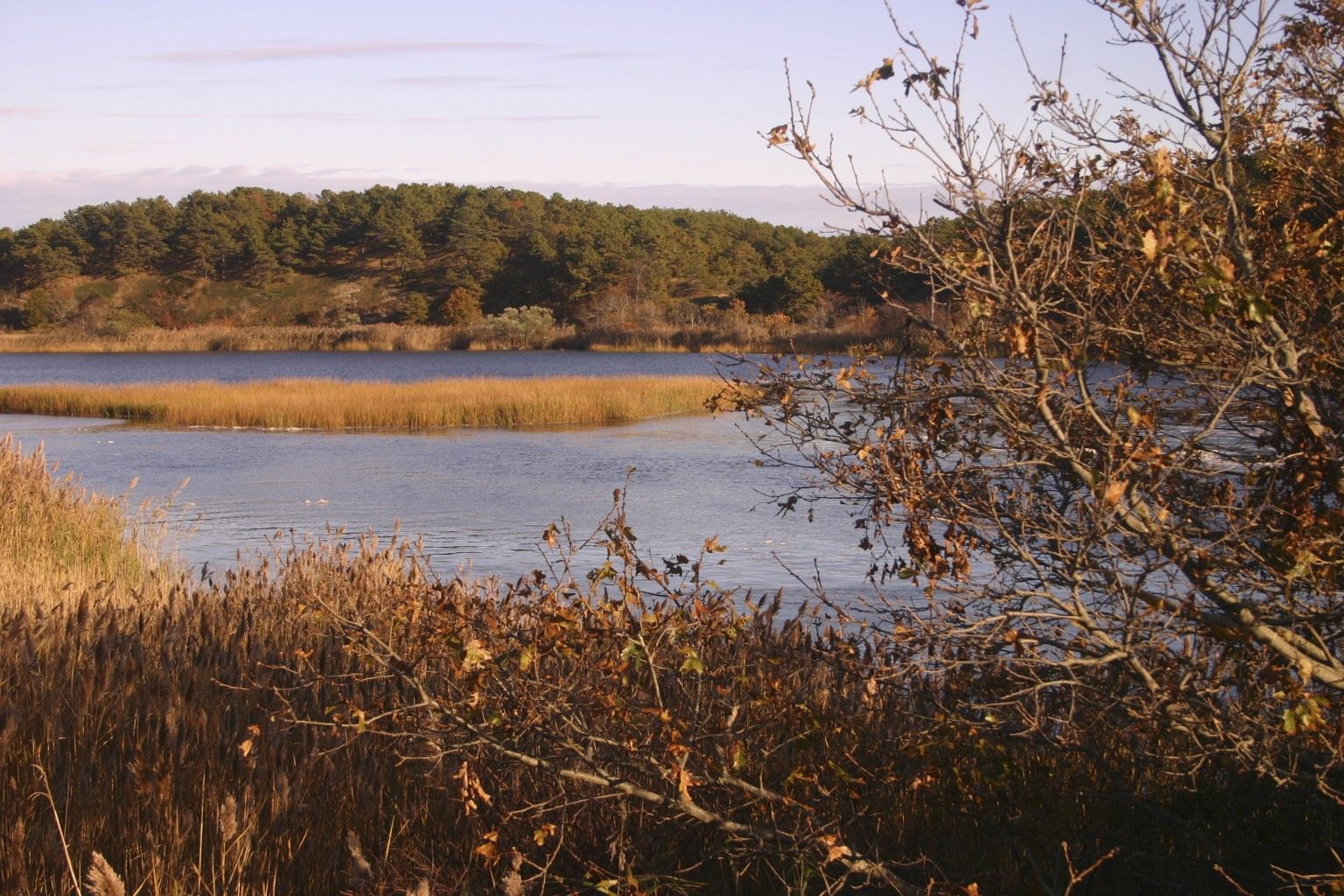
Herring River estuary

Herring River estuary

The current habitat for communication between science and the public is dysfunctional. One need only look at the “debates” about climate change or disease prevention to see the problem.

Scientific findings are regularly misrepresented and sensationalized in the mass and social media. Even when well presented, those findings are ignored or distorted, attacked through faulty arguments, or tied to unsupported inferences. At its best, current science/public dialogue tends to be one-way, with the occasional enlightening article, book, or video, followed by public commentary. This rarely serves to deepen  understanding, much less lead to enhanced inquiry.

State of Wellfleet Harbor Conference 

Wellfleet marina

Wellfleet marina, note osprey nest, upper left

The 10th Annual State of Wellfleet Harbor Conference held yesterday at the Wellfleet Elementary School represents an alternative to that typical dysfunctional science/public relationship. One refreshing note was an effort by scientists to explain not only the results, but also the assumptions, methods, and theories behind them. People asked about the selection of factors to study, or about habitat assessment in tidal river versus bay sites, not to discredit a finding, but to understand more about how results were achieved. The conference was itself a small data point for the case that ordinary citizens can engage in science-based discussions, given enough time and well-crafted presentations, displays, videos, and other materials.

Poster session

Poster session

You can see from the schedule that there was a wide variety of presentations and posters. There was talk about dolphin mass strandings, bathymetry, auditory evoked potential, sentinel species, estuaries, cross-shore sediment transport, salt marsh backup, turtle gardens, terrapin clutches, brumation, eutrophication, cultching, winter/spring blooms, quahog seed, anoxic shellfish, temperature-dependent sex determination, anthropogenic effects, and many other topics related to the diverse ecosystems of the Outer Cape.

There were some good videos from the Friends of Herring River and the International Fund for Animal Welfare (IFAW). Brian Sharp complemented the latter with a talk and a tour of the IFAW van used for marine mammal rescues. This was especially salient given the mass strandings of dolphins in Wellfleet Bay in the early part of the year.

Mayo Beach, with groin

Mayo Beach, with groin

These presentations emphasized the interconnectedness of ecosystems, with humans as an integral part. Mark Borrelli from the Provincetown Center for Coastal Studies talked about how groins and revetments prevent local beach erosion, e.g., to protect a house, but shift the erosion elsewhere. Thus, they are simply “erosion relocation structures.” Sarah Martinez from the Mass Audubon Wellfleet Bay Wildlife Sanctuary presented a poster on the consequences for horseshoe crabs of their use as bait for conch and eels. Moreover, the revetments that relocate beach erosion also disturb the spawning, much of which occurs above the high tide mark.Vincent Malkoski from the Massachusetts Division of Marine Fisheries spoke about the data on horseshoe crab fisheries. These findings have led to harvesting closures for five days around the new and full moons in May and June to allow lunar spawning. Diane Murphy from the Cape Cod Cooperative Extension and Woods Hole Sea Grant spoke on the relation between oyster and clam growth and the wide variety of habitats they find in Cape Cod Bay.

Avoiding Either/Or Thinking 

Fishing boats

Fishing boats

One consequence of creating the forum in this way was that discussions avoided the either/or kind of thinking often expressed in mainstream media. For example, although most of the participants shared deep commitments to preserving natural environments and generally opposed rampant development, I heard statements such as “you can’t say that dredging is always bad or good; the decision is about choices and values.” There would then be productive dialogue that critiqued human-made alterations of the shoreline, estuaries, ponds, and so on, but acknowledged values others might hold for commerce, recreation, or housing. Zero-based planning  is no longer an option in the Wellfleet area: Every change today, even one that seeks to undo earlier construction, interacts with a myriad of alterations over centuries and can have unintended consequences for the environment.

Interactive map

Interactive map

Multilogue

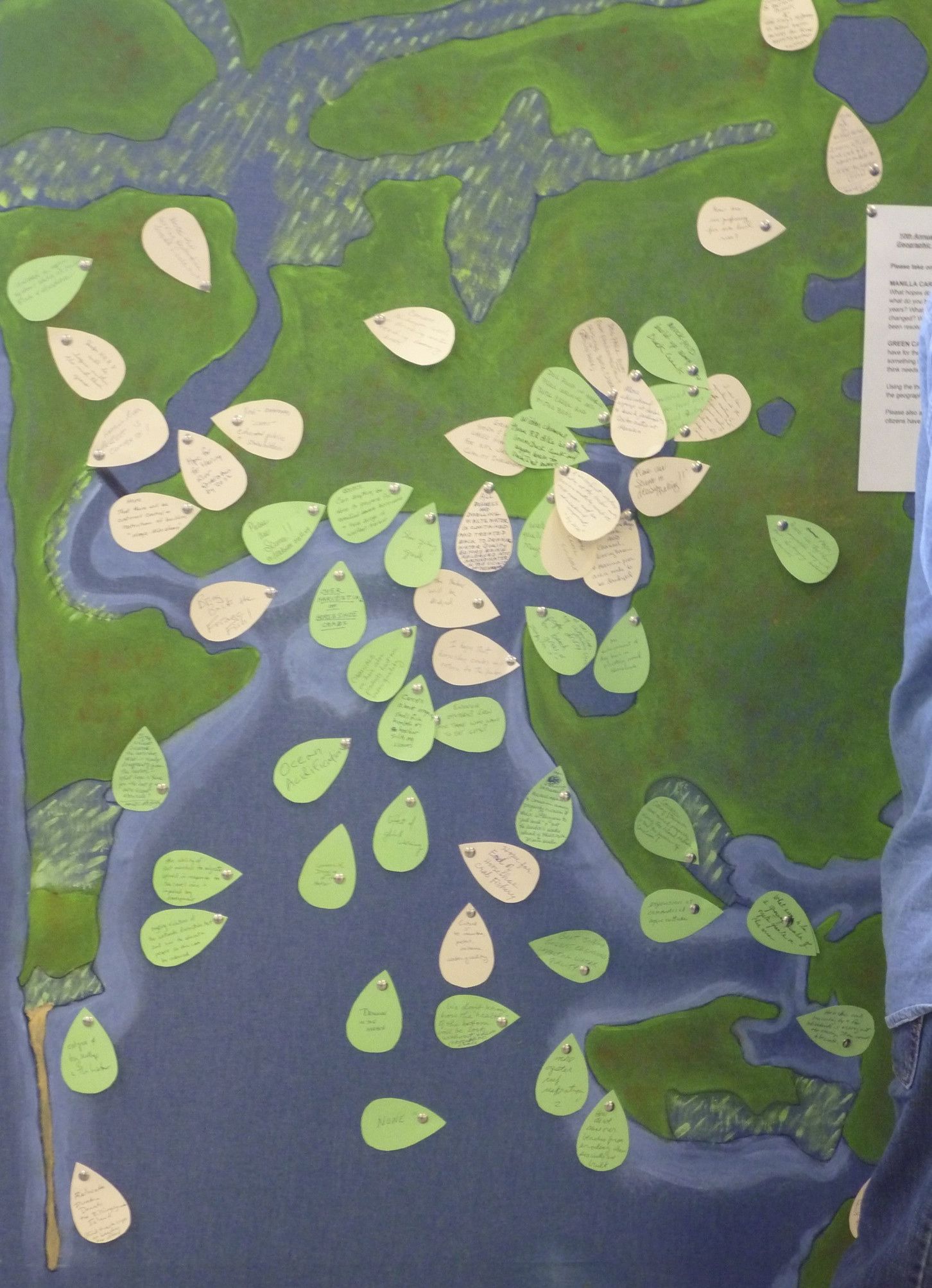
Through Q/A, posters, and ample time for informal discussion, the conference fostered one to many, many to one, and many to many conversations among participants including scientists in the same and other disciplines, students, and general public. There was an interactive map on which people could write their hopes and concerns and peg them to a geographic spot. The map activity will be continued at the library to solicit input from those who did not attend the conference. I saw numerous examples of scientists taking seriously the concerns or knowledge of the public.

This was perhaps enhanced by the fact that many of the projects involve direct citizen science participation , e.g., the river herring count, the horseshoe crab spawning assessment, terrapin sightings, and the dolphin rescues. Others involve coordination with local activist organizations, such as the Wellfleet Conservation Trust.

Some were of special relevance to those involved in commerce, such as oyster farmers. Jessica Smith and Barbara Brennessel from Wheaton College had an interesting poster on a study of genetic diversity among hatchery versus reef oysters, showing, as one might expect, a greater diversity for the reef oysters. This provides indirect support for seeding oyster beds with pelagic, rather than hatchery, veligers. Some oyster farmers still collect these wild larvae for seeing their beds, despite the method being considered slower, difficult, and old-fashioned. A quahog farmer of 30 years was able to add comments about changes over three decades that was missing from most of the shorter-term scientific studies.

Sustainability

IFAW van

IFAW van

Perhaps a meeting like this requires a supportive habitat such as Wellfleet in order to thrive, just as the terrapins, horseshoe crabs, eels, dolphins, ospreys, and other creatures do. Would it fail to survive elsewhere?

Richard Lewontin points out in The Triple Helix that no organism can survive without a supportive environment, but also that no living environment exists without organisms. In this case, the conference organism succeeds because of the town environment, but also shapes it to become more supportive of exactly the kind of discussion heard today.

The conference was well-organized with good snacks, including clam chowder. I came away with a renewed appreciation for the special beauty of Wellfleet, but also sadness about what we’ve done to destroy this, and so much else of the natural world. The fact that a conference such as this is so rare punctuates that sadness. How much did you hear from political candidates or mass media this year about protecting the environment we all live in and depend upon?

Small but good things are worth preserving. I hope to make the conference an annual event.