NatureBreak is a video blog/social network for people who love nature. A recent and fascinating post is best summarized by the creator/victim’s own words:
Witness the horror as I extract a botfly maggot from my head. Beware, this one is gross!

NatureBreak is a video blog/social network for people who love nature. A recent and fascinating post is best summarized by the creator/victim’s own words:
Witness the horror as I extract a botfly maggot from my head. Beware, this one is gross!
 I had shoulder surgery on August 18, so my days of paddling through rapids or hoisting a canoe on my shoulders need to be postponed. As a substitute, I’ve been reading A thousand miles in the Rob Roy canoe on rivers and lakes of Europe (1866), by John Macgregor (1825-1892).
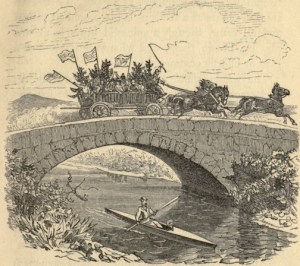 MacGregor himself led a life that sounds like an overdone adventure yarn. At the age of three months, he was rescued from a burning ship whil een route to India with his parents. At the age of 12, he helped launch a rescue boat for a ship in distress off Belfast, then slipped aboard secretly a the last moment to help out. He grew up sailing, boat-building, riding, reading, and experimenting with home-made steam engines, batteries, and chemicals that led to several major explosions. He attended seven schools before graduating from Trinity College, Dublin in mathematics. He traveled throughout the world, fighting Greek pirates and crocodiles, climbing Mont Blanc, Etna, and Vesuvius. He won awards for sharpshooting, drew for Punch and illustrated books, and wrote his own books on marine propulsion, patent law, travel, and transcriptions of Syrian and Egyptian melodies he had heard in his travels.
MacGregor built a hybrid canoe / kayak with a sail and a double-bladed, kayak paddle which he named the “Rob Roy”. He then paddled through the rivers, lakes and canals of Germany, France and Switzerland, portaging between waterways on a cart or on trains. His account of the journey became a best seller and was the beginning of the recreational canoeing movement. His trip inspired many, including Robert Louis Stevenson, who made his own voyage in a Rob Roy, and then wrote about it in his first published book, An inland voyage.
 MacGregor’s account portrays a Europe with only distant resonance to today. Instead of shopping centers and freeways, there were people cutting hay with hand tools. Instead of the Web, there were newspapers, 3241 in Germany alone.
A thousand miles displays a buoyant optimism and refreshing sense of discovery. MacGregor talks of “a strange feeling of freedom and novelty which lasted to the end of the tour,” (p. 15), and throughout, of a reverence for the canoe, which I share:
Something like it is felt when you first march off with a knapsack ready to walk anywhere, or when you start alone in a sailing-boat for a long cruise.
But then in walking you are bounded by every sea and river, and in a common sailing-boat you are bounded by every shallow and shore; whereas, I was in a canoe, which could be paddled or sailed, hauled, or carried over land or water to Rome, if I liked, or to Hong-Kong. (p. 15)
 I also like his descriptions of wildlife, for example of herons “wading about with that look of injured innocence they put on when you dare to disturb them.” (p. 35) Later, he refers to a gathering including the
long-necked, long-winged, long-legged heron, that seems to have forgotten to get a body, flocks by scores with ducks of the various wild breeds, while pretty painted butterflies and fierce- looking dragon-flies float, as it were, on the summer sunbeams, and simmer in the air. (p. 71)
At the village of Geisingen it was discovered that the boiler of my engine needed some fuel, or, in plain terms, I must breakfast. (p. 59)
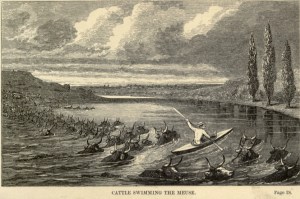 MacGregor’s challenges along the way become not discouragements, but the very stuff of the journey. He reminds me that a broken shoulder is just a toss on the billows, one that can be an opportunity to learn:
It is, as in the voyage of life, that our cares and hardships are our very Mentors of living. Our minds would only vegetate if all life were like a straight canal, and we in a boat being towed along it. The afflictions that agitate the soul are as its shallows, rocks, and whirlpools, and the bark that has not been tossed on billows knows not half the sweetness of the harbour of rest. (p. 37)
This video about journey sticks for learning geography presents a project for Key Stage 2 pupils (ages 7-11) in England. It’s a different age level, orientation, population, and technology from our Youth Community Informatics project. Even so, it has some interesting ideas and you’ll enjoy watching it. It shows how simple tools can help young people open up to the world around them.
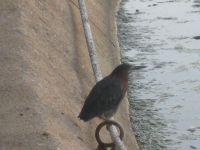
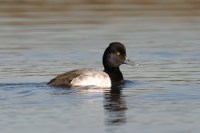
WIllow Lake in Fort Worth is an artificial lake in an urban setting, which nevertheless boasts a wide variety of wildlife. I spent a week near there and saw fish, turtles with foot-long shells, scaups, coots, ducks, grey herons, nutrias, and more.
The nutrias are South American water rodents that were introduced recently into Louisiana and have been spreading in the southern US. In many places they’re considered pests, because they eat all the desirable water plants. I suspect them of eating the duck eggs at Willow Lake, but don’t have proof so I won’t say that.



Emily Dickinson’s “My River” tells the comforting tale of the river running to the gracious sea:
My river runs to thee.
Blue sea, wilt thou welcome me?
My river awaits reply.
Oh! sea, look graciously.
I’ll fetch thee brooks
from spotted nooks.
Say, sea, Take me!
But as a recent article in The Economist (Sin aqua non, April 11-17, 2009, pp. 59-61) points out, many rivers no longer reach those welcoming waters:
An alarming number of the world’s great rivers no longer reach the sea. They include the Indus [at right], Rio Grande, Colorado, Murray-Darling and Yellow rivers. These are the arteries of the world’s main grain-growing areas.
Along with the rivers being depleted, the Aral Sea drying up.
Fish stocks in lakes and rivers have fallen roughly 30% since 1970. This is a bigger population fall than that suffered by animals in jungles, temperate forests, savannahs and any other large ecosystem. [Moreover,] half the world’s wetlands…were drained, damaged or destroyed in the 20th century, mainly because, as the volume of fresh water in rivers falls, salt water invades the delta, changing the balance between fresh and salt water.
Of course, the seas won’t disappear. In fact they’re actually rising due to the melting of the Greenland and polar ice caps. Thus, the world will survive, but it may not be one with blue seas and “brooks from spotted nooks.” People may survive, too, but in what kind of world? What will our poetry become when we’ve destroyed the brooks, the rivers, the forests, the fish and other animals, the plants, and the beauty of the planet?
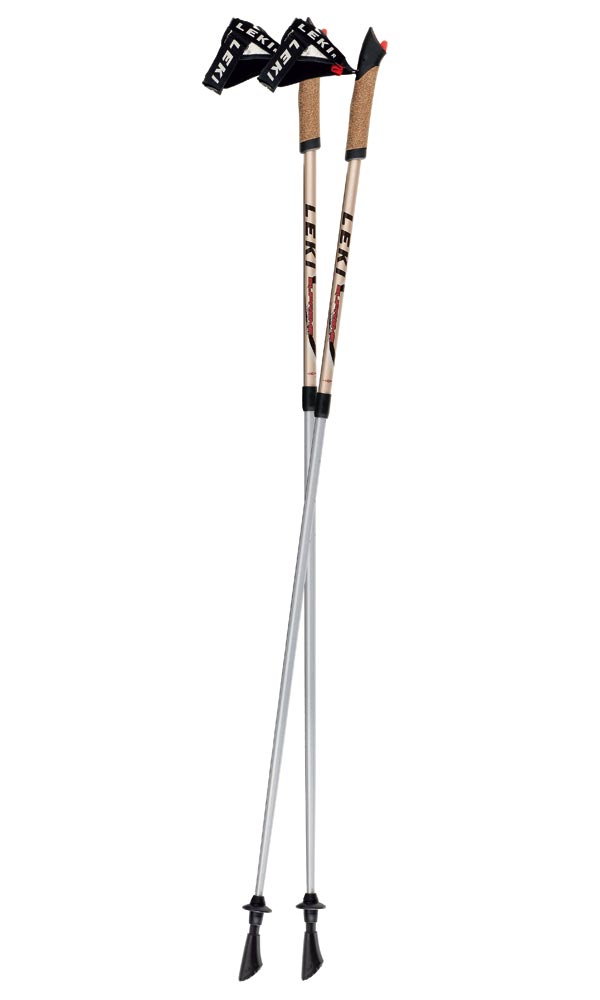 OK. I know it looks strange, but here are a few reasons I like to use walking poles:
 Charles Darwin was born 200 years ago today. In November this year it will be 150 years since he published On the origin of species.
Although others talked about evolution and natural selection before he did, his work was what made the ideas enter our collective consciousness, changing forever our views of science and life. Aside from his detailed scientific work to reveal the workings of natural laws, Darwin was able to write in an engaging way. What’s most evident in those writings is that he revered life, yet saw in death the possibilities for renewal.
The last paragraph of On the origin of species is worth quoting again on this, his birthday:
It is interesting to contemplate an entangled bank, clothed with many plants of many kinds, with birds singing on the bushes, with various insects flitting about, and with worms crawling through the damp earth, and to reflect that these elaborately constructed forms, so different from each other, and dependent on each other in so complex a manner, have all been produced by laws acting around us…
Thus, from the war of nature, from famine and death, the most exalted object which we are capable of conceiving, namely, the production of the higher animals, directly follows. There is grandeur in this view of life, with its several powers, having been originally breathed into a few forms or into one; and that, whilst this planet has gone cycling on according to the fixed law of gravity, from so simple a beginning endless forms most beautiful and most wonderful have been, and are being, evolved.
See the references for interesting stories about Darwin and the evolution of his own ideas and texts.
Darwin, Charles R. (1859). On the origin of species. Various publishers and editions; the link here and the quote are for the 1st edition, in Project Gutenberg.
Krulwich, Robert (2009, February 12, ). Death of child may have influenced Darwin’s work. NPR Morning Edition. 
Urbanowicz, Charles F. (2002). There is a grandeur In this view of life. In Amanda Chesworth et al. (eds.), Darwin Day collection one: The best single idea ever. Albuquerque, New Mexico: Tangled Bank. See also the full version: On Darwin: Countdown to 2008 / 2009!
 Are we beings who pass through a natural world, or are we part and parcel of it? Arthur Bentley asks that question in his 1941 essay, “The Human Skin: Philosophy’s Last Line of Defense.” He suggests that philosophers position the person on one side of a boundary (the human skin) and nature on the other. This artificial separation leads to confusion about cause and effect and about our place in the natural world.
Recent biomedical research supports Bentley’s rejection of the human skin boundary as an artificial distinction. One such set of findings has been called the “Pylori paradox.”
Robin Warren and Barry Marshall were awarded the Nobel Prize for their work showing that Helicobacter pylori, causes inflammation of the stomach lining, and potentially ulcers and stomach cancer. The bacterium, H. pylori has been a resident of the human stomach for thousands of years, is still common in the US, and up to 90% of adults in developing countries may be infected.
Improved living conditions and increased antibiotics use have led to a decrease in H. pylori infections. this sounds good, but as fewer children carry the bacterium, asthma incidence has risen. Recent research has also shown that while H. pylori harms the stomach, it protects the esophagus: Continue reading
 I awakened around 3 am last night to a large racket inside our house. Being the only one there at the time, it didn’t take long for even my groggy brain to understand that there was an intruder. Actually it sounded like a large gang of clumsy intruders, perhaps those who flunked Stealth in burglary school.
Although I sensed a problem quickly, it took me a longer time to get my body to move to do anything about it. How many were there? Mightn’t a wise response be to pull the covers over my head? Probably the best response would have been to call 911, but in my state I couldn’t think that far.
So, I pulled on some shorts and moved cautiously in the direction of the last sound I’d heard. I was relieved, and then distressed, to see the large screen from a skylight lying on the floor. This meant I was probably dealing with a raccoon and not a person. On the other hand, I didn’t relish dealing with a raccoon at that time of night, either.
 I then saw that a large, iron plant stand had been toppled, breaking pottery and seashells. But there was no raccoon. I moved to our dining room, where I saw that he/she/they had upended a candle chandelier. But where was the culprit? There was no sign of the offender, so I started systematically searching, closing off each room once I’d determined that it was intruder-free. Finally, I found him, pretending to be a bear rug next to the fireplace. I say “him” not based on a close inspection, but because he was huge! It’s no wonder that he managed to force the screen through.
By now, I was mostly awake, but also clueless about what to do next. I had a broom, and considered a frontal attack, but then remembered that he might carry rabies or distemper, not to mention large teeth and claws. I tried reasoning with him, but he just stared back at me. Finally, I decided on a lure-him-out approach. I cut up an apple and left sections, one near him and others 10 feet apart leading to the front door, which I’d propped open, and then some on the porch. It did occur to me that I’d just created a delightful invitation for his buddies to come join him. Still, it seemed worth the risk.
 Despite all the apple sections, he just stared back. I couldn’t tell whether he was hurt or just frightened. I know I was the latter and worried about the former.
I was pretty sure that he wouldn’t move while I was standing there. So I went upstairs and then online, checking out phone numbers for animal control and websites on raccoon management. I came down to check on him, but still no movement. I did it again a half hour later. And again. That probably slowed the process, because the next check showed that he had left. Or at least left his fireplace rug position.
I closed up and went to bed. I made sure the bedroom door was firmly shut, because I wasn’t convinced that he was really gone, or that he was the only one.
Morning showed that the evacuation procedure had worked. But it also revealed that he’d made an amazing mess in a short time. There was raccoon scat in two different places. Objects were overturned. raccoon scratches and smell everywhere.
 I’m sure that my nighttime visitor was from the clan that earlier invaded our pool house. They had cut a hole in the roof on the back side where it was hidden by trees. They then settled in to a project of chewing rafters, destroying electrical work, and embedding their odor in the wood. It took a major construction job to recover from that.
This visit was probably notice that if we close off one option, they can just move in to share our quarters. I don’t know what they have planned next, but I’ll be ready.
Bob Louisell reminded me of a Tom Paxton song, “Whose Garden Was This?”, which expresses sentiments similar to those in The last flower in WALL-E. There are various versions available online, including this one accompanied by some nice photos, and sung by Paxton himself.
 Chip's journey