Theodosian Walls at the Selymbria Gate, showing outer walls, inner walls, & moat wall
Last Monday I walked along the Walls of Constantinople, then returned along the Sea of Marmara. It was a beautiful day, with great views in every direction.
The stone walls were built in 324–336 to protect the city of Constantinople (née Byzantium) after its founding as the new capital of the Roman Empire by Constantine the Great. It was the last and one of the most complex fortification systems built in antiquity. Gunpowder began their demise, but it was the large number of Ottoman invaders that caused the city to fall to a siege on May 29, 1453.
Mihrimah Sultan Camii
Nevertheless, the walls had protected the city for over 1100 years, making them the most successful ever built. Even after the fall of Constantinople, Ottomans under Sultan Mehmed II added to the fortifications by building the Yedikule Hisari (Seven Towers Fortress) at the Golden Gate.
The walls have suffered from wars, earthquakes, and urban development, but still stand as an impressive monument and a marker of inner and outer İstanbul. Restoration began in the 1980s.
It’s not possible to walk on top of the walls the entire 4.5 km length. There are heavily damaged sections and major roads now pass through most of the original gates. Several times I climbed up steep stone stairs overgrown with weeds and broken in many places. I’d walk a while, then find that I needed to retrace my steps. At other times, I had to walk away from the wall to circle through some neighborhood before returning to it. As a consequence, I had to walk at least twice the length of the wall itself.
Ottoman Empire, 1683
The route is part of the Sultan’s Trail, a project to build a long-distance path from Vienna to İstanbul. That project appears stalled, but you can still see blazes for it. You can also see many aspects of İstanbul: beautiful vistas and trash piles, new and ancient constructions, carefully planned development and urban sprawl. In Turkish, I’d say güzel ve çirkin, yeni ve eski, iyi ve kötü.
There are many interesting sights along the wall. My favorite is the Mihrimah Sultan Camii (mosque) at Edirnekapı (the Edirne Gate). It was designed by Mimar Sinan (“Sinan the Architect”) for the favorite daughter of Suleiman the Magnificent, Princess Mihrimah. It’s filled with light due to the extraordinary number of windows, a speciality of Sinan’s. Although it’s a large cami, it has only one minaret, symbolizing the loneliness of Mihrimah and Sinan due to their forbidden love. Edirnekapı itself is where Sultan Mehmed II entered the city after its defeat in 1453.
Ottoman furniture today
As I walked, I imagined what it would take to make something like the Promenade Plantée in Paris or the High Line in New York City. With some repairs to the wall, a little new construction, and handrails for people like me, İstanbul could have the best of these new urban walkways.
Walking back through a park along the Sea of Marmara made this into a strenuous, but rewarding day. I was personally fortified with a tradtional Ottoman dinner in the Sultanahmet area at Pasazade and appreciated the Ottoman-style furniture in our hotel. The day after, we ate at Asitane, which claims to have done six months of research on the details of fine Ottoman court cuisine in order to recreate that food culture.
I’ve always been interested in maps, and that interest has grown rather than diminished as I began to learn about them as rhetorical devices. Mark Monmonier discusses this in his How to Lie with Maps.
As faithful representations of reality, maps are endlessly fascinating and useful as tools for many purposes, not just finding one’s way. But as constructed artifacts, they embody a mix of physical reality and human passion––becoming devices for power, greed, delusion, hope, art, and more.
Recently, I read The Mapmaker: A Novel of a Great Navigator who sailed Fifty Years Before Columbus by Frank G. Slaughter. It’s a fictionalized account of Bianco’s life, but one done with an attempt to represent accurately what is known about Bianco, while filling in the gaps with a plausible story.
Portugal’s ruler Prince Henry the Navigator, sent various expeditions into the western Atlantic and along the African coast, beginning in 1418. These voyages were secret. There was a real interest in adding to the knowledge of the world, but that was coupled with a desire to use that knowledge for private gain. Not all of the discoveries were shown on published maps, and some were designed to mislead commercial rivals by concealing the existence of new lands and resources.
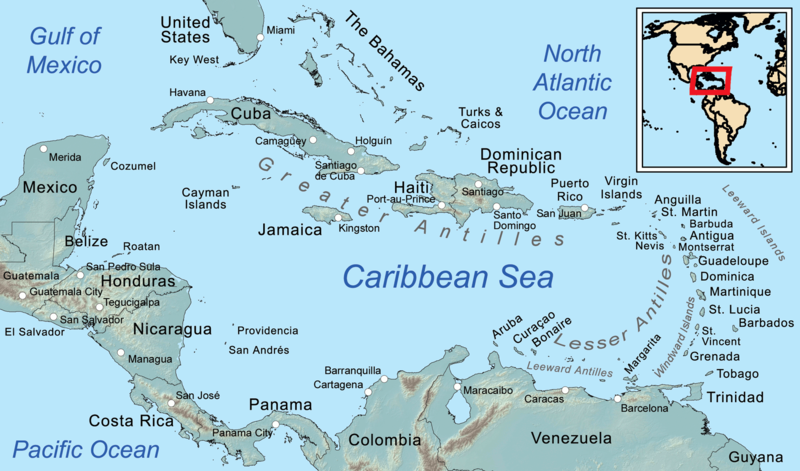
Antilles within the Caribbean
The Portuguese had probably reached the Antilles archilpelago at the Eastern edge of the Caribbean by 1430. Between 1436 and 1448, Andrea Bianco made, but did not publish, maps showing the locations of Newfoundland, Florida, and Brazil. Later Portuguese maps, published in 1459 and 1489, show Asia with something like Florida, conveniently omit South America.
Bianco developed the “Tondo e Quadro” (“circle and square”) method for seeing and measuring a return course. This was invaluable for repeat voyages to secure foreign resources. He collaborated with Fra Mauro, who made other detailed world maps and estimated the world’s circumference within 10% of modern figures. See The Ancient Americas: Migrations, Contacts, and Atlantis, by David Pratt.
Prior to the Portuguese voyages, the famous Chinese admiral Zheng He (a Muslim) had circumnavigated the earth. A world map was published in China during the Ming dynasty in 1418. It shows that the Ming navy had a rough knowledge of Baja California, the west coast of South America, as well as Labrador, Florida, and the Gulf of Mexico. The Chinese maps probably contributed to the Europeans’ knowledge.
The Europeans also learned from Arab science and technology. Arabs put south at the top of maps. When you face the sun in the morning, south is on the right, and right has positive associations. Also, with the sea to the south their land was then on the top of the map. Europeans flipped the map to put north and themselves on top.
Andrea Bianco, explorer and mapmaker
These points are supported by other historical accounts, which in sum show that 15 C Europeans knew that the world was a sphere roughly 24,000 miles in circumference and that there were large land masses between Europe and East Asia. The issue was not to “discover” America nor to prove the word was round, but to map the details and determine who should control it.
To me, this all suggests that what I had learned about voyages of discovery was mostly wrong, and much less interesting than the fuller, more objective accounts available today. School textbooks tended to minimize or omit entirely any non-European contribution. That left out crucial parts of the story, including the cultural aspects of geography.
The textbooks also represented the discovery era as one of courageous, individualized pursuit of knowledge. Instead, the voyages were an essential aspect of empire building based on already extensive knowledge. Rather than enlightening an ignorant world, they were used to acquire knowledge, then deliberately mislead competitors.
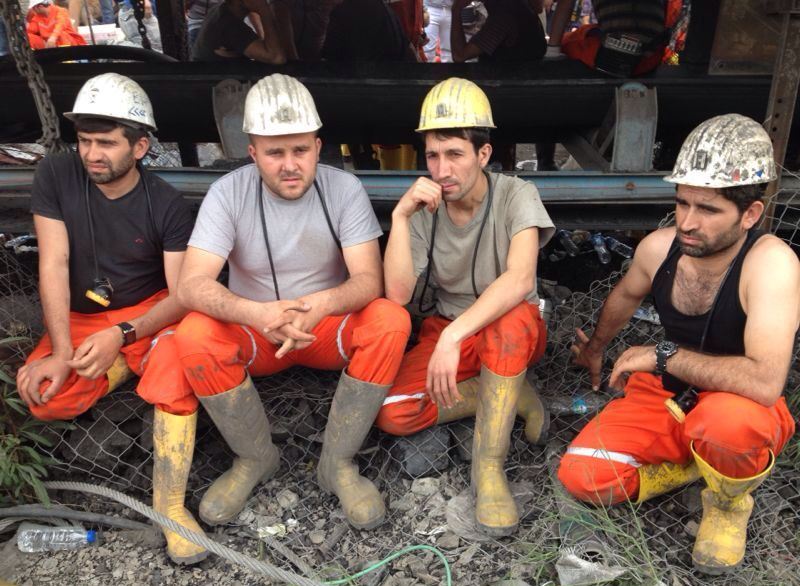
As I watch the Russian oil tankers going through the Dardanelles, I’m reminded that Turkey has little oil, but does have large coal reserves. Looking away from the straits, I see the hills towards Soma, just 100 miles away, where over 300 coal miners died in a disaster that should never have happened.
Miners at Soma coal mine
Despite the callous response from the mine owners and the government, most people I see want to say “Soma ,adencisi yalnız değil” (Soma miners are not alone). On campus, students sell pastries to raise funds for the victims’ families. In town, people march and spray graffiti to protest the government’s policies before, and the response afterwards. In the countryside, I see people whom I can imagine as not so different from the villagers whose family members worked in the mine.
Trying not to think about Soma, I walk to the Dardanos Tümülüsü (tumulus). This is a burial hill not far from our apartment, with artifacts dating from the second century BC, possibly earlier. The Çingene (also called Gypsy) people in Çanakkale say that they have been there for six centuries, possibly before the Ottoman rulers. But long before they arrived, who were the people who built the tumulus? I wonder about their walking on the same hills and coastlines, which they did when there was no choice to take the bus or car.
Dardanos Tümülüsü
My wanderings lead to wonderings about how we as humans, or any life, will survive the growth-at-all-costs ethos, dominant around the world. Fifty years ago, in the month I graduated from high school, Lyndon Johnson asked:
whether we build a society where progress is the servant of our needs, or a society where old values and new visions are buried under unbridled growth…expansion is eroding the precious and time-honored values of community with neighbors and communion with nature.
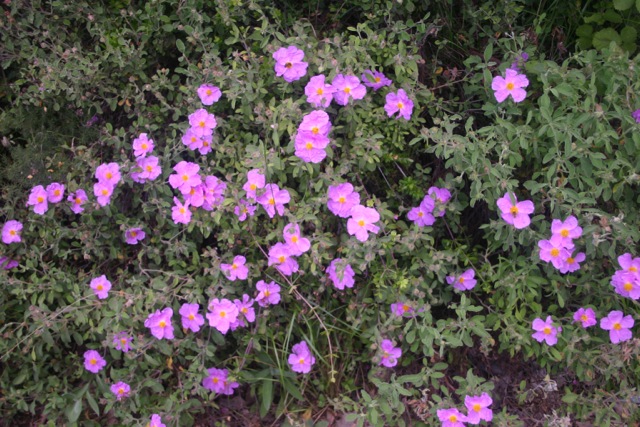
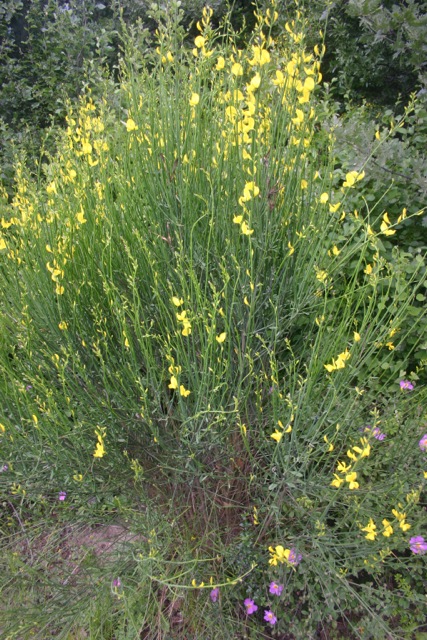
At least, here at Dardanos, there is some respite, if only within an hour’s walk. I see children in the large playground. There’s a vineyard. In the scrub forest there is a maquis ecology, with small pines, fir, cedar, holly, cyprus, and other evergreen trees, as well as some nut and fruit trees, such as valonia oaks, almond, fig, apple, and olive. The underbrush includes flowering broom, sage, oleander, and many interesting grasses. Most striking are the wildflowers–poppy, petunia, aster, and rose, plus many I can’t name. There are butterflies everywhere, birds, frogs, and lizards, all mocking the many wild cats. The ocean seems full of life, with octopus and squid, many kinds of fish and seaweeds, in spite of the heavy ship traffic.
Poppy field
Alongside the Dardanos, these life forms seem in tune with the beautiful setting and oblivious to the massive commerce steaming past and the construction boom on land. Let’s hope they can continue for a long time.
I’m afraid that my generation hasn’t done much to manifest Johnson’s call for “the wisdom to use…wealth to enrich and elevate our national life, and to advance the quality of our American civilization.” We have more nuclear weapons, greater destruction of the environment, abuse of workers, and precious little understanding of neighbors at home or abroad. All too often, our “old values and new visions are buried under unbridled growth.”
Petunias
In that 1964 speech, Johnson said,
The Great Society is a place where every child can find knowledge to enrich his mind and to enlarge his talents. It is a place where leisure is a welcome chance to build and reflect, not a feared cause of boredom and restlessness. It is a place where the city of man serves not only the needs of the body and the demands of commerce but the desire for beauty and the hunger for community.
I can’t say that I’ve learned very much in the fifty years since Johnson’s speech, but one thing is that the leisure he spoke about is not lost time, but a central aspect of being. Walking becomes for me a way to ensure that it happens. Otherwise I too often feel compelled to check the computer, go to a meeting, or accomplish some task. Or, I seek escape as a spectator, rather than participant in life.
That leisure is a necessary means to build connections and become one with the plants and animals nearby, the people, the land and sea, and the history that ties them all together. It’s both an essential part of life and means to understanding it better.
Observing the world while walking is paradoxical. It’s slower even than riding a bicycle or a horse, so the total distance covered seems puny. There’s little chance to see a Michelin *** “worth the trip,” a ** “worth a detour,” or even a * “of interest.” If you were to see a Michelin *, there would most likely be just one in several days of walking.
Yet I find that when I travel fast just to see a *, it often fails to live up to its rank. It’s often overrated, overly crowded, or less accessible than I imagined. But beyond that, if I got there in a blur, I don’t have a sense of what it means to be that * in just that place or how it relates to the things around it. But those relations are usually part of what gives it * status––the most of this or the best of that.
Çanakkale Martyrs’ Memorial
In contrast, when I walk I have plenty of time to observe and to think about what I see. Just this week, we walked from ÇOMU Dardanos, through Dardanos Village, past Kepez Limani, to Kepez center. The place names aren’t important if you don’t know the area. What’s worth noting is that this was a distance of over five miles each way, following the coastline. We could look at the hillsides to the east and across the Dardanelles to the Gallipoli peninsula to the west. With some stops and detours, plus lunch in Kepez, the return trip consumed much of the day.
Walking along the Dardanelles in this way we observed the bustling ship traffic. Some carried Russian oil from the Black Sea, traversing the Bosporous, the Sea of Marmara, the Dardanelles, then into the Aegean Sea and the Mediterranean. Some northbound traffic contained goods from China bound for İstanbul, then on to various destinations in Europe. There are weapons, radioactive materials, household items, clothes, industrial equipment, paper items, and who knows what else, probably 60,000 ships a year. Most of what I see is ships with cargoes mysterious to me, though I could spin fanciful tales about their purposes.
Fishing
The Dardanelles is a narrow, winding strait about 40 miles long. Making things worse, there’s a current of up to four knots flowing toward the Aegean, with a countercurrent underneath. The current changes as the strait narrows and widens, something I could examine in detail while walking. Ships pass port to port, so walkers on our path would most clearly see the northbound ships.
The bumper to bumper and two-way ship traffic and uncertain current makes it a difficult and dangerous waterway. Pilots must slow down and speed up their engines to maintain the 15 knot speed limit. Nevertheless, in 2005 over 55,000 ships, including almost 6,000 oil tankers passed through Marmara, most carrying Russian oil. (By the way, “bumper to bumper” may not be the correct nautical terminology.)
As I observed the straits on this and other walks, including a long one to Güzelyalı, I became intrigued by the shape of the straits and what that meant both for walking and shipping. I could see about a third of its length, from the Aegean Sea, where ships waited their turn to enter all the way to Çanakkale, where there’s a 90˚ turn at the narrowest point.
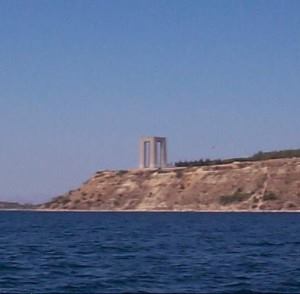
The narrowing and widening, the shape of the bays, and the strong prevailing winds off the water define the character of the walking, just as they constrain the ship traffic. The visibility changes with the winds; a good indicator being the Çanakkale Martyrs’ Memorial at the tip of Gallipoli. It’s clearly visible and sharp, with the Turkish flag flying above when the air is clear.
The walking and leisurely viewing made me think about the geography I was experiencing and want to read more about it. Gazing across to the Gallipoli peninsula, I couldn’t help being aware that I was in Asia, looking at Europe. About 50 miles to the south, is Cape Baba, in Babakale (Papa’s Castle), the westernmost point of Asia.
One could have these thoughts while riding in a car or sitting in an armchair at home. But I find that being outdoors, seeing the details of the landscape, and feeling the effects of sun, wind, tide, and time, I become more directly connected to the world and learn geography in a way I could never do with a map or book alone, and absolutely not while locked into a faster mode of transit.
On ne peut penser et ecrire qu’assis [One cannot think and write except when seated] (G. Flaubert). There I have caught you, nihilist! The sedentary life is the very sin against the Holy Spirit. Only thoughts reached by walking have value.
An important example of this for Nietzsche was his concept of the eternal recurrence of the same events. It occurred to him while he was walking in Switzerland in the woods around Lake Silvaplana, when he was inspired by the sight of a large, pyramidal rock. His inner life as writer and philosopher could not be separated from his embodied life as a person who spent hours walking in beautiful spots in Europe.
Why does it require the direct connection reached through walking to embrace an idea like eternal recurrence? Why not just use a map? Reading a book, map, diagram, photo, movie, etc. can be a powerful experience. Why can’t we have the same insights without being there? And what is the relation between reading a text about a phenomenon and experiencing it more directly?
John Dewey addresses this dichotomy in The Child and the Curriculum:
The map is not a substitute for a personal experience. The map does not take the place of an actual journey…But the map, a summary, an arranged and orderly view of previous experiences, serves as a guide to future experience; it gives direction; it facilitates control; it economizes effort, preventing useless wandering, and pointing out the paths which lead most quickly and most certainly to a desired result. Through the map every new traveler may get for his own journey the benefits of the results of others’ explorations without the waste of energy and loss of time involved in their wanderings–wanderings which he himself would be obliged to repeat were it not for just the assistance of the objective and generalized record of their performances.
Sunset on the Dardanelles
I’ve been thinking along these lines while reading, A Philosophy of Walking, by Frédéric Gros. The book is a pleasure to read (though not while walking). It intersperses Gros’s observations with accounts of other great walkers such as Rimbaud and Nietzsche. Gros writes,
By walking, you escape from the very idea of identity, the temptation to be someone, to have a name and a history … The freedom in walking lies in not being anyone; for the walking body has no history, it is just an eddy in the stream of immemorial life.
Curiously, the anomia and ahistory of walking, its “freedom,” is what allows the walker to connect to a greater degree with history, geography, and ideas in general. This has become even more evident to me during our stay in Turkey.
In 1971, I was fortunate to see an excellent play at Wyndham’s Theatre in London. It was Abelard and Heloise, by Ronald Millar. Keith Mitchell and Diana Rigg(!) had the title roles. The play was moving and the acting was superb. I can still visualize scenes, not so much from the stage setting, which was fine, but because the story caught my imagination.
Under the pretext of study we spent our hours in the happiness of love, and learning held out to us the secret opportunities that our passion craved. Our speech was more of love than of the books which lay open before us; our kisses far outnumbered our reasoned words. –Abélard
Over the years I would read whatever I could find by or about Héloïse d’Argenteuil and Peter Abélard, including biographies, fictionalized accounts, children’s stories, poetry, song, and of course the letters themselves. I saw several movie versions, some better than others. I began to learn how the story had inspired copies, re-mediations, satires, and endless allusions in a wide variety of artforms.
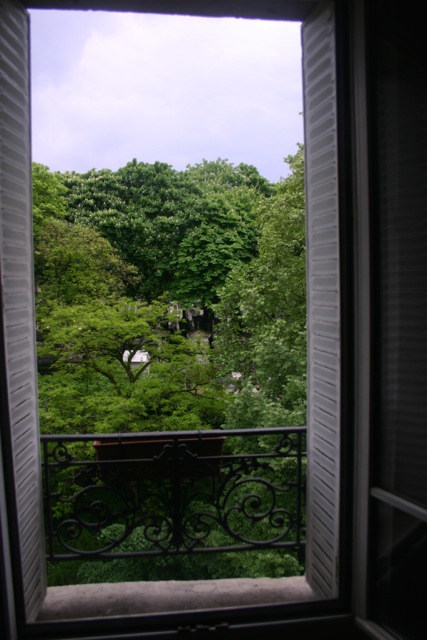
Père Lachaise Cemetery from apartment
Héloïse had seen this coming, with her own perceptive reflections on pictures, letters, talk, and physical presence. For example,
If a picture, which is but a mute representation of an object, can give such pleasure, what cannot letters inspire? They have souls; they can speak; they have in them all that force which expresses the transports of the heart; they have all the fire of our passions, they can raise them as much as if the persons themselves were present; they have all the tenderness and the delicacy of speech, and sometimes even a boldness of expression beyond it. –Héloïse
My obsession with the topic became worse in 2004, when we lived not far from Notre-Dame de Paris, where Abélard had studied and taught. I found an English translation of Régine Pernoud’s book in a used book store. Pernoud lists Héloïse first, which makes sense. Abélard was a great orator and writer, one we might revere even more if most of his works hadn’t been destroyed for his heresies. Yet, Héloïse (a great scholar herself) is the one who makes their story come alive, whether you interpret it as a love story, a theological debate, an example of 12th C patriarchy, or an invention of later writers. His letters are fascinating to read, but hers leap to the heights of the written art, even in translation from the original Latin.
One thing that comes through in every retelling is the tragedy of it all. There is of course the castration and the subsequent separation of Héloïse and Abélard. But there is also the tangible agony of struggles between possibility and reality, spirituality and desire, trust and betrayal. Their love always entailed suffering with happy moments that became recollections before they were fully realized. Even their son Astrolabe appears as a shadow of a world they imagined, but never had.
Monument to Abelard & Héloïse
Later, when their connection was only through letters, Héloïse seeks a way to share the loss, to find meaning in the emptiness:
Let me have a faithful account of all that concerns you; I would know everything, be it ever so unfortunate. Perhaps by mingling my sighs with yours I may make your sufferings less, for it is said that all sorrows divided are made lighter. –Héloïse
You can read one version of this in Alexander Pope’s poem, Eloisa to Abelard. Eloisa is in anguish over her powerful feelings for Abélard, especially as manifested in her dreams:
Black Melancholy sits, and round her throws A death-like silence, and a dread repose: Her gloomy presence saddens all the scene, Shades ev’ry flow’r, and darkens ev’ry green, Deepens the murmur of the falling floods, And breathes a browner horror on the woods.
She realizes that Abélard, now as a eunuch who is free from the “contagion of carnal impurity” cannot return her feelings even if he wants to. And so she begs, not for forgiveness, but for forgetfulness.
How happy is the blameless vestal’s lot! The world forgetting, by the world forgot. Eternal sunshine of the spotless mind! Each pray’r accepted, and each wish resign’d;
Today, one can walk near Père Lachaise cemetery on rue Pierre-Bayle. Bayle was a 17C philosopher. Where Abélard committed the heresy of seeing reason as a path to faith, Bayle advocated a separation between the spheres of faith and reason. He wrote about Héloïse and Abélard in his Historical and Critical Dictionary, a forerunner of the encyclopedias. One can also walk on the rue du Repos, which, were it not for the cemetery wall, would lead directly to where they lie in “repose” at their monument.
Héloïse d’Argenteuil
Cynics will point out that the monument was placed there in 1817 simply as a marketing ploy to convince Parisians to be buried among the famous; that the bones of the famous lovers are probably at the Oratory of the Paraclete, or the church of Nogent-sur-Seine, or most likely, just lost; that their love, if it existed at all, was no more than an expression of medieval structures of religious oppression, patriarchy, abuse of position, class, and power; and that the famous letters themselves were a literary concoction made long after the actual events.
Abélard would disdain these worldly concerns, and urge the cynics, along with Héloïse to
Strive now to unite in yourself all the virtues of these different examples. Have the purity of virgins, the austerity of anchorites, the zeal of pastors and bishops, and the constancy of martyrs.
But Héloïse would know that “the truth is more important than the facts.” She’d recognize that the Père Lachaise monument shows their eternal love, which endured politics, religion, castration, and even Abélard’s pomposity and coldness. She’d also see that just like Keats’s youth, they can never touch, so encased in granite, their suffering also endures forever.
I worked on these journal issues with John Pecore, Brian Drayton, and Maureen Hogan, as well as article contributors from around the world. We’re now exploring options for developing some of the articles along with some additional material into a handbook. The series is timely given current debates about the purpose and form of education in an era of rapid technological change, globalization, demographic and political shifts, and growing economic inequities. It asks, “What have we learned about pedagogy that can support democratic, humanistic, and morally responsible development for individuals and societies?”
Progressive education is a pedagogical movement that emphasizes aspects such as learning by doing, student-centered learning, valuing diversity, integrated curriculum, problem solving, critical thinking, collaborative learning, education for social responsibility, and lifelong learning. It situates learning within social, community, and political contexts. It was promoted by the Progressive Education Association in the US from 1919 to 1955, and reflected in the educational philosophy of John Dewey.
But as an approach to pedagogy, progressive education is in no way limited to the US or the past century. In France, the Ecole Moderne, developed from the work of Célestin Freinet, emphasizes the social activism side of progressive education. Loris Malaguzzi and the Reggio Emilia approach to early childhood education demonstrates the importance of art in learning, a key element of the holistic approach in progressive education. Paulo Freire’s work in Brazil on critical literacy, highlights the link between politics and pedagogy. Similarly, influenced by his experiences in South Africa, Mahatma Gandhi’s conception of basic education resonates with progressive ideals of learning generated within everyday life, cooperation, and educating the whole person, including moral development.
It is worth noting that progressive education invariably seeks to go beyond the classroom walls. Thus, the work of Jane Addams and others at Hull House with immigrants fits, even if it is not situated within a traditional school. Myles Horton and the Highlander Folk School focused on social activism with adults, exemplifying the progressive education ideals. So too is the Escuela Nueva in Spain, Colombia, and elsewhere. The informal learning in museums, libraries, community and economic development, and online may express progressive education more fully than what we see in many schools today.
We hope that these issues will prove to be a useful resource for anyone interested improving education for a healthier world.
It seems surprisingly easy to slip into dichotomies about the past. As Dickens wrote in A Tale of Two Cities,
It was the best of times, it was the worst of times, it was the age of wisdom, it was the age of foolishness, it was the epoch of belief, it was the epoch of incredulity, it was the season of Light, it was the season of Darkness, it was the spring of hope, it was the winter of despair, we had everything before us, we had nothing before us, we were all going direct to heaven, we were all going direct the other way.
Our idealized construction of the past then leads us to simplistic views of the present and even more cartoonish views of the future and what to do next. The US Presidential campaign is filled with examples of this, few of which bear repeating.
Cambridge Public Library, Past, Present, Future
Lapham shows some ways around dichotomous thinking about the past. One of those dichotomies is between the view of history as a detailed, and verifiable account of past events with little room for interpretation and of history as a consensual hallucination. He shows that history requires both careful attention to detail and continual reconstruction.
Most importantly, Lapham makes an effective case for the idea that history is necessary for a critical, socially engaged intelligence in the time in which we live. This means history that grows out of meticulous study of the details, openness to counter-intuitive or disturbing ideas, and investigation of the gremlins that don’t fit our preconceptions. He cites Faulkner’s “The past is never dead. It’s not even past” (Requiem for a Nun), on the way to showing how making sense of the past is part and parcel of making sense of the present.
We use the present to construct our past, just as we use our past to construct our present. For Lapham, then, the past is the phoenix in the attic. No matter how we engage with it, our uses of history shape what is to come. As he puts it,
History is work in progress, a constant writing, and rewriting as opposed to museum-quality sculpture in milk-white marble.
This doesn’t mean anything-goes relativism. Instead, it is a call to realize that who we are and who we may become are inseparable from who we have been. Unfortunately, that realization seems lacking, and the desire to learn is all too meagre for the needs of today.
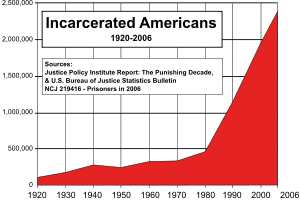
In his now classic analysis of the criminal justice system (The Crime of Punishment, 1966), Karl Menninger wrote, “I suspect that all the crimes committed by all the jailed criminals do not equal in total social damage that of the crimes committed against them.” That was at a time when the number of people in the US who were in jail or prison amounted to around 300,000. Today, that number is well over two million. The US has the highest documented incarceration rate in the world, well ahead of the #2 jailer, Russia, or that of many regimes considered to be dictatorships, police states, backward regimes, failed states, or otherwise democracy-challenged.
If you take into account prisoners, a large majority of African American men in some urban areas have been labeled felons for life. (In the Chicago area, the figure is nearly 80%.) These men are part of a growing undercaste — not class, caste — permanently relegated, by law, to a second-class status. They can be denied the right to vote, automatically excluded from juries, and legally discriminated against in employment, housing, access to education, and public benefits, much as their grandparents and great-grandparents were during the Jim Crow era.
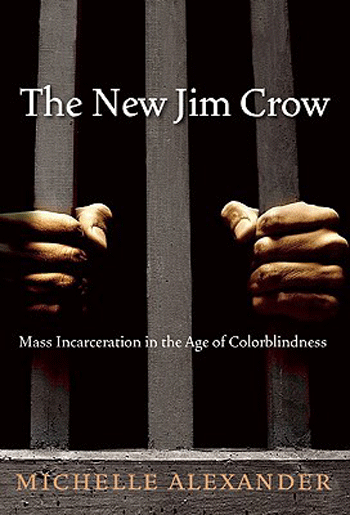
I just finished reading her book, The New Jim Crow: Mass Incarceration in the Age of Colorblindness (The New Press, 2010), which piles on the stunning and depressing statistics. But the book does much more than to amplify a sorry state of affairs that most of us know about, but rarely talk about. Several points came through strongly for me:
Through actual case stories, the book shows what these numbers mean for the felons for life, their families, their communities, and our democracy. In many cases the people so labeled are innocent, coerced into a plea bargain, or at most convicted of a minor crime.
Those who subsequently become subject to legalized second-class citizenship are disproportionately African American. Large numbers are convicted of drug crimes, even while their White counterparts are bigger users and sellers of drugs.
The mechanism by which this happens is a maze of laws and court rulings, which have severely compromised civil rights for all of us, even though their impact is primarily on people of color. One more item was added to the maze this week, when the Supreme Court ruled 5-4 that correctional officials may without cause, strip-search a person arrested for the most minor offense. Albert W. Florence was strip-searched twice after being wrongly detained over a traffic fine. Florence said at the time, “It was humiliating. It made me feel less than a man. It made me feel not better than an animal.”
The interlocking system including bias, laws, police procedures, courts, prison industry jobs and profits, has created a shameful justice system, far worse than the one lamented by Menninger.
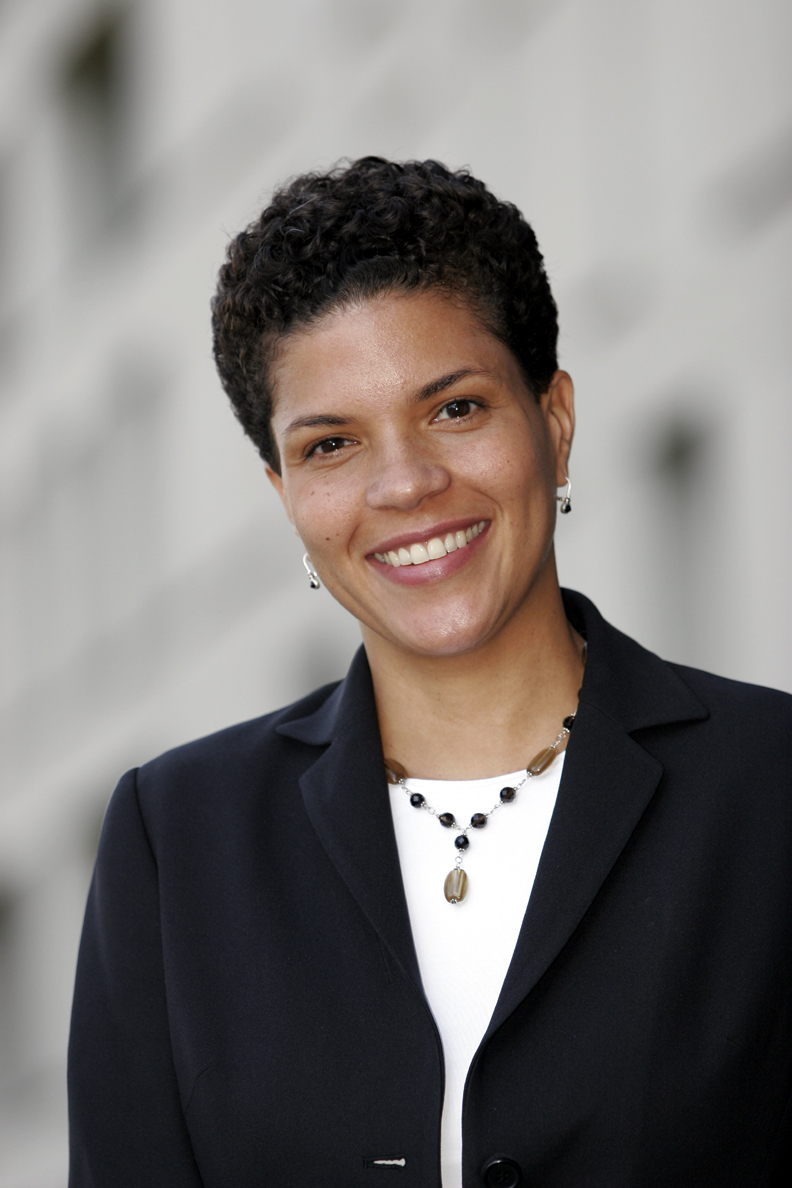
Michelle Alexander
Alexander says that she had several specific audiences in mind for the book. One is “people who care deeply about racial justice, but who for any number of reasons do not yet appreciate the magnitude of the crisis faced by communities of color as a result of mass incarceration. In other words, I’m writing this book for people like me, the person I was 10 years ago.” Another was for people “lacked the facts and data to back up their claims” about how the criminal justice system was operating as a third mode of racial caste making (following first slavery, then Jim Crow). I felt I fit in both of those camps, and fortunately not in the third, that of people trapped in the system.
Following her work on an ACLU racial justice project, Alexander says “I had come to suspect that I was wrong about the criminal justice system. It was not just another institution infected with racial bias but rather a different beast entirely…Quite belatedly, I came to see that mass incarceration in the United States had, in fact, emerged as a stunningly comprehensive and well-disguised system of racialized social control that functions in a manner strikingly similar to Jim Crow.”
Coming to appreciate that system in a deeper way makes the book powerful for me. It doesn’t in any way try to excuse crime, or to lay the blame for it on lack of employment, poor education, or inadequate housing, as many liberals might do. Nor does it link the injustice of the system to individual bias per se. Furthermore, it debunks accounts of individual responsibility, moral failure, or familial inadequacy as some conservatives might propose. Instead, it shows how the system operates, how it developed and grew, and why it will be so hard to change. Yes, better Supreme Court justices matter, but they won’t dismantle the system. Affirmative action is helpful, but it’s far from a solution. All of those explanations for crime and incarceration matter, too, but they’re not the central narrative.
The book is disturbing, and depressing at times. It cannot be said to end on a happy note, but in the last section, “All of Us or None,” there is at least a vision of what could make a difference. Alexander calls for a conversation on race in which “us” means “all of us,” or as Martin Luther King said, that a shift was needed from civil rights (interpreted simply as rights for those who are dispossesed) to human rights.
This means, among other things that
Whites should demonstrate that their silence in the drug war cannot be bought by tacit assurances that their sons and daughters will not be rounded up en masse and locked away. Whites should prove their commitment to dismantling not only mass incarceration, but all of the structures of racial inequality that guarantee for whites the resilience of white privilege. (p. 244)
The book closes with an excerpt from James Baldwins’s letter to his nephew in The Fire Next Time. That entire letter is worth reading and re-reading many times, but I’ll just end here with a small excerpt from that excerpt:
this is the crime of which I accuse my country and my countrymen, and for which neither I nor time nor history will ever forgive them, that they have destroyed and are destroying hundreds of thousands of lives and do not know it and do not want to know it…It is the innocence which constitutes the crime…They are, in effect, still trapped in a history which they do not understand; and until they understand it, they cannot be released from it…those innocents who believed that your imprisonment made them safe are losing their grasp of reality…And if the word integration means anything, this is what it means: that we, with love, shall force our brothers to see themselves as they are, to cease fleeing from reality and begin to change it. For this is your home, my friend, do not be driven from it; great men have done great things here, and will again, and we can make America what America must become.
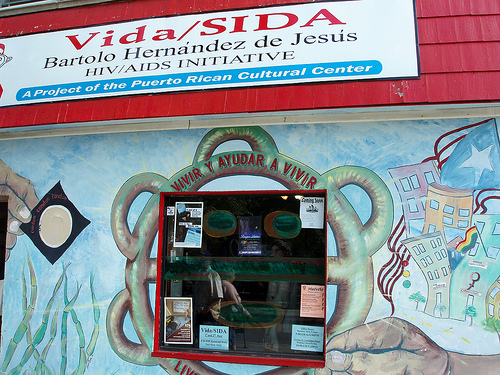
The mural on the front of Vida/SIDA in Chicago includes the phrase, “vivir y ayudar a vivir” (to live and help to live). That’s very appropriate for a health clinic, but it’s really the motto for everything done in the Paseo Boricua community. The idea is that in order to build a healthy community, people need to move beyond “live and let live,” which can mean “live for myself and to hell with you.” The more expansive motto, “vivir y ayudar a vivir,” can be seen there on murals, brochures, websites, and coffee cups.
I know that other groups have used the same phrase, but I’ve never been sure of its origin. Some people attribute it to Orison Swett Marden, a 19th century writer associated with the New Thought Movement. He founded Success Magazineand wrote extensively on how our thoughts influence our actions and experiences.
The Voice of Industry
The general idea is of course much older. For example, the Jain Center of Cincinnati Dayton has an historical marker asserting that the motto of Jainism is “live and let live and help others to live.” And Jainism dates at least from the 6th century BC, if not earlier.
More recently, both in the course of events, and in my own discovery process, I came across The Voice of Industry, a labor newspaper published from 1845-48. It was founded by the Lowell Female Labor Reform Association. An article from November 14, 1845, “Live -Let Live -Help Live,” gives one of the clearest and earliest explanations of the phrase that I’ve seen. Basically, it says that there are three sorts of people: those who take for their motto live regardless of others, those who adopt live and let live, and those who say live and help others to live.
I’d like to hear about other sources, or uses, of the phrase.













 Chip's journey