As we do research, prepare proposals for conferences, and work with community members to document their own experiences, it’s worth thinking about alternative methods for doing and presenting research.
English’s article (available online through Sage or the UI Library) uses interesting photographs to discuss the role of the camera in inquiry. He also explores the metaphor of the photo as a way of thinking about different approaches to a research subject, foe example, the wide angle view that surveys a situation versus the telescopic that focuses in on a particular issue.
Several of our Youth Community Informatics sites are mapping cemeteries. What sounds like small project, or even a gloomy one, soon opens up into far-reaching explorations of history, geography, health, families, technology, mathematics, literacy, and more.
At Iroquois West Middle School, youth started with a story about a primary school’s project to study cemeteries: Learning from graveyards. The “Map Masters” soon expanded this by incorporating technologies of GPS and GIS into their mapping project of the Onarga Cemetery. They have already made many discoveries and are continuing to do more. They’ll also connect with cemetery mapping projects in Cass County and East St. Louis.
One interesting tombstone that we found at the Onarga Cemetery was in the shape of a tree trunk. The name of the person buried there was Emory Gish. According to our reseach on symbolism the tree trunk showed a life cut short. The number of broken branches might symbolize the number of deceased family members buried nearby.
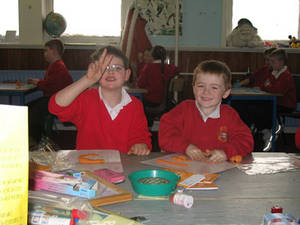
This video about journey sticks for learning geography presents a project for Key Stage 2 pupils (ages 7-11) in England. It’s a different age level, orientation, population, and technology from our Youth Community Informatics project. Even so, it has some interesting ideas and you’ll enjoy watching it. It shows how simple tools can help young people open up to the world around them.
The theme of the symposium is Critical Pedagogy: Community Building as Curriculum. As professionals and institutions are engaging with communities to enhance the life chances and well-being of residents, the conference examines how community-building and critical pedagogy can offer effective and sustainable change, locally and among collaborators as well.
The keynote speaker this year is Antonia Darder, a Professor at the University of Illinois in Educational Policy Studies and Latino/a Studies. There will be presentations and workshops on
The conference also offers Batey Urbano‘s production of Crime against Humanity, screenings of original documentaries filmed on Paseo Boricua, community tours, and art exhibits.
Community as Intellectual Space is co-organized by the Juan Antonio Corretjer Puerto Rican Cultural Center (Chicago) and the University of Illinois Graduate School of Library and Information Science. Continuing Professional Development Units (CDPUs), academic course credit for those who enroll in UI’s LIS590 CIO, and registration scholarships available.
One of the most impressive set of projects I saw while in Dublin, Ireland last year was the Community Links Programme out of Dublin Institute of Technology. It was established in 1996 by DIT lecturer Dr. Tommy Cooke to help individuals and communities reach their full educational potential. Programs include psychotherapy, music, and courses for mature students.
One important component is the DISC Programme, which operates in 38 inner-city disadvantaged primary and secondary schools. DISC installs computer resources in schools and community centers, and trains teachers to integrate the use of computers into the teaching/learning process in all curricular areas. Projects include the use of comic creation, clay animation, video production, class blogs, podcasting, video game making, 3d design, and robotic Lego.
Staff such as Ian Roller and Riona Fitzgerald bring knowledge of pedagogy together with skills in video and computers to help teachers and youth leaders do amazing projects. More importantly, they do it in a way that empowers teachers as creative agents in the education process.
I was very fortunate to hear Elizabeth Pierre-Louis speak yesterday.
Elizabeth was on campus to accept the 2008 Young Humanitarian Award. As Director of the Library Program at Fondasyon Konesans Ak Libète (FOKAL) in Haiti, she helped to set up 45 community libraries across the country. She coordinates the training and management of these libraries, which are improving the quality of live for the people there. Elizabeth described a wide variety of programs of FOKAL, including projects on supplying running water, developing basic literacy, supporting the visual arts, dance and music, debate, and economic education.
Throughout these many programs, there is an emphasis on participatory democracy, including organization and responsibility of citizens, leadership, financial and technical management, resolving conflicts, and collective decision making. Elizabeth’s work is just part of an amazing organization helping people work together toward common purposes.
The photo, of the Monique Calixte Library in FOKAL’s Cultural Center, and this text below are from the FOKAL site.
The Fondation Connaissance et Liberté / Fondasyon Konesans Ak Libète (FOKAL) Cultural Center, built in 2003 in the center of Port-au-Prince thanks to funding from the Open Society Institute (OSI) and support from George Soros, is designed for meetings, training, reading, debates, recreation and discovery.
The center is comprised of a public library, with a membership of over 5,000 where children and youths from the poor neighborhoods of Port-au-Prince have access to reading materials in optimal conditions, a small auditorium, a café-terrasse and a cybercafé. The UNESCO auditorium is a hall designed for conferences, debates, meetings, audio-visual presentations, films, concerts and theatre. The center also includes a large atrium where one can discover the works of both Haitian and foreign painters, writers, and sculptors; and a sound and video production studio, a training hall and gardens…
FOKAL’s cultural center offers a place, eminently rare in Haiti, where peasants, women, children and youths from poor neighborhoods have a chance to interact with each other and with representatives of all sectors of society on subjects which concern education, the environment, culture, and democracy…
The book, How Europe Underdeveloped Africa, is now available online.
Rodney presents a new way of thinking about Africa’s so-called “underdevelopment.” The question was “why are some areas of the world rich and others poor?” I had been taught many reasons for this—that successful countries had better inventions, more adventurous explorers, greater natural resources, geographical advantages, better climate, less corruption, or just good fortune. The implication was that they mostly deserved their status as did the less successful ones. Africa’s underdevelopment was thus to a large extent Africa’s fault. Of course, a generous impulse might lead us to help those less fortunate to develop and share the goods of the world, maybe not to achieve full equality, but at least enough to meet their minimal needs.
Rodney challenges that entire view. He describes an Africa that is more developed than Europe in most ways except military conquest. When Europe fails to compete on even terms with Africa and Asia it turns to war and colonization to take by force what it cannot achieve through fair trade. Africa is then consciously exploited by European imperialists, leading directly to the modern underdevelopment of most of the continent. Thus, “underdeveloped” is an active verb, with an agent who does the underdeveloping; it’s not just a descriptive adjective.
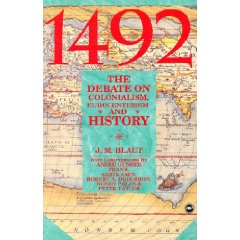
Rodney’s thesis was highly influential. James M. Blaut’s works, The Colonizer’s Model of the World: Geographical Diffusionism and Eurocentric History (Guilford, 1993) and 1492: The Debate on Colonialism, Eurocentrism, and History (Africa Research & Publications, 1993) extends the basic thesis, with more detailed economic analyses.
Other writers have criticized aspects of Rodney’s work, but the general idea seems even more salient in an era of neocolonialism. For example, Haiti today struggles under a crushing external debt. Nearly half of that was incurred under the Duvaliers, puppet dictators of the US. The Duvaliers stole the resources of the Haitian people, then assumed debts that oppress their children and grandchildren. Debt service, a burden essentially imposed by the US, makes economic growth nearly impossible. Yet commonplace accounts would say that “they” (the Haitian people) can’t manage finances, don’t know how to protect their natural resources, have a corrupt economy, lack creativity or initiative, or otherwise are to blame for their fate.
For many countries in Africa, for Haiti, and for other colonized areas, the forcible appropriating of indigenous human and natural resources means underdeveloping those areas. When we turn “underdevelop” into a past participle, “underdeveloped,” we make it easy to forget how that happened. Rodney puts it this way:
The question as to who, and what, is responsible for African underdevelopment can be answered at two levels. Firstly, the answer is that the operation of the imperialist system bears major responsibility for African economic retardation by draining African wealth and by making it impossible to develop more rapidly the resources of the continent. Secondly, one has to deal with those who manipulated the system and those who are either agents or unwitting accomplices of the said system. The capitalists of Western Europe were the ones who actively extended their exploitation from inside Europe to cover the whole of Africa. In recent times, they were joined, and to some extent replaced, by the capitalists from the United States; and for many years now even the workers of those metropolitan countries have benefited from the exploitation and underdevelopment of Africa. (§1.2)
Rodney’s account of Africa, written 37 years ago, is still relevant for Africa today. But it extends to other international regions and even to communities within so-called “developed” countries. When we see, and label, communities as underdeveloped, low-resource, impoverished, disadvantaged, economically depressed, troubled, or marginalized, we follow the lead of the 1965 Moynihan report, which described a “tangle of pathology,” locating problems within the community with causes in the distant past.
We should ask not only how these communities compare to privileged ones, or even what useful things we might do to help them. We need to look first at the structures and mechanisms of power that caused these conditions in the first place, and now, continue to maintain them. This means turning from the conceit that underdevelopment just happens, that an appropriate and full response is to “give” to those less fortunate. It requires collaborative struggle in which all participants are willing to examine the roots of oppression and to engage in the practice of freedom.
[tag cloud from the UC Books to Prisoners site, created using wordle]
UC Books to Prisoners is an Urbana, IL based project providing books to Illinois inmates at no cost. Books to Prisoners offers books by mail to all Illinois inmates and operates lending libraries in the two Champaign County jails.
Is your book collection weighing you down? Do you have a home library that is threatening the structural integrity of your abode? Champaign-Urbana has many great places to donate books. One of the neediest is the Books to Prisoners program, profiled earlier in a Smile Politely piece.
We take donations of used books from the community, mail books in response to prisoner requests, and stock and staff the two local jail libraries. Those books that are not suitable for prisoners, for a variety of reasons, are sold to cover the postage to mail books.
Thanks to community support, we have sent 32,162 books in 8,281 packages to 5,096 inmates since we were founded five years ago. Go here for details about dropping off books.
If you’d like to get rid of your books, merely to make space to acquire more, come to our Spring Book Sale April 3–5 at the IMC in the old Urbana Post Office. A huge assortment of high quality books: paperbacks at 50 cents, hardbacks for a buck.
Image courtesy of Windows to the Universe. “This is an artist’s conception of Pluto and Charon. Pluto is in the background and Charon is in the foreground. Pat Rawlings, Science Applications International”
The Illinois State Senate has redeemed poor Pluto from dwarf planet status to its rightful place in the universe, and established March 13 as Pluto Day. This was done in large part to honor Illinois native Clyde Tombaugh. One justification for this was that Tombaugh was the only American to discover a planet. Another was that there were no real problems left to work on.
There are of course a few problems with the Senate’s idea. Early Native Americans undoubtedly discovered most of the planets in our solar system, even if official histories don’t credit them. Other Americans have discovered many planets outside of our solar system. And what Tombaugh discovered isn’t really a planet, under current definitions.
But Pluto is now part of our culture. Even if it’s not a planet, do we really want children going around saying “My very educated mother just served us nine”? Nine what? Pluto gives us a reason to add “pizzas,” which might be reason enough to keep it.
Tombaugh did do something. Eric Jakobsson, points out that they should have honored him for “discovering the first of the Kuiper objects (as opposed to the last of the planets). Arguably, that was a more important discovery than another planet, because it added a whole new dimension to our understanding of the solar system.”
Eric’s argument highlights two different conceptions of learning. In one, authority gives us the answer, case closed. In another, ideas become tools for further inquiry. Richard Shaull, puts it this way in the foreword to Paulo Freire’s Pedagogy of the Oppressed (1993):
There is no such thing as a neutral educational process. Education either functions as an instrument to facilitate the integration of the younger generation into the logic of the present system, or it becomes the practice of freedom, the means by which men and women participate in the transformation of their world.
We should remember and honor Tombaugh’s dedication, intelligence, and painstaking studies of photographs. His work on Pluto and asteroids contributed to transforming our scientific understanding of the universe. That was not the social world that Freire means when he says the “practice of freedom,” but in its own way represented a challenge to the “present system.” Unfortunately, the Senate’s rearguard action has become an internet joke that fails to express what Tombaugh really accomplished.
I’ve been reading the articles on RiseOut, an online “news center focused on deschooling, youth activism, and other related issues concerning the rights of youth in the U.S.” There are entries on deschooling; unschooling; youth media; racism; the Highlander Folk School in New Market, Tennessee; Dr. “Patch” Adams; a review of the book, The Teenage Liberation Handbook, How to quit school and get a real life and education (by Grace Llewellyn); critiques of school segregation (and recent Supreme Court decisions that support it), credentialism, and military conscription.
Most of the articles on RiseOut are well-researched, thoughtful, and provocative. They remind me of the wonderful book, Letter to a teacher by the schoolboys of Barbiana, in which youth in Italy present a searing critique of their education and the unjust society it supports.
Both the Barbiana book and RiseOut address the question that Earl Kelley asks: What is real in education?. Kelley answers that the bedrock reality is the the actual life of youth.
The Obama administration’s proposed “Cradle to Career” education plan, has many good components, but education reform will never accomplish much if schooling continues to be separated from actual life and fails to come to terms with the issues raised in RiseOut.
From the RiseOut site:
We provide a diversity of alternatives to education that are self-directed and decentralized from standardized schooling. We support a young person’s choice in dropping out of school, free of social stereotypes and biases. We aim to provide a plethora of alternatives from a 12-year prison like sentence of state schooling, while staying vigilant of abuses against young people through diagnosing, segregation, ageism, adultism, sexism, and other assholisms.
A message to those who have decided to quit school:
Instead of dropping out, we applaud you for your courage to “riseout” from a nightmarish disposition of compulsory schooling. We hope RiseOut can be a resource for sharing your stories and providing choices towards regaining control over your own education.

 While lost amidst sorting through 30 boxes of my files, I’ve occasionally come across some gems. One is

 Ian Roller and
  Riona Fitzgerald bring knowledge of pedagogy together with skills in video and computers to help teachers and youth leaders do amazing projects. More importantly, they do it in a way that empowers teachers as creative agents in the education process.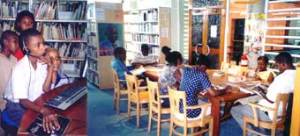



 Chip's journey