People of the rebus

Camp family, 1900

Camp family, 1900

If you’re curious about the rebus baby announcement––Who sent it? Who was the baby? Who was Dorothy?, this may help a little.

Camp family, legend

Camp family, legend

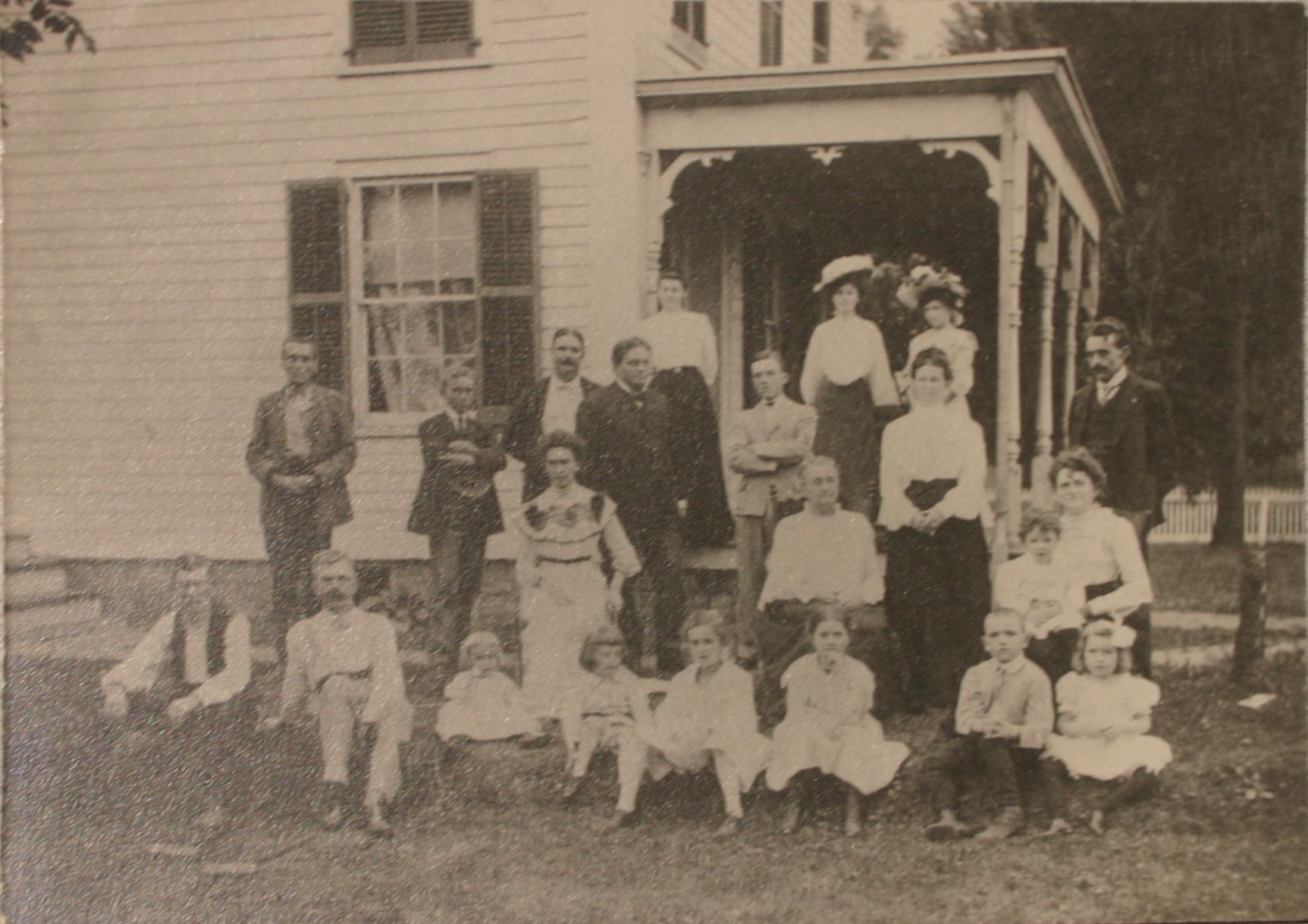
The picture to the left (click to enlarge it) is of the Camp family, around 1900. In the center is Samantha Ann Harris Camp (11), who was known to the others in the photo as “Grandma.” She was born in southern Pennsylvania on July 3, 1835. When she was one year old, her family went down the Ohio by flatboat, then up the Mississippi and Illinois to the beautiful area of Sharp’s Landing, not far from where I’ve done some youth media work in Beardstown and Virginia.

Sharp's Landing area, by JaySRT4

Sharp's Landing area, by JaySRT4

Samantha Harris taught school in Vermont, Illinois, then married Sterling P. Camp and moved with him to his farm in Walnut Grove. They had five children: Thomas (5) William (12), John R. (21), Frank (1), and Anna (13), who surround her in the photo. They later moved to Bushnell. John R. Camp became Editor of The Bushnell Record, the local weekly.

Unfortunately, Sterling died young. One consequence was that Samantha outlived him by more than 40 years and had to raise the five children mostly on her own. She died on January 10, 1913, thirteen years after this photo was taken in front of their family residence in Bushnell.

By the time of the photo, Samantha’s son William had married Jennie Daniels (4), who came from Spokane. Their children were John (20), Glanville (19), and Dorothy (18).

Fannie Daniels (not shown) was one of Jennie’s siblings, the others being Minnie, Annie, and Willie. As far as I know, none of them married or had children. (Aunt) Fannie was the one who created the rebus for Dorothy, about five years after this photo.

What did Dorothy think of it? Did she decode it on her own? Was Fannie in the habit of making rebuses for her nieces and nephews? The Camp family seemed adept at producing offspring; why not the Daniels? How did William from rural Illinois connect with Jennie in Spokane? I need to find a flatboat and go back in time to find out.

Can a community stop fracking?

Photo courtesy creative commons by Helen Slottje

Mari Margil and Ben Price have a detailed article in Yes! magazine this month about Pittsburgh’s recent ban on natural gas drilling, which uses the “fracking” or hydraulic fracturing technique. Pittsburgh is the first major city in the US to ban corporations from natural gas drilling.

The ordinance has a direct impact on Pittsburgh, but as they point out, its implications go much further:

Provisions in the ordinance eliminate corporate “personhood” rights within the city for corporations seeking to drill, and remove the ability of corporations to wield the Commerce and Contracts Clauses of the U.S. Constitution to override community decision-making.

Community decision making is essential in this arena for two reasons: First, exemptions to the Clean Water Act and the Clean Air Act for the oil and gas industry, expanded even further in 2005, mean that the burden of proof is now on communities to prove that any drilling practice is unsafe. This, it’s essential that communty decision making be supported and seen as the proper venue for judging the value of any drilling. Second, no individual landowner can have much impact on the drilling. The horizontal drilling methods mean that the fracking can proceed, regardless of landowner approval. All the landowner can do is decide to forego any royalties. This effectively grants all power to the corporation doing the drilling.

This issue hits home for me, since Fort Worth has been a major site for fracking (Smith, 2010). Although the oil and gas industry has asserted that fracking does not pollute underground water supplies or air quality, does not cause earthquakes, and is all in all a benign way to produce clean energy, it’s difficult to accept the assertions when they continually seek exemptions to EPA review and refuse to release data on the chemicals and procedures they use.

References

Turkey’s Village Institutes

One of the goals I had for my recent trip to Turkey was to learn more about the Village Institutes (Köy Enstitüleri) there. I knew that they represented an innovative approach to expanding opportunities for learning, but that they had come to an abrupt end in the late 1940’s.

I’d read several articles about the Institutes (see below), and also knew that they had been influenced by John Dewey’s report on the Turkish educational system, but I wanted to hear firsthand from Turkish people who had been involved with the Institutes, or had studied them from a Turkish perspective.

The Village Institutes were created to meet a serious educational need. In 1928 (the year of the introduction of the Latin script in Turkey), 82.5 per cent of men and 95.2 per cent of women were illiterate. For 13.6 million people, there were only 4,894 elementary schools and most of those were in the towns, not the villages where most of the people lived (Vexliard & Aytac, 1964).

Between 1939 and 1946 twenty-one co-educational boarding schools were built to prepare primary school teachers. Much of the construction work was done by pupils and teachers. Youth of both sexes, aged twelve to sixteen, who had completed a five-year village primary school, qualified for admission. Their education was free following a pledge to teach in an assigned village for twenty years after graduation.

The duties of the new teachers included:

  • primary education
  • adult education in the villages
  • raising the cultural level of the villages through the distribution of books, educational programs, radio, and vocal, dance, & instrumental music education; the photo above (by George Pickow/Three Lions/Getty Images), shows Turkish teenagers in an Institute presenting a mass concert on the saz, the Turkish national instrument
  • promoting progressive agricultural techniques in the fields, the orchards, and kitchen gardens; the raising of  livestock; rural handicrafts such as ironwork, carpentry, leather work, mechanics, and electricity
  • instruction for adults in child-rearing, housekeeping, needlework
  • the creation and development of rural cooperatives

The graduates of the Institutes were to return to their villages as leaders and reformers. Teachers, students, and villagers in general were to learn practical skills, mostly related to their agricultural economy, new tools for life, and general education.

The Institute approach embodied ideas of Ataturk, Dewey, and others such as integrating theory and practice, focusing on the underserved, working across institutions, and a systemic approach to building a stronger society. Classical education was to be combined with practical abilities and applied to local needs.

The Institutes had a major impact, and many people regret that they were shut down. But there was resistance against this secular and mixed education. Some feared that it would educate ‘the communists of tomorrow,’ a damning statement during the Cold War. Traditionalists questioned the coeducational and secular aspects. Powerful landlords did not appreciate the goal of educating children who could ask “Why?” questions. There were also questions about the organization and preparation of the teachers. By 1953 the Village Institutes had been completely shut down.

I heard strong statements from people who knew about the Institutes and decried their closing. An artist we met, who had been born during the Institute period, said “They killed the Turkish children! They murdered Turkey’s future!”

Others were more reserved, but still felt that a crucial opportunity had been lost. There are estimates of major losses for Turkey in terms of general literacy and economic development still being felt today because of the closings.

From the little I know, it appears that the Village Institutes demonstrated a successful model for education that could be applied anywhere after suitable adjustment for local needs. I’d like to learn more, and have many questions.

For example, all the photos I’ve seen show only (or mostly) young men, even though the Institutes were coeducational. How did the young men and women get along? How did they each experience the Institutes? The graduates would now be in their 80’s. How do they think about that experience today? What did their training mean for the villages where they went to teach?

How do the Village Institutes compare to other grassroots, community-based education initiatives, such as the school at Weedpatch Camp in California, Foxfire, the Misiones Pedagogicas (village literacy program in Spain, which was shut down by Franco), Paulo Freirean projects in many countries, Paseo Boricua, the Reggio Emilia Approach, or the school set up by the schoolboys of Barbiana?

Perhaps most importantly, could or should the Institutes be revived? Or, are there principles we can derive from them that would be valuable for the more urban populations of today?

References

Ata, Bahri (2000). The influence of an American educator (John Dewey) on the Turkish educational system. Turkish Yearbook of International Relations (Milletlerarası Münasebetler Türk Yıllığı), 31. Ankara: Ankara Üniversitesi.

Bilgi, Sabiha, & Özsoy, Seckin (2005). John Dewey’s travelings into the project of Turkish modernity. In Thomas S. Popkewitz (ed.), Inventing the modern self and John Dewey: Modernities and the traveling of pragmatism in education (pp. 153-177). New York: Palgrave Macmillan.

Dewey, John (1983). Report and recommendations upon Turkish education. In Jo Ann Boydston (ed.), The Middle Works: Essays on Politics and Society, 1923-1924. Vol. 15 of Collected Works. Carbondale: Southern Illinois Press.

Eğrikavuk, Işil (2010, April 9). Anniversary marks unfinished story of Turkish village schools. Hürriyet Daily News.

Stirling, Paul (1965, 1994). Turkish village. Canterbury, UK: Centre for Social Anthropology and Computing, University of Kent at Canterbury.

Stone, Frank A. (1974). Rural revitalization and the Village Institutes in Turkey: Sponsors and critics. Comparative Education Review, 18(3), 419–429.

Uygun, Selçuk (2008, November). The impact of John Dewey on the teacher education system in Turkey. Asia-Pacific Journal of Teacher Education, 36(4), 291–307.

Vexliard, Alexandre, & Aytac, Kemal (1964). The Village Institutes in Turkey. Comparative Education Review. 8(1), 41-47.

Wolf-Gazo, Ernest (1996). John Dewey in Turkey: An educational mission. Journal of American Studies of Turkey, 3, 15-42.

Yılmaz, Omer (1977). Schools for developing countries: The Turkish Village Institutes. Educational Planning, 3(4), 72–80.

Navigating the corridor of inquiry

It’s not often that I have an Aha! moment reading an academic article. Many have significant flaws and many of the best repeat what’s been said many times before. But I had a very different reaction to Patricia M. Shields’sPragmatism as a Philosophy of Science: A Tool for Public Administration.”

The paper shows how pragmatism as a philosophy of science is used in a research methods class. The course includes guides to writing an empirical capstone project, such as steps to follow, the notebook method, and the classification of conceptual frameworks.  But what makes it special is the explication of these in terms of their roots in the ideas of Peirce, Dewey, and James.

She quotes from William James (1904), who writes about the relation of pragmatism to theories:

Theories thus become instruments, not answers to enigmas, in which we can rest. We don’t lie back upon them, we move forward, and, on occasion, make nature over again by their aid. Pragmatism unstiffens all our theories, limbers them up and sets each one at work…

All these [theories], you see, are anti-intellectualist tendencies… [pragmatism] stands for no particular results. It has no dogmas, and no doctrines save its method. As the young Italian pragmatist Papini has well said, it lies in the midst of our theories, like a corridor in a hotel. Innumerable chambers open out of it. In one you may find a man writing an atheistic volume; in the next some one on his knees praying for faith and strength; in a third a chemist investigating a body’s properties. In a fourth a system of idealistic metaphysics is being excogitated; in a fifth the impossibility of metaphysics is being shown. But they all own the corridor, and all must pass through it if they want a practicable way of getting into or out of their respective rooms.

The paper accomplishes four major feats. First, it serves as an excellent introduction to pragmatism, articulating it in terms of actual experience and concrete action in the world, as pragmatists would have it. Second, it offers a way of thinking about research, which can help anyone who struggles with the relation between theory and practice, or gets stuck in dichotomies such as quantitative/qualitative. It show how theories can come alive, be unstiffened, so that they can help us make sense of experience without overconstraining. Third, the paper describes a creative use of an institutional repository, which helps students enter into a community of inquiry. See, for example, the excellent paper by Robert Brom (2000), Workplace diversity training: A pragmatic look at an administrative practice. Finally, it does a fine job of doing what it sets out to do, to describe the process of designing an excellent approach to a research methods or capstone course.

References

Brom, Robert A. (2000). Workplace diversity training: A pragmatic look at an administrative practice. Applied Research Projects. Paper 91.

James, William (1904, December). What is Pragmatism. From series of eight lectures dedicated to the memory of John Stuart Mill, A new name for some old ways of thinking, from William James, Writings 1902-1920. The Library of America

Shields, Patricia M. (1998). Pragmatism as a philosophy of science: A tool for public administration. Faculty Publications-Political Science. Paper 33.

Libraries for netroots activists?

Netroots is a term that describes political activism organized through blogs, wikis, social network services, and other online media. Jerome Armstrong used it first in Netroots for Howard Dean (2002) on MyDD.

The netroots can be a powerful alternative to traditional media and organizations. Often though, the change that activists promote never happens, can’t be sustained, or can’t scale. Netroots talk doesn’t always lead to action.

It may seem to strange to turn to libraries as a solution. Aren’t libraries all about books and old stuff, not the new participatory culture of the net? Aren’t they determinably neutral, both unwilling and unable to engage with the kinds of change activists seek?

In fact, libraries already play a crucial role to support activism of various kinds. And they’re already deeply entangled both with how we go online and with how we find what’s not available there. They’re not only a supplement to the netroots, but a necessary resource to bring netroots activism to life.

If you go to any public library in the US at opening time, you’ll see a group of people waiting to enter. They’re of all ages, ethnicities, and genders, dressed in formal business attire, sports clothes, or old rags. Some may be waiting to check out a book or video, but most are waiting to go online to read their mail, connect with friends, check the news, hunt for a job or apartment, shop, book travel, or do any of the many other functions that reveal how much the net has infiltrated our lives. For them, the library is the face of the net, and the only, or at least the best, way of connecting with it.

Moreover, libraries can provide substantive data, e.g., on the climate, business trends, local history, political processes, art, and more, which is not always available online; text resources, including books, journals, magazines; videos and software; and repositories or archives of local activities. They also offer meeting spaces, and sustainable local points of contact. These resources can expand enormously the knowledge base for netroots activism, something that can turn strongly held views into evidence-based arguments and uncover duplicity in corporate or government bodies.

Libraries also offer reference services, which is important since the deep web holds several orders of magnitude more information than the surface web, and non-web information is much more than that. Libraries also offer instruction on accessing all of these resources, data, and services.

Beyond finding information, libraries increasingly offer opportunities to create and house community-designed or collected resources. For example, a collaboration between Dr. Pedro Albizu Campos High School (PACHS) in Chicago’s Humboldt Park neighborhood and the Newberry Library in Chicago led to a student-curated Puerto Rican history exhibit at the Newberry: Puerto Rican History through the Eyes of Others.

As a means of finding information and tools, a venue for creating resources, a place to learn, and access in the first place, libraries can help turn netroots talk about activism into real action in the world. Of course, most libraries are devoted to principles of open access for all. As a result, what they offer is available to groups large and small, but also to groups on opposing sides of an issue. This means that despite all the power and innovation of the net, much of the action is still, if not increasingly, found in the library.

Inquiring and acting

John Dewey makes an interesting distinction between understanding and information:

An individual may know all about the structure of an automobile, may be able to name all the parts of the machine and tell what they are there for. But he does not understand the machine unless he knows how it works and how to work it; and, if it doesn’t work right, what to do in order to make it work right…Understanding has to be in terms of how things work and how to do things. Understanding, by its very nature, is related to action; just as information, by its very nature, is isolated from action or connected with it only here and there by accident. (Dewey, 1937, p. 184)

If we line up “how things work” with inquiry and “how to do things” with action, we have a good summary of the Youth Community Informatics activity guide, Community as Curriculum. It’s set up with units on Youth as Inquirer and Youth as Activist.

An example might be to study the problem of alcoholism in your community (Inquirer), then make a book about it, such as This is the Real Me (Activist). Several thoughts occur to me:

  • The inquire/act distinction is not absolute; it’s hard to come up with a good example in which the two roles are not blended and mutually supportive. But it can still be useful for reflecting on our work, and thinking about future directions for community informatics.
  • The Inquirer part goes well beyond what usually happens in school in terms of relevance, connectedness, community base, and so on. But the Activist part rarely happens at all.
  • Much of the research in social informatics, and even community informatics, which studies community use of ICTs, digital divide, or demographic patterns, tends to “name all the parts of the machine and tell what they are there for.” That can be useful, just as it would be for an automobile.
  • But, if we seek understanding in Dewey’s sense, we need more of a community inquiry approach.

References

Dewey, John (1937). The challenge of democracy to education. In The collected works of John Dewey, 1882-1953. Electronic edition. The Later Works of John Dewey, 1925-1953. Volume 11: 1935-1937, Essays, Liberalism and Social Action. [First published (February 1937) in Progressive Education 14, 79-85, from a transcript of an address on November 13, 1936 at the Eastern States Regional Cnference of the Progressive Education Association in New York City.]

Inquiry-based community engagement

Melissa Pognon just alerted me to an interesting article by David Low, on university-community engagement. It presents a dialogical, or inquiry-based, view of engagement, drawing from communication theory and Perice’s theory of inquiry. Low emphasizes that

we do not ‘transfer’ or ‘transmit’ knowledge between social systems, but, rather, we engage a method that enables the recognition of a shared object of enquiry – its entelechy (Nicholls 2000) (p. 108).

This shared enquiry must not only tolerate dissent or difference, it actually depends on dissent to function at all. Such a view is radically different from the dominant university discourse around topics such as “knowledge transfer,” “public outreach,” or “service learning.”

Low writes,

without a method to nurture and reveal dissent, universities would be unable to even recognise different ways of being in the world, and enquiry would be rendered impossible (Hawes 1999, p. 235) (p. 111).

I find myself drawn initially to 2×2 tables such as the one Low presents in his grid-group, then later becoming frustrated with all that they obscure as well as reveal. But the article as a whole has many useful insights.

References

Hawes, L. (1999). The dialogics of conversation: Power, control, vulnerability. Communication Theory, 9(3), 229–264.

Low, David (2008). University-community engagement: A grid-group analysis. Gateways: International Journal of Community Research and Engagement, 1, 107-127.

Nicholls, A. (2000, September). The secularization of revelation from Plato to Freud. Contretemps, 1, 62–70.

Peirce, Charles S. (1877, November). The fixation of belief. Popular Science Monthly, 12, 1-15.

Outside lies magic, Part 1

Gesa Kirsch recently pointed me to John R. Stilgoe’s, Outside lies magic: Regaining history and awareness in everyday places. It’s a refreshing call for becoming more aware of the ordinary world around us. Stilgoe urges us not only to walk or cycle more, but also to use the advantages of those modes of transport to see the world that we usually ignore.

I finished the book, and am writing now, in the antipode of his call to walk and observe. I’m cramped in an airplane seat near the end of a four and a half hour flight. Stilgoe would say that I should still take the opportunity to observe, to learn, and to make sense of my surrounding, but instead I’m counting down the minutes until we land.

The chapters—Beginnings, Lines, Mall, Strips, Interstate, Enclosures, Main Street, Stops, Endings—lie somewhere between prose poems, history lessons, and sermons about the everyday. They remind me of John McDermott’s summary that John Dewey “believed that ordinary experience is seeded with possibilities for surprises and possibilities for enhancement if we but allow it to bathe over us in its own terms” (1973/1981, p. x).

To appreciate the book, you need to follow Stilgoe as he discovers nature, history, urban planning, ethics, social class, and more through cracks in the pavement, vegetation, telephone poles, roadside motels, angle parking, and other seemingly forgettable objects. The real point is not his own findings, but the demonstration that slowing down to look can open up worlds of understanding.

He shows the value of a camera, despite the lament that “ordinary American landscape strikes almost no one as photogenic” (p. 179). He recognizes the dread of causal photography (‘why are you photographing that vacant lot?’), but ties it to “deepening ignorance” (p. 181). This ignorance makes asking directions dangerous: People question us back, ‘Why do you want to know?’

Stilgoe says, “discovering the bits and pieces of peculiar, idiosyncratic importance in ordinary metropolitan landscape scrapes away the deep veneer of programmed learning” (p. 184). Unprogrammed exercise and discovery leads to a unified whole that reorients the mind and the body together. Someone else may own the real estate, but “the explorer owns the landscape” (p. 187).

Stilgoe’s prescription is simple:

Exploration encourages creativity, serendipity, invention.
So read this book, then go.
Go without purpose.
Go for the going.

See Outside lies magic, Part 2.

References

  • McDermott, John J. (1981). The philosophy of John Dewey: Two volumes in one. Chicago: University of Chicago Press. (Originally published 1973)
  • Stilgoe, John R. (1998). Outside lies magic: Regaining history and awareness in everyday places. New York: Walker.

Youth planners in Richmond, CA

I was fortunate to have a visit with youth planners at the Kennedy High School in Richmond, CA on Wednesday this week. These were students studying their own community and developing plans to improve it. They’ll be presenting these plans to the Mayor next month.

What I saw is part of Y-PLAN (Youth — Plan, Learn, Act, Now), a city planning program run by UC Berkeley’s Center for Cities & Schools. Deborah McKoy is the creator of Y-PLAN and the center’s founder and executive director.

Sarah Van Wart from the UC Berkeley I School was my guide. She and two undergrads, Arturo and Sarir had been leading the high school students in a community planning exercise. They first examined their current situation, using dialogue, photos, and data. They then considered alternatives and how those might apply to a planned urban development project.
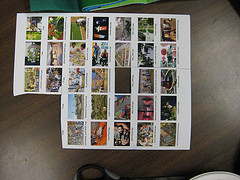
The development will include schools, housing, a park, and community center, but the questions for city planners, include “How should these be designed?” “How can they be connected?” “How can they be made safe, useful, and aesthetically pleasing?”

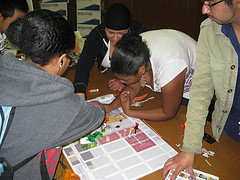
On the day I visited, the youth had already developed general ideas on what they’d like to see in the development. Now they were to make these ideas more concrete through 3-D modeling. Using clay, toothpicks, construction paper, dried algae, stickers, variously colored small rocks, and other objects, they constructed scale models of the 30 square block development. One resource they had was contact sheets of photos of other urban environments. They could select from those to include as examples to emulate or to avoid.

I was impressed with the dedication and skill of the leaders of the project, including also the teacher, Mr. G. But the most striking thing was how engaged the young people were. I heard some healthy arguing about design, but I didn’t see the disaffection that is so common some high schools today.
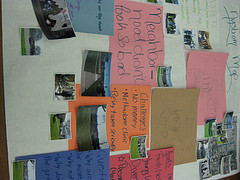
My only regret is that I wasn’t able to follow the process from beginning to end. But from the rich, albeit limited, glimpse I had, the project is an excellent way to engage young people in their own communities, to use multimedia for learning and action in the world, and to learn how to work together on meaningful tasks. It’s a good example of community inquiry.

Sara Bernard has a more detailed article on the project on Edutopia, which includes an audio slide show:

Audio slide show: Putting Schools on the Map Slide Show
Putting Schools on the Map

References

Bernard, Sara (2008, October). Mapping their futures: Kids foster school-community connections.

Bierbaum, Ariel H., & McKoy, Deborah L. (2008, Spring). Y-PLAN: A tool for engaging youth and schools in planning for the future of their communities. IMPACT: A Multidisciplinary Journal Addressing the Issues of Urban Youth, 2(1).

McKoy, Deborah, & Vincent, J. 2007. Engaging schools in urban revitalization: The Y-PLAN (Youth-Plan, Learn, Act, Now). Journal of Planning Education and Research, 26, 389-403.

Coffee Party USA

I met recently with someone who’s played a major role in starting Coffee Party USA. It’s a promising idea, one which provides at least some counter to the vicious, self-serving, and dogmatic rhetoric we hear so often in other arenas. I’ll be interested to see how it develops.

Coffee Party USA includes online forums and Facebook. On Saturday, the First National Coffee Day was launched in 350+ coffee shops in 44 States. The group

…aims to reinvigorate the public sphere, drawing from diverse backgrounds and diverse perspectives, …[believing] that faithful deliberation from multiple vantage points is the best way to achieve the common good…

We are 100% grassroots. No lobbyists here. No pundits. And no hyper-partisan strategists calling the shots in this movement. We are a spontaneous and collective expression of our desire to forge a culture of civic engagement that is solution-oriented, not blame-oriented.

We demand a government that responds to the needs of the majority of its citizens as expressed by our votes and by our voices; NOT corporate interests as expressed by misleading advertisements and campaign contributions.