Sabbatical with major stays in Beijing, China and Brisbane, Australia and stops in Oklahoma, New Mexico, Arizona, Nevada, Texas, California, Indonesia, Malaysia, Singapore, Italy, and Wales along the way, 1996-1997.
Discoveries (1995) is a series of four interactive CD-ROM programs for Grades 3-6 (ages 8-12). It includes hypertext, panoramic images, and immersive technology in a pre-web ecology.
Into the Forest (Great Smoky Mountains National Park) [ISBN 0-669-36168-2]
Alvermann, D. E., Arrington, H. J., Bridge, C. A., Bruce, B. C., Fountas, I. C., Garcia, E., Paris, S. G., Ruiz, N. T., Schmidt, B. A., Searfoss, L. W., & Winograd, P. (1995). Teacher to teacher: A professional’s handbook for the primary classroom. Lexington, MA: D. C. Heath. [218 pp.; ISBN 0-669-35984-X]
Alvermann, D. E., Arrington, H. J., Bridge, C. A., Bruce, B. C., Fountas, I. C., Garcia, E., Paris, S. G., Ruiz, N. T., Schmidt, B. A., Searfoss, L. W., & Winograd, P. (1995). Teacher to teacher: A professional’s handbook for the intermediate classroom. Lexington, MA: D. C. Heath. [216 pp.; ISBN 0-669-35985-8]
The National Assessment of Educational Progress (NAEP) is the only nationally representative and continuing assessment of what America’s students know and can do in various subject areas. Assessments are conducted periodically in mathematics, reading, science, writing, the arts, civics, economics, geography, and U.S. history.
Since NAEP assessments are administered uniformly using the same sets of test booklets across the nation, NAEP results serve as a common metric for all states and selected urban districts. The assessment stays essentially the same from year to year, with only carefully documented changes. This permits NAEP to provide a clear picture of student academic progress over time.
In the late 1980’s a plan developed for state-by-state reporting of 1992 reading data from the National Assessment of Educational Progress (NAEP). This plan was accompanied in the early 1990’s by a new framework for the assessment of reading. Jean Osborn, Michelle Commeyras, and I were asked to investigate the adequacy of the process used to develop the framework, the degree to which it represented a consensus among professionals in the reading field, and its content and curricular validity.
To conduct this investigation, we analyzed documents produced by NAEP, convened a 2-day panel of experts, held two public colloquia, conducted 50 interviews, and analyzed responses to a questionnaire completed by 627 leading educators. We found that the planning process did not include enough time to address some major concerns of the field. Despite this, there was widespread agreement that the 1992 NAEP in Reading represents important advances in reading assessment, including more open-ended responses, more authentic texts, and student choice about passages. But these very advances raise problems for test design and the interpretation and scoring of student responses.
Materials from this study are now stored in University of Illinois Archives, including trial materials (items proposed for use in the assessments), working papers, meeting minutes, and research protocols.
References
Bruce, Bertram C., Osborn, Jean, & Commeyras, Michelle (1993). Contention and consensus: The development of the 1992 National Assessment of Educational Progress in Reading. Educational Assessment, 1(3), 225-253.
Bruce, Bertram C., Osborn, Jean, & Commeyras, Michelle(1993). The content and curricular validity of the 1992 National Assessment of Educational Progress reading framework. In R. Glaser & R. Linn (Eds.), The trial state assessment: Prospects and realities (pp. 157-162). Stanford, CA: National Academy of Education.
Commeyras, Michelle, Osborn, Jean, & Bruce, Bertram C. (1992). Reading educators’ reactions to the Reading Framework for the 1992 NAEP. In C. K. Kinzer & D. J. Leu (Eds.), Literacy research, theory, and practice: Views from many perspectives (Forty-first yearbook of the National Reading Conference) (pp. 137-152). Chicago, IL: The National Reading Conference.
Commeyras, Michelle, Osborn, Jean, & Bruce, Bertram C. (1994). What do classroom teachers think about the 1992 NAEP in reading? Reading Research and Instruction, 34(1), 5-18.
Citizen Ambassador Program Reading Education Delegation to the People’s Republic of China (Spokane, WA: People to People International). School visits and meetings in Beijing, Wuxi, Nanjing, and Shanghai.
Quill was a suite of software tools designed to foster an environment for literacy in classrooms. We wrote it in Pascal for the Apple II computer. The software, teacher’s guide, and workshops were used widely, including in village schools in Alaska, which I visited three times during the project in 1983-84. Carol Barnhardt played a major role in setting up that Alaska project and in helping us understand the history and context of schooling in Alaska. Continue reading →
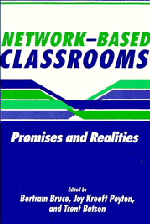
Students in network-based classrooms converse in writing through the use of communications software on local-area computer networks. Through the electronic medium they are immersed in a writing community–one that supports new forms of collaboration, authentic purposes for writing, writing across the curriculum, and new social relations in the classroom. The potential for collaborative and participatory learning in these classrooms is enormous. Continue reading →
DIME members have studied together how to improve their own teaching practices through research, the sharing of ideas, and mutual support. They have also engaged in critical analysis of the disciplinary and institutional forces shaping their work.
The history of DIME shows the importance of accommodating difference in providing support for sustained community.
Reasoning Under Uncertainty was a project funded by the National Science Foundation under its EHR/Applications of Advanced Technology program during 1985-91. The project led to a variety a publications and presentations (e.g., Rosebery & Rubin, 2007; Rubin & Bruce, 1991). Andee Rubin and I were the PIs, but the project eventually involved many other colleagues at Bolt Beranek and Newman, MIT, and local schools in the Cambridge, Massachusetts area. Continue reading →


 Into the Forest (Great Smoky Mountains National Park) [ISBN 0-669-36168-2]


 Soon after arriving in Illinois in 1990, I joined the
 Chip's journey