Many of us grew up playing the Animal, Vegetable, Mineral? game. You had to guess an object, knowing only which of those three categories it fell into. Animal and vegetable (plant) were supposed to cover all living things.
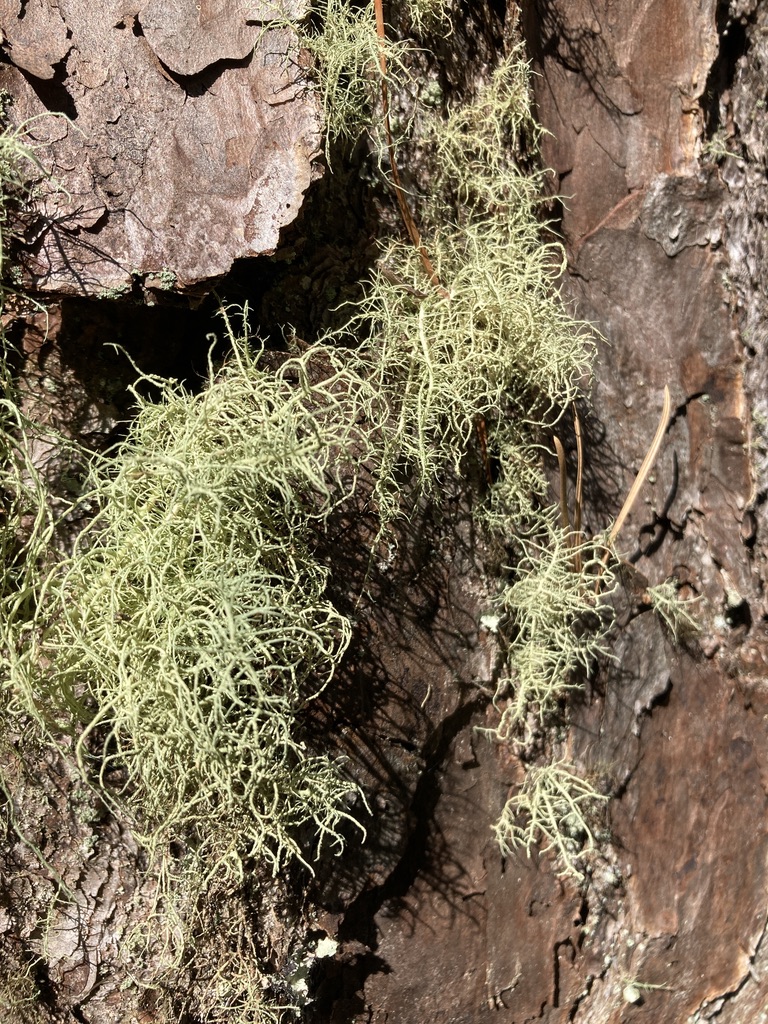
Beard lichen (Usnea), a genus of fruiticose lichen
But what if you came across some living thing that was neither animal nor vegetable? What if the thing you found looked like a plant, but wasn’t; looked like a single organism, but wasn’t; could appear as a mineral of some sort, but was full of life?
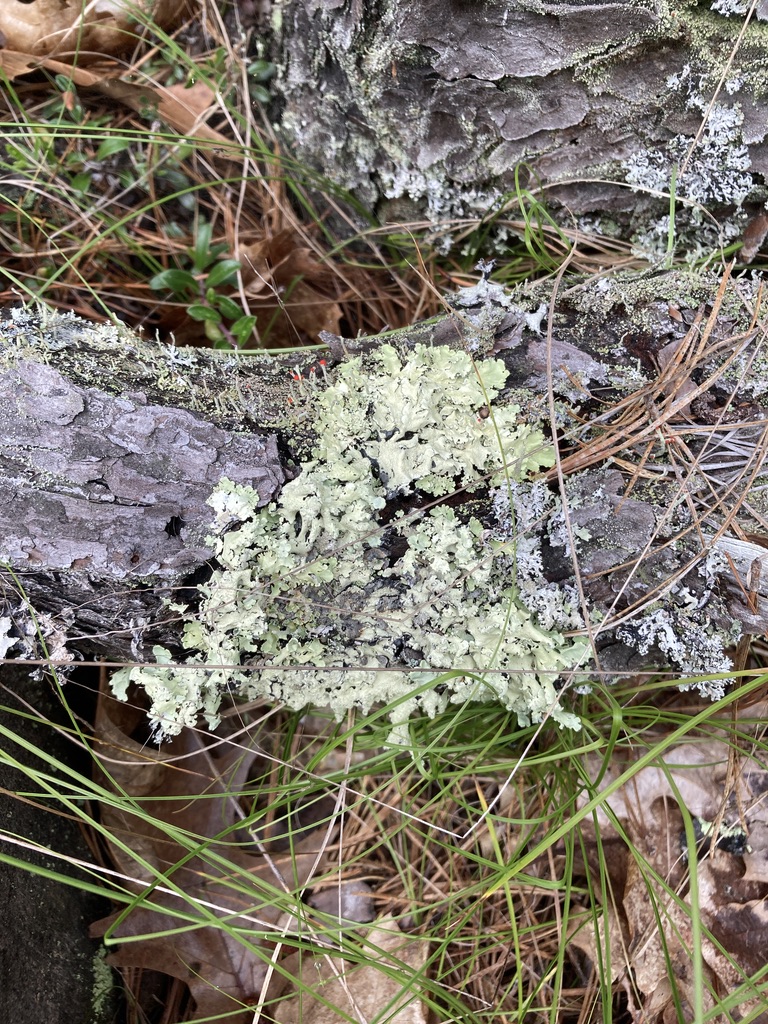
Powdered ruffle lichen (Parmotrema hypoleucinum); a foliose type
You could be looking at one of the most interesting phenomena on Cape Cod, but one that is often overlooked, even by those otherwise expert about birds, trees, wildflowers, turtles, mammals, mollusks, insects, and other fascinating flora and fauna.
That strange thing you observe might be a lichen, a composite organism made up of algae or cyanobacteria living among multiple fungi species. The fungi are in a kingdom separate from either plants or animals. That kingdom includes yeasts, molds, and mushrooms. Like animals, they cannot photosynthesize, but acquire food directly or indirectly from plants.
Within a lichen, the fungi provide structure and attachment to a tree, rock, or split rail fence. The algae contain the green pigment, chlorophyll, which gives the green color to the lichen and captures energy from the sun to support. photosynthesis.
One common type you may find is foliose, or leaf-like lichen. Another is fruiticose, reminiscent of tiny fruit trees. There are also crustose, which attach to rocks so tightly that they can’t be removed without destroying them or the rock. They seem like the Mineral in the old guessing game. Some common crustose lichen are bright orange.
Reindeer lichen (Cladonia portentosa); fruiticose
Lichens are gray when the algae components are dead or dormant, but they may turn bright green after a rain. The fungus (which surrounds the algae) soaks up water, causing its to become more transparent, and revealing the green pigment of the algae.
See what you can find the next time you venture onto a WCT trail.
In 1939, Billie Holiday recorded Strange Fruit, a searing depiction of lynching, written by Abel Meeropol. Two years later she released another haunting song “God Bless the Child.”
“God Bless the Child” is a classic, covered by Aretha Franklin, Blood, Sweat & Tears, and many others. It has many interpretations, from hope in a time of trouble, to self-reliance, or stewardship. In her autobiography Holiday says that she got the idea after approaching her mother for a loan. Despite being the birth mother and benefiting from her daughter’s financial assistance, she refused. Holiday shouted back: “God bless the child that’s got his own.”
One interpretation is that Blacks need to act for themselves, but that message rings hollow in the face of Jim Crow laws, analogues of which persist to this day.
For me, though, the song seems uncannily appropriate given the recent Supreme Court decision on affirmative action. There’e been much written about that decision, including perspectives from the Fourteenth Amendment, public policy, sociology, history, and education. But one thing that stands out is expressed in the song’s beginning:
Them that’s got shall get Them that’s not shall lose So the bible said and it still is news
One could argue that affirmative action has fallen short at increasing diversity or mitigating discrimination. But it’s been an important tool to lessen the reality of an unjust and racist society.
The decision leaves in place the myriad ways that our college admissions system perpetuates, even extends, racial injustice–legacy admissions, unequal funding of K-12 education, biased testing, access to sports, opaque pricing of colleges, healthcare inequities, to name just a few. These perpetuate wealth disparities as well as racial prejudice.
Holiday’s song reminds us:
Money, you’ve got lots of friends They’re crowding around the door
A starkly politicized Supreme Court is doing its best to ignore the reality that Holiday sang about. It’s become a stalwart friend of Money and as Holiday says, “Empty pockets don’t ever make the grade.”
It seems that we’re back to offering crusts of bread, but only for those who stay in their place.
Rich relations give crusts of bread and such You can help yourself, but don’t take too much
“Beauty is in the eye of the beholder.” So said Margaret Wolfe Hungerford in Molly Bawn (1878). Her sentiment applies quite well to one of my favorite walks, out of the many on Cape Cod.
This one is easy to reach from either end, borderline accessible, and close to my home. But few people would single it out as an outstanding nature walk.
Narrow section along Snake Creek Rd
Snake Creek Road
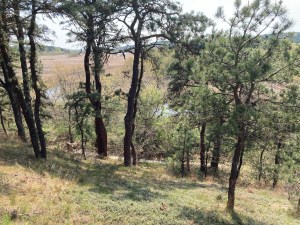
The walk is along Snake Creek Road, aka Way 672, in Wellfleet. The road was once passable by large vehicles, but due to downed trees, not any more. It’s best suited to walkers, brave runners, and the occasional horse rider.
The road is maintained simply by its use. There are no trail markers, maps, or guide booklets. Some parts are wide and clear; others remind the visitor to wear protection against twisted branches and roots, prickly thorns, and poison ivy. Conditions change with the weather and as tree branches fall across the path.
Canoe launch, showing Phragmites australis
Unlike many trails I’ve enjoyed, Snake Creek Road is not an official National Seashore trail. Nor is it a trail of the Wellfleet Conservation Trust, Massachusetts Audubon, or some other such organization. There’s a road sign, but nothing to indicate that you can, with a little difficulty, walk the 3/4 miles, but not drive it.
There are about ten houses on a bluff above the road. You might be able to hear people on a deck talking, but usually they aren’t close enough for you to hear what they’re saying. Similarly, you’ll be far enough away that they probably won’t see or hear you.
Flora
Snake Creek Road is a great place to explore the question:
Which invasive plant would win if we put them all together in one place?
Snake Creek Road sign surrounded by Rosa multiflora
Here you’ll find bramble, poison ivy, Virginia creeper, autumn olive, both bush and vine honeysuckle, phragmites, broadleaf dock, buckthorn, garlic mustard, oriental bittersweet, black locust, Japanese knotweed, bamboo, and much more. There are also magnificent spreads of multiflora rose blooming in various colors.
In one section there’s a large stand of lily of the valley, both alongside the trail and on the walkway itself. Like many of its partners in the ecosystem, it’s invasive, toxic, medicinal, good for wildlife, and beautiful.
We’re taught to resist invasives and to stamp them out at all costs. Given the choice, I’d prefer a healthy native plant ecosystem. But I can’t help but be in awe of the signs of life bursting through, without the need of harmful fertilizer, herbicides, or constant tending.
Lily of the valley (Convallaria majalis)
Brambles (Rubus)
Besides, there are also many native plants along Snake Creek, including moss, bayberry, bearberry, beach plum, mayapple, reed grass, black cherry, bear oak, fir, pitch pine, and white pine, to name just a few. There are introduced plants, such as Norway spruce as well.
Best of all, it’s easy to find many prime examples of lichen, including green shield, fishnet, and reindeer lichen. They steadfastly refuse to be placed in a simple category like “flora” or “fauna,” preferring “mycota.” They’re accompanied by wood ears and the underground fungi with their occasional spore-bearing fruiting bodies.
Black oak (Quercus velutina)
40-foot Eastern red cedar (Juniperus virginiana)
The Iris sibirica? pool with irises just beginning to bloom on the little islands
Fauna
Snake Creek is home to all sorts of animals as well––birds, reptiles, mammals, and countless invertebrates. The creek (aka Herring River), despite its degradation from being dammed, is home to various fish, such a the eponymous herring, frogs, turtles, and even river otters.
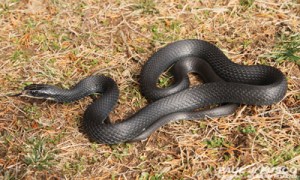
Northern black racer (Coluber c. constrictor). Image from Connecticut Department of Energy & Environmental Protection
On the land side there are coyotes, rabbits, fox, snakes, squirrels, chipmunks, mice, and voles. In addition to many songbirds, I’ve seen swans and great blue herons close up, ospreys and hawks overhead. And many crows. Woodpeckers enjoy the many damaged trees.
When I walk leisurely, I feel that I’m inside a marvelous habitat space like those in some modern zoos. But this is one that’s self-maintaining and ever-changing.
A couple of days ago, as the weather had warmed a little, I almost stepped on a 4-5 foot black racer sunning itself on the trail.
I’ve been especially intrigued to follow the evolution of two dens along the trail. I believe they’re made by coyotes, which I’ve heard at night, but they could be for foxes. Recently they’ve deteriorated without repair, suggesting that the canine families have moved on.
This beholder
I can’t say that Snake Creek is the best 3/4 mile walk anywhere. It’s rather flat and straight, and there are too many signs of degradation from human activity. It will also be changing in a major way soon, with the restoration of the Herring River tidal flow. I expect it to be inundated at high tide after that. It will be a salt marsh habitat and more of a mud flat or at low tide.
Great blue heron? Or sign of human presence?
Moreover, the possibility of getting lost is one of my top criteria for a good walk, and that’s very hard to do on a straight line path with a bluff on one side and a river on the other.
But a walk from one end to the other and back has never failed to yield surprises and contentment that can be found in few other ways.
Project Condor is an excellent example of how collaboration between private and public sectors can help mitigate climate change, while educating students for positive contributions to our future. My thanks to Muhammed Shah and Mojgan Momeni for the photos and other assistance in producing this article.
World Innovations Network
Condor was developed within the framework of World Innovations Network (WIN). WIN provides the glue for projects that engage community college students, to work on socially beneficial projects. For example, through the United Community Alliance, West Valley College students and faculty, local government officials, entrepreneurs, high-tech leaders, and the venture capital community have worked on COVID-19, student homelessness, and clean water.
Project Condor co-founders bring the car on campus to be worked on
Interdisciplinary, multi-organizational, and cross-role collaboration
The project was started by Muhammed Majid Shah, Tim Hyde, and Akilan Babu through an internship project organized and mentored by WIN in the spring of 2022. Silicon Valley Clean Energy helped sponsor the project through their education fund.
OEM Honda Hybrid system within the 2002 Honda Insight
The students partner with mentors from higher education and industry. They gain practical experience related to their studies, while the industry partners contribute to education and positive social change. Along the way, students find jobs and companies find experienced employees. And the public sees solutions to social, economic, and environmental problems.
Project Condor team inspires potential West Valley College students at the open house
Like other WIN projects, Condor represents a true interdisciplinary collaboration across organizations. It’s since grown to a team of 12-15 students from Mission College, many with a business focus, and West Valley College, many with an engineering focus. It’s highly interdisciplinary with students from science, math, engineering, business, and marketing.
The technology
Installing a manual control board that allows the driver to request on-demand assist and regen braking from the hybrid system
One of the key inspirations in our project has been the work done by John Sullivan, who designed the battery management system that we’re currently studying. Our goal with Project Condor goes beyond just providing a technological solution–we strive to provide student participants with a resume-building experience through hands-on work on a real-world project.
Showcasing the new hybrid system, unveiled by temporarily removing the safety cover over the internal components, all within the same enclosure
In pursuit of this goal, we’re eager to demonstrate the potential of this new hybrid technology by using a Honda Insight as our initial platform. Our team is focused on collecting and analyzing data from both before and after the battery conversion. Once we’re able to effectively prove the feasibility and benefits of this technology, we plan to implement a similar system for the most ubiquitous player in the hybrid market––the Toyota Prius.
We’ve learned that design and business is an iterative process and the importance of having an interdisciplinary approach.
A friend commented that he had done a lot of hiking and walking on nature trails, but that he’d only recently become aware of the many decisions and the work it took to build and maintain a trail. He would be interested to see what we do with Wellfleet Conservation Trust trails.
We plan these trails to entail minimal destruction to the environment. They should be obvious so that walkers can stay on them without creating social trails through the woods. But we like them to be as unobtrusive as possible. This requires a balance of engineered and natural features.
Visitors from Nepal helping to repair a roped off area at Herring River Overlook
Among other things, we cut overhanging branches that pose a hazard to walkers, but leave any vegetation higher than a Celtics player, unless it’s in danger of falling. We make the trail wide enough for anyone to walk easily, but usually require a single file. We place trail blaze arrows at confusing junctions, but try not to use more than absolutely necessary.
In some places we’ve added stakes and ropes to discourage off trail walking. As enticing as that bushwhacking may be for some, it can be very destructive for the land. For example, at the Herring River Overlook trail, walking down the dune towards the river kills fragile lichen, moss, bearberry, mayapple, violets, sea oats, and other vegetation. That in turn can lead to serious dune erosion.
National Park Service plea, too often ignored
The ropes are easily bypassed, but we don’t want to mar the sites with massive barriers. We have to trust that responsible visitors will recognize the message and stay on the trail.
In many parks today we see the sign that “vegetation grows by the inch but dies by the foot.” That’s especially true on Cape Cod. Tenacious plants can survive despite salty winds off the sea, sandy, nutrient poor soil, and hungry wildlife, but only if we’re on their side.
About 14 years ago, Mojgan Momeni was earning her Master’s degree in Library and Information Science at the University of Illinois. That was the beginning of a saga both tragic and renewing, one involving several people and linking over time. It reminds us of the importance of connecting with nature and others.
I invited Mojgan to share what happened. What follows is the story in her own words:
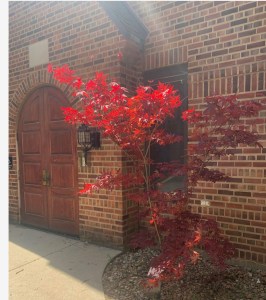
The Japanese maple today in front of the iSchool building
Last month, I came across a stunning photo on LinkedIn of a Japanese maple tree with bright red leaves under the afternoon sun at the School of Information Science. I had been curious for years if the tree was still alive. This was important to me because I had planted it in 2009 in memory of my classmate Yingbo Zhou, who tragically passed away following a hit-and-run car accident on an icy freeway.
Yingbo Zhou
Jill Gengler, Director of Alumni Affairs at the School of Information Sciences, took the shot and shared it. She informed me that the tree had been officially turned into a memorial tree with a plaque (the first bilingual marker on campus). Thanks to the efforts of Professor Kate Williams, Yingbo’s tree is now an official University of Illinois at Urbana-Champaign memorial tree. I am incredibly grateful!
I was also deeply moved by Yingbo’s parents, who gave me a gift as a gesture of appreciation during their summer visit.
I completed my Master’s degree from GSLIS (Graduate School of Library and Information Science) in May 2009. This experience was a significant turning point in my life, and I felt a sense of purpose and direction. That’s why I wanted to express my gratitude by giving back to the school somehow. As a gardening enthusiast, I purchased some perennials and bulbs to plant in a few areas in the school front yard and a young Japanese maple tree. After finishing the design and planting, I dedicated the tree to Yingbo.
The tree in 2009
Planting is one thing, but watering it during an Illinois summer can be challenging. After graduating, my student ID expired, and I could not access the building. Consequently, I had to drive to the new garden daily with water containers from home. I would sit on the stairs hoping that someone would exit the building so I could refill the containers. I felt honored when Chip brought a group of visitors to tour my garden, and shared his positive feedback about it on his blog.
Long story short, I got a job at a software company and relocated to California. I had been curious about the garden and tree for over a decade until I saw Jill’s post by chance.
We Make the Road by Walking was the book title that Myles Horton and Paulo Freire adapted from a proverb by the Spanish poet Antonio Machado.
Daring to gloss a rich and multifaceted book with in a few words, I’d say that the path to social justice is not at all clear. Nevertheless, we must act, and that act will light the way,
Horton and Freire lived, as well as articulated, that insight, a version of learning by doing. It applies in many domains, but seems especially relevant to discussions about the new AI and its implications for ethical life.
I’d like to suggest three heuristics applicable to any new technology, but none more so than the new AI:
The path isn’t there until we make it.
Paradoxically, it’s already there.
We need to engage.
Inevitably
Much of the discourse around the new AI adopts a deterministic stance:
We’re confronted, against our desires, will, or knowledge with a new device. It acts independently of us and even the expects who built it. All we can do is watch as it upends medical care, environmental protection, racial justice, privacy, education, military preparedness, intellectual property, and democratic life, just for starters.
This is a discourse of inevitability. It portends a world that we don’t understand and can’t control. And, most of the scenarios are catastrophic. The fact that it might make shopping easier doesn’t count for much when the world’s about to end.
But is that future inevitable? Should we hunker down, or as many do, imagine possibilities more benign, even glorious?
Making the path: An Oppenheimer moment?
Robert Oppenheimer was the wartime head of the Los Alamos Laboratory, the home of the Manhattan Project. He’s seen as the “father” of the atomic bomb. But he’s equally famous for his realization of the potential disaster his project had wrought. He famously quoted from the Bhagavad-Gita: “Now I am become Death, the destroyer of worlds.”
Two years after the Trinity explosion, he said “the physicists have known sin; and this is a knowledge which they cannot lose.”
Are we facing a new Oppenheimer moment? Tristan Harris and Aza Raskin see that and call for action to address the “AI dilemma.” Some things in their video are already dated; it was made 11 days ago.
Regardless of whether we adopt the stance of Cassandra or that of Pollyanna, we will follow some path. But when we take one of the extremes, we’ll find that our path is defined by some corporation’s idea of how to maximize their profit or some government’s idea of how to control the populace,’
Horton and Freire would tell us that we need to engage in making that path ourselves.
It’s always-already there
Always-already is a widely used term in philosophy (Heidegger, Derrida, Althusser, etc.). Generally it means that the features of a phenomenon seem to precede any perception of it; they’re “always already” present. It’s related to the idea in hermeneutics that there’s no understanding free of presuppositions, or bias.
When we come to the impact of new technologies, such as the new AI, this always-already sense is very evident. For all the novelty of the technology and its impact, none of the disaster scenarios is entirely new.
For example, many people rightly worry about how AI chat programs based on large language models can be used to promote disinformation, including malicious attacks on individuals or groups, promotion of fascist ideologies, or incitement to war.
But disinformation has been a problem since the beginning of language, was exacerbated by writing and then the printing press, and already seems off the rails in the age of the web and social media. Could AI chat programs make that worse? Probably yes. But we always-already know much of what that could look like and much of what we could do about it, even as we often fail to act.
We could say similar things about employment, public health, democracy governance, and other arenas that the new AI may affect. We don’t know what will happen; but we can be sure that what does happen will be a product of both the technology per se and the way we as humans have responded in the past and present.
What, for example, is our response to disinformation already? Do we expand public radio and TV? Provide tools for citizens to examine claims that are made? Teach critical thinking? Promote civic discourse? Emphasize public education at all levels? Fund research?
Or, do we ban books, starve libraries and schools, treat rants of extremists as “news events”?
Characteristics of new technologies will make a difference, but less than our response to them.
Engagement
Writing about an educational innovation, Quill, Andee Rubin and I said:
When an innovation that calls for significant changes in teacher practices meets an established classroom system, “something has to give.” Often, what gives is that the innovation is simply not used. Rarely is an innovation adopted in exactly the way the developers intended… the process of re-creation of the innovation is not only unavoidable, but a vital part of the process…. [The users’] role in the innovation process is as innovators, not as recipients of completed products.
Electronic Quills, p, 293
The re-creation process clearly applies to general prescriptions, such as “plan ahead.” But it also applies to the most solid, apparently immutable technologies.
For example, over the last century and a quarter automobiles have changed the world. We now have parking lots, suburbs, traffic laws and traffic deaths, carbon emissions, changes in sexual and family relations, and drive-in movies. But none of these were inevitable consequences of a four-wheeled vehicle with an internal combustion engine.
We could for example, value human life more and systematically restrict vehicle speed. Or, we could ban cars from urban areas, as some cities, especially in Europe, are beginning to do. We could have done many such things in the past and still could. Some would be good; some bad; some inconsequential.
The point is that how we engage is what matters in the end, not just the technology per se, if such a concept is even viable,
For the first Earth Day, in 1970, Walt Kelly made a poster pointing the finger at all of us, not just evil polluters or a few thoughtless individuals. He declared: “We have met the enemy and he is us.”
It’s useful to apply a critical view to new AI technologies. We should ask how they work and what their potential might be. But ultimately, we need to look at ourselves.
If we’re concerned about job loss from AI chatbots, then we ought to ask how we think of securing work with dignity for all, whether AI chat bots exist or not.
If we’re concerned about robots controlled by opaque, unregulated software, then we ought to ask questions about the control and use of any robots, even those controlled by opaque, unregulated humans.
If we’re frightened by the thought of nuclear war initiated by rogue AI, then we ought to work towards guaranteeing that that never happens due to rogue humans, regardless of how much they’re aided by AI.
One positive from the advent of the new AI is that people are beginning to ask questions about the camino (the path) that we’re on, questions that deserve better answers independent of the new AI. We need to realize that the path is one that we alone can make.
It can take me a long time to recognize something wonderful right in front of me, even as I blame my troubles on lacking some item of little value.
One such under-appreciated gem is Radoslav Tsanoff. His Humanities 100 course opened new doors for my understanding of philosophy, but I’ve only recently come to fully appreciate that opportunity.
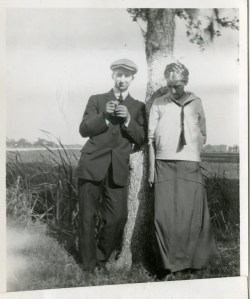
Radoslav & Corinne Tsanoff, c, 1916
Tsanoff’s bio
Radoslav Tsanoff was born in Sofia, Bulgaria. Coming to the US at age 16 to study at Oberlin, he received his PhD in philosophy at Cornell. He became the first professor of philosophy at Rice in 1914 and went on to become a brilliant teacher who inspired generations of students. He was a noted authority on intellectual history and author of many excellent books.
After a five-year retirement, Radoslav returned as Professor of Humanities, before retiring for the second time in 1974. He won many awards. With his wife Corinne, he was an active supporter of music and arts in Houston. He was religious and politically liberal, but not a member of any church or political party. He died just two months after Corinne died.
I recall that Radoslav donated his time, teaching for $1 a year. He would carefully empty his satchel at Fondren Library to allow the student at the door to check that he wasn’t stealing any books. In her excellent blog on Rice history, Melissa Kean tells many fascinating stories about the Tsanoff’s.
Tsanoff at Rice University, much as I remember him when he was my professor in 1967-68
Guiding principles
Radoslav’s close colleague says this about the couple:
They know what makes life worth living…. [Their happiness] comes from their enthusiasm for things life has to offer…. their wisdom consists in their constantly drawing on the great wealth contained in the achievements of the human spirit––in science, letters, and art, in the beauty of nature, and in the deep satisfaction that comes with working with other people toward common goals….
They throw themselves resolutely and devotedly into these boundless realms of value, try to assimilate, absorb, and enjoy them, and then do all they can to make these values patent and accessible to others…. The result is that magic we sense when we were in their presence.
Konnie Kolenda, speaking at an event honoring Radoslav and Corinne Stephenson Tsanoff, 1973; document recovered by Melissa Kean
Revisiting The Great Philosophers
Radoslav’s own The Great Philosophers was the text for Humanities 100. It’s scholarly, yet very readable, a bridge between popular discussions of philosophy as one might find in a good magazine and detailed, technical analyses found in a philosophy journal.
Recently, I’ve been having weekly discussions with an 88 year old friend. He’s a former shop teacher, who never took a philosophy course. We’ve read various short selections, including blog posts, entries in the Stanford Encyclopedia of Philosophy, and other sources. But we’ve settled on The Great Philosophers, as a book offering plenty of substance in an accessible form.
Re-reading that book has renewed my appreciation of Radoslav Tsanoff. His discussions of various issues are enlightening still, 70 years after the book was written and 55 years after I first read it. Among other things, he has interesting commentary on Epicurus and Spinoza, whose stars have risen anew since 1953. His capsule summary of pragmatism, especially of James and Dewey seems more prescient than that found in similar books.
Dreamers and doers
In an essay for Humanities 100, I included a New Yorker cartoon. I can’t find a copy of that essay, or of the cartoon, but I recall it showing two bums slouching in an alleyway. One says, “There are the dreamers and there are the doers. I’m a dreamer.”
Radoslav said that it was the only illustrated student essay that he ever received. I’m not sure, but I think that was a compliment. I know that he illustrated his own lectures with verbal images of works of art and architecture, cityscapes, and scenes from nature.
He also reminded me that one can’t always be just a dreamer; that life means engagement with ideas, arts, nature, and community.
His own life exemplified both dreaming and doing. Perhaps that’s why the last chapter emphasized philosophical pragmatism.
It’s worth quoting from the final paragraph, written 70 years ago. Many people might assume he’s talking about our own age:
Ours is a transitional age, and unsettled in its thinking, and in its social structure, facing exceedingly grave perils, yet having the possibility of unprecedentedly rich fruition…. Philosophy disposes only of its routine tasks. Its major inquiries may become more enlightened, but they cannot be terminated. This is not a skeptical reflection. It signifies, not that philosophical thought is futile, but that it is inexhaustible.