
We discovered this stone thing buried in our back yard. There are straight grooves on three sides. It weighs 713 grams (about a pound and a half).
The best guess so far is from Phil Harris,


We discovered this stone thing buried in our back yard. There are straight grooves on three sides. It weighs 713 grams (about a pound and a half).
The best guess so far is from Phil Harris,

The first North Atlantic right whale mother and calf pair has arrived in Cape Cod Bay. The Right Whale Ecology Program team from the Center for Coastal Studies (CCS) sighted the pair on March 18––Porcia, a 21-year-old right whale, and her newborn calf. They were first seen in late December off the coast of Georgia.
Yesterday, Susan and I were fortunate go on a Whale Walk sponsored by the Center. It turned out to not much of a walk because whales came close to shore next to the pavilion where we were supposed to start. They were relatively easy to see as they fed at the surface, so we had a sort of stationary walk.
We learned a useful tip from Jesse Mechling who led the group: If you see a large black rock moving across the water, it’s probably a right whale. There’s no evidence for black rocks off Cape Cod moving in that way.

The North Atlantic right whales are critically endangered. There are fewer than 340 individuals left and only 80 breeding females. The principal factors in their decline are shipping and entanglement from fishing gear. They’re called “urban whales” because they’re trying to survive off the shore of dense human populations with some of the most active shipping and fishing in the world.
They’re also affected by global warming, which results in warming of the oceans, shifts in the populations of copepods, alterations of the feeding patterns of the whales, coming into the way of new harms, etc. These issues are discussed at our annual Wellfleet harbor conference.

I have very mixed feelings right now. On the one hand I feel incredibly fortunate to benefit from organizations such as the CCS and their public engagement programs. I love being able to go a short distance to see relatively unpolluted beaches and magnificent creatures such as the right whales, directly from shore.
But on the other hand, I feel shame knowing that my generation is responsible for the destruction of these whales and other wildlife, and the habitats that they need to survive.

After cancer and chemo, I feel surprisingly healthy. The main problem is that my blood lab numbers are dismal.
At first I considered looking for a new lab service that could produce the numbers I wanted, but I’ve now come up with a better solution: An AI chat program can do the trick.
I asked ChatGPT to produce a report for a healthy male my age. And did it come through! The numbers are much more to my liking.
You can see the report below. The bottom line is that this way of getting a lab report is easier, faster, and cheaper. It doesn’t require being poked with a syringe needle. Best of all I can customize the results.
What can possibly go wrong?

The Embrace is a bronze figural abstraction based on a photo of an embrace between Dr. Martin Luther King, Jr. and Coretta Scott King after he won the Nobel Peace Prize in 1964. The 20-foot-tall, 25-foot-wide artwork differs from the singular, heroic form of many memorials to Dr. King and others, instead emphasizing the power of collective action, the role of women as leaders, and the forging of new bonds of solidarity out of mutual empathy and vulnerability. The Embrace is an unprecedented attempt to give shape and prominence to Dr. King’s conception of agape love. It is also intended to reflect Coretta Scott King’s faith in the power of art, and her long life of struggle against militarism, poverty, discrimination, racism, and sexism.
City of Boston
One compensation for the many trips to Boston for cancer treatment has been the opportunity to visit people and places we might otherwise have not seen. On the last trip we had a pleasant walk through the Boston Common and Public Garden, highlighted by The Embrace.
It’s a moving sculpture, both in the sense of being emotionally significant and in the sense of conveying a feeling of life in motion. It’s a testament to the King Family, the Civil Rights movement, and what Boston hopes to become.
I’ve felt an embrace from the people around me during this cancer journey, especially from Susan, who’s had a harder time of it than I have. (I’ve slept through much of it.)
She said in one message to friends and family:
He’s grateful for all your concern and messages. He can’t easily respond to your messages, but we’d love to hear from you.
That was very true. I’ve felt support from everyone.
And of course, I can’t say enough about the many health providers at Dana-Farber, Outer Cape Health Services, Cape Cod Hospital, and more. In an era when public health is deteriorating rapidly, I’ve been fortunate to receive the best care in the world.
[This article is cross-posted on my semi-private cancer blog, Surviving Lymphoma. Login with your own WordPress account to request access, or write to me for a login and password.]
I’ve just come across some memorabilia from my great-grandfather, William Sterling Camp.
I never met him and don’t know much about him, except that he was born in Walnut Grove, Illinois in the middle of the Civil War and died in San Antonio in the middle of World War II.
One item is a book of poetry. He modestly presents it thusly,
Take this bouquet of vagrant weeds,
A plenitude of naught,
Grown from the zephyr-carried seeds
Of idleness of thought;
Pray ponder well the printed page,
Then say if the relator
Should not in haste seek to engage
A mental conservator.

There are no dates on the poems, but I can guess the years from the content. The poems inadvertently tell the story and prejudices of his times. They also talk of death. The most charming ones, such as “A Luscious Bit of Erin,” speak of lifelong love.
One may have been inspired by the popular song, “Roses of Picardy.” That song reflected the bitter fighting in Picardy during World War I, but expressed it as a melancholy love ballad (“Roses are shining in Picardy / In the hush of the silver dew / Roses are flow’ring in Picardy / But there’s never a rose like you!”).
In Bill Camp’s version, we have
Picardy Roses
When fair Picardy fields are free
From with’ring blight of war’s debris,
O’er clefted stones that fashioned hedge
For winding lanes ere Prussian wedge
Was driven deep in Freedom’s heart
And rapine came, a German art,
Will clamber roses as before
Fair Picardy was rent by war –
But ev’rywhere that Virtue bled
Picardy roses will bloom red.
I not only never met Bill Camp; I never heard (or remember) any stories about him. Looking back it amazes me how oblivious I must have been to the lives of those around me. My grandmother, for example. She was his daughter. I wish now that I had asked her more about him and his wife, Jennie.

I’m not sure what I was doing in 2009 when Logicomix came out. I missed its arrival then.
Perhaps that’s a good thing; it probably means more to me now. Fate saved me from reading it before I was ready.
Logicomix is a graphic novel by Apostolos Doxiadis and Christos H. Papadimitriou, with art by Alecos Papadatos and Annie di Donna.
On first look, it appears similar to the For Beginners series of graphic documentary comic books, which introduces topics such as Nietzsche, Marx, capitalism, psychiatry, and Foucault.
But Logicomix is better done, with a more compelling story, a cleverer conceit about self reference, topped off by deluxe printing and stunning, full color images. In its own way it belongs among classics such as Maus and Fun Home: A Family Tragicomic.
Logicomix recounts the spiritual quest of Bertrand Russell for secure logical foundations for mathematics and philosophy. His quest crosses paths with Gottlob Frege, David Hilbert, Alfred Whitehead, Kurt Gödel, and Ludwig Wittgenstein.
Readers looking for a straightforward introduction to the mathematics may be disappointed and there won’t be any surprises for the philosopher or mathematician. But the novel does an excellent job of conveying why Russell took on this quest. It also shows, with some literary license, the character of the people in his world, their passions, and the political tensions of the time.
In a self-referential way, the writers and artists become characters in the novel. They debate the purpose of the book, with Christos the computer scientist arguing for fuller explanation of the mathematics and for more on how the early work in formal logic set the stage for Turing, Von Neumann, and the programmable computer revolution.
Apostolos describes Russell’s foundational quest as a “spiritual tragedy.” He denies that it’s meant to be an introduction to Russell’s mathematics (even though it succeeds at that). Emphasizing that the story is “100% character,” he argues that the actions and ideas derive from that. Christos asks

you mean, if they weren’t neurotic, or whatever, they wouldn’t have the necessary passion and persistence to create logic? … Or the ideas themselves were inspired by neurosis?
In an interaction with Alfred Whitehead’s son, Eric, Russell admits that Principia Mathematica used 362 pages to show that “1+1=2.” He goes on to say that this was the price for “absolute certainty.” Apostolos tells Christos that “less tortured characters would not have found this price worth paying!”
There is no absolute certainty at the end of Russell’s quest. There were multiple blows, among them, his own discovery of paradoxes in set theory, Gödel’s proof that any consistent axiomatic system for arithmetic must of necessity be incomplete, and Wittgenstein’s argument that logic is vacuous and cannot tell us anything about reality.
This impasse deterred Russell from foundational work and led to his many contributions to education, politics, and ethics.
The frame story within the novel has Russell relating his life experiences, including his certainty of opposition to the first World War. But in dialogue with pacifists before the second World War, and referring to Leibniz, he says, “I, too, dreamed this man’s dream: To find the perfect logical method for solving all problems, from logic, all the way up to Human Life!” He concedes that logic, and more broadly, reason, is not enough:

take my story as a cautionary tale, a narrative argument against ready-made solutions. It tells you that applying formulas is not good enough – not, that is, when you’re faced with really hard problems!
The answer is in the story. Russell’s life as presented here is tragic, with losses including unresolved quests and failed marriages. He finds wisdom through these travails, but not through the means he had imagined.
The Finale of Logicomix is another story, a performance of Aeschylus’s Oresteia: Orestes kills his mother, Clytemnestra, who had killed her husband, Agamemnon, who had killed his daughter, Iphigenia, etc. More had occurred earlier to make all of this inevitable.
Athena offers no easy solution for the Athenians. Instead she chooses forgiveness:
Furies, respect persuasion and the sacred power of reason, embodied in justice! Stay in my city! Do good, and in return, receive good!
The creators of Logicomix are in the audience.
Athena’s trick is to give the other half a voice. She says that “to achieve wisdom… you must also allow for a lot that’s usually left out as un-wise.” In other words, there are times when it’s best to embrace contradictions, something Russell spent his early years fighting against.
With “modern” people having absolute certainty that they are right, finding ever more effective ways to kill, and refusing even to listen to one another, the story of Russell’s quest and the tragedy of Oresteia could never be more relevant.
In the 1960s, Ted Nelson coined terms such as hypertext and hypermedia. Much less known is his coinage of the term, stretchtext.
Stretchtext is similar to zooming in for more detail or out for a summary. It never took off the way that hypertext did through the World Wide Web. (Note: HTML supports one-way links, not the superior two-way links that Nelson proposed, in which each node knows what other nodes are linked to it.)
The current “AI” chat systems offer a possible means to accomplish Nelson’s stretchtext.
I just presented ChatGPT with a paraphrase of some text at the end of Ludwig Wittgenstein’s Tractatus: “The answer to the riddle of life is that there is no riddle.” It responded this way:
As an AI language model, I don’t have a personal belief or opinion, but I can tell you that the idea of there being no riddle to life is one philosophical perspective. Some people believe that life simply exists and that there is no inherent meaning or purpose to it. From this perspective, there is no riddle or puzzle to solve; life just is. Others may argue that there is a meaning to life, but it is subjective and varies from person to person. Ultimately, what the answer to the riddle of life is, if there is one, remains a matter of debate and personal interpretation.
This missed Wittgenstein’s entire point that one can’t properly formulate a question about life’s meaning, but as an elaboration of what I gave it, CharGPT’s response isn’t bad.
I then asked “Can you say more about that?” thinking of Nelson’s stretching of a text. It said “Certainly!” and then proceeded to expand its original 100 word response to 300 words. It brought in existentialist philosophy, the individual’s freedom and responsibility in creating meaning, humanistic and spiritual traditions.
Could I have continued to get it to write a book on the topic?
I decided not to pursue that but to ask, “Could you say it more succinctly?” It came back with 76 words.
I pushed on:
Please summarize that in fewer words.
The meaning of life is a complex and subjective question. Some believe life has no inherent meaning, while others see it as subjective or objective. Ultimately, it depends on an individual’s beliefs and experiences.
Can you state that more briefly?
The meaning of life is subjective and varies among individuals.
Even shorter?
Meaning of life varies individually.
Shorter still?
Life’s meaning is subjective.
Shorter?
Life’s meaning subjective.
Finally, it emphatically gave up:
Say it with fewer words.
Life’s meaning subjective!
My little experiment says that ChatGPT does a reasonable job on what Ted Nelson imagined. I’d now like to say things like “expand this chapter into a book” or “condense it into an abstract, a title, or even one word, or three, if it insists.
To say that someone has a musical gift, or is gifted, usually means that they have unusual talent or can perform beautifully for others. I mean something quite different here.
When I say “musical gift” in this and the next two posts, I mean a gift to me, one that enhances my enjoyment of music. I was granted these through no effort on my own––no long, arduous hours of practice.

The first of the three gifts is opportunity. It came in multiple ways.
My father sold pianos through his store. We always had a piano in the house; it was part of the store’s inventory. If anyone wanted that model he could sell it as a lightly used piano. That meant that we might discover that our much loved mahogany spinet might be suddenly hauled away and replaced by a large black upright, or in later years by an electronic keyboard.
Continue readingOur rain chain goes through beautiful transformations as the water freezes or thaws, with differences for flash freezing versus slow, and with varying amounts of snow on the ice.
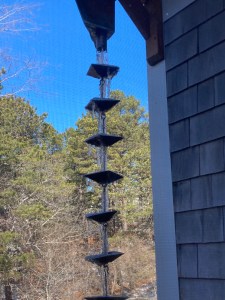
As the ice melts it makes tinkling sounds like a tiny wind chime.

I just watched a couple of nuthatches swimming in the barrel at the bottom. They took to the (freezing) water like tiny ducks.

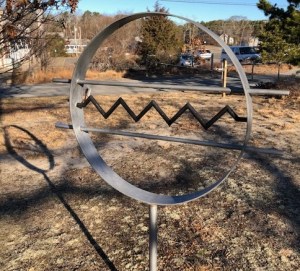
A friend in Wellfleet, Ernie Bauer, makes things of function and beauty, especially in metal. A few years ago he made a sculpture inspired by the Navajo word, Hózhó. It stands near the post office and WHAT, the Wellfleet Harbor Actors Theater.
You can see it and its shadow in the photo above.
Hózhó is often translated as ‘balance and beauty’; it can also be seen as harmony, finding peace amidst the jagged ups and downs of life.
Hózhó also emphasizes how ephemeral aspects of the world can be linked into a more significant whole. This shows up in Navajo weaving and other art forms.

The concept of beauty in Hózhó extends beyond what can be perceived directly by the senses. It implies orderly and harmonious relationships with other people, with the natural world, and with the world of spiritual beings and forces.
The estate of Elinor and Vincent Ostrom donated the rug shown above to the IU museum. It seems quite appropriate. Elinor Ostrom is best known for her work on how we can escape the “tragedy of the commons,” a phrase popularized by Garrett Hardin. For this work she became the first woman to win the Nobel Prize in Economics.
Ostrom’s work examined how societies have found ways to manage natural resources and avoid ecosystem collapse. Like the rugs she donated, it’s a realization of the Hózhó idea of living in harmony with others and with the natural world.
Too few people notice Ernie’s Hózhó sculpture. It treads softly. It’s in harmony with the semi-natural area where it stands.
In Wellfleet, the post office and the theater serve as a commons without people needing the sculpture to remind them. They visit with friends and enjoy community events.
But in a larger sense, I fear that humanity is playing out the dystopic scenarios of Garrett Hardin. Can we ever find ways to work together as Ostrom showed is possible?

