
The Blizzards of 2026 started for us around January 25.
From inconvenience to danger
We’ve experienced several feet of snow and near-hurricane force winds. That’s led to power outage, loss of internet and cell connectivity, downed trees and fences, impassable driveway and roads, and other problems.
We have a wood stove and plenty of firewood, plus a propane-powered generator that keeps some essential services going, such as the well pump. But others are not so fortunate. An acquaintance is home bound with a terminal illness. His visiting nurse can’t get to him because the roads are blocked.
In our case, a small problem has been that we couldn’t call for help because our cell service went from feeble to non-existent and the internet connection was out.
The local superette is one of the few places open with food. They have no power, so shopping means to walk around with a flashlight to find something edible. We bag the item and write down its price in a notebook, On checkout, we report what we find. There’s no working cash register or scanner. Transactions are cash only.
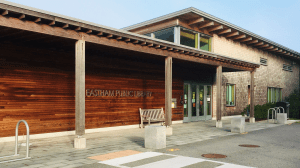
Enter the warming center
One bright spot in all of this are the warming centers. We enjoyed one at the Eastham library. It’s yet another reminder of the wonderful things that a library can do. It meets community needs and is open to everyone,
In the Eastham center, there’s plenty of water, hot coffee, and half & half. Library staff brought in food–green salad, turkey salad, and pizza. There are newspapers and power chargers. A couple are working on jigsaw puzzles. A parent is playing cards with a seven year-old. People see old friends and acquaintances. They learn about weather, road conditions, and specialty health services.
Other warming centers are at churches, the fire department, the high school, and other public places (with generators). Some have cots and blankets.










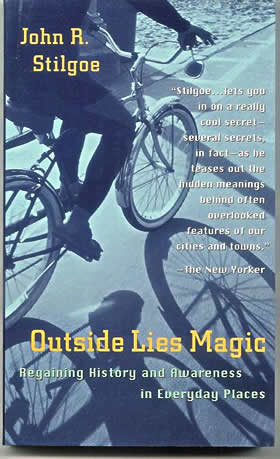 Gesa Kirsch recently pointed me to John R. Stilgoe’s, Outside lies magic: Regaining history and awareness in everyday places. It’s a refreshing call for becoming more aware of the ordinary world around us. Stilgoe urges us not only to walk or cycle more, but also to use the advantages of those modes of transport to see the world that we usually ignore.
 The chapters—Beginnings, Lines, Mall, Strips, Interstate, Enclosures, Main Street, Stops, Endings—lie somewhere between prose poems, history lessons, and sermons about the everyday. They remind me of John McDermott’s summary that John Dewey “believed that ordinary experience is seeded with possibilities for surprises and possibilities for enhancement if we but allow it to bathe over us in its own terms” (1973/1981, p. x).
 He shows the value of a camera, despite the lament that “ordinary American landscape strikes almost no one as photogenic” (p. 179). He recognizes the dread of causal photography (‘why are you photographing that vacant lot?’), but ties it to “deepening ignorance” (p. 181). This ignorance makes asking directions dangerous: People question us back, ‘Why do you want to know?’
 Chip's journey