Summer clarinet and piano

Photos courtesy of Luz Zambrano

Photos courtesy of Luz Zambrano

Like the TARDIS, Wellfleet seems bigger on the inside. The array of activities seems impossible for a town its size.

Last night I saw that the array was not just in quantity, but in quality as well. Monika Woods on clarinet and Deborah Geithner on piano offered a concert worthy of any featured event in a major city. The full house, the standing ovation, and the encore were testament to the beautiful music.

coverIt is easy to understand why Monika was the first prize winner at the Cape Cod Symphony Orchestra Soloist competition this year. You can listen to one of her performances here.

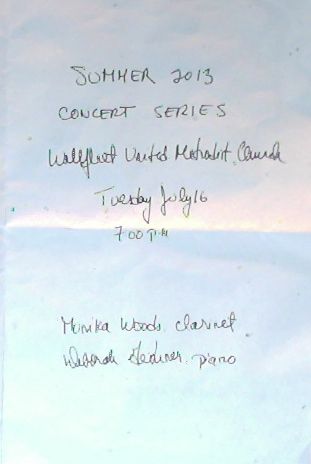
The programme yesterday evening featured Bach, Schumann, Saint-Saëns, Vaughn Williams, and Massenet. Every piece was a pleasure to hear, not something I’d say about many concerts. The feeling of a special event is enhanced by the fact that each attendee’s copy of the programme is individually penned, as is Deborah’s tradition.

The Saint-Saëns Clarinet Sonate in E-flat major, Op. 167, which he composed in his 86th and last year of life, was a highlight that elicited wows and bravos. The Allegretto first movement was especially ethereal and welcomed when its theme returns in the fourth movement. The piece as a whole was captivating.

The Sonate showed off the dialogue of clarinet and piano, as did Massenet’s Méditation from the opera Thaïs (Andante Religioso). That was another very moving selection. but it’s futile to make too much of any one piece, since every offering was excellent.programme

It was no surprise that the audience would demand an encore. The reward was Este a székelyeknél (Evening in the Village), by Béla Bartók. It’s a simple, lyrical piece, with two contrasting themes, which balance beautifully.

Drawing on elements from Transylvanian folk songs, Este a székelyeknél completed the evening’s theme of familiar, entrancing melodies, revealed by great composers and two great performers.

Monika Woods & Deborah Geithner

Monika Woods & Deborah Geithner

The concert was part of the Summer 2013 Concert Series at the Wellfleet United Methodist Church. This series has been a big plus for the community, drawing in people even while it’s still light enough for beach-going. The sanctuary last night was filled with nearly 100 concert goers.

Citizen Science in Wellfleet

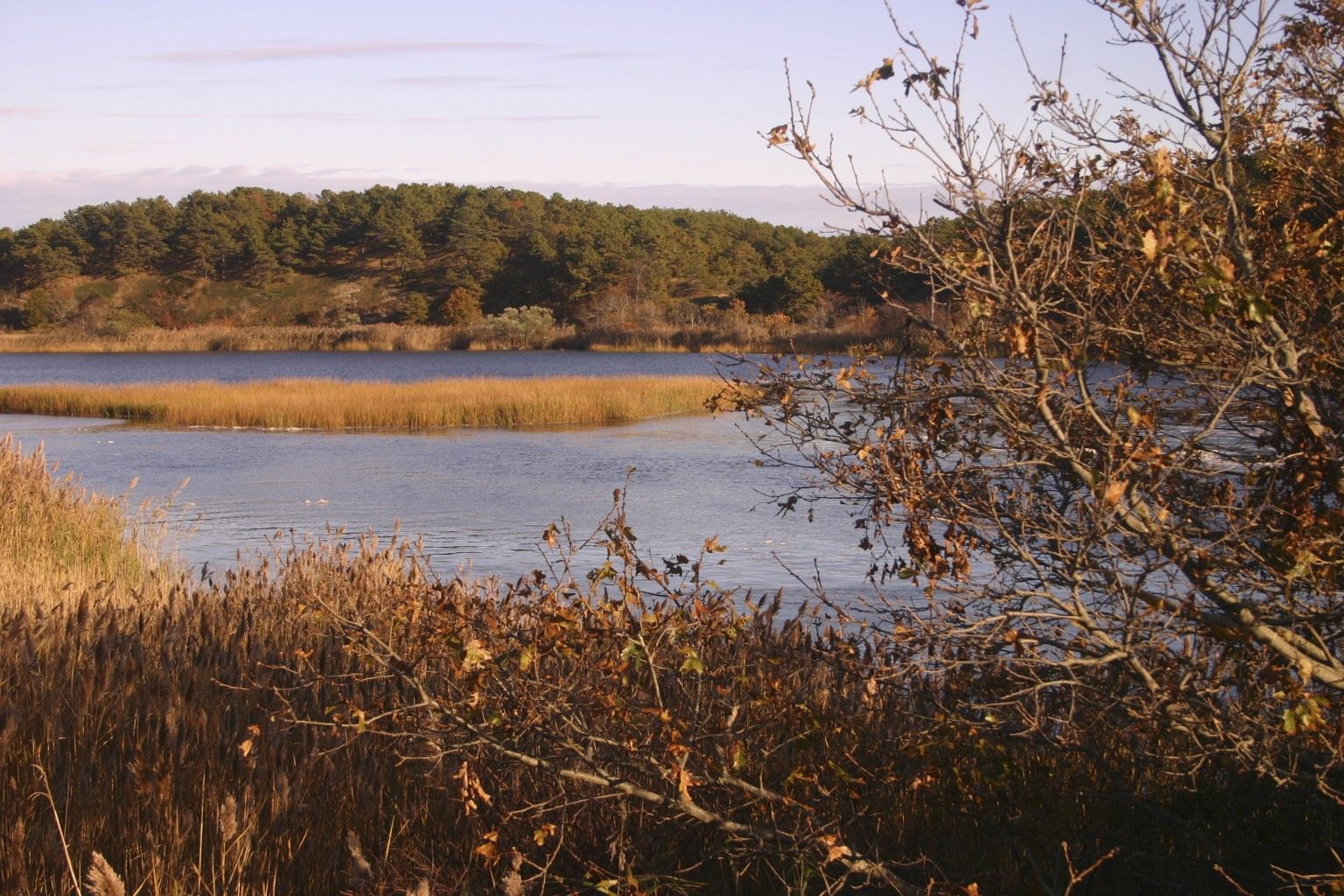
Herring River estuary

Herring River estuary

The current habitat for communication between science and the public is dysfunctional. One need only look at the “debates” about climate change or disease prevention to see the problem.

Scientific findings are regularly misrepresented and sensationalized in the mass and social media. Even when well presented, those findings are ignored or distorted, attacked through faulty arguments, or tied to unsupported inferences. At its best, current science/public dialogue tends to be one-way, with the occasional enlightening article, book, or video, followed by public commentary. This rarely serves to deepen  understanding, much less lead to enhanced inquiry.

State of Wellfleet Harbor Conference 
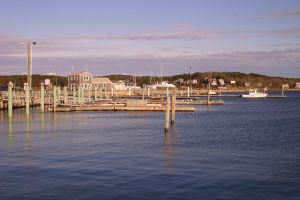
Wellfleet marina

Wellfleet marina, note osprey nest, upper left

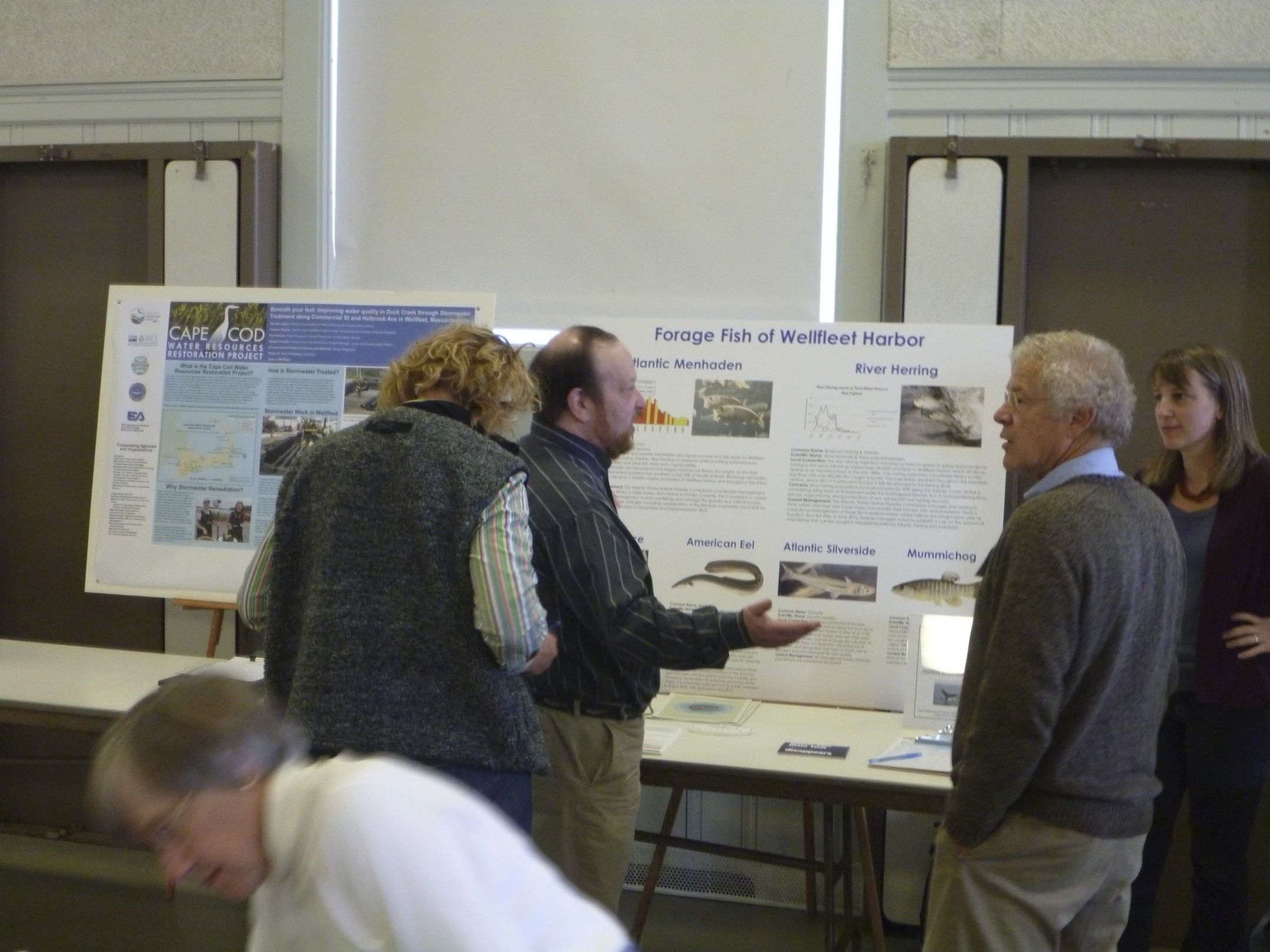
The 10th Annual State of Wellfleet Harbor Conference held yesterday at the Wellfleet Elementary School represents an alternative to that typical dysfunctional science/public relationship. One refreshing note was an effort by scientists to explain not only the results, but also the assumptions, methods, and theories behind them. People asked about the selection of factors to study, or about habitat assessment in tidal river versus bay sites, not to discredit a finding, but to understand more about how results were achieved. The conference was itself a small data point for the case that ordinary citizens can engage in science-based discussions, given enough time and well-crafted presentations, displays, videos, and other materials.
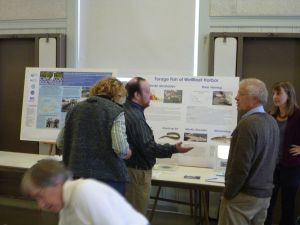
Poster session

Poster session

You can see from the schedule that there was a wide variety of presentations and posters. There was talk about dolphin mass strandings, bathymetry, auditory evoked potential, sentinel species, estuaries, cross-shore sediment transport, salt marsh backup, turtle gardens, terrapin clutches, brumation, eutrophication, cultching, winter/spring blooms, quahog seed, anoxic shellfish, temperature-dependent sex determination, anthropogenic effects, and many other topics related to the diverse ecosystems of the Outer Cape.

There were some good videos from the Friends of Herring River and the International Fund for Animal Welfare (IFAW). Brian Sharp complemented the latter with a talk and a tour of the IFAW van used for marine mammal rescues. This was especially salient given the mass strandings of dolphins in Wellfleet Bay in the early part of the year.
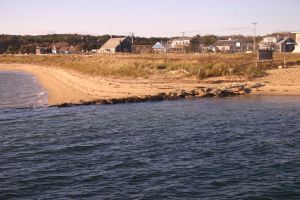
Mayo Beach, with groin

Mayo Beach, with groin

These presentations emphasized the interconnectedness of ecosystems, with humans as an integral part. Mark Borrelli from the Provincetown Center for Coastal Studies talked about how groins and revetments prevent local beach erosion, e.g., to protect a house, but shift the erosion elsewhere. Thus, they are simply “erosion relocation structures.” Sarah Martinez from the Mass Audubon Wellfleet Bay Wildlife Sanctuary presented a poster on the consequences for horseshoe crabs of their use as bait for conch and eels. Moreover, the revetments that relocate beach erosion also disturb the spawning, much of which occurs above the high tide mark.Vincent Malkoski from the Massachusetts Division of Marine Fisheries spoke about the data on horseshoe crab fisheries. These findings have led to harvesting closures for five days around the new and full moons in May and June to allow lunar spawning. Diane Murphy from the Cape Cod Cooperative Extension and Woods Hole Sea Grant spoke on the relation between oyster and clam growth and the wide variety of habitats they find in Cape Cod Bay.

Avoiding Either/Or Thinking 
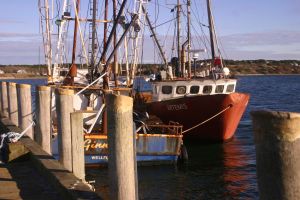
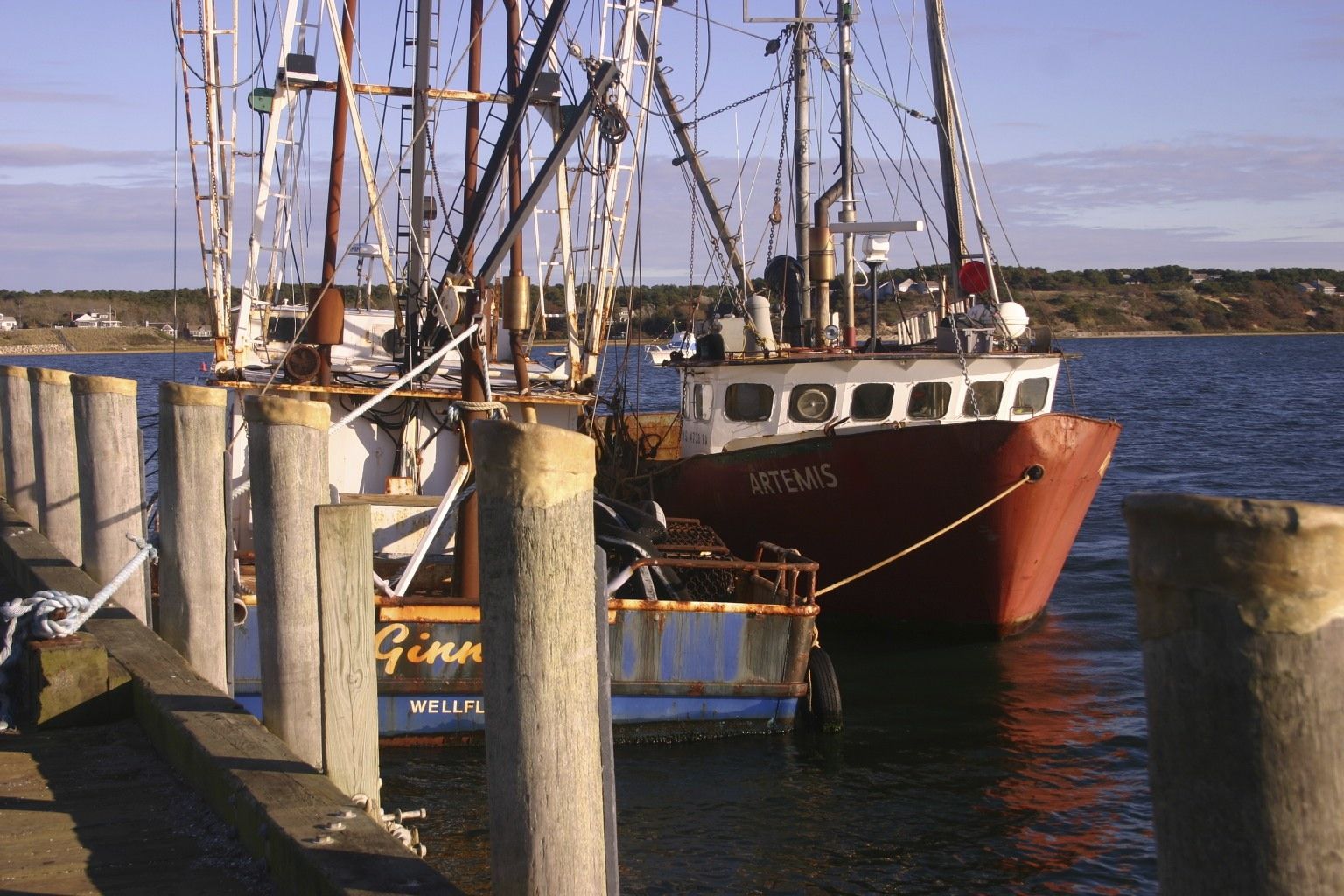
Fishing boats

Fishing boats

One consequence of creating the forum in this way was that discussions avoided the either/or kind of thinking often expressed in mainstream media. For example, although most of the participants shared deep commitments to preserving natural environments and generally opposed rampant development, I heard statements such as “you can’t say that dredging is always bad or good; the decision is about choices and values.” There would then be productive dialogue that critiqued human-made alterations of the shoreline, estuaries, ponds, and so on, but acknowledged values others might hold for commerce, recreation, or housing. Zero-based planning  is no longer an option in the Wellfleet area: Every change today, even one that seeks to undo earlier construction, interacts with a myriad of alterations over centuries and can have unintended consequences for the environment.
Interactive map

Interactive map

Multilogue

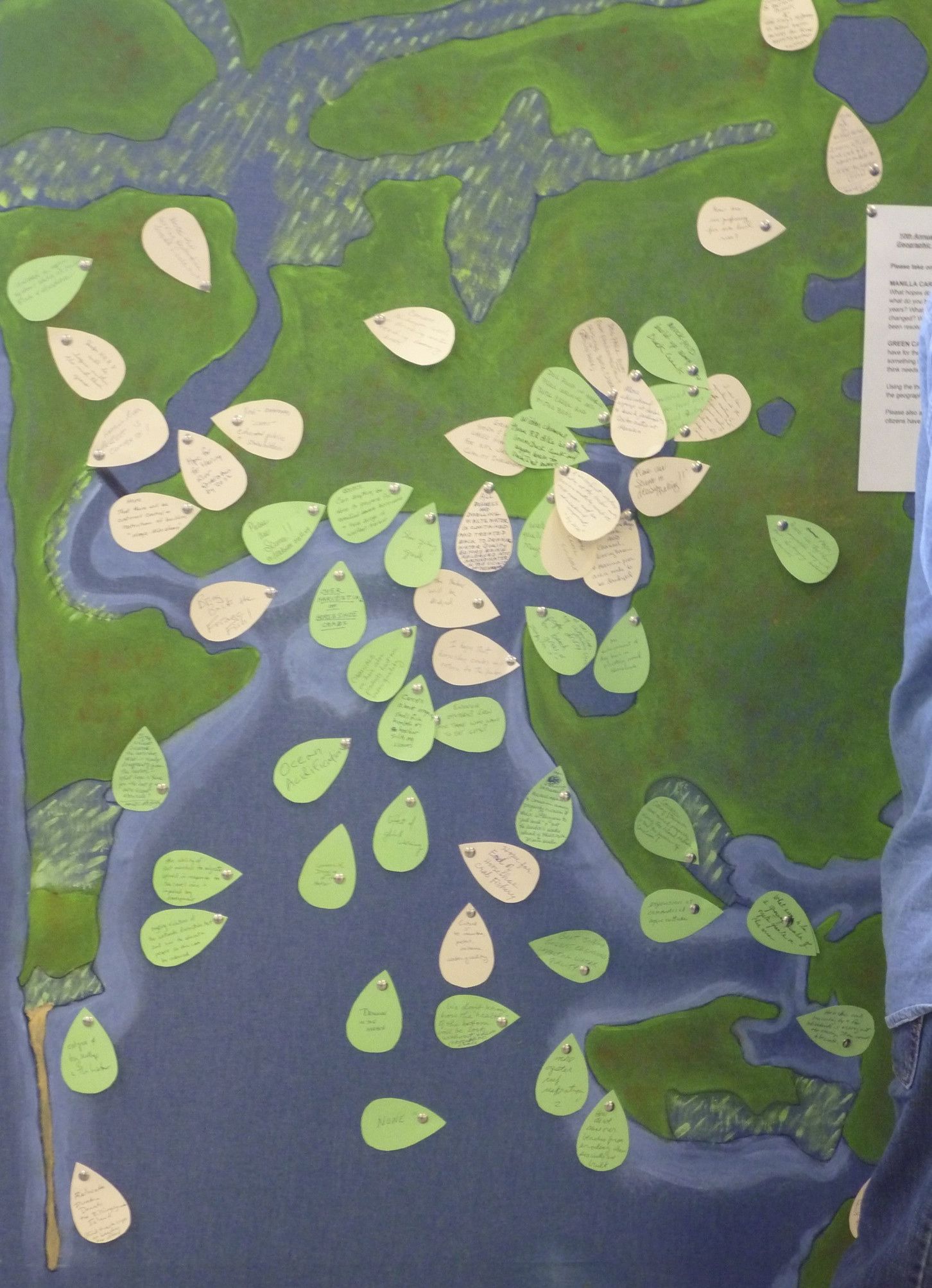
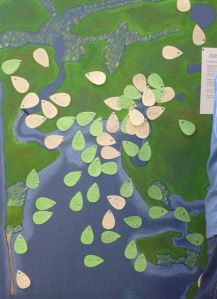
Through Q/A, posters, and ample time for informal discussion, the conference fostered one to many, many to one, and many to many conversations among participants including scientists in the same and other disciplines, students, and general public. There was an interactive map on which people could write their hopes and concerns and peg them to a geographic spot. The map activity will be continued at the library to solicit input from those who did not attend the conference. I saw numerous examples of scientists taking seriously the concerns or knowledge of the public.

This was perhaps enhanced by the fact that many of the projects involve direct citizen science participation , e.g., the river herring count, the horseshoe crab spawning assessment, terrapin sightings, and the dolphin rescues. Others involve coordination with local activist organizations, such as the Wellfleet Conservation Trust.

Some were of special relevance to those involved in commerce, such as oyster farmers. Jessica Smith and Barbara Brennessel from Wheaton College had an interesting poster on a study of genetic diversity among hatchery versus reef oysters, showing, as one might expect, a greater diversity for the reef oysters. This provides indirect support for seeding oyster beds with pelagic, rather than hatchery, veligers. Some oyster farmers still collect these wild larvae for seeing their beds, despite the method being considered slower, difficult, and old-fashioned. A quahog farmer of 30 years was able to add comments about changes over three decades that was missing from most of the shorter-term scientific studies.

Sustainability

IFAW van

IFAW van

Perhaps a meeting like this requires a supportive habitat such as Wellfleet in order to thrive, just as the terrapins, horseshoe crabs, eels, dolphins, ospreys, and other creatures do. Would it fail to survive elsewhere?

Richard Lewontin points out in The Triple Helix that no organism can survive without a supportive environment, but also that no living environment exists without organisms. In this case, the conference organism succeeds because of the town environment, but also shapes it to become more supportive of exactly the kind of discussion heard today.

The conference was well-organized with good snacks, including clam chowder. I came away with a renewed appreciation for the special beauty of Wellfleet, but also sadness about what we’ve done to destroy this, and so much else of the natural world. The fact that a conference such as this is so rare punctuates that sadness. How much did you hear from political candidates or mass media this year about protecting the environment we all live in and depend upon?

Small but good things are worth preserving. I hope to make the conference an annual event.

Hoffmann’s feverish dreams

E. T. A. Hoffmann

E. T. A. Hoffmann

One doesn’t just read, but rather descends, into the tales of Hoffmann. Sir Walter Scott must have agreed when he judged that Hoffmann didn’t need literary criticism as much as he needed medical assistance:

It is impossible to subject tales of this nature [referring to “The Sand-man”] to criticism. They are not the visions of a poetical mind; they are scarcely even the seeming authenticity which the hallucinations of lunacy convey to the patient; they are the feverish dreams of a light-headed patient.

Lunatic he may be, but somehow Hoffmann manages to convey essential truths through his grotesque tales and drawings.

The Nutcracker

The Nutcracker

In conventional stories, a character has an identity that we learn about as events unfold. Often that identity develops or evolves, but generally, we at least know whom we’re talking about. Supernatural elements, if they appear, may be hard to explain, but we can usually distinguish them from the ordinary. There’s typically some sort of resolution, which gives us a semblance of coherence.

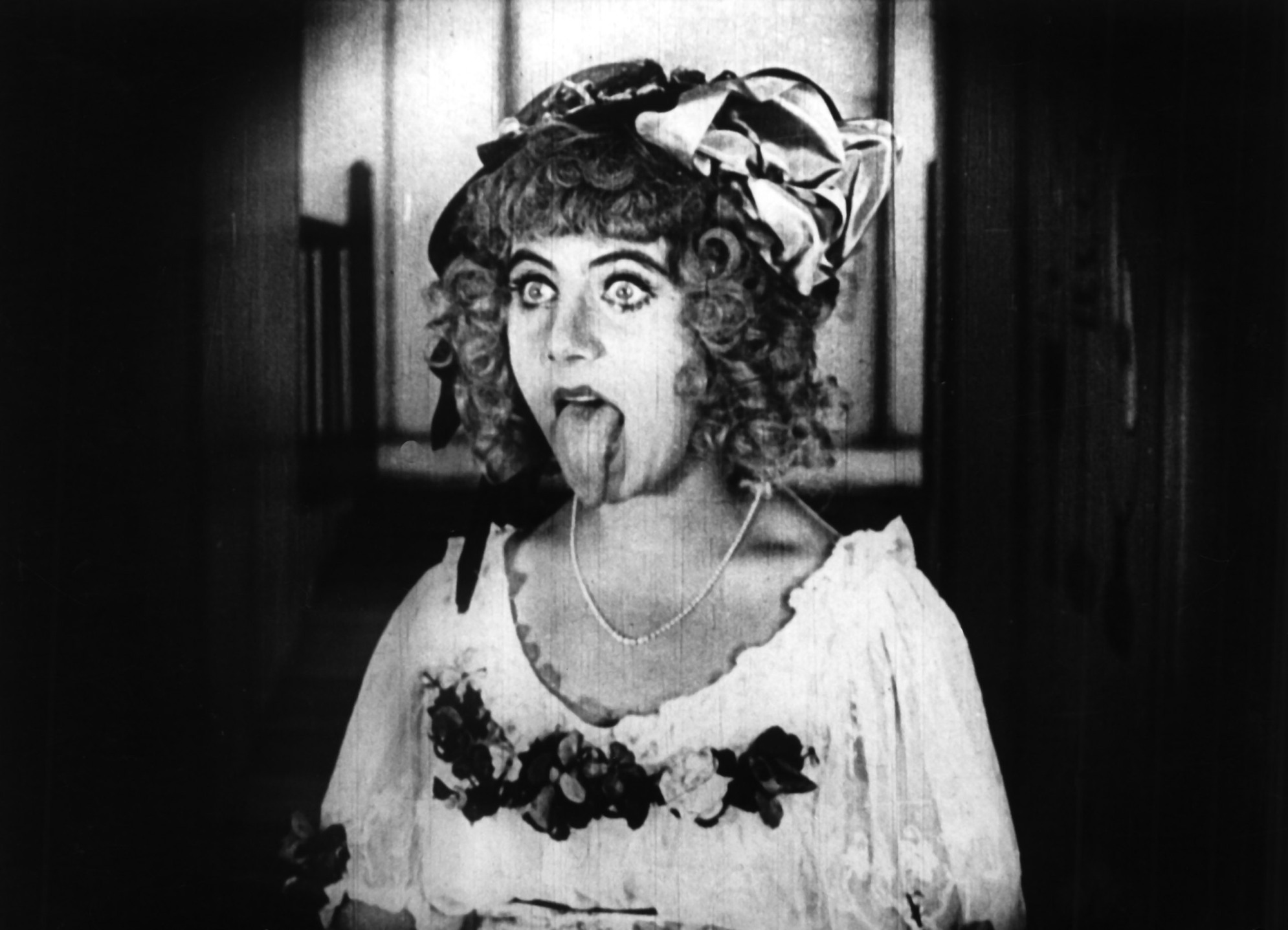
Hoffmann is quite different. Writing two centuries before post-modernism, Hoffmann turns the rules inside out. Neither we as readers, nor the characters, nor, as I suspect, Hoffmann himself, always know whether a given event is real or imagined. Is it an hallucination, a metaphor, a dream, or a supernatural occurrence? Is the kobold we encounter an independent entity, or simply a buried aspect of some character’s personality? Is this one a person, or a doll that the character assumes is alive? Is some occurrence the dream of a character, of Hoffmann, or one that we forgot that we’d been having and now can’t eliminate from our thoughts?

The Tales of Hoffmann

Spalanzani & Coppélius in “Tales of Hoffmann”

Combining rich, believable realism with extravagant fantasy, Hoffmann gets the reader to probe deep into the story, whatever the reader imagines that to be. He challenges Aristotle’s Poetics by offering only the beginning and the middle, but not the end, or resolution: He shows us that it’s a disservice to a good story to bring it to an end; the reader should be allowed to carry it onward.

In one of his best stories, The Golden Flower Pot, We struggle along with Anselmus to make sense of a world that doesn’t make much sense. The Archivarius tells him,

the gold-green snakes, which you saw in the elder-bush, Herr Anselmus, were simply my three daughters; and that you have fallen over head and ears in love with the blue eyes of Serpentina the youngest, is now clear enough.

The elder-bush, then a snake, now becomes the love of his dreams:

The Student Anselmus felt as if he now merely heard in plain words something he had long dreamed of, and though he fancied he observed that elder-bush, wall and sward, and all objects about him were beginning slowly to whirl around, he took heart, and was ready to speak; but the Archivarius prevented him; for sharply pulling the glove from his left hand, and holding the stone of a ring, glittering in strange sparkles and flames before the Student’s eyes, he said: “Look here, Herr Anselmus; what you see may do you good.”

It’s painfully obvious what Anselmus should not do, yet, he does. We as readers follow obediently and disastrously, learning along the way the preposterousness and the tragedy of romanticism from one its major initiators.

The Doll (DIe Puppe)

The Doll (DIe Puppe)

Thanks to these features, Hoffmann’s stories invite a variety of interpretations on multiple levels. The nutcracker may be Napoleon and the seven-headed mouse king, his seven cabinet members. But they may also be Hoffmann’s critique of romanticism, or a manifestation of buried aspects of the personalities of Clara and Fritz. Or, maybe they’re just idle fantasies, and Hoffmann has seduced the reader into unveiling his own psychic disturbances.

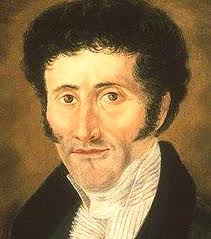
Ernst Theodore Wihelm Hoffmann is best known by his pen name, E. T. A. Hoffmann (Ernst Theodor Amadeus Hoffmann). But if my experience and that of a few friends is any guide, he’s not known well known by any name today, at least in the US beyond scholars of German romanticism, and certainly not anywhere near what his contributions deserve.

Some people are familiar with Offenbach’s The Tales of Hoffmann, an opera based on Hoffmann’s short stories with him as the main protagonist, or with the Powell and Pressburger film. Fewer still know that Tchaikovsky’s ballet The Nutcracker was inspired by Hoffmann’s “The Nutcracker and the Mouse King.” That may be due to the fact that the sweet Christmas performances of the ballet lack the disturbing edge that Hoffmann works into all of his stories.

Kapellmeister Kreisler

Kapellmeister Kreisler

But I didn’t know that Hoffmann’s stories inspired many other famous works of music and film (e.g., Alfred Hitchcock, Bergman’s Fanny and Alexander); that his writings were a major influence on Edgar Allen Poe, Nikolai Gogol, Charles Dickens, Charles Baudelaire, George MacDonald, Fyodor Dostoevsky, Franz Kafka, Jorge Luis Borges, Robertson Davies, Alexandre Dumas, père, and even Sigmund Freud and Carl Jung; that he wrote the first (Western) detective story, a novella (Mademoiselle de Scudéri); that his stories are the basis for much of modern gothic, ghost, sci-fi, and other genres; that he was arguably the first romantic composer in music, inspiring Robert Schumann and others; that his music and literary criticism were major influences on romanticism; or that he was an accomplished sketch artist, political satirist, and philosopher.

Worth getting to know. Just be careful about those dreams.

References

Hoffmann, E. T. A. (1967). The best tales of Hoffmann (edited with an Introduction by E. F. Bleiler). New York: Dover.

Scott, Sir Walter (1827). On the supernatural in fictitious composition. The Foreign Quarterly Review, I(1), 60-98.

Green oats in June

An Irish day on Cape Cod: It began with a 5K walking race along Nantucket Sound in South Yarmouth (Cape Cod Irish Village Road Race). At the conclusion of the race we enjoyed Irish music at the Irish Village. Unfortunately, any loss to our waistlines from the race was fully counteracted by hamburgers and pints of stout.

The day ended with listening to Celtic Sojourn on WGBH. That program featured a beautiful poem by Patrick Kavanagh, which is appropriate for Mother’s Day, or for remembrance on any loved one.

But I don’t read the poem as being only about remembrance; it’s more about valuing the “earthiest” aspects of all our daily interactions–walking “together through the shops and stalls and markets” or among the “green oats in June.” Kavanagh reads the poem in the video below.

When we lived in Dublin in 2007-08, I remember walking many times along the beautiful Grand Canal, which was near our apartment. You can see a statue of Kavanagh there (“The Crank on the Bank”). It’s also shown in the slide show and below.

The bronze Kavanagh is sitting on a bench as the flesh and blood one once did. It was inspired by his “Lines written on a Seat on the Grand Canal, Dublin”:

O commemorate me where there is water
canal water preferably, so stilly
greeny at the heart of summer. Brother
commemorate me thus beautifully.

If you were to visit Dublin, I recommend sitting beside him to contemplate the people walking by, the ever-present swans, and the stilly, greeny water.

Patrick Kavanagh, Royal Canal

Patrick Kavanagh, Royal Canal

In Memory of My Mother

by Patrick Kavanagh

I do not think of you lying in the wet clay
Of a Monaghan graveyard; I see
You walking down a lane among the poplars
On your way to the station, or happily

Going to second Mass on a summer Sunday–
You meet me and you say:
‘Don’t forget to see about the cattle–‘
Among your earthiest words the angels stray.

And I think of you walking along a headland
Of green oats in June,
So full of repose, so rich with life–
And I see us meeting at the end of a town

On a fair day by accident, after
The bargains are all made and we can walk
Together through the shops and stalls and markets
Free in the oriental streets of thought.

O you are not lying in the wet clay,
For it is harvest evening now and we
Are piling up the ricks against the moonlight
And you smile up at us — eternally.

A house concert with RUNA

Moving to Wellfleet, I wondered whether I’d be trading cultural life for nature. With the National Seashore, ocean and bayside beaches, 17 ponds in Wellfleet alone, walking and biking trails, forest and dunes, I was prepared to make that trade, assuming that we’d seek out music, art, and so on, in Boston or other places. But the reality has been the opposite. Yes, the natural world feels especially close at hand, but cultural events seem more, not less accessible.

I do miss the human diversity of the university or the large city, but there’s been more on that score than I expected. In terms of public events, we’ve been to many galleries and art shows, enjoyed the Saturday Tea and Music concerts in the Wellfleet Public Library, book talks, and just saw the Blind Boys of Alabama in the recently renovated Provincetown Town Hall.

About a week ago we attended a wonderful house concert by RUNA, a Celtic music group. They’re an international ensemble comprising vocalist Shannon Lambert-Ryan, guitarist Fionán de Barra, percussionist Cheryl Prashker, and fiddler Tomoko Omura. They play both traditional and more contemporary Celtic songs and instrumental pieces from Ireland, Scotland, Canada, and the US.

The performances were excellent. I especially enjoyed the traditional songs, but some of the more recently composed ones, too. The video here is not from the concert we attended, but we did hear Fionnghuala there.

Vivir y ayudar a vivir

Vida/SIDA

Vida/SIDA

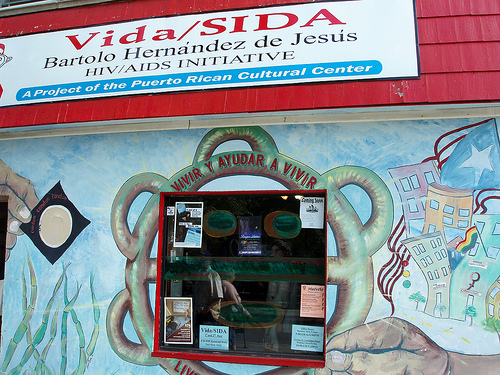
The mural on the front of Vida/SIDA in Chicago includes the phrase, “vivir y ayudar a vivir” (to live and help to live). That’s very appropriate for a health clinic, but it’s really the motto for everything done in the Paseo Boricua community. The idea is that in order to build a healthy community, people need to move beyond “live and let live,” which can mean “live for myself and to hell with you.” The more expansive motto, “vivir y ayudar a vivir,” can be seen there on murals, brochures, websites, and coffee cups.

I know that other groups have used the same phrase, but I’ve never been sure of its origin. Some people attribute it to Orison Swett Marden, a 19th century writer associated with the New Thought Movement. He founded Success Magazine and wrote extensively on how our thoughts influence our actions and experiences.

The Voice of Industry

The Voice of Industry

The general idea is of course much older. For example, the Jain Center of Cincinnati Dayton has an historical marker asserting that the motto of Jainism is “live and let live and help others to live.” And Jainism dates at least from the 6th century BC, if not earlier.

More recently, both in the course of events, and in my own discovery process, I came across The Voice of Industry, a labor newspaper published from 1845-48. It was founded by the Lowell Female Labor Reform Association. An article from November 14, 1845, “Live -Let Live -Help Live,” gives one of the clearest and earliest explanations of the phrase that I’ve seen. Basically, it says that there are three sorts of people: those who take for their motto live regardless of others, those who adopt live and let live, and those who say live and help others to live.

I’d like to hear about other sources, or uses, of the phrase.

Almost counting herring

Black Pond, Wellfleet

Black Pond, Wellfleet

Because of the warm winter on Cape Cod this winter, the alewives are returning early to the local rivers. Alewives are a type of herring. They’re anadromous, meaning that they live in the ocean, but swim up freshwater streams to spawn.

Their population is declining in New England, so the River Herring Network organizes herring wardens and volunteers (called “monitors”) to assess their numbers during the spring run. The counts go on for two months, with volunteers assigned specific times each week to count.

field test kit

field test kit

Locally, the count is connected with efforts by the Friends of Herring River to restore that river to something akin to its condition before the Chequessett Neck Road Dike was installed and the surrounding wetlands were developed.

Susan got the official training for the count, so she’s the real Monitor, but I went along as a volunteer for the volunteer. I guess you could say that I was an Unofficial Herring River Estuary Alewife Monitor Assistant (UHREAMA).

water temperature

water temperature

We decided to cycle to the site for our first scheduled count. It’s only a half hour away, but has some good hills and soft sand paths to make the cycling interesting. We passed Black Pond and a friend’s house on the way. You can these and other photos at photos from the count.

The official count site is at a beautiful bend in the tiny Herring River, with a fallen willow marking the spot and serving as a convenient shelf for the field test kit. Byu the way, there are many Herring Rivers. This is the one in Wellfleet.

Here’s the data for our first foray:

  • Time: 9:07- 9:17 am
  • Air temperature 12 ºC
  • Water temperature: 13 ºC

Unfortunately, the number that matters most is this one:

  • Number of herring: 0

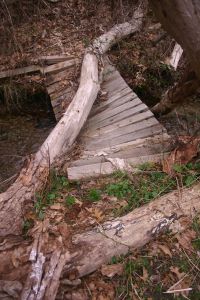
Somewhere else, this bridge over the Herring River would be seen as in need of a little repair, but here, it’s just a reminder of the alliance between culture and nature in the National Seashore area. That alliance isn’t without its problems, as we can see in the decline of the Herring River and its herring, but at least there’s an effort to try to make it work.

Popper, Wittgenstein, and the raccoon

We had a visitor last night. Like a previous one of her kin, she managed to visit every room, leaving small gifts on the floor and thoughtfully rearranging books, wall hangings, pottery, and other items.

This one had a special talent for philosophy. She was particularly interested in Karl Popper’s critique of teleological historicism and his reanalysis of Plato, as he develops in The Open Society and Its Enemies. One question she wanted to explore was whether raccoons enter houses with the intention to be ornery or do they just fall in because I haven’t come up with a way to secure the skylight screen. Popper would argue that there are genuine alternatives in history, multiple causal processes, and a role for raccoon intentionality. But I’m not sure how that helps to answer the question.

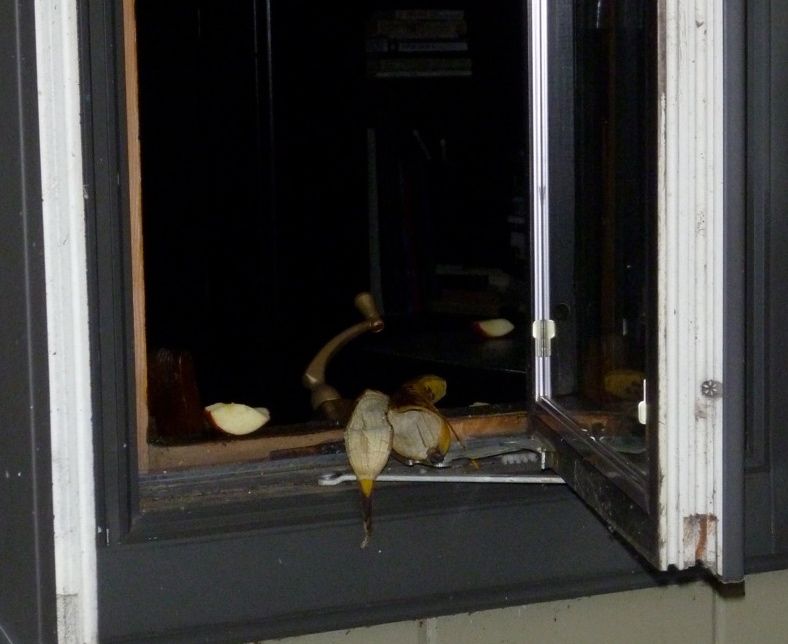
Hoping to appeal to her desire for conscious agency as well as her stomach, I set out some cut apples and banana peel in a trail across the counter to an open window. But her drive to remain curled up in the philosophy section was too strong, and she ignored all my offerings.

I noticed that our visitor preferred to stay in the Popper section and didn’t give any time to poor Ludwig Wittgenstein, his antagonist in the famous confrontation at the Cambridge University Moral Sciences Club. As there was a wood stove in the room, I thought I might reason with her using the fireplace poker, just as Wittgenstein had done with Popper in 1946. In that event, Popper stormed out, which would have been a pleasant outcome in this case, given my moral perspective.

But she held her ground, insisting that Wittgenstein’s view of formal philosophy as nothing but language games was an abdication of moral responsibility, that the Open Society could not be maintained without strong raccoon ideals. I argued that “open” in this case did not include raccoons. This led to a discussion about the danger of a priori categories and the need for dialogue across differences. While I appreciated the general argument, I felt that Wittgenstein might have a valid point in this case, and that it was time to terminate the game.

I assembled a set of tools in order to move to the next stage in this debate: the poker, large leather fireplace gloves, a broom, a blanket, a powerful flashlight, fresh fruit to appeal to her culinary desires. All I was missing was the courage to grab on to her and show her to the exit. As I said above, poking with the poker had no effect.

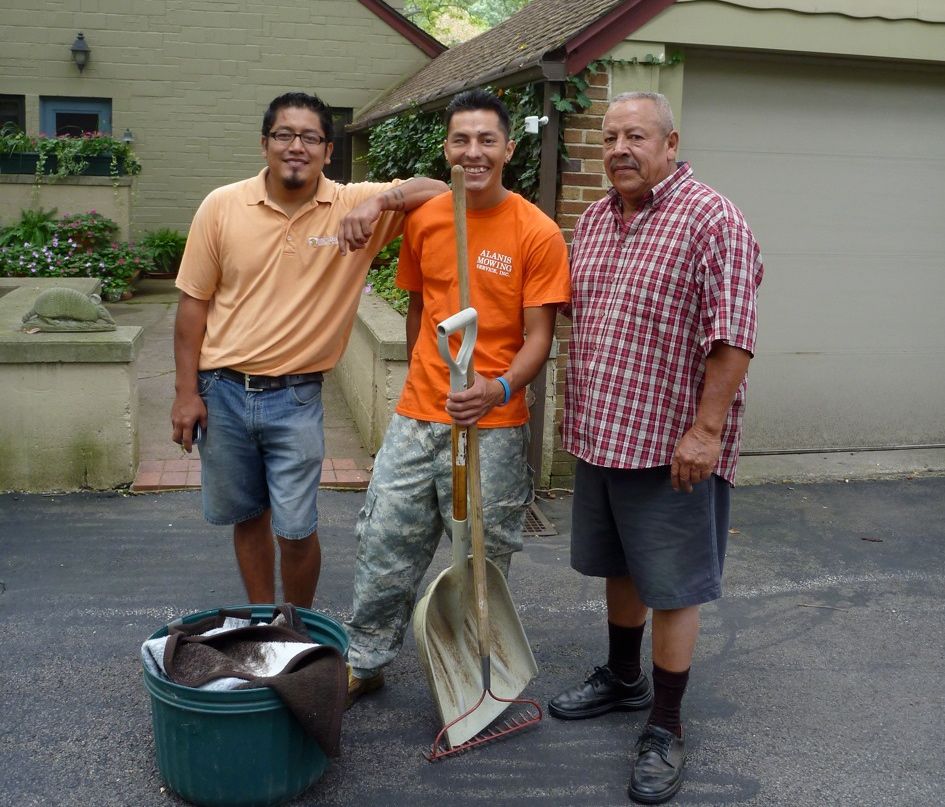
Fortunately, we had some helpers with more resourcefulness and courage than I. It took all three of them and a large plastic tub, but they managed to corner the raccoon in the tub, cover her with a blanket, and take her to the woods, where, I believe, her interest in environmental philosophy can be more profitably continued.

References

Evangelicals attack Voudo practitioners in Haiti

As if people in Haiti haven’t faced enough problems already, Christians, many from outside Haiti, have begun attacking people there who are simply praying or singing.

PORT-AU-PRINCE, Haiti – Angry crowds in a seaside slum attacked a group of Voodoo practitioners Tuesday, pelting them with rocks and halting a ceremony meant to honour victims of last month’s deadly earthquake.

Voodooists gathered in Cite Soleil where thousands of quake survivors live in tents and depend on food aid. Praying and singing, the group was trying to conjure spirits to guide lost souls when a crowd of Evangelicals started shouting. Some threw rocks while others urinated on Voodoo symbols. When police left, the crowd destroyed the altars and Voodoo offerings of food and rum.

Some groups use an interesting method to convince Haitians to abandon their beliefs. Quoted in the same article, Pastor Frank Amedia of Miami-based Touch Heaven Ministries says:

“We would give food to the needy in the short term but if they refused to give up Voodoo, I’m not sure we would continue to support them in the long term because we wouldn’t want to perpetuate that practice. We equate it with witchcraft, which is contrary to the Gospel.”

Does this mean that pelting worshipers with rocks, urinating on their sacred symbols, and withholding food from hungry people is the modern Christian way? Aren’t those acts themselves “contrary to the Gospel”? Why do outsiders, in this case mostly Americans, think that violence is the path to rebuilding a nation? When will we learn that acting responsibly in the world doesn’t mean insisting that we are always right and that our way is the only way?

See the photo in the Associated Press report at Voodooists attacked at ceremony for Haiti victims.