
 Netroots is a term that describes political activism organized through blogs, wikis, social network services, and other online media. Jerome Armstrong used it first in Netroots for Howard Dean (2002) on MyDD.
The netroots can be a powerful alternative to traditional media and organizations. Often though, the change that activists promote never happens, can’t be sustained, or can’t scale. Netroots talk doesn’t always lead to action.
It may seem to strange to turn to libraries as a solution. Aren’t libraries all about books and old stuff, not the new participatory culture of the net? Aren’t they determinably neutral, both unwilling and unable to engage with the kinds of change activists seek?
In fact, libraries already play a crucial role to support activism of various kinds. And they’re already deeply entangled both with how we go online and with how we find what’s not available there. They’re not only a supplement to the netroots, but a necessary resource to bring netroots activism to life.
 If you go to any public library in the US at opening time, you’ll see a group of people waiting to enter. They’re of all ages, ethnicities, and genders, dressed in formal business attire, sports clothes, or old rags. Some may be waiting to check out a book or video, but most are waiting to go online to read their mail, connect with friends, check the news, hunt for a job or apartment, shop, book travel, or do any of the many other functions that reveal how much the net has infiltrated our lives. For them, the library is the face of the net, and the only, or at least the best, way of connecting with it.
Moreover, libraries can provide substantive data, e.g., on the climate, business trends, local history, political processes, art, and more, which is not always available online; text resources, including books, journals, magazines; videos and software; and repositories or archives of local activities. They also offer meeting spaces, and sustainable local points of contact. These resources can expand enormously the knowledge base for netroots activism, something that can turn strongly held views into evidence-based arguments and uncover duplicity in corporate or government bodies.
Libraries also offer reference services, which is important since the deep web holds several orders of magnitude more information than the surface web, and non-web information is much more than that. Libraries also offer instruction on accessing all of these resources, data, and services.
Beyond finding information, libraries increasingly offer opportunities to create and house community-designed or collected resources. For example, a collaboration between Dr. Pedro Albizu Campos High School (PACHS) in Chicago’s Humboldt Park neighborhood and the Newberry Library in Chicago led to a student-curated Puerto Rican history exhibit at the Newberry: Puerto Rican History through the Eyes of Others.
As a means of finding information and tools, a venue for creating resources, a place to learn, and access in the first place, libraries can help turn netroots talk about activism into real action in the world. Of course, most libraries are devoted to principles of open access for all. As a result, what they offer is available to groups large and small, but also to groups on opposing sides of an issue. This means that despite all the power and innovation of the net, much of the action is still, if not increasingly, found in the library.
 Gesa Kirsch recently pointed me to John R. Stilgoe’s, Outside lies magic: Regaining history and awareness in everyday places. It’s a refreshing call for becoming more aware of the ordinary world around us. Stilgoe urges us not only to walk or cycle more, but also to use the advantages of those modes of transport to see the world that we usually ignore.
 The chapters—Beginnings, Lines, Mall, Strips, Interstate, Enclosures, Main Street, Stops, Endings—lie somewhere between prose poems, history lessons, and sermons about the everyday. They remind me of John McDermott’s summary that John Dewey “believed that ordinary experience is seeded with possibilities for surprises and possibilities for enhancement if we but allow it to bathe over us in its own terms” (1973/1981, p. x).
 He shows the value of a camera, despite the lament that “ordinary American landscape strikes almost no one as photogenic” (p. 179). He recognizes the dread of causal photography (‘why are you photographing that vacant lot?’), but ties it to “deepening ignorance” (p. 181). This ignorance makes asking directions dangerous: People question us back, ‘Why do you want to know?’
 I was fortunate to have a visit with youth planners at the
  What I saw is part of
 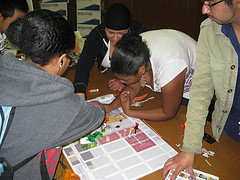 Sarah Van Wart from the UC Berkeley I School was my guide. She and two undergrads, Arturo and Sarir had been leading the high school students in a community planning exercise. They first examined their current situation, using dialogue, photos, and data. They then considered alternatives and how those might apply to a planned urban development project.
  The development will include schools, housing, a park, and community center, but the questions for city planners, include “How should these be designed?” “How can they be connected?” “How can they be made safe, useful, and aesthetically pleasing?”
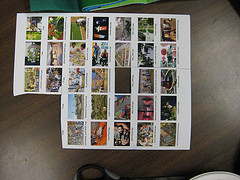
 On the day I visited, the youth had already developed general ideas on what they’d like to see in the development. Now they were to make these ideas more concrete through 3-D modeling. Using clay, toothpicks, construction paper, dried algae, stickers, variously colored small rocks, and other objects, they constructed scale models of the 30 square block development. One resource they had was contact sheets of photos of other urban environments. They could select from those to include as examples to emulate or to avoid.
 I was impressed with the dedication and skill of the leaders of the project, including also the teacher, Mr. G. But the most striking thing was how engaged the young people were. I heard some healthy arguing about design, but I didn’t see the disaffection that is so common some high schools today.
 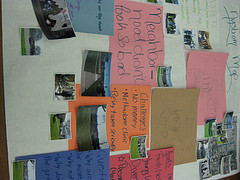 My only regret is that I wasn’t able to follow the process from beginning to end. But from the rich, albeit limited, glimpse I had, the project is an excellent way to engage young people in their own communities, to use multimedia for learning and action in the world, and to learn how to work together on meaningful tasks. It’s a good example of
 I just saw a reference to a New Scientist article,
  He starts by discussing the positive reaction to his first book,


 Chip's journey
