
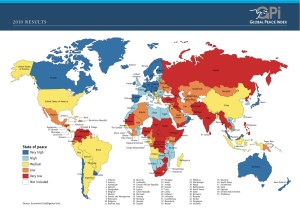
 The Vision of Humanity project has just released its latest report on the “texture of peace.”
Using 24 indicators, such as a nation’s level of military expenditure, its relations with neighbors, and the respect for human rights, the report quantifies the different aspects of peacefulness. It measures peacefulness within, as well as between, nations.
Understanding the texture of peace is more useful than saying simply “at war” or “peace is good.” It helps us see that no country is totally peaceful and that degrees of peacefulness can be quantified for comparison among countries or over time. We can also see how the lack of peace has costs beyond acts of violence per se.
The report identifies some of the drivers of peace, such as levels of democracy and transparency, education, and national well being. Their data show that
[t]he most peaceful societies have higher per capita income, high levels of well-being, more freedom, perform better at sustainability, and appear to have a more equitable distribution of social spending (Institute for Economics & Peace, 2010, p. 4).
The study also examines the economic consequences of peace. One remarkable finding for 2010 is that
…had the world been at peace, world economic output might have reached US$62.4 trillion, an increase of 8.5% and easily exceeding the output losses due to the economic crisis of 2008/9… Even a reduction in levels of violence of just 15% would equal the output loss due to the economic crisis (Ibid, p. 51)
I doubt that many people who turn to violence as a solution for conflicts, or any military contractors who benefit from the lack of peace, will read this report and suddenly decide that they’re misguided. But for the rest of us, this study provides some tools to question the direction we’re going, a way to measure progress, and a way to demonstrate the consequences of violence to the economy and the quality of life.
By the way, last year I celebrated ironically the ascension of the US to #83 on the list. It’s not good for anyone that the most powerful nation on earth is ranked among countries with severe poverty, Balkan states, which are still recovering from major conflict, and former Soviet republics. This year the US has dropped to #85.
References
Institute for Economics & Peace (2010). Peace, wealth and human potential. 2010 discussion paper.
 Netroots is a term that describes political activism organized through
  If you go to any public library in the US at opening time, you’ll see a group of people waiting to enter. They’re of all ages, ethnicities, and genders, dressed in formal business attire, sports clothes, or old rags. Some may be waiting to check out a book or video, but most are waiting to go online to read their mail, connect with friends, check the news, hunt for a job or apartment, shop, book travel, or do any of the many other functions that reveal how much the net has infiltrated our lives. For them, the library is the face of the net, and the only, or at least the best, way of connecting with it.
 Gesa Kirsch recently pointed me to John R. Stilgoe’s, Outside lies magic: Regaining history and awareness in everyday places. It’s a refreshing call for becoming more aware of the ordinary world around us. Stilgoe urges us not only to walk or cycle more, but also to use the advantages of those modes of transport to see the world that we usually ignore.
 The chapters—Beginnings, Lines, Mall, Strips, Interstate, Enclosures, Main Street, Stops, Endings—lie somewhere between prose poems, history lessons, and sermons about the everyday. They remind me of John McDermott’s summary that John Dewey “believed that ordinary experience is seeded with possibilities for surprises and possibilities for enhancement if we but allow it to bathe over us in its own terms” (1973/1981, p. x).
 He shows the value of a camera, despite the lament that “ordinary American landscape strikes almost no one as photogenic” (p. 179). He recognizes the dread of causal photography (‘why are you photographing that vacant lot?’), but ties it to “deepening ignorance” (p. 181). This ignorance makes asking directions dangerous: People question us back, ‘Why do you want to know?’
 I met recently with someone who’s played a major role in starting
 I was saddened to learn about the lonely death of Juanita Goggins, a great leader and educator. Her life is a reminder of both the possibilities we have and the great challenges we still face around race in America.
 Chip's journey