Popper, Wittgenstein, and the raccoon

We had a visitor last night. Like a previous one of her kin, she managed to visit every room, leaving small gifts on the floor and thoughtfully rearranging books, wall hangings, pottery, and other items.

This one had a special talent for philosophy. She was particularly interested in Karl Popper’s critique of teleological historicism and his reanalysis of Plato, as he develops in The Open Society and Its Enemies. One question she wanted to explore was whether raccoons enter houses with the intention to be ornery or do they just fall in because I haven’t come up with a way to secure the skylight screen. Popper would argue that there are genuine alternatives in history, multiple causal processes, and a role for raccoon intentionality. But I’m not sure how that helps to answer the question.

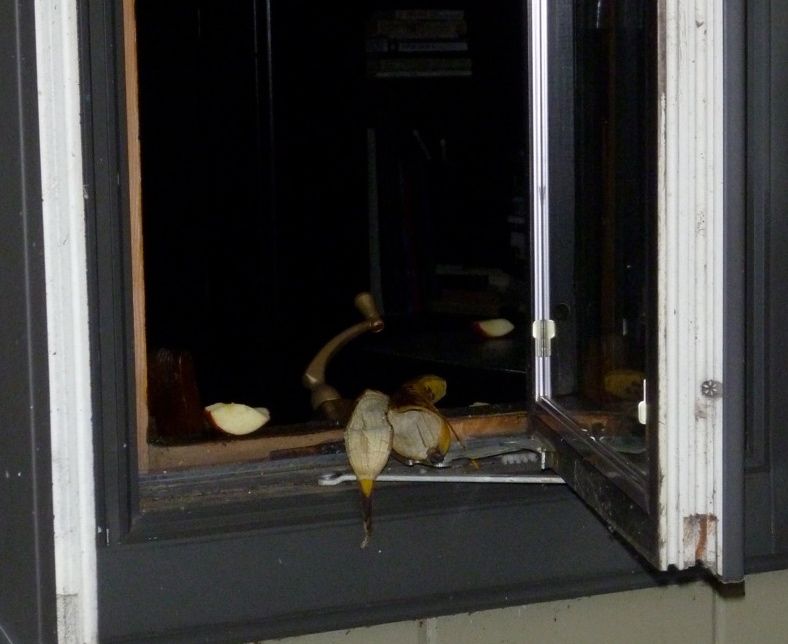
Hoping to appeal to her desire for conscious agency as well as her stomach, I set out some cut apples and banana peel in a trail across the counter to an open window. But her drive to remain curled up in the philosophy section was too strong, and she ignored all my offerings.

I noticed that our visitor preferred to stay in the Popper section and didn’t give any time to poor Ludwig Wittgenstein, his antagonist in the famous confrontation at the Cambridge University Moral Sciences Club. As there was a wood stove in the room, I thought I might reason with her using the fireplace poker, just as Wittgenstein had done with Popper in 1946. In that event, Popper stormed out, which would have been a pleasant outcome in this case, given my moral perspective.

But she held her ground, insisting that Wittgenstein’s view of formal philosophy as nothing but language games was an abdication of moral responsibility, that the Open Society could not be maintained without strong raccoon ideals. I argued that “open” in this case did not include raccoons. This led to a discussion about the danger of a priori categories and the need for dialogue across differences. While I appreciated the general argument, I felt that Wittgenstein might have a valid point in this case, and that it was time to terminate the game.

I assembled a set of tools in order to move to the next stage in this debate: the poker, large leather fireplace gloves, a broom, a blanket, a powerful flashlight, fresh fruit to appeal to her culinary desires. All I was missing was the courage to grab on to her and show her to the exit. As I said above, poking with the poker had no effect.

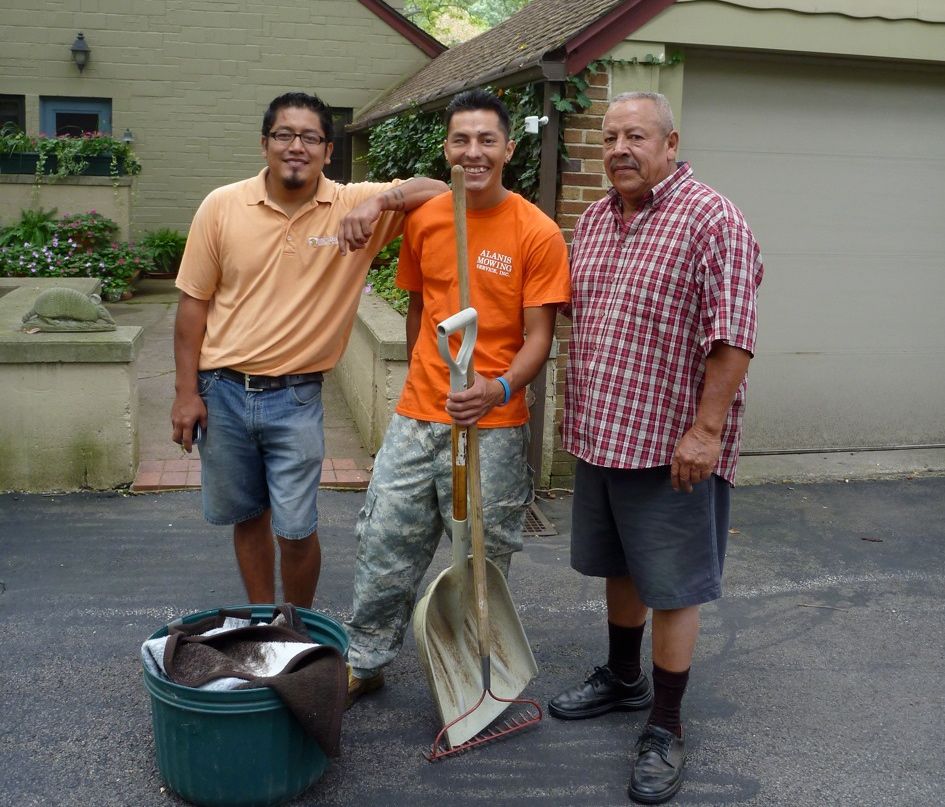
Fortunately, we had some helpers with more resourcefulness and courage than I. It took all three of them and a large plastic tub, but they managed to corner the raccoon in the tub, cover her with a blanket, and take her to the woods, where, I believe, her interest in environmental philosophy can be more profitably continued.

References

Outside lies magic, Part 2

I wrote most of my last post while flying from San Francisco to Chicago. Flipping through the airline magazine, the essay by Gerard J. Arpey, “The world is a book” caught my eye. It’s from St. Augustine: “The World is a book, and those who do not travel read only a page.” That seemed to be the message of Stilgoe’s Outside lies magic.

But on reading the essay, I encountered another quote that seemed hugely at odds with my own experience at the time. It’s from Antoine de Saint-Exupery’s Wind, sand, and stars, writing about airplanes:

The central struggle of men has ever been to understand one another, to join together for the common weal. And it is this very thing that the machine helps them to do! It begins by annihilating time and space.

Yes, the machine, the airplane, was annihilating time and space, but it was doing so by destroying my connection to the world around me. Instead of seeing more deeply as Stilgoe recommends, I found myself seeking ways to ignore the drone of the engines and the constant pressure on my knees from the seat in front of me. Saint-Exupery’s means for promoting our common humanity has become a factory ship processing fish.

See Outside lies magic, Part 1.

Happy Pi day!

Happy Pi day!  It’s March 14, or 3/14, the first three digits in the decimal expansion of Pi.

This only works for those of us living in Belize, Micronesia, Palau, Philippines, the US, and sometimes, Canada. The 95% of the world that more logically puts the day first thinks of today as 14/3. They’ll have to wait until July 22, but will have the consolation of knowing that 22/7 is a better approximation of Pi than 3.14.

As a gift for today, New Scientist offers five tasty facts about the famous ratio “We did consider giving you 3.14 facts but alas we had five…”

Climate change’s OJ Simpson moment

Bill McKibben has just written an excellent article: Climate Change’s OJ Simpson Moment | Mother Jones. Although one can read it as yet another argument pro or con on climate change, it’s even more a sophisticated analysis of how the discourse has developed over the last 20 years, in the process giving a surprisingly sympathetic account of climate change deniers.

He starts by discussing the positive reaction to his first book, The End of Nature, which was one of the first books for a general audience on climate change:
And here’s what’s odd. In 1989, I could fit just about every scientific study on climate change on top of my desk. The science was still thin. If my reporting made me think it was nonetheless convincing, many scientists were not yet prepared to agree.

Now, you could fill the Superdome with climate-change research data…Every major scientific body in the world has produced reports confirming the peril. All 15 of the warmest years on record have come in the two decades that have passed since 1989. In the meantime, the Earth’s major natural systems have all shown undeniable signs of rapid flux: melting Arctic and glacial ice, rapidly acidifying seawater, and so on.

Somehow, though, the onslaught against the science of climate change has never been stronger, and its effects, at least in the US, never more obvious: fewer Americans believe humans are warming the planet.

But McKibben doesn’t just rail agains the deniers of global warming, or pull out reams of reports, data, and arguments. Instead, he  talks about how we all respond to disturbing news and to mountains of evidence we don’t have the capacity to sort through. I felt as if he were speaking to all of us across a wide range of complex topics in the modern era–health, economics, education.

He goes on then to show how evidence alone is not the issue; in fact, its effect can be contrary to what you might think at first:

the immense pile of evidence now proving the science of global warming beyond any reasonable doubt is in some ways a great boon for those who would like, for a variety of reasons, to deny that the biggest problem we’ve ever faced is actually a problem at all.

The “OJ Simpson moment” relates to the problem that the defense faced in the OJ Simpson murder trial, in which “it was pretty clear their guy was guilty. Nicole Brown’s blood was all over his socks, and that was just the beginning.” How could they cast doubt, when there appeared to be no remotely reasonable doubt? McKibben shows how, ironically, one resource they had was the immense body of evidence against their client.

He also shows how ordinary language is shaped and changed. One reason the deniers of global warming are winning the debate is that they’re able to connect with our fear of change, of having to do something. As McKibben says:

The great irony is that the climate skeptics have prospered by insisting that their opponents are radicals. In fact, those who work to prevent global warming are deeply conservative, insistent that we should leave the world in something like the shape we found it. We want our kids to know the world we knew. Here’s the definition of radical: doubling the carbon content of the atmosphere because you’re not completely convinced it will be a disaster.

Turtles in China and Australia

During our sabbatical in Beijing and Brisbane, we had a surprising common theme: turtles.

I’ve always liked turtles, so perhaps it was natural that I saw them everywhere we turned. It started when we asked Caroline, a ten-year-old friend from Canada, about her classes at the Bei Da elementary school. She described a strange typing class, which involved typing expressions such as “FD 100 RT 120 FD 100 RT 120”. Although she didn’t realize it at first, this was not typing class, but computer programming using the Logo language. The commands were eventually to be used to command a robotic turtle, or one on a computer screen. In this example, the turtle would be commanded to draw an equilateral triangle, 100 pixels on a side.

We decided that turtle talk was a nice, limited domain in which to practice our feeble Chinese. Wang Dongyi, a Chinese friend, was helping us with that, and we were helping him with his English. Before long we had a bustling turtle circus going in our apartment at Shao Yuan on the Bei Da campus. Caroline, Emily, and Stephen played the turtles, with occasional help from certain childlike adults. We’d issue Logo commands in Chinese or English, and learn from the consequences of the turtles’ behaviors. In this way, we were all practicing both language and programming skills. We of course had to learn the Chinese word for sea turtle, Hai Gui (海归), so that we could say Turtle Emily, forward 30, or its equivalent in Chinese.
These navigational commands happened to be useful for us visitors, as we were continually seeking of giving directions. We began to refer to taxis as Hai Gui, since they needed to execute programs such as forward ten blocks, left, then forward three more.

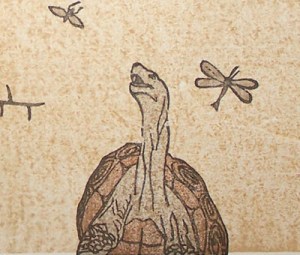
Hai Gui, from Woodblock Dreams

We saw images and sculptures of turtles. We even ate Hai Gui, probably more than we realized, since we couldn’t always identify or obtain a name for what we were eating. We then learned that the “Hai Gui” or “sea turtles” of China are the returning professionals who contribute to the growth of the Chinese economy. These are the students who were sent abroad, like baby sea turtles, to get advanced degrees and Western experiences, then return to lay their eggs in their homeland.

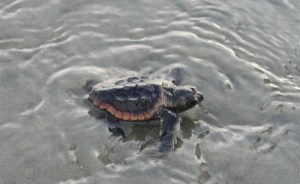
When we reached Australia, we spent a lot of time outdoors, taking advantage of the beautiful countryside in Queensland. We saw many turtles in lakes and in the ocean, and even swam with adult loggerheads. One highlight, near Bundaberg, was Mon Repos Beach, one of the two largest Loggerhead turtle rookeries in the South Pacific Ocean. Successful breeding there aids survival of this endangered species. The research program conducts animal surveys of nesting turtles, studies of reproduction, migration, behavior, incubation, and genetics.

Visitors can watch the turtles, and if they’re lucky, see the adults lay eggs (from mid November to February) or even better, see the hatchlings emerge and crawl to the sea (from January until the end of March). We couldn’t miss that. The night we went was magical. We saw baby turtles hatch and then crawl to the sea. Emily and Stephen took on the role of turtle guides, standing with legs spread and using a flashlight to guide the way. The turtles would follow the light until they neared the ocean edge and then could follow the moonlight.

Susan and I would not have done well as turtle guides since watching Emily and Stephen do this was too wonderful on its own. As Susan wrote in an email at the time, “The theme of any future message will be turtles; we did see the hatchlings and Stephen and I swam with a huge loggerhead on the [Great Barrier] Reef, a few seconds that were worth the total airfare.”

In that year, we were Hai Gui ourselves, emerging from our safe nest with little understanding of the world we were about to encounter.

New literacies and frogs

I visited the University of Connecticut in Storrs yesterday. It was a brief stop, but enough to be once again impressed with the excellent work of the New Literacies Research Team, led by Don Leu. They use new media, not simply to enhance or modernize in a superficial way, but to return classroom literacy to its roots in real communication. Nearly every project I heard about emphaizes reading and writing with a purpose and communication with real audiences.
For example, one project links a fourth-grade class studying the continents with a first-grade class in another state doing the same. The fourth-graders made online slide presentations to help teach the younger students, but quickly learned that their language was too advanced. They then recorded audio explanations to help explain things better.

On the way to UConn, I passed through nearby Willimantic, which is famous for its legend,“The Battle of Frog Pond”. This great battle occurred in 1754 around the time of the French and Indian War. It started with a huge racket in the middle of the night. The terrified villagers seized their muskets and prepared for the attack. In some accounts, they fired wildly across the town common. But no attack materialized. Instead, when morning arrived, they found hundreds of dead bullfrogs. A nearby pond had dried up causing the bullfrogs to fight for the remaining water.

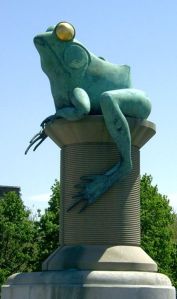
Later, American Thread Company established a mill in the town, which grew to be one of the largest producers of thread in the world. Willimantic became known as “Thread City,” and today boasts four statues on its bridge across the Willimantic River, each with a huge thimble and a giant, now silent, bullfrog.

Goodbye, maple

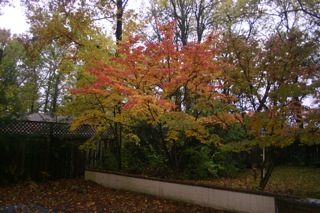
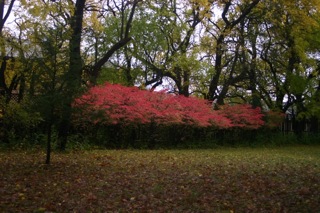
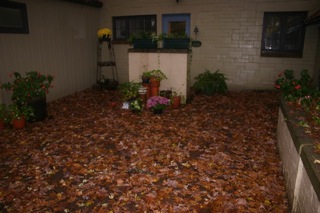
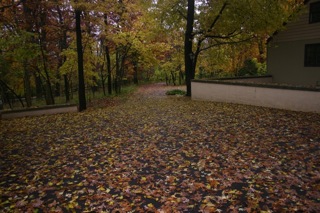
We had to take down a beautiful maple tree at the back of the house that was way too close to the foundation. Still, there are other maples nearby. And look at the dogwoods. Burning bush, pruned by the deer up to nose height. And leaves from yesterday’s storms. We still have plenty of trees. –Susan Bruce

Apples and apples

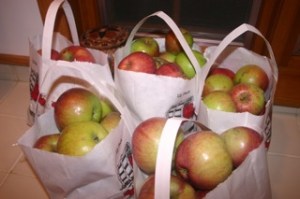
IMG_8487There’s more than corn and beans in the farmland here. Last Sunday, we visited an apple farm/orchard in Monticello, Illinois, which had 17 varieties.

Appropriately (for Monticello), one was Thomas Jefferson’s favorite, Spitzenberg. We got a little carried away and bought five half-pecks for $20.

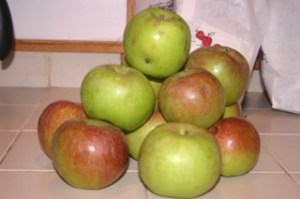
IMG_8489Fortunately, one is a long-keeper, Buff, which is supposed to last until late winter if it stays cold.

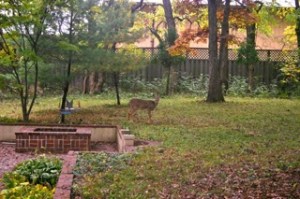
IMG_8485If we don’t eat them all, we can feed them to our deer. See this backyard scene, where we played boule at the potluck in honor of John Dewey’s 150th birthday on Tuesday.