Technologies to improve the quality of life

Gary McDarby was one of many very impressive people I met during my stay in Ireland during 2007-08. If you watch this short video, I think you’ll understand why.

It’s amazing how he manages to introduce several important projects in a short time, including Camara, SMART, and the Computer Clubhouse.

Prepare yourself for some tears.

Gary writes:

as many of you know, on the 7th of August 2009 Stuart Mangan and Robert Stringer passed away. I had been working with Stuart on technologies to help improve his quality of life (he had suffered a severe spinal injury in 2008) and Robert Stringer had been taking a holiday after volunteering with Camara in Tanzania when he was killed. In a strange twist of fate they died on the same day.

I have been giving a series of talks on these events with the sole of intention of trying to create something positive out of what was a very sad and challenging time. First and foremost I want to pay tribute to these two wonderful young men.

Recently I gave an IGNITE talk in the Science Gallery on what happened. It’s a short, 5 minute format which is quite a challenge to do, especially if the subject matter is non trivial.

I wanted to try and create something meaningful in this short format so it could be passed around in the viral ways we are all so used to. Its by no means perfect but please feel free to pass it on. The talk is here:

Inquiry-based community engagement

Melissa Pognon just alerted me to an interesting article by David Low, on university-community engagement. It presents a dialogical, or inquiry-based, view of engagement, drawing from communication theory and Perice’s theory of inquiry. Low emphasizes that

we do not ‘transfer’ or ‘transmit’ knowledge between social systems, but, rather, we engage a method that enables the recognition of a shared object of enquiry – its entelechy (Nicholls 2000) (p. 108).

This shared enquiry must not only tolerate dissent or difference, it actually depends on dissent to function at all. Such a view is radically different from the dominant university discourse around topics such as “knowledge transfer,” “public outreach,” or “service learning.”

Low writes,

without a method to nurture and reveal dissent, universities would be unable to even recognise different ways of being in the world, and enquiry would be rendered impossible (Hawes 1999, p. 235) (p. 111).

I find myself drawn initially to 2×2 tables such as the one Low presents in his grid-group, then later becoming frustrated with all that they obscure as well as reveal. But the article as a whole has many useful insights.

References

Hawes, L. (1999). The dialogics of conversation: Power, control, vulnerability. Communication Theory, 9(3), 229–264.

Low, David (2008). University-community engagement: A grid-group analysis. Gateways: International Journal of Community Research and Engagement, 1, 107-127.

Nicholls, A. (2000, September). The secularization of revelation from Plato to Freud. Contretemps, 1, 62–70.

Peirce, Charles S. (1877, November). The fixation of belief. Popular Science Monthly, 12, 1-15.

Outside lies magic, Part 1

Gesa Kirsch recently pointed me to John R. Stilgoe’s, Outside lies magic: Regaining history and awareness in everyday places. It’s a refreshing call for becoming more aware of the ordinary world around us. Stilgoe urges us not only to walk or cycle more, but also to use the advantages of those modes of transport to see the world that we usually ignore.

I finished the book, and am writing now, in the antipode of his call to walk and observe. I’m cramped in an airplane seat near the end of a four and a half hour flight. Stilgoe would say that I should still take the opportunity to observe, to learn, and to make sense of my surrounding, but instead I’m counting down the minutes until we land.

The chapters—Beginnings, Lines, Mall, Strips, Interstate, Enclosures, Main Street, Stops, Endings—lie somewhere between prose poems, history lessons, and sermons about the everyday. They remind me of John McDermott’s summary that John Dewey “believed that ordinary experience is seeded with possibilities for surprises and possibilities for enhancement if we but allow it to bathe over us in its own terms” (1973/1981, p. x).

To appreciate the book, you need to follow Stilgoe as he discovers nature, history, urban planning, ethics, social class, and more through cracks in the pavement, vegetation, telephone poles, roadside motels, angle parking, and other seemingly forgettable objects. The real point is not his own findings, but the demonstration that slowing down to look can open up worlds of understanding.

He shows the value of a camera, despite the lament that “ordinary American landscape strikes almost no one as photogenic” (p. 179). He recognizes the dread of causal photography (‘why are you photographing that vacant lot?’), but ties it to “deepening ignorance” (p. 181). This ignorance makes asking directions dangerous: People question us back, ‘Why do you want to know?’

Stilgoe says, “discovering the bits and pieces of peculiar, idiosyncratic importance in ordinary metropolitan landscape scrapes away the deep veneer of programmed learning” (p. 184). Unprogrammed exercise and discovery leads to a unified whole that reorients the mind and the body together. Someone else may own the real estate, but “the explorer owns the landscape” (p. 187).

Stilgoe’s prescription is simple:

Exploration encourages creativity, serendipity, invention.
So read this book, then go.
Go without purpose.
Go for the going.

See Outside lies magic, Part 2.

References

  • McDermott, John J. (1981). The philosophy of John Dewey: Two volumes in one. Chicago: University of Chicago Press. (Originally published 1973)
  • Stilgoe, John R. (1998). Outside lies magic: Regaining history and awareness in everyday places. New York: Walker.

Youth planners in Richmond, CA

I was fortunate to have a visit with youth planners at the Kennedy High School in Richmond, CA on Wednesday this week. These were students studying their own community and developing plans to improve it. They’ll be presenting these plans to the Mayor next month.

What I saw is part of Y-PLAN (Youth — Plan, Learn, Act, Now), a city planning program run by UC Berkeley’s Center for Cities & Schools. Deborah McKoy is the creator of Y-PLAN and the center’s founder and executive director.

Sarah Van Wart from the UC Berkeley I School was my guide. She and two undergrads, Arturo and Sarir had been leading the high school students in a community planning exercise. They first examined their current situation, using dialogue, photos, and data. They then considered alternatives and how those might apply to a planned urban development project.
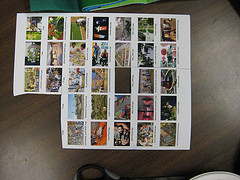
The development will include schools, housing, a park, and community center, but the questions for city planners, include “How should these be designed?” “How can they be connected?” “How can they be made safe, useful, and aesthetically pleasing?”

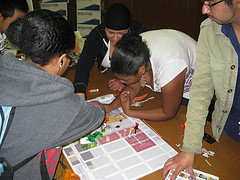
On the day I visited, the youth had already developed general ideas on what they’d like to see in the development. Now they were to make these ideas more concrete through 3-D modeling. Using clay, toothpicks, construction paper, dried algae, stickers, variously colored small rocks, and other objects, they constructed scale models of the 30 square block development. One resource they had was contact sheets of photos of other urban environments. They could select from those to include as examples to emulate or to avoid.

I was impressed with the dedication and skill of the leaders of the project, including also the teacher, Mr. G. But the most striking thing was how engaged the young people were. I heard some healthy arguing about design, but I didn’t see the disaffection that is so common some high schools today.
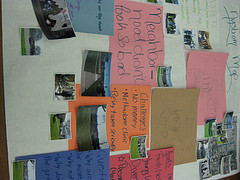
My only regret is that I wasn’t able to follow the process from beginning to end. But from the rich, albeit limited, glimpse I had, the project is an excellent way to engage young people in their own communities, to use multimedia for learning and action in the world, and to learn how to work together on meaningful tasks. It’s a good example of community inquiry.

Sara Bernard has a more detailed article on the project on Edutopia, which includes an audio slide show:

Audio slide show: Putting Schools on the Map Slide Show
Putting Schools on the Map

References

Bernard, Sara (2008, October). Mapping their futures: Kids foster school-community connections.

Bierbaum, Ariel H., & McKoy, Deborah L. (2008, Spring). Y-PLAN: A tool for engaging youth and schools in planning for the future of their communities. IMPACT: A Multidisciplinary Journal Addressing the Issues of Urban Youth, 2(1).

McKoy, Deborah, & Vincent, J. 2007. Engaging schools in urban revitalization: The Y-PLAN (Youth-Plan, Learn, Act, Now). Journal of Planning Education and Research, 26, 389-403.

Coffee Party USA

I met recently with someone who’s played a major role in starting Coffee Party USA. It’s a promising idea, one which provides at least some counter to the vicious, self-serving, and dogmatic rhetoric we hear so often in other arenas. I’ll be interested to see how it develops.
Coffee Party USA includes online forums and Facebook. On Saturday, the First National Coffee Day was launched in 350+ coffee shops in 44 States. The group

…aims to reinvigorate the public sphere, drawing from diverse backgrounds and diverse perspectives, …[believing] that faithful deliberation from multiple vantage points is the best way to achieve the common good…

We are 100% grassroots. No lobbyists here. No pundits. And no hyper-partisan strategists calling the shots in this movement. We are a spontaneous and collective expression of our desire to forge a culture of civic engagement that is solution-oriented, not blame-oriented.

We demand a government that responds to the needs of the majority of its citizens as expressed by our votes and by our voices; NOT corporate interests as expressed by misleading advertisements and campaign contributions.

Will there at last be a public option for health care?

Finally, the Democrats are stepping up to offer a real alternative to the Republican’s do-nothing approach and their own save-the-insurance-companies approach.

On March 9, Congressman Alan Grayson, D-Fla., introduced a bill (H.R. 4789 — the Public Option Act, or the Medicare You Can Buy Into Act) which would make it possible for any US citizen or permanent resident to buy into Medicare.

Grayson said,

Obviously, America wants and needs more competition in health coverage, and a public option offers that. But it’s just as important that we offer people not just another choice, but another kind of choice. A lot of people don’t want to be at the mercy of greedy insurance companies that will make money by denying them the care that they need to stay healthy, or to stay alive. We deserve to have a real alternative.”

The bill would require the Secretary of Health and Human Services to establish enrollment periods, coverage guidelines, and premiums for the program. Because premiums would be equal to cost, the program would pay for itself.

“The government spent billions of dollars creating a Medicare network of providers that is only open to one-eighth of the population. That’s like saying, ‘Only people 65 and over can use federal highways.’ It is a waste of a very valuable resource and it is not fair. This idea is simple, it makes sense, and it deserves an up-or-down vote,” Congressman Grayson said.

I signed the petition calling for at least a vote on Grayson’s proposal. If you agree, sign it too and to urge Speaker Pelosi to allow that vote.

International Violence Against Women Act

The International Violence Against Women Act was re-introduced in Congress on February 4. It’s one step in the effort to end violence against women and girls across the globe, supported by organizations such as Amnesty International USA,  Women Thrive Worldwide, the Family Violence Prevention Fund, and the International Rescue Committee.

This violence is a global human rights, health, and economic problem. It’s a barrier to addressing poverty, HIV/AIDS, and conflict. One out of every three women worldwide has been physically or sexually abused during her lifetime, with rates much higher in some countries. The abuse ranges from rape to domestic violence and acid burnings to dowry deaths and “honor” killings.

A small, but useful action is to urge Members of Congress to co-sponsor the Act.

Juanita Goggins

[Note: This post was written five months ago, but I must have forgotten to click “publish”. I’d like to have it on the blog, even though her death is now old news, if only to help record a courageous life.]

I was saddened to learn about the lonely death of Juanita Goggins, a great leader and educator. Her life is a reminder of both the possibilities we have and the great challenges we still face around race in America.

Goggins was the daughter of a sharecropper in rural South Carolina, the youngest of 10 children, and the only one to earn a four-year college degree, from what was then all-black South Carolina State College. She taught in South Carolina’s segregated schools, and then went on to a number of major achievements.

In 1972, she became the first black woman to represent the state as a delegate to the Democratic National Convention. Two years later, she became the first black woman appointed to the U.S. Civil Rights Commission and the first black woman elected to the South Carolina Legislature. She was responsible for funding sickle-cell anemia testing in county health departments and sponsored key legislation on school funding, kindergarten, and class size.

One indication of the world she had to navigate was the Orangeburg Massacre. In February, 1968, students from Goggins’s alma mater attempted to bowl at Charlotte’s only bowling alley. The owner refused. Tensions rose and two days later violence erupted. The Orangeburg Massacre resulted in injury to 28 students and the death of three.

Sadly, by the early 1980’s, Goggins had developed mental illness and in later life became increasingly reclusive. She froze to death at age 75, living alone in a rented house not far from the Statehouse in Charlotte, where she had served.

See Once-revered lawmaker freezes to death alone (Associated Press, March 10, 2010).

The New Jim Crow

Writing in Mother Jones, Michelle Alexander  has an excellent article on The New Jim Crow. It’s about how the War on Drugs has led to a permanent American undercaste. Similar ideas came up in my class yesterday as we discussed equity and excellence in education. As with many other topics we saw how making progress within education cannot be separated from addressing the same problems beyond the walls of academia.

Here’s an excerpt from her article:

Ever since Barack Obama lifted his right hand and took his oath of office, pledging to serve the United States as its 44th president, ordinary people and their leaders around the globe have been celebrating our nation’s “triumph over race.” Obama’s election has been touted as the final nail in the coffin of Jim Crow, the bookend placed on the history of racial caste in America.

Obama’s mere presence in the Oval Office is offered as proof that “the land of the free” has finally made good on its promise of equality. There’s an implicit yet undeniable message embedded in his appearance on the world stage: this is what freedom looks like; this is what democracy can do for you. If you are poor, marginalized, or relegated to an inferior caste, there is hope for you. Trust us. Trust our rules, laws, customs, and wars. You, too, can get to the promised land.

Perhaps greater lies have been told in the past century, but they can be counted on one hand. Racial caste is alive and well in America.

She offers some important information that should make us all question how America deals with race today, starting with:

There are more African Americans under correctional control today—in prison or jail, on probation or parole—than were enslaved in 1850, a decade before the Civil War began.

The article addresses the obvious questions that some readers may have, such as “well, shouldn’t we be locking up criminals?” or “aren’t we at least improving in the ways we deal with racism and poverty?”

It’s worth noting that Alexander’s just saying that the absolute number of African Americans under correctional control today is greater than the number enslaved in 1850. In a sense that makes it less horrific. One might also qualify the claim by pointing out that being on parole is very different from being a slave.

Nevertheless, some aspects of the modern system are even worse and less justifiable. Many people would be surprised to learn that the absolute scale of the institution is now greater. Unlike slavery, it’s now pervasive in every state, and stands out as inconsistent with other contemporary practices. And the current prison system doesn’t even produce goods; it simply drains scarce resources to destroy lives.

Should we subsidize good journalism?

The Death and Life of American Journalism: The Media Revolution that Will Begin the World Again, by John Nichols and Robert W. McChesney, has just been published. It makes a convincing case that journalism is a public good, with broad social benefits, including being necessary for democracy.

They also show how good journalism is under threat from a variety of forces. One is media consolidation, meaning that a few huge corporations control most of our media. Another is that our reliance on the Internet is radically changing business models, making it increasingly difficult to support investigative journalism. Moreover, whether the Internet can remain open, diverse, and democratic is very uncertain. Meanwhile, support for public media is waning, especially in the US, which spends only a tiny percentage of what other nations do for non-corporate media.

To address these problems, they propose what some might consider to be a radical proposal. But it’s actually quite in line with traditional government initiatives in areas such as defense, education, transportation, etc., which support vital services that the market can’t supply. Moreover, their proposal operates through free market mechanisms, without requiring, or even allowing government control over media content. It’s an innovative idea, one whose importance goes far beyond just saving the local newspaper.

Their proposal contains four key elements:

  1. free postage for any publication, with less than 20% of its pages in advertising
  2. up to $200 individual tax deduction for a newspaper subscription
  3. a viable school newspaper and radio station for every middle school, high school and college, so that young people not only read the news, but also produce it
  4. increased spending on public and community broadcasting

I might add other items, such as broadening the youth production aspect to include other sites in which that occurs, such as community centers and libraries, or find some way to support local book production as well.

The proposal could ensure a diversity of news sources, with support for those who produce the news. It would immediately move us beyond reliance on a handful of media conglomerates, while still allowing their operation, for those who so chose. The cost is no more than that supported by other nations with advanced economies. It’s well worth considering for anyone concerned with maintaining a modern democracy.

Nichols and McChesney, are co-founders, along with Josh Silver, of Free Press, which works for net neutrality and has launched a major campaign to save the news.

References

Nichols, John, & McChesney, Robert W. (2009, March 18). The death and life of great American newspapers. The Nation.