Reality and the third rail

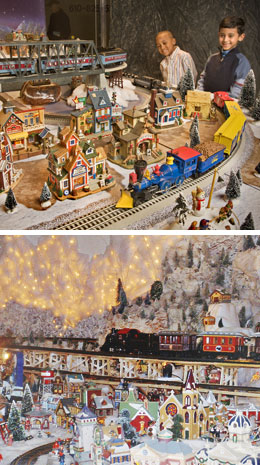
The Reading Terminal Holiday Railroad Photos by G. Widman for GPTMC

When I was last in Philadelphia I walked through the Reading Terminal Holiday Railroad and Train Display.

This is a giant model railroad layout (1/3 mile of tracks) at the Reading Terminal Market. There’s a detailed, interactive display featuring historic scenes of Philadelphia and rural Pennsylvania. Trolleys and Reading Railroad trains pass through City Hall and travel over the Schuylkill River.

I couldn’t help noticing that these were Lionel trains, the sign being the characteristic third rail. I remember as a boy having mixed feelings about that third rail.

On the one hand, it was a reminder that my model train layout wasn’t reality. Of course, a cynic might have pointed out that my mountain was a clearer giveaway, since it scaled to 25 feet high, not to mention that the entire world fit within a 4′ x 8′ rectangle with abrupt declivities on each edge. Yet I could somehow overlook those signs and still be bothered by the third rail.

On the other hand, the third rail was a reminder that I didn’t have the less realistic American Flyer train that my friend Jeff had. My locomotive and cars, as well as my accessories, were all more real, and the third rail spoke to that. In a practical sense, the third rail also permitted more “realistic” wiring of the tracks and switches.

One might say that the third rail marked a gateway between reality and fantasy. It was an icon, drawing me into the model railroad world. I spent hours and hours in that world, which felt more real than many other parts of my life. At other times, though I would look at it and be reminded that that world wasn’t as real as I hoped.

Now, as an adult, rushing to catch the “real” train to the airport, I had the opposite reaction. The beautiful train layout caught my eye, and I immediately wished there was more time to study it. But there was easily enough time to notice a key feature, that characteristic third rail.

This time I knew. That third rail told me that this was a real Lionel train, not some second-rate substitute. This train layout was a real world, with City Halls and rivers, trolleys and people. It was a place I’d once again be happy to lose myself within, as opposed to the false world outside, with all its fake products, commercialism, planned obsolescence, and unkept promises, not to mention the wars, institutional violence, and injustice that belie its values.

Rethinking schools

Rethinking Schools began in 1986 in Milwaukee, Wisconsin, as an effort to address problems such as “basal readers, standardized testing, and textbook-dominated curriculum.”

It’s since become an international publisher of educational materials, with a magazine and books on classroom practice and educational theory, social justice, anti-racism, vouchers and marketplace-oriented reforms, funding equity, and school-to-work. The publications are written by and for teachers, but speaks to students, parents, administrators, researchers, and community members as well.

I like their vision of the common school:

Schools are about more than producing efficient workers or future winners of the Nobel Prize for science. They are the place in this society where children from a variety of backgrounds come together and, at least in theory, learn to talk, play, and work together.

Schools are integral not only to preparing all children to be full participants in society, but also to be full participants in this country’s ever-tenuous experiment in democracy. That this vision has yet to be fully realized does not mean it should be abandoned.

I highly recommend their publications, including the classic, Rethinking Columbus: The Next 500 Years, which was my introduction. I’ve used several of the books or magazine issues in my own teaching and can say that I’ve learned important things from every one of them.

The Fun Theory

My sister, Susan, just sent a link to the Piano Staircase, which combines health, music, and fun, three of my favorite things:

Take the stairs instead of the escalator or elevator and feel better” is something we often hear or read in the Sunday papers. Few people actually follow that advice. Can we get more people to take the stairs over the escalator by making it fun to do? See the results here.

The Piano Staircase is from the Fun Theory, which

is dedicated to the thought that something as simple as fun is the easiest way to change people’s behaviour for the better. Be it for yourself, for the environment, or for something entirely different, the only thing that matters is that it’s change for the better.

The site has all sorts of clever ideas, many of which have been realized, and some with videos.

John Dewey and Daisaku Ikeda

ikeda-headshotI attended the 6th Annual Ikeda Forum for Intercultural Dialogue yesterday at the Ikeda Center for Peace, Learning, and Dialogue in Cambridge. The topic was John Dewey, Daisaku Ikeda, and the Quest for a New Humanism. The occasion was the 150th Anniversary of John Dewey’s birth.

Although Ikeda’s Nichiren Buddhism, a form of Mahayana Buddhism, may at first seem far removed from Dewey’s American pragmatism, the speakers found many areas of consonance between the work of the two. I was pleased to see that Jane Addams was brought into the conversation, too.

Ikeda CenterNichiren was a 13th century Buddhist reformer, who based his teachings on the Lotus Sutra and its  message of the dignity of all life. Like Dewey’s pragmatism, Nichiren Buddhism is grounded in the realities of daily life. It promotes “human revolution,” in which individuals take responsibility for their lives and help to build a world in which diverse peoples can live in peace.

Ikeda is the founder of the Soka Gakkai International, a movement characterized by its emphasis on value creation (soka). This implies that each individual needs the opportunity to find value in their unique path while contributing value to humanity. Soka schools have much in common with the kinds of schools Dewey envisaged (but rarely saw enacted).

At the Ikeda Forum discussions focused on connections and divergences between Dewey’s naturalistic humanism and Ikeda’s Buddhist humanism. Presentations examined how their work can be used as resources for individual and social change.

The land of forms

form_1040_us_individual_income_tax_return_form_imageFar across the sea, there’s a certain land in which curious practices began to emerge some time ago. These practices began with the idea of documenting the work people were doing. Someone had the brilliant idea to ask each person to fill out a form to show how much they had done at such and such a time. It was never clear that the information so collected had any bearing on the work or the people involved, but the form was beautiful and quickly evolved from a few simple questions into a formidable document.

Soon, it was decided that forms would be useful in health care, asking all kinds of questions about the body, regardless of whether that information would be used. There were then forms for voting, for taxes, for getting a job, for running a business, for schools, for shopping, for clubs, for religion, for travel, for sports, for software, indeed for every aspect of the people’s lives. In the early stage, the typical form would fit on a sheet of paper. But that stage was short-lived. The forms began to grow, soon needing special, long sheets of paper, or multiple sheets. Then, online forms appeared, with checkboxes, open fields, Previous and Next buttons and all sorts of other helpful features.

prc-health-form-eAn especially useful feature was “Are you absolutely sure that the information you have entered is accurate and complete? Severe penalties for non-compliance will ensue.” This one was good because the forms were inevitably obscure and self-contradictory, making it a challenge to know what one had just filled out, much less whether it was accurate and complete.

A major advance in the practice of forms was to create forms to determine whether you were filling out other forms properly. Ethics compliance forms were established to check that other activities, inevitably themselves involving forms, were properly conducted. As with the other uses of forms, the genesis was quite understandable. For example, people had been incorrectly filling out forms to issue driving licenses, thus endangering the public. A new form arose to ensure more ethical behavior. The fact that ethical abuses escalated following the introduction of the new ethical form led to a now-familiar phenomenon: The form was expanded. Again, the link between ends and means was tenuous at best.

An especially interesting aspect of the forms culture was that some forms could not be completed without first doing another form. Completing the second form would lead to the production of a control number to be entered on the first, assuming of course that it, the second one, could be properly completed, submitted, and reviewed. This practice reached its zenith with the realization that form number two could itself require the completion of another form, and so on.

In this way, the forms began to come alive, each connected to the others though a complex, essentially unknowable rhizomatic network. Forms naturally spawned other forms in an ever-growing ecology of forms in multiple media.pro-job-application-form-thumb

As the forms ecology grew, some people began to raise questions about whether it was possible to complete a form if doing so entailed completing other forms in an endless succession. Fortunately, there were philosophers and mathematicians to weigh on on this question. One school of thought, the Infinitists, began to argue that the chains of forms were infinite, meaning that some forms were uncompleteable, a seeming tragedy in the forms world. Others claimed that the total number of forms had to be finite, but that there were circular chains such that a form could be completed only by being already completed.

This latter view is reminiscent of Schopenhauer’s demand on the reader in his The World as Will and Idea. Schopenhauer says that his book has but one idea. That idea is an organic whole that cannot be expressed by a book with “a first and a last line.” His compromise solution to this conundrum is to ask the reader to read the book twice or not at all. The Circularists,  as those who believed in the circular chains of forms came to be called, adopted a similar view: They argued that although the circular topology prevented the form from ever being completed, repeated revisitings could lead to a kind of oneness with the form akin to groking Schopenhauer’s one organic idea.

Pragmatists, of the Peircean variety were quick to see the ever-increasing complexity of the forms ecology, with its convoluted topologies and possible lack of finitude. But they emphasized an additional wrinkle that had passed by even some of the great connoisseuers of forms. The forms were not static; they could change in small and large ways at a moment’s notice. This meant, among other things, that having completed a form on one day was no assurance that one would not be required to complete it again the next.

autofill_formThere was also a curious aspect of the storage of forms data. I’ve remarked on the separation of the forms from the dally life and purposes they purported to address. But beyond that, they spoke to themselves in what some deemed to be a fractured dialect. Forms completed at a doctor’s office could not communicate with the apparently similar form at the physical therapy facility whose purpose was to implement the doctor’s prescription. And neither of those forms could speak to the pharmacy forms or those of the medical supply.  This occurred even when the facilities were all part of the same organization.

On the other hand, even though the forms were disconnected from daily life and each other, they had a remarkable ability to retain and communicate data in a dysfunctional fashion. For example, no matter how grudgingly and circumspectly people had revealed details of their lives or how many assurances had been made, these details were regularly transmitted throughout the land. The word for “privacy” disappeared from the language, as it no longer had a use.

Despite the massive accumulation and dissemination of data engendered by the forms, people seemed to know less and less about one another or the concrete problems they faced in their lives. The reason was clear: Police spent time on forms, not on preventing crime; health providers likewise became adept at forms, but not at ensuring health; teachers knew every line and checkbox, but had little time for details such as students.

Over time, the people learned that nothing was real in their lives unless it could fit on a form–their wealth, their citizenship, their job, their spouse, and so on. What could not be form-alized did not exist. The forms became the reality they originally sought only to document. They infiltrated every aspect of the people’s lives and slithered with ease across natural and political boundaries. While the forms ecology had a beginning in specific times and places, it warmed the hearts of forms afficianados to know that there was no way to stop their spread.

I welcome comments on this little story. There’s a form below for your convenience.

Boys and tables: Asking may not be enough

In my last post, I talked about the parable of the blind men and the elephant, concluding that if we want to know how others see the world, “we need to ask.”

But often, simple asking is not enough. John Dewey includes the following story (from Ogden and Richards, quoting J. H. Weeks) in his Essays in Experimental Logic. He obviously liked the story as I do, because he repeats it in his Logic: The theory of inquiry:

I remember on one occasion wanting the word for Table. There were five or six boys standing around, and tapping the table with my forefinger, I asked, ‘What is this?’ One boy said it was a dodela, another that it was an etanda, another stated that it was bokali, a fourth that it was elamba, and the fifth said it was meza.

[It turned out afterwards that] one boy thought we wanted the word for tapping; another understood that we were seeking the word for the material of which the table was made; another had the idea that we required the word for hardness; another thought we wished for a name for that which covered the table; and the last, not being able, perhaps, to think of anything else, gave us the word, meza, table—the very word we were seeking.

References

Ogden, C. K., & Richards, I. A. (1949). The meaning of meaning: A study of the influence of language upon thought and of the science of symbolism, 10th ed. With supplementary essays by Bronislaw Malinowski and F. G. Crookshank (orig. pub. 1923). Routledge & Kegan Paul.

Blind people and elephants: We need to ask

blind_elephant[These comments grew out of a discussion in our Community Engagement class.]

The parable of the blind men and the elephant (see also the Wikipedia entry) has been told and retold many times. In that story, blind men feel different parts of the elephant, each concluding that the elephant is only what they directly feel.

For example, as John Godfrey Saxe’s poem re-telling would have it, different men saw the elephant as a wall, a snake, a spear, a tree, a fan, or a rope. E.g.,

The Second, feeling of the tusk,
Cried, “Ho! what have we here
So very round and smooth and sharp?
To me ’tis mighty clear
This wonder of an Elephant
Is very like a spear!”

The story reminds us that reality may be viewed differently depending upon one’s perspective. But our fascination with it reveals that we, too, see only part of reality, making judgments about blindness based on not seeing actual blind people encountering actual elephants.

In Letter on the Blind for the Use of Those Who See, Javier Téllez takes the story in a new direction, by asking blind people to interact with a real elephant. (interview with Téllez and curator Mark Beasley)

As quoted in Greg Cook’s review in The Boston Phoenix, participants said things such as:

“It felt like a tire, a car tire, except it was warm. It wasn’t a good feeling.” “When I first went to touch it, I bumped into it, and I thought it was the wall. It felt like thick lizard skin.” “I felt an ear that felt like a hat and a trunk that felt like a hand.” “You feel the ridges and the bumps. And you can feel the life pulsing through it. You can’t hide it.” “It felt like I was touching some curtains.” “I imagined it to be quite large, but I couldn’t really sense how wide or tall it was. . . . And then I couldn’t tell if the damn thing was breathing or not breathing.”

Despite all the many tellings and re-tellings of that story, the actual blind people saw the elephant in ways not included in the standard versions of the parable. They helped me to see both blindness and elephants in new ways.

It’s good to recognize that people see the world differently, but to know what those different ways really are, we need to ask.

Dreaming in Hindi, by Katherine Russell Rich

kathy_sari

Recently, I listened to an interesting Afternoon Magazine (WILL AM 580) radio interview with Katherine Russell Rich, related to her book, Dreaming in Hindi: Coming Awake in Another Language.

It’s her own story of learning language. When Rich lost her job at a New York magazine, she didn’t just file for unemployment compensation, she decided to immerse herself in Hindi and in India, as she says on her website;

I’d recently lost a job, I was watching the business I’d been in and loved, magazines, begin to crumble. My world had been turned upside down. Compounding that was the fact that in the decade before, I’d gotten smacked around twice by breast cancer. I barely recognized my own life anymore. Or the way that I put it in the book was, “I no longer had the language to describe my own life, so I decided to borrow someone else’s.”

There are many examples revealing about Hindi, English, language in general, culture, and Rich herself, e.g.,

…the word for yesterday and tomorrow is the same: kal, from Kali, the goddess of death and destruction. There’s a philosophy embedded in there—it’s only when you’re in today, aaj, that you’re here; if you’re in yesterday or tomorrow, you’re in blackness.

Is it good to synchronize traffic signals?

The Champaign County Regional Planning Commission hopes to apply for a $1.94 million federal grant to coordinate the traffic signals at dozens of intersections in the community, covering major corridors such as Neil Street and Prospect, University, Bradley, Mattis and Florida/Kirby avenues.

Champaign-Urbana Urbanized Area Transportation Study…says the proposed “traffic signal energy efficiency and conservation strategy” could reduce the typical motorist’s annual travel times by 20 to 50 percent, cut fuel consumption by 14 percent and reduce carbon dioxide, methane and nitrogen dioxide emissions by 13.3 percent.

via The News-Gazette.com: Re-timing of traffic signals could be first stage in overhaul.

Champaign_Illinois_20080301_4107Saving energy, reducing pollution, reducing travel time, all sound good. But synchronized signals along University Avenue may have an insidious consequence.

It’s already the case that University Avenue marks and maintains racial divisions in the cities of Champaign and Urbana. Some people south of University, especially whites, view “north of University” as an area they don’t want to be in. And some blacks north of University may view south of University as an unwelcoming place. The busy traffic corridor with miserable access for pedestrians reinforces the view that these two domains are separate, and necessarily so.

As an already busy traffic corridor, University Avenue makes it difficult for alert, athletic adults to cross from one area of town to another on foot or bicycle. It’s positively unsafe for children or anyone without well-honed defensive faculties. Drivers already go too fast and are inattentive to pedestrians and cyclists. This could become worse with synchronization.

Could the street become safer with synchronization? Maybe. But I doubt that will happen if the only concerns considered are overall vehicular traffic flow.

I’m not sure in the final analysis whether the proposed changes should be done or not, but I do believe that we’d be better off if we were to understand better the symbolic and material consequences of slashing through our community.

hear you are — [murmur]

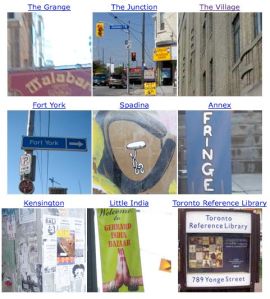
murmur[murmur] is a documentary oral history project that records stories and memories told about specific geographic locations. We collect and make accessible people’s personal histories and anecdotes about the places in their neighborhoods that are important to them. In each of these locations we install a [murmur] sign with a telephone number on it that anyone can call with a mobile phone to listen to that story while standing in that exact spot, and engaging in the physical experience of being right where the story takes place. Some stories suggest that the listener walk around, following a certain path through a place, while others allow a person to wander with both their feet and their gaze…

All our stories are available on the [murmur] website, but their details truly come alive as the listener walks through, around, and into the narrative. By engaging with [murmur], people develop a new intimacy with places, and “history” acquires a multitude of new voices. The physical experience of hearing a story in its actual setting – of hearing the walls talk – brings uncommon knowledge to common space, and brings people closer to the real histories that make up their world.

Being cellphone-impaired, and far from Toronto, I’m reduced to listening to the stories on the website, but they still convey a sense of the city and its history. The site’s a well-designed example of integrating oral history, geographic information systems, and mobile phones.