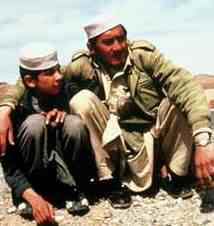
There are times when a movie just grabs me, despite technical flaws, my low expectations, and even a boring DVD case cover. In This World is one of those. The political message is clear, but understated, conveyed instead by an intimate look at the consequences of war and greed on the lives of decent people.
The movie presents a fictitious journey that conveys disturbing truths of life “in this world” we inhabit. Although it’s low-key and rough as cinema, it produces an intimate connection to its characters, Afghan refugees Jamal and Enayatullah, as they travel from Shamshatoo refugee camp near Peshāwar, Pakistan, across Pakistan, through Iran, Turkey, Italy and France, towards London.
Like thousands of others every year, their desperation feeds the multibillion dollar human smuggling business, an unconscionable stain on any of our pretensions to justice. The smuggling fuels crime, violence, corruption, illegal drug trade, and too often leads to death, no longer being “in this world.”
The actors are Afghan refugees themselves, and the encounters in the movie elide life and art. I was fascinated by the places they moved through, and their resourcefulness in learning how to cope with diverse languages and unscrupulous people.
The camps near Peshāwar are filled with people displaced by the Soviet invasion of Afghanistan and later, US bombing. UNHCR says that there are currently “1.7 million registered Afghans in Pakistan, with 45 percent residing in refugee villages and the rest scattered among host communities.” But the total, including children born to refugees, may be several million. The humanitarian crisis is compounded now by two million civilians fleeing the fighting in Pakistan’s Northwest Frontier.
Even though the story is depressing about our institutions, I finished it feeling hopeful about our human capacity. I wanted to travel the modern silk road and more still to learn about the world of these refugees and the policies that lead to their plight.
The theme of the symposium is Critical Pedagogy: Community Building as Curriculum. As professionals and institutions are engaging with communities to enhance the life chances and well-being of residents, the conference examines how community-building and critical pedagogy can offer effective and sustainable change, locally and among collaborators as well.
The keynote speaker this year is Antonia Darder, a Professor at the University of Illinois in Educational Policy Studies and Latino/a Studies. There will be presentations and workshops on
The conference also offers Batey Urbano‘s production of Crime against Humanity, screenings of original documentaries filmed on Paseo Boricua, community tours, and art exhibits.
Community as Intellectual Space is co-organized by the Juan Antonio Corretjer Puerto Rican Cultural Center (Chicago) and the University of Illinois Graduate School of Library and Information Science. Continuing Professional Development Units (CDPUs), academic course credit for those who enroll in UI’s LIS590 CIO, and registration scholarships available.
So far this school year, 36 children and teens have been murdered–more than one a week–and [Rev. Michael] Pfleger at St. Sabina Church] is among a chorus of weary Chicagoans who say the slayings aren’t getting the attention they deserve.
Had 36 kids died of swine flu this year, “there would be this great influx of resources that say, ‘Let’s stop this, lets deal with this,'” Pfleger said.
why overlook the humanity of so many others because of their ethnic background or economic circumstances? Surely the slaughter of dozens of Chicago schoolchildren is worthy of wide national coverage. CNN has covered the story, but there has been precious little coverage elsewhere.
One of the most impressive set of projects I saw while in Dublin, Ireland last year was the Community Links Programme out of Dublin Institute of Technology. It was established in 1996 by DIT lecturer Dr. Tommy Cooke to help individuals and communities reach their full educational potential. Programs include psychotherapy, music, and courses for mature students.
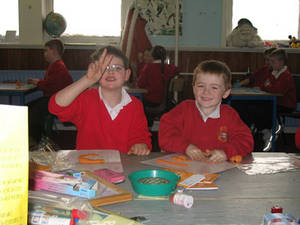
One important component is the DISC Programme, which operates in 38 inner-city disadvantaged primary and secondary schools. DISC installs computer resources in schools and community centers, and trains teachers to integrate the use of computers into the teaching/learning process in all curricular areas. Projects include the use of comic creation, clay animation, video production, class blogs, podcasting, video game making, 3d design, and robotic Lego.
Staff such as Ian Roller and Riona Fitzgerald bring knowledge of pedagogy together with skills in video and computers to help teachers and youth leaders do amazing projects. More importantly, they do it in a way that empowers teachers as creative agents in the education process.
I was very fortunate to hear Elizabeth Pierre-Louis speak yesterday.
Elizabeth was on campus to accept the 2008 Young Humanitarian Award. As Director of the Library Program at Fondasyon Konesans Ak Libète (FOKAL) in Haiti, she helped to set up 45 community libraries across the country. She coordinates the training and management of these libraries, which are improving the quality of live for the people there. Elizabeth described a wide variety of programs of FOKAL, including projects on supplying running water, developing basic literacy, supporting the visual arts, dance and music, debate, and economic education.
Throughout these many programs, there is an emphasis on participatory democracy, including organization and responsibility of citizens, leadership, financial and technical management, resolving conflicts, and collective decision making. Elizabeth’s work is just part of an amazing organization helping people work together toward common purposes.
The photo, of the Monique Calixte Library in FOKAL’s Cultural Center, and this text below are from the FOKAL site.
The Fondation Connaissance et Liberté / Fondasyon Konesans Ak Libète (FOKAL) Cultural Center, built in 2003 in the center of Port-au-Prince thanks to funding from the Open Society Institute (OSI) and support from George Soros, is designed for meetings, training, reading, debates, recreation and discovery.
The center is comprised of a public library, with a membership of over 5,000 where children and youths from the poor neighborhoods of Port-au-Prince have access to reading materials in optimal conditions, a small auditorium, a café-terrasse and a cybercafé. The UNESCO auditorium is a hall designed for conferences, debates, meetings, audio-visual presentations, films, concerts and theatre. The center also includes a large atrium where one can discover the works of both Haitian and foreign painters, writers, and sculptors; and a sound and video production studio, a training hall and gardens…
FOKAL’s cultural center offers a place, eminently rare in Haiti, where peasants, women, children and youths from poor neighborhoods have a chance to interact with each other and with representatives of all sectors of society on subjects which concern education, the environment, culture, and democracy…
The book, How Europe Underdeveloped Africa, is now available online.
Rodney presents a new way of thinking about Africa’s so-called “underdevelopment.” The question was “why are some areas of the world rich and others poor?” I had been taught many reasons for this—that successful countries had better inventions, more adventurous explorers, greater natural resources, geographical advantages, better climate, less corruption, or just good fortune. The implication was that they mostly deserved their status as did the less successful ones. Africa’s underdevelopment was thus to a large extent Africa’s fault. Of course, a generous impulse might lead us to help those less fortunate to develop and share the goods of the world, maybe not to achieve full equality, but at least enough to meet their minimal needs.
Rodney challenges that entire view. He describes an Africa that is more developed than Europe in most ways except military conquest. When Europe fails to compete on even terms with Africa and Asia it turns to war and colonization to take by force what it cannot achieve through fair trade. Africa is then consciously exploited by European imperialists, leading directly to the modern underdevelopment of most of the continent. Thus, “underdeveloped” is an active verb, with an agent who does the underdeveloping; it’s not just a descriptive adjective.
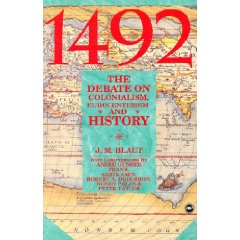
Rodney’s thesis was highly influential. James M. Blaut’s works, The Colonizer’s Model of the World: Geographical Diffusionism and Eurocentric History (Guilford, 1993) and 1492: The Debate on Colonialism, Eurocentrism, and History (Africa Research & Publications, 1993) extends the basic thesis, with more detailed economic analyses.
Other writers have criticized aspects of Rodney’s work, but the general idea seems even more salient in an era of neocolonialism. For example, Haiti today struggles under a crushing external debt. Nearly half of that was incurred under the Duvaliers, puppet dictators of the US. The Duvaliers stole the resources of the Haitian people, then assumed debts that oppress their children and grandchildren. Debt service, a burden essentially imposed by the US, makes economic growth nearly impossible. Yet commonplace accounts would say that “they” (the Haitian people) can’t manage finances, don’t know how to protect their natural resources, have a corrupt economy, lack creativity or initiative, or otherwise are to blame for their fate.
For many countries in Africa, for Haiti, and for other colonized areas, the forcible appropriating of indigenous human and natural resources means underdeveloping those areas. When we turn “underdevelop” into a past participle, “underdeveloped,” we make it easy to forget how that happened. Rodney puts it this way:
The question as to who, and what, is responsible for African underdevelopment can be answered at two levels. Firstly, the answer is that the operation of the imperialist system bears major responsibility for African economic retardation by draining African wealth and by making it impossible to develop more rapidly the resources of the continent. Secondly, one has to deal with those who manipulated the system and those who are either agents or unwitting accomplices of the said system. The capitalists of Western Europe were the ones who actively extended their exploitation from inside Europe to cover the whole of Africa. In recent times, they were joined, and to some extent replaced, by the capitalists from the United States; and for many years now even the workers of those metropolitan countries have benefited from the exploitation and underdevelopment of Africa. (§1.2)
Rodney’s account of Africa, written 37 years ago, is still relevant for Africa today. But it extends to other international regions and even to communities within so-called “developed” countries. When we see, and label, communities as underdeveloped, low-resource, impoverished, disadvantaged, economically depressed, troubled, or marginalized, we follow the lead of the 1965 Moynihan report, which described a “tangle of pathology,” locating problems within the community with causes in the distant past.
We should ask not only how these communities compare to privileged ones, or even what useful things we might do to help them. We need to look first at the structures and mechanisms of power that caused these conditions in the first place, and now, continue to maintain them. This means turning from the conceit that underdevelopment just happens, that an appropriate and full response is to “give” to those less fortunate. It requires collaborative struggle in which all participants are willing to examine the roots of oppression and to engage in the practice of freedom.
Residents of New Orleans lost their homes, their neighborhoods and schools, their jobs and businesses, and the lives of family members because of Hurricane Katrina in 2005. The effect on the community was devastating as has been documented in books and movies, e.g., Katrina’s Children and When the Levees Broke: A Requiem in Four Acts. To this day major areas, such as the Ninth Ward, are still struggling to recover.
Of all the losses, losing keepsakes and family treasures was especially hard. One category had an especially acute impact on a city famous for its food: Residents lost their family recipe files. These included the family recipes handed down by generations, as well as those clipped from newspapers, such as the The Times-Picayune. Without these recipes the task of rebuilding families and communities was made much harder.
As residents started to rebuild their lives, The Times-Picayune of New Orleans became a post-hurricane swapping place for old recipes that were washed away in the storm. The newspaper has compiled 250 of these delicious, authentic recipes along with the stories about how they came to be and who created them. Cooking Up a Storm [Recipes Lost and Found from The Times-Picayune of New Orleans] includes the very best of classic and contemporary New Orleans cuisine, from seafood and meat to desserts and cocktails. But it also tells the story, recipe by recipe, of one of the great food cities in the world, and the determination of its citizens to preserve and safeguard their culinary legacy.
The collective effort to reconstruct family recipe collections is positive counterpoint to all of the negative stories that came out of the Katrina disaster. It’s a wonderful example of community informatics—people coming together to address a common need, making use of newspapers, fax, email, digital archives, and other communication tools.
Anyone who writes a blog is curious about who’s reading it and is usually interested to read on similar topics. Both of those motivations lead to an interest in blog aggregators, sites that bring together blog posts from around the world.
Some of these are automatic, based on keywords in the posts. In most cases these turn out to be spam sites, promoting a product or service. I suspect that the large number of hits I received on a post about youth may have come from an automatic aggregator.
There are also more intentional aggregations such as blog rolls or blog carnivals. At blog carnival, for example, you can find carnivals on many topics, and submit your own posts to them. You can also create a new carnival on a topic of your choice. Some of the existing ones are elaborate, representing considerable effort, such as Carnival of Education. But even the best of the carnivals have a little of that quality of random listing that one sees in the spam aggregators.
There are now in between sites, such as Alpha Inventions or Condron. For these, new posts are harvested automatically, but you can also submit a post and categorize it. Visitors to the aggregator site see a slide show like presentation of other sites, often constrained by topic or language. This leads to an enormous boost in hits on blog posts, especially from Alpha Inventions.
Lesley Dewar has been running some experiments on this at No Tall Poppies. I plan to replicate those here, and share the results.
The big question of course, is not whether some scheme can produce more visits to a web page, but what if anything leads people to engage in what they read, to think critically, and to integrate that with their own experiences. My guess is that somewhere in all the surfing, syndication, aggregation, cross-linking, and such, that there are occasional sparks of real connection, but that there’s also a lot of smoke without fire.
Community informatics has very definitions, such as that it
…brings together people concerned with electronically enabling local (and virtual) communities; and structuring collaborations between researchers, practitioners (including industry) and policy makers to support community ICT implementation and effective use.
Definitions such as the one above appropriately name various constituencies, thus serving organizational needs. But for me they are oddly both too narrow, excluding legitimate elements and activities, and too broad, lacking a principled organization or rationale.
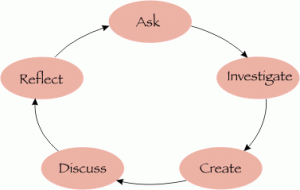
Inquiry cycle
The Inquiry Cycle
I’d like to suggest an alternative, drawing from the experience of the Community informatics Initiative (CII) at the University of Illinois, as well as helpful discussion with CII staff and students. The organizational principle that I’d like to suggest is that community informatics is a form of disciplined inquiry, with central questions, methods of investigation, actions, collaborations, and theories. I’d like to present that here using the the Inquiry Cycle as a framework and CII activities as concrete examples.
The Inquiry Cycle (Bruce, 2009) characterizes inquiry as involving five major aspects: a guiding question (Ask), methods of investigation (Investigate), active participation (Create), collaboration and dialogue (DIscuss), and reflection (Reflect). These aspects don’t necessarily proceed in a prescribed order; inquiry may involve any of the aspects in varying degrees and orders. For example, Reflect is often the beginning point of inquiry, leading to the formulation of the Ask. The idea of cycle (or better, spiral) suggests that inquiry does not complete, but generates further inquiries.
Community Informatics as a Type of Inquiry
The definition below is rather lengthy. Think of the Ask as the core question that defines community inquiry. The other elements then elaborate on that, emphasizing the variety of approaches needed to address the core question.
Ask: How can we work with communities to learn about democratic participation in the digital age, and to promote engagement with information and communication technologies for both individual and community growth?
Investigate: CII investigates the ways that people in communities create and share knowledge, how social networks operate and evolve, how access to technologies is differentially distributed, especially along lines of race and class, and the development of policy regarding information and communication technologies. These communities may be large or small, geographically-based or online. The goal of these investigations is to learn more about the dynamics of communities, their capacities and challenges, and how they make use, or not, of various tools. Basic research such as this is necessary for informed and meaningful action with communities.
Create: CII builds tools, such as Prairienet, Community Inquiry Labs, geographic information systems, media archives, and computer technology centers. It works with organizations such as Books to Prisoners, S.O.A.R. [after-school program]@ B.T. Washington Elementary, Paseo Boricua, and others to expand opportunities for learning and to support social justice. Building as well as using tools in a critical manner not only addresses immediate needs; it’s a key aspect of learning about community informatics.
Discuss: CII provides forums for interaction and collaboration, such as the Journal of Community Informatics, CI Reflections blog, and the CI Research Series. A diversity of theories and methods are not only welcomed, but seen as necessary for understanding diverse and changing social and technological realities.
Reflect: CII helps make sense of experiences of communities as they use information and communication to address their needs. It also critically analyzes its own inquiries, its tools, and its modes of interaction and collaboration. These reflections help build stronger accounts of community informatics, including extensions of critical race theory, political economy, critical literacy, as well as the development of new frameworks, such as the theory of community inquiry, and generate new questions for further inquiry.
References
Bruce, Bertram C. (2009, April). “Building an airplane in the air”: The life of the inquiry group. In Joni Falk & Brian Drayton (eds.), Creating and sustaining online professional learning communities. New York: Teachers College Press. [ISBN: 0-807749-40-0]
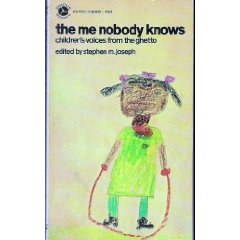
I came across the poem, “Today,” in the me nobody knows: children’s voices from the ghetto, by Stephen M. Joseph (Avon, 1969). There are many beautiful, and some heartbreaking, stories and poems in the book, which is an anthology of writings by children in Bedford-Stuyvesant, Harlem, Jamaica, and the lower west and east sides of Manhattan. The year after the book was published, a musical based it, The Me Nobody Knows, premiered in New York.
Joseph, a teacher, invited the children to write, offering three choices: to write using their names, in which case he was willing to meet at lunch or outside of school to talk with them about it; omit their names, but still hand in the writing; or write, but neither sign the paper nor hand it in. But he never forced them to write at all.
The pieces in the book give one picture of life in the inner city, or for that matter, many children everywhere. They invite the question: Are we doing any better for children today, 40 years later?
This poem struck me for its rhythm and the ways that things seem not totally to fit, but do fit all the same.
Today
Cynthia L, Age 15
Today is my day,
Today should be your day,
If it’s your day and my day
It’s everybody’s day.
In your way is my day
Because you made a day that comes all the way.
And two days of a way equal today.
That will never fade away.
In our own way let’s find ways
To make great exciting things happen.
In your ways, make my days,
You made a day that comes all the way,
And two days that are made up of your ways,
Those kind of days will never fade away.

 There are times when a movie just grabs me, despite technical flaws, my low expectations, and even a boring DVD case cover. In This World is one of those. The political message is clear, but understated, conveyed instead by an intimate look at the consequences of war and greed on the lives of decent people.
 Like thousands of others every year, their desperation feeds the multibillion dollar human smuggling business, an unconscionable stain on any of our pretensions to justice. The smuggling fuels crime, violence, corruption, illegal drug trade, and too often leads to death, no longer being “in this world.”

 Ian Roller and
  Riona Fitzgerald bring knowledge of pedagogy together with skills in video and computers to help teachers and youth leaders do amazing projects. More importantly, they do it in a way that empowers teachers as creative agents in the education process.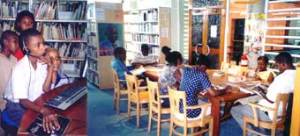

 From Cooking up a Storm, ©2008 Marcelle Bienvenu and Judy Walker. Used with permission of

 Chip's journey