Faubourg Tremé

Just to the Northwest of the French Quarter lies a neighborhood that few tourists visit, and many have never heard of, called Faubourg Tremé. Much of the area now appears bleak with Interstate Highway 10 bisecting it, industrial yards, and boarded up buildings. But it’s one of the most important neighborhoods in American history, and still has meaning for today. There are efforts to restore Faubourg Tremé and to learn what it has to tell us.
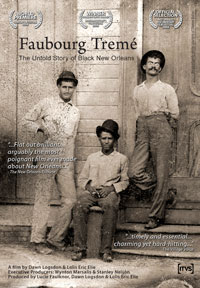
faubourg_tremeA recent, award-winning documentary tells the fascinating story, made all the more compelling by relating it to the life of a young reporter for the Times-Picauyune. The film is Faubourg Tremé: The Untold Story of Black New Orleans. Reporter Lolis Eric Elie leads us in his discoveries about his own city. He and director Dawn Logsdon show the relation between the city’s present and its rich past, enlivened throughout by music, including Derrick Hodge’s original jazz score, the Tremé Song by John Boutté, and a century of New Orleans music.

Viewers also meet Irving Trevigne, Elie’s seventy-five year old Creole carpenter, who descends from over two hundred years of skilled craftsmen, as well as Paul Trevigne, editor of L’Union, the first black newspaper in the US. L’Union and later, the Tribune, were strong advocates for the abolition of slavery, but beyond that, for full citizenship and social equality for all blacks, something most northern abolitionists shied away from. They hear from Louisiana Poet Laureate Brenda Marie Osbey, musician Glen David Andrews, and historians John Hope Franklin and Eric Foner as well.
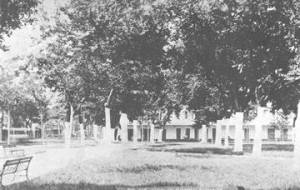
armstrong_park_Congo Squre cFaubourg Tremé was home to the largest community of free black people in the Deep South during slavery, where they published poetry and wrote and conducted symphonies. It was a racially-integrated community, a model for our own future. It as also possibly the oldest black neighborhood in America, the home of the Civil Rights movement and the birthplace of jazz. (See Congo Square to the right.)

Long before Rosa Parks, Tremé residents organized sit-ins on streetcars leading to their eventual desegregation. But on June 7, 1892, Homer Plessy from Tremé deliberately challenged the Louisiana 1890 Separate Car Act, by insisting on sitting in a whites-only car on a commuter train. He was arrested, tried, and convicted and eventually lost in the infamous Supreme Court decision of Plessy v. Ferguson. The resulting “separate-but-equal” decision legitimized segregation throughout the US for the next 62 years, and was a major blow to Tremé.

Following later assaults from urban renewal, Interstate Highway 10, and then Hurricane Katrina, it’s surprising that anything remains in Tremé. But one thing that has survived is a sense of history, embedded deep in the music, dance, architecture, social relations, and stories of the community. It is this history which holds a promise for the renewal of Tremé and perhaps of the larger US Society.

The film is a must-see, telling a story that is simultaneously informative, uplifting, and disturbing.

Visualize your inquiry unit

radar_plotThe Youth Community Informatics project now offers a free tool to create a radar plot for visualizing the strengths of an inquiry unit. The basic version is built on the Inquiry Cycle.

There are a variety of possible uses:

  • to show how different inquiry units emphasize different aspects of the Cycle. For example, an otherwise good unit might offer little in the way of Discuss (or collaboration). That might be fine if other units do emphasize collaboration, or it might indicate that some modification is needed to include that.
  • to compare across sites or projects.
  • to portray the development of a single site over time.
  • to support development of inquiry units.

The scoring of units could be done by researchers, teachers or youth leaders, community leaders, or community members.

None of these uses are a substitute for detailed analysis, but they can help start an investigation of the units.

The basic version of the tool, shown here, simply provides a single radar plot, with a logarithmic scale of arbitrary magnitude. Other versions might support overlays, color-coding, additional axes, or other features.

No tent cities for the wealthy

A continuing saga locally, similar to that in many other communities, is that of tent cities.

St. Mary’s Catholic Church in east Champaign apparently will be the home for the Safe Haven tent community for the next month.

The Rev. Tom Royer, pastor of the church at 612 E. Park Ave., sent a letter to Mayor Jerry Schweighart and the city council, dated Sunday, that “the parish of St. Mary has decided to host the Safe Haven tent community for 30 days.”

“This will give them (residents) additional time to work with you and the zoning commission to find a more permanent location for their community,” wrote Royer, who did not give a date when the tent city would locate at the church.

City Zoning Administrator Kevin Phillips said Wednesday the city still holds that tent cities are in violation of the city’s zoning ordinance, and he said the city would take enforcement action if the tent city does relocate at St. Mary’s Catholic Church.

via Eastern Champaign church takes in tent city residents

The discussions revolve around questions such as whether the tent city would annoy nearby residents, or how long it will be allowed to stay in a particular location. It’s amazing to me how little talk there is about alternatives. What other options are there for people who are down on their luck, often facing physical and emotional, as well as financial challenges? Shouldn’t we be asking ourselves what we can do to provide housing, not how to prevent people from coping?

One can’t help but recall Anatole France’s (1844-1924) famous passage from Le lys rouge (The red lily):

Cela consiste pour les pauvres à soutenir et à conserver les riches dans leur puissance et leur oisiveté. Ils y doivent travailler devant la majestueuse égalité des lois, qui interdit au riche comme au pauvre de coucher sous les ponts, de mendier dans les rues et de voler du pain.

For the poor it consists in sustaining and preserving the wealthy in their power and their laziness. The poor must work for this, in presence of the majestic quality of the law which prohibits the wealthy as well as the poor from sleeping under the bridges, from begging in the streets, and from stealing bread.

“Free parking isn’t free”

As someone who tries to walk modest distances in town, I’ve been impressed again and again with how unfriendly our cites are for walkers. There are dangerous intersections, or worse, busy roads with no designated crossing. There are missing sidewalks and senseless barriers. Making things worse is the fact that everything is so far apart. One of the culprits here is our irrational obsession with free parking, which like any addiction creates its own need.

Seth Zeren has an excellent essay on Worldchanging about why “free parking” actually costs us all a lot.  He points out that what seemed once to be reasonable zoning requirements for parking actually costs us all a lot in terms of polution, traffic, health, aesthetics, and even direct cash.

Why do Americans drive everywhere? Because everything’s far apart. Why’s it far apart? Often because there’s so much parking in between! In the end, creating bright green cities will require undoing the damage created by mandating free parking.

Free Parking Isn’t Free, August 4, 2009

The wisdom of crowds

There’s an interesting report this week in The New Scientist on the wisdom of crowds. It summarizes a number of recent studies showing that crowds may be wiser than we’ve been told. Here’s an excerpt:

The “unruly mob” concept is usually taken as read and used as the basis for crowd control measures and evacuation procedures across the world. Yet it is almost entirely a myth. Research into how people behave at demonstrations, sports events, music festivals and other mass gatherings shows not only that crowds nearly always act in a highly rational way, but also that when facing an emergency, people in a crowd are more likely to cooperate than panic. Paradoxically, it is often actions such as kettling [corralling the entire crowd into a small area] that lead to violence breaking out. Often, the best thing authorities can do is leave a crowd to its own devices.

via Why cops should trust the wisdom of the crowds – life – 17 July 2009 – New Scientist.

The story of stuff

home-diggerAnnie Leonard has created an excellent, 20-minute video+animation that calls for creating a more sustainable and just world: The Story of Stuff with Annie Leonard

The story is told in an engaging, even funny, way, very accessible to children, as it addresses serious environmental and social issues. It discusses the inadequacies of the linear model for the materials economy, which conceives stuff in terms of extraction, production, distribution consumption, and disposal. Annie shows how these mostly hidden processes affect communities in the US and abroad. It’s lively, informative, humorous, and makes us think of the stuff in our lives in a new way.

The story of stuff website has additional resources, and the book will be available March 9, 2010

Using photography for qualitative research

nikon-d40-digital-cameraWhile lost amidst sorting through 30 boxes of my files, I’ve occasionally come across some gems. One is

English, Fenwick W. (1988, May). The utility of the camera in qualitative inquiry. Educational Researcher, 17, pp. 8 – 16.

As we do research, prepare proposals for conferences, and work with community members to document their own experiences, it’s worth thinking about alternative methods for doing and presenting research.

English’s article (available online through Sage or the UI Library) uses interesting photographs to discuss the role of the camera in inquiry. He also explores the metaphor of the photo as a way of thinking about different approaches to a research subject, foe example, the wide angle view that surveys a situation versus the telescopic that focuses in on a particular issue.

Mapping cemeteries

Several of our Youth Community Informatics sites are mapping cemeteries. What sounds like small project, or even a gloomy one, soon opens up into far-reaching explorations of history, geography, health, families, technology, mathematics, literacy, and more.

At Iroquois West Middle School, youth started with a story about a primary school’s project to study cemeteries: Learning from graveyards. The “Map Masters” soon expanded this by incorporating technologies of GPS and GIS into their mapping project of the Onarga Cemetery. They have already made many discoveries and are continuing to do more. They’ll also connect with cemetery mapping projects in Cass County and East St. Louis.

One interesting tombstone that we found at the Onarga Cemetery was in the shape of a tree trunk. The name of the person buried there was Emory Gish. According to our reseach on symbolism the tree trunk showed a life cut short. The number of broken branches might symbolize the number of deceased family members buried nearby.