Blind people and elephants: We need to ask

blind_elephant[These comments grew out of a discussion in our Community Engagement class.]

The parable of the blind men and the elephant (see also the Wikipedia entry) has been told and retold many times. In that story, blind men feel different parts of the elephant, each concluding that the elephant is only what they directly feel.

For example, as John Godfrey Saxe’s poem re-telling would have it, different men saw the elephant as a wall, a snake, a spear, a tree, a fan, or a rope. E.g.,

The Second, feeling of the tusk,
Cried, “Ho! what have we here
So very round and smooth and sharp?
To me ’tis mighty clear
This wonder of an Elephant
Is very like a spear!”

The story reminds us that reality may be viewed differently depending upon one’s perspective. But our fascination with it reveals that we, too, see only part of reality, making judgments about blindness based on not seeing actual blind people encountering actual elephants.

In Letter on the Blind for the Use of Those Who See, Javier Téllez takes the story in a new direction, by asking blind people to interact with a real elephant. (interview with Téllez and curator Mark Beasley)

As quoted in Greg Cook’s review in The Boston Phoenix, participants said things such as:

“It felt like a tire, a car tire, except it was warm. It wasn’t a good feeling.” “When I first went to touch it, I bumped into it, and I thought it was the wall. It felt like thick lizard skin.” “I felt an ear that felt like a hat and a trunk that felt like a hand.” “You feel the ridges and the bumps. And you can feel the life pulsing through it. You can’t hide it.” “It felt like I was touching some curtains.” “I imagined it to be quite large, but I couldn’t really sense how wide or tall it was. . . . And then I couldn’t tell if the damn thing was breathing or not breathing.”

Despite all the many tellings and re-tellings of that story, the actual blind people saw the elephant in ways not included in the standard versions of the parable. They helped me to see both blindness and elephants in new ways.

It’s good to recognize that people see the world differently, but to know what those different ways really are, we need to ask.
Is it good to synchronize traffic signals?

The Champaign County Regional Planning Commission hopes to apply for a $1.94 million federal grant to coordinate the traffic signals at dozens of intersections in the community, covering major corridors such as Neil Street and Prospect, University, Bradley, Mattis and Florida/Kirby avenues.

Champaign-Urbana Urbanized Area Transportation Study…says the proposed “traffic signal energy efficiency and conservation strategy” could reduce the typical motorist’s annual travel times by 20 to 50 percent, cut fuel consumption by 14 percent and reduce carbon dioxide, methane and nitrogen dioxide emissions by 13.3 percent.

via The News-Gazette.com: Re-timing of traffic signals could be first stage in overhaul.

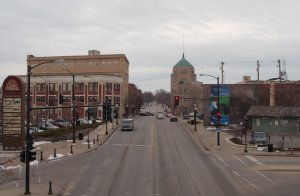
Champaign_Illinois_20080301_4107Saving energy, reducing pollution, reducing travel time, all sound good. But synchronized signals along University Avenue may have an insidious consequence.

It’s already the case that University Avenue marks and maintains racial divisions in the cities of Champaign and Urbana. Some people south of University, especially whites, view “north of University” as an area they don’t want to be in. And some blacks north of University may view south of University as an unwelcoming place. The busy traffic corridor with miserable access for pedestrians reinforces the view that these two domains are separate, and necessarily so.

As an already busy traffic corridor, University Avenue makes it difficult for alert, athletic adults to cross from one area of town to another on foot or bicycle. It’s positively unsafe for children or anyone without well-honed defensive faculties. Drivers already go too fast and are inattentive to pedestrians and cyclists. This could become worse with synchronization.

Could the street become safer with synchronization? Maybe. But I doubt that will happen if the only concerns considered are overall vehicular traffic flow.

I’m not sure in the final analysis whether the proposed changes should be done or not, but I do believe that we’d be better off if we were to understand better the symbolic and material consequences of slashing through our community.

hear you are — [murmur]

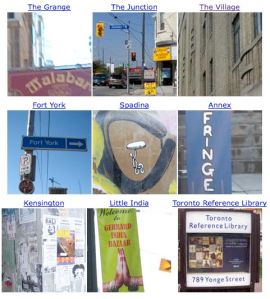
murmur[murmur] is a documentary oral history project that records stories and memories told about specific geographic locations. We collect and make accessible people’s personal histories and anecdotes about the places in their neighborhoods that are important to them. In each of these locations we install a [murmur] sign with a telephone number on it that anyone can call with a mobile phone to listen to that story while standing in that exact spot, and engaging in the physical experience of being right where the story takes place. Some stories suggest that the listener walk around, following a certain path through a place, while others allow a person to wander with both their feet and their gaze…

All our stories are available on the [murmur] website, but their details truly come alive as the listener walks through, around, and into the narrative. By engaging with [murmur], people develop a new intimacy with places, and “history” acquires a multitude of new voices. The physical experience of hearing a story in its actual setting – of hearing the walls talk – brings uncommon knowledge to common space, and brings people closer to the real histories that make up their world.

Being cellphone-impaired, and far from Toronto, I’m reduced to listening to the stories on the website, but they still convey a sense of the city and its history. The site’s a well-designed example of integrating oral history, geographic information systems, and mobile phones.

White privilege

Peggy McIntosh’s essay, White privilege: Unpacking the invisible knapsack” (1990) provides a very accessible discussion of race/racism, in particular, how whites have trouble even seeing it. She identifies 50 daily effects of white privilege, “conditions that…attach somewhat more to skin-color privilege than to class, religion, ethnic status, or geographic location” per se.

McIntosh predicts that if you’re White you’ll answer “yes'” to most of these, and if you’re Black, you’ll say “no” to many of them. Try it yourself. For example,

1. I can if I wish arrange to be in the company of people of my race most of the time.

6. I can turn on the television or open to the front page of the paper and see people of my race widely represented.

7. When I am told about our national heritage or about “civilization,” I am shown that people of my color made it what it is.

21. I am never asked to speak for all the people of my racial group.

22. I can remain oblivious of the language and customs of persons of color who constitute the world’s majority without feeling in my culture any penalty for such oblivion.

24. I can be pretty sure that if I ask to talk to the “person in charge”, I will be facing a person of my race.

25. If a traffic cop pulls me over or if the IRS audits my tax return, I can be sure I haven’t been singled out because of my race.

34. I can worry about racism without being seen as self-interested or self-seeking.

44. I can easily find academic courses and institutions which give attention only to people of my race.

John Berry (2004) adapts these for the library profession. I like both of these articles, and can imagine ways to use such lists to spark a discussion.

I would have to answer yes to most of the statements myself. Then I imagined it for my time in Ireland (thinking more about nationality, than about race per se). Still mostly yes, but some no’s and some harder to answer. When I thought about my stay in Turkey, there were fewer yes’s. For Haiti, fewer still.

But what was most interesting to me is that even for Haiti, I could still say yes to most of the statements, even though I’m the outsider there in terms of race, nationality, language, culture, and above all, economic class. The fact that I can take myself mentally to Haiti, and still possess White Privilege shows even more to me why it’s such a powerful social construct. It also reveals why it’s so hard to understand and accept that one possesses that unfair privilege.

In a Harvard Law Review article, Cheryl Harris (1993), takes this concept further, arguing that racial identity and property are deeply intertwined. She examines “how whiteness, initially constructed as a form of racial identity, evolved into a form of property, historically and presently acknowledged and protected in American law.”

References

The Soloist (2009)

The Soloist (2009) is an excellent film based on the true-life book, The Soloist by Steve Lopez. Lopez is a Los Angeles Times columnist who discovers Nathaniel Ayers, a Juilliard School dropout, who becomes schizophrenic and homeless, living on the streets of LA.

Ayers is a classically-trained cellist, who now has only a two string violin to play and instead of a concert stage, an urban tunnel or street corner. Lopez wonders how Ayers can stand to play in those conditions, but Ayers tells him that “the only thing that I hear is the music and the applause of the doves and the pigeons.” Ayers is hooked and decides to write a series of feature articles in the Times.

Robert Downey Jr. portrays  Lopez in the movie, and Jamie Foxx portrays Ayers. The two main characters give terrific performances, as do the actual homeless extras from the Lamp Community.

Ayers’s story makes us wonder about the many other homeless people in LA and elsewhere. As Lamp says,

Close to 74,000 people are homeless in Los Angeles–more than in New York, Chicago, and San Francisco combined. Los Angeles’ Skid Row, a 52-block area east of the downtown business district, has the highest concentration of homelessness in the United States. More than half of the homeless men and women in this area are chronically homeless, meaning they struggle with a mental or physical disability and have been living on the street for years.

That relatively greater challenge in LA doesn’t of course diminish the shameful job we do across the US in dealing with homelessness. The book, Ayers’s music, and the movie all reinforce Jane Addams’s view that art and cultural activities can reduce our isolation form one another, and reinforce essential human: “Social Life and art have always seemed to go best at Hull-House.”

The DVD includes features with the real Steve Lopez and Nathaniel Ayers, and also, Beth’s Story, an animated short telling another story of homelessness:

References

Addams, Jane (1930). The second twenty years at Hull-House: September 1909 to September 1929. New York, Macmillan.

Inquiry Page and Community Inquiry Labs

inquiry_pageIn a previous post, I described the latest version of Community Inquiry Labs (CILabs). I’d like to add to that, based on some questions.

A precursor of CILabs, is the Inquiry Page. This site is still very active, open, and free. It offers an easy way to learn about inquiry-based teaching and learning, to search a large database of Inquiry Units, and to create your own, either de novo or a spin-offs of existing units. There are other features, including help with evaluation and quotes about learning.

CILabs just offers another way to do Inquiry Units, but in the context of the group support functions (blog, document center, group email, web pages, etc.). The two sites were developed at very different times, using different software (Perl vs. Drupal). A current effort is to make the connections between them more evident and to enable them to work synergistically.

Governor’s Home Town Award for UC Books To Prisoners!

UC Books To Prisoners – a project of the UCIMC (B2P) is based in Urbana, Illinois. B2P mails books to Illinois inmates at no cost to them and operates lending libraries in the two local county jails.

guv_mansionB2P has just been awarded a Governor’s Home Town Award (for volunteerism).  The award makes B2P eligible for the Governor’s Cup, a traveling silver trophy signifying the project deemed most representative of the spirit of Illinois volunteerism. The award will be presented at the Governor’s Mansion in Springfield on October 29. At that time, we’ll learn what level of award B2P has received.

Books to Prisoners has also received a Social Justice grant from the Illinois Disciples Foundation, with a press conference on October 1, and an honorable mention from the McKinley Foundation Social Justice Awards.

b2p_booksale_fall_2009

Community Inquiry Labs

Inquiry cycle

Inquiry cycle

Community Inquiry Labs (aka CIL’s or CILabs) is rising again!

What is CILabs?

Drawing from the work of John Dewey and others, showing that education begins with the curiosity of the learner, CILabs promotes an iterative process of inquiry: asking questions, investigating solutions, creating new knowledge, discussing experiences, and reflecting on new-found knowledge, in a way that leads to new questions.

In addition to the standard features found on group support sites, such as Ning, Google, Yahoo, and Moodle, CILabs offers a means for building Inquiry Units based on the Inquiry Cycle. Also, unlike most university-supported software there is a secure means for users without university netid’s to participate. This is crucial for university-community collaborations.

CILabs (aka iLabs) are being used currently in courses such as Will Patterson’s Hip Hop as Community Informatics and Martin Wolske’s Intro to Network Systems. Projects such as Youth Community Informatics use it as do a variety of  other projects and organizations.

The redesign

Despite filling a need for many individuals and groups since 2003, use of CILabs fell off after a security hole was discovered in CILabs 3. That led to a temporary shutdown and a major redesign on the Drupal platform.

Thanks to the support of Robert Baird at CITES EdTech, a project to rebuild CILabs was led by Alan Bilansky with Julieanne Chapman as lead programmer. Claudia Serbanuta represented GSLIS and the CILabs user base. The new CILabs is now hosted by the University of Illinois College of Education, thanks to Ryan Thomas and John Barclay. This represents an unusual and successful collaboration across two colleges and CITES, with support from the Center for Global Studies, Community Informatics Initiative and the Illinois Informatics Institute.

I encourage you to give it a try now, and to let us know how to improve it.it

Dr. Evil’s community engagement

Richard Berman, aka Dr. Evil is

the force behind several industry-backed nonprofits that share staff and office space with his very for-profit communications and advertising firm, Berman and Company. The firm promises clients it will not ‘just change the debate’ but ‘start’ one, and a range of companies, from Anheuser-Busch to Philip Morris to the casino chain Harrah’s, have signed up for Berman’s ‘aggressive’ and ‘hard-hitting’ advocacy. Some clients pay Berman and Co. directly, while others donate to his nonprofits—but much of the cash winds up in the same place, via hefty management fees the front groups pay to Berman’s company.

Among Berman’s outfits is the Center for Consumer Freedom, which targets critics of fast food, alcohol, and mercury-laden fish. (Seen its commercial in which the “food police” yank an ice cream cone from a little boy?) Berman’s Employment Policies Institute campaigns against minimum-wage increases. And his Employee Freedom Action Committee crusades against unionization.

via Dr. Evil’s Payday | Mother Jones

This Mother Jones article goes on to show several examples in which mainstream news agencies pick up on the press releases of Berman’s organizations, using them in a totally unexamined, uncritical way.

One might view Berman’s method as a form of community engagement, offering appealing names (e.g., “Consumer Freedom”) and prima facie activities to promote a greater good. But it’s the opposite of what Jane Addams meant when she talked about making the entire social organism democratic.

Faubourg Tremé and community engagement

Thinking about Faubourg Tremé and also an earlier post about Cooking up a storm gives me a different understanding of community engagement or civic renewal. Sirianni and Friedland (2005), for example, talk about a broad civic renewal movement in the US in areas such as community organizing and community development, neighborhood associations, civic environmentalism, civic journalism, and healthy communities. They also discuss policies that can foster civic capacity building and problem solving.

Although their survey is useful (I use it in my own course on community engagement), three things seem missing from their picture. The most glaring omission is race. Every one of the areas they discuss is deeply imbued with the history and present circumstances of race relations in the US. The very notion of civic capacity building and problem solving can’t be examined fully without taking into account that there is a legacy of oppression and a lack of understanding about how race has shaped American history and policies.

A second omission is history. Much of Sirianni and Friedland focuses on current movements and tools for organizing, all useful, to be sure. But without a grounding in historical precedents it’s difficult to see clearly our way forward. For example, long before the present generation of civic renewal, Jane Addams and colleagues led the way through their work in Chicago on health care, working conditions, literacy, and participatory democracy. Before that, the Paris Commune built social institutions based on liberty, justice, and equality, with a deep respect for learning by all. Even before that, Faubourg Tremé showed how an engaged community could work together to establish effective civic journalism, work toward racial equality, and build a healthy community.

A third area of omission is art. John Ruskin argues that art and culture reflect the moral health of society. Ruskin influenced Jane Addams, who saw that art in all its forms, including crafts, theater, and cultural practices was essential to community and individual development. The importance of art as a means for a community to find shared values, maintain its own history, and to express itself is striking in both the Faubourg Tremé and Cooking up a storm stories as well. I’m not sure that art ought to listed as a civic renewal movement per se, but it does seem crucial to understand more about what it means for civic health and civic renewal.

References