Sharing reading across generations

I recently had an enlightening day reading with middle schoolers. It was definitely more fun than when I had to be in middle school myself. I had volunteered for an intergenerational reading group, part of Project Read. This meant that adults in the area would read the same texts and do the same homework as the students. We would then meet with them in small groups during regular class hours to discuss the reading.

On this particular day, we had all read Shirley Jackson’s story, The Lottery. This classic of secondary school has long provided fodder for discussion, confusion, and in some cases distress. I know at least one person my age who says that she’s still disturbed by it. It’s interesting to read the reactions of readers as shown in their letters to the New Yorker, where it was first published in 1948.

There were four class periods with small reading groups, then whole-class discussion, so I was able to hear a variety of responses and share my own:
  • Many students were excited to discover the similarity of the story to that of The Hunger Games novel/film, and even more to learn that others had made the same discovery.
  • I was surprised to hear one boy say that the story must have been set very long ago, because “the heads of household were all men.” Another added that “the men did all the talking and mostly talked about the women, rather than letting them talk.” I don’t believe that middle school boys from my time would have said the same.
  • One student said that the stoning in the story was wrong “because there were only 300 people in the village.” (One death would make a big difference.) We then talked about whether stoning someone to death was ever justifiable.
  • A big question concerned why people in the story, especially Mr. Warner, didn’t want to change. Several students agreed that the people who resisted ending the practice of stoning were similar “to the people who resist allowing fast food restaurants into Brewster. People are afraid of new things.” I didn’t do a poll, but I imagine a sharp generation divide on the fast food issue, with the older ones opposed. The students were right: The older folks don’t want change. Nevertheless, I was uncomfortable equating stoning people to death with opposing fast food.
  • A volunteer adult added, “sometimes you’ve been doing something your whole life and it’s hard to admit that you were wrong.” I doubt that the 13 year-olds have that same feeling about doing something their whole life.
  • I was dismayed to hear two girls in separate groups describe incidents in which boys had thrown (multiple) stones at them.
  • Another student said that Tessie Hutchinson was stoned because she was engaging in protest. The usual reading is that her cry that the stoning was unfair was disingenuous since she never said anything until after she’d been selected. But in the context of Ferguson events I can now understand the interpretation the student made.
  • My best contribution was to bring up Martin Niemöller’s famous First they came… statement. This much-quoted passage reads all the more powerful for me knowing Niemöller’s own earlier national conservative views and anti-semitism. And it makes his analogy to Tessie Hutchinson more telling. The statement is quoted in a book that the students will be reading later in the year in their Holocaust unit.

Like any good learning experience, this one was shared broadly. The teachers, volunteers, and middle school students had to cross some boundaries, but all learned something about the story and about each other. A quote on the classroom wall seemed especially a propos for this intergenerational encounter:

Travel is fatal to prejudice, bigotry, and narrow-mindedness, and many of our people need it sorely on these accounts. Broad, wholesome, charitable views of men and things cannot be acquired by vegetating in one little corner of the earth all one’s lifetime.” –Mark Twain, The Innocents Abroad

Personal geography: Life and death

Russian oil tanker

Russian oil tanker

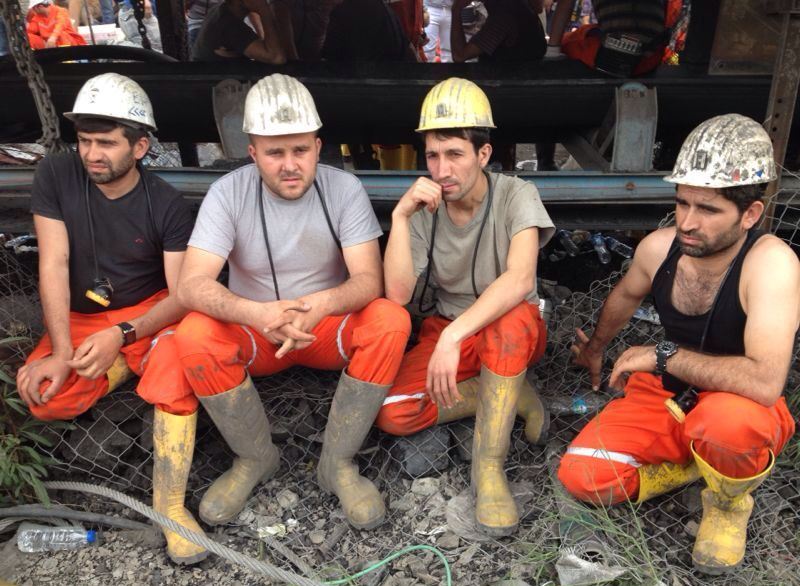
As I watch the Russian oil tankers going through the Dardanelles, I’m reminded that Turkey has little oil, but does have large coal reserves. Looking away from the straits, I see the hills towards Soma, just 100 miles away, where over 300 coal miners died in a disaster that should never have happened.

Miners at Soma coal mine

Miners at Soma coal mine

Despite the callous response from the mine owners and the government, most people I see want to say “Soma ,adencisi yalnız değil” (Soma miners are not alone). On campus, students sell pastries to raise funds for the victims’ families. In town, people march and spray graffiti to protest the government’s policies before, and the response afterwards. In the countryside, I see people whom I can imagine as not so different from the villagers whose family members worked in the mine.

Trying not to think about Soma, I walk to the Dardanos Tümülüsü (tumulus). This is a burial hill not far from our apartment, with artifacts dating from the second century BC, possibly earlier. The Çingene (also called Gypsy) people in Çanakkale say that they have been there for six centuries, possibly before the Ottoman rulers. But long before they arrived, who were the people who built the tumulus? I wonder about their walking on the same hills and coastlines, which they did when there was no choice to take the bus or car.

Dardanos Tümülüsü

Dardanos Tümülüsü

My wanderings lead to wonderings about how we as humans, or any life, will survive the growth-at-all-costs ethos, dominant around the world. Fifty years ago, in the month I graduated from high school, Lyndon Johnson asked:

whether we build a society where progress is the servant of our needs, or a society where old values and new visions are buried under unbridled growth…expansion is eroding the precious and time-honored values of community with neighbors and communion with nature.

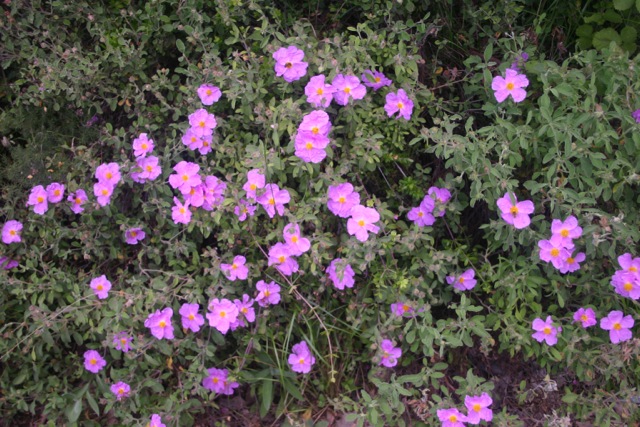
At least, here at Dardanos, there is some respite, if only within an hour’s walk. I see children in the large playground. There’s a vineyard. In the scrub forest there is a maquis ecology, with small pines, fir, cedar, holly, cyprus, and other evergreen trees, as well as some nut and fruit trees, such as valonia oaks, almond, fig, apple, and olive. The underbrush includes flowering broom, sage, oleander, and many interesting grasses. Most striking are the wildflowers–poppy, petunia, aster, and rose, plus many I can’t name. There are butterflies everywhere, birds, frogs, and lizards, all mocking the many wild cats. The ocean seems full of life, with octopus and squid, many kinds of fish and seaweeds, in spite of the heavy ship traffic.

Poppy field

Poppy field

Alongside the Dardanos, these life forms seem in tune with the beautiful setting and oblivious to the massive commerce steaming past and the construction boom on land. Let’s hope they can continue for a long time.

I’m afraid that my generation hasn’t done much to manifest Johnson’s call for “the wisdom to use…wealth to enrich and elevate our national life, and to advance the quality of our American civilization.” We have more nuclear weapons, greater destruction of the environment, abuse of workers, and precious little understanding of neighbors at home or abroad. All too often, our “old values and new visions are buried under unbridled growth.”

Petunias

Petunias

In that 1964 speech, Johnson said,

The Great Society is a place where every child can find knowledge to enrich his mind and to enlarge his talents. It is a place where leisure is a welcome chance to build and reflect, not a feared cause of boredom and restlessness. It is a place where the city of man serves not only the needs of the body and the demands of commerce but the desire for beauty and the hunger for community.

I can’t say that I’ve learned very much in the fifty years since Johnson’s speech, but one thing is that the leisure he spoke about is not lost time, but a central aspect of being. Walking becomes for me a way to ensure that it happens. Otherwise I too often feel compelled to check the computer, go to a meeting, or accomplish some task. Or, I seek escape as a spectator, rather than participant in life.

That leisure is a necessary means to build connections and become one with the plants and animals nearby, the people, the land and sea, and the history that ties them all together. It’s both an essential part of life and means to understanding it better.

The Icon Walk

Merchant's Arch, Temple Bar

Merchant’s Arch, Temple Bar

Temple Bar is an area with narrow, cobbled streets on the south bank of the Liffey in central Dublin. It’s famous the world over for its lively nightlife, but that’s not high on my list of reasons to visit it. There are better places in Dublin to experience Irish food and music, ones where you’re more likely to encounter people who actually live in Ireland. However, the area does offer much that’s special, such as the Irish Film Institute.

One that we just discovered is The Icon Walk, a project of The Icon Factory. It’s located just off Fleet Street, along Aston Place, Bedford Lane, and Price’s Lane. Local artists have transformed the lanes into an open air gallery of Irish culture. It’s recently been awarded approval as a UNESCO City of Literature site.

Someone described the Walk as a twenty minute activity, but it deserves more than that. There’s a great collection of photographs, drawings, paintings accompanying sayings of famous writers and artists, descriptions of moments in the history of sports, movies, fashion, and more.

Arriving at the Playwrights section, we read,

Around 1610, Shakespeare wrote the “The Tempest” and retired to Stratford on Avon where he died in 1613. Queen Elizabeth I having completed the conquest of Ireland was dead. The last of the great leaders, O’Neill and O’Donnell were gone to Spain and Ulster planted with Crown subjects.

Between 1613 and the War Of independence in 1922, which won back self rule for most of Ireland, no play of real merit was written in the English language by anyone other than by an Irish-born writer.

The selected icons–Samuel Beckett, Brendan Behan, Sean O’Casey, George Bernard Shaw, John Millington Synge, and Oscar Wilde–won’t be enough to convince everyone of that claim, but their collective oeuvre is amazing.

Along the walk, you can see many great images produced by a wide variety of artists. A few of those are on the website, but the majority are visible only on the walk itself. They’re best seen that way, in any case, in the context of the other artworks and Temple Bar itself.

One of the best parts for me was the individual quotes, both from writer’s works and from their lives. For example, we read,

Beckett went on to live with an older woman who was not exactly a barrel of laughs. She took the phonecall that informed them of Samuel’s Nobel Prize. “This is a disaster, our lives are ruined” she responded.

In the eighties, Beckett was invited to Germany to direct “Waiting For Godot”. When presented with the script which he had not read in many years he exclaimed; “This thing needs a good edit”.

John Hume, third from left

John Hume, third from left

(Again, however, most of these texts exist only on the walls. I hope there will be an exhibition book at some point.)

One thing I learned was that in 2010 John Hume was chosen in an RTÉ survey as Ireland’s Greatest. He was also the winner of the Nobel Peace Prize (1998), the Gandhi Peace Prize, and the Martin Luther King award. He had modeled his own work for equality in citizenship on that of Gandhi and King. Unfortunately, his peaceful work was disrupted by violence and the “troubles” began. Hume became a leading figure in the civil rights movement in the late 1960s. Through speeches, marches, hunger strikes, dialogues, and long-term negotiations, Hume was behind many of the developments and agreements toward peace in Ireland, and later for European unity.

You can get a sense of the walk from the video below (only part of which is in English):

Las Misiones Pedagógicas

burros
Traveling libraries

As we’re about to set off on a trip both to explore and to discuss progressive education, I’m thinking about the example of the Misiones Pedagógicas in Spain in the early 1930’s.

My colleague, Iván M. Jorrín Abellán, just sent a link to a digital copy of the 1934 report: Patronato de Misiones Pedagógicas : septiembre de 1931-diciembre de 1933, in the collection of the Bibliotecas de Castilla y León. It tells the story of the Misiones  through text, photos, and a map. Even if your Spanish is as poor as mine you can enjoy the many photos and get enough of the text to appreciate the project.

Some of the photos of uplifted, smiling faces are a bit much for today’s cynical eyes. Still, it’s hard to deny that something important was happening for both the villagers and the missionaries.

el-teatro
Watching theater

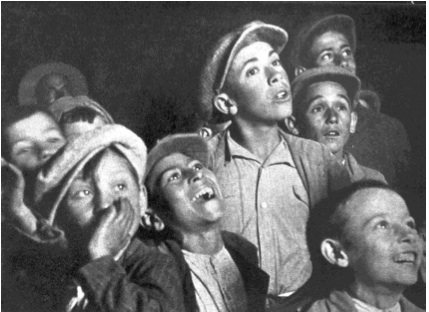
The Misiones Pedagógicas were a project of cultural solidarity sponsored by the government of the Second Spanish Republic, created in 1931 and dismantled by Franco at the end of the civil war. Led by Manuel Bartolomé Cossio, the Misiones included over five hundred volunteers from diverse backgrounds: teachers, artists, students, and intellectuals. A former educational missionary, Carmen Caamaño, said in an interview in 2007:

We were so far removed from their world that it was as if we came from another galaxy, from places that they could not even imagine existed, not to mention how we dressed or what we ate, or how we talked. We were different. –quoted in Roith (2011)

phonograph
Listening to music, outdoors

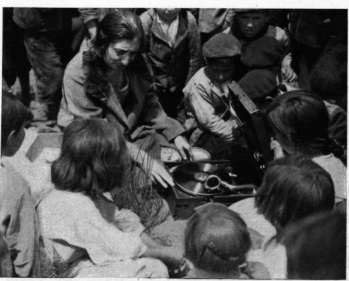
The Misiones eventually reached about 7,000 towns and villages. They established 5,522 libraries comprising more than 600,000 books. There were hundreds of performances of theatre and choir and exhibitions of painting through the traveling village museum.

We are a traveling school that wants to go from town to town. But a school where there are no books of registry, where you do not learn in tears, where there will be no one on his knees as formerly. Because the government of the Republic sent to us, we have been told we come first and foremost to the villages, the poorest, the most hidden and abandoned, and we come to show you something, something you do not know for always being so alone and so far from where others learn, and because no one has yet come to show it to you, but we come also, and first, to have fun. –Manuel Bartolomé Cossio, December 1931

There’s an excellent documentary on the Misiones, with English subtitles. It conveys simultaneously the grand vision and the naïveté, the successes and the failures. As Caamaño says, “something unbelievable arrived” [but] “it lasted for such a short time.”

Watching a film
Watching a film

In her study of Spanish visual culture from 1929 to 1939, Jordana Mendelson (2005) examines documentary films and other re-mediations of materials from the Misiones experience. Her archival research offers a fascinating contemporary perspective on the cultural politics of that turbulent decade, including the intersections between avant-garde artists and government institutions, rural and urban, fine art and mass culture, politics and art.

I’m struck by several thoughts as I view the documentation on the Misiones. Today’s Spain is more literate, more urban, more “modern”. But although the economic stresses are different, they have not disappeared.  There are still challenges, in some ways greater, for achieving economic and educational justice.

Iván and other educators are asking how the spirit of the Misiones might influence community-based pedagogy in current times. Their experiences have lessons for those outside of Spain as well.

References

Acacia Films (2011). Misiones Pedagógicas 1934 – 1936. República española.

Board of Educational Missions (1934). Patronato de Misiones Pedagógicas : septiembre de 1931-diciembre de 1933. Madrid.

Mendelson, Jordana (2005). Documenting Spain: Artists, exhibition culture, and the modern nation, 1929–1939. State College: Penn State University Press.

Roith, Christian (2011).High culture for the underprivileged: The educational missions in the Spanish Second Republic 1931 – 1936. In Claudia Gerdenitsch & Johanna Hopfner,  (eds.), Erziehung und bildung in ländlichen regionen–Rural education (pp. 179-200). Frankfurt am Main: Peter Lang.

Walker trail

Map of WCT lands

Map of WCT lands

Wellfleet Conservation Trust logo

Wellfleet Conservation Trust logo

The Wellfleet Conservation Trust has been very active recently, securing land for conservation, guiding walks, and building trails for anyone to enjoy. Their website gives a good idea of their many projects. As you can see from the map on that site, the WCT land complements that of several other organizations, making a wide variety of environments available for protection of plant and animal life and preservation of the fragile land, as well as helping the people have healthier lives in every sense of that word.

Walker trail pond

Walker trail pond

I was fortunate to get to assist with some of the trail clearing, including at the recently established Walker trail. The site is nearby, one that we can visit on the way to swim in local ponds or after a trip to the transfer station.

The trail minus foliage

The trail minus foliage

The trail runs through land donated by the Walker family. It’s short, but surprisingly varied, with some ups and downs, views of a few houses, and a small pond. Making the trail included installing some benches and rustic steps for the steeper portions. There was also a major project to remove a large dead branch that was hanging over the trail. Members of the WCT, young workers from the two Wellfleet residences for the AmeriCorps Cape Cod program, and other volunteers all contributed to the effort.

Hung branches

Hung branches

The WCT mission is “to assist and promote the preservation of open spaces and natural resources and to protect the rural character of the town of Wellfleet…The Trust acquires land by gift or purchase…develops walking trails and encourages the study and implementation of sound environmental practices.”

Start of trail

Start of trail

Click on any of the photos to enlarge them.

WCT bench

WCT bench

Log steps

Log steps

Lac-Mégantic: beauty and death

Tread softly because you tread on my dreams –W.B. Yeats

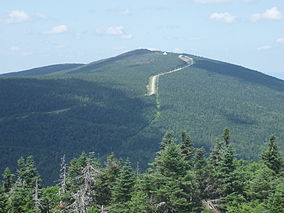
284px-Mont-Mégantic-2About six weeks ago, Susan and I canoed in Maine, then made a brief excursion into Québec.

Nature around Mont Mégantic

We planned to visit the area around Mont Mégantic, a monadnock about 15 km north of the border. It’s in the middle of the Parc national du Mont-Mégantic and is the terminus of the Sentiers Frontaliers, a hiking trail that connects with the Cohos Trail in the US, which runs north from Crawford Notch, NH to the border. The trail is in a beautiful area, and represents an even more beautiful cooperation among volunteers on both sides of the border, who are working to make ways to enjoy, but tread softly, in the forests and rivers.

Image 1The treasuring of the environment is even more evident there because the Mont Mégantic Observatory is the first site to be recognized as an International Dark-Sky Reserve. Lighting within a 50 km radius is strictly controlled to minimize the impact of artificial lighting on astral observations and on wildlife. Again, international cooperation will be needed to sustain the dark sky, but already a rare resource has been created in which both professionals and amateurs can enjoy seeing the Milky Way and know that at least in this one small region respect and love for nature prevails.

Down the grade into Lac-Mégantic

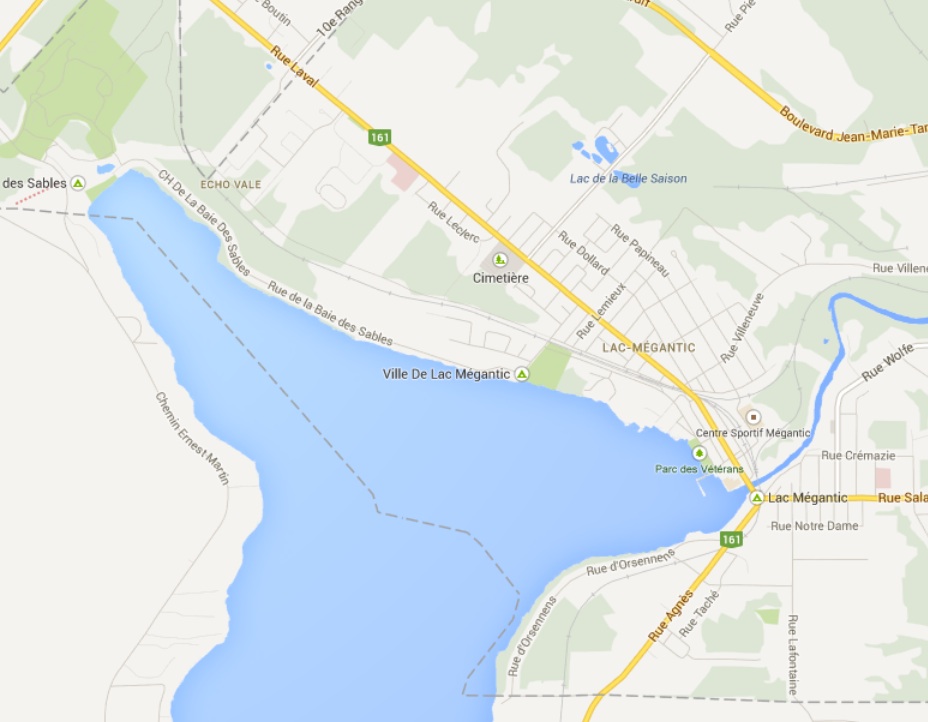
lac-meganticWe came to the Mégantic area from the east, and actually slightly north, having visited Saint-Georges. Traveling on back roads we reached the village of Nantes, at a small elevation and a few miles from Lac Mégantic.

From there we descended into to the beautiful lakeside town of Lac-Mégantic, following the little used rail line along Rue Laval. We walked for a while around the town and in the parc des Vétérans. If we had not had a B&B reservation, we might have stayed longer to enjoy the lake and the small town atmosphere, which fit so well with what we knew about the peace with nature in that region. But unlike so many who have suffered there, we were fortunate to be away when disaster struck.

On July 5, a Montreal, Maine and Atlantic Railway train engine near Nantes caught fire. That fire was extinguished and the train was left unattended, parked on the line. Hours later it rolled down the grade towards Lac-Mégantic, derailed, exploded, and turned the town into an inferno. There were soon photos of the physical destruction, but accounting for deaths has been slow due to the extreme destruction.

The cost of cheap energy

Aujourd’hui, nous sommes tous des citoyens de Lac-Mégantic.

The story has moved to the back pages of US media, even as the death toll has risen to 38, with many still unaccounted for. As awful as some more publicized recent bombings, explosions, fires, plane crashes, etc. in North America have been, this disaster is already more deadly than all of those combined.

Lac-Mégantic explosionOf course, the tragedy might not have affected me so much if I hadn’t felt some kinship with the area. But it has made me both sad and angry. It’s impossible to imagine how people can cope with the loss of loved ones and the destruction of their town.

I’m glad that people are asking questions, starting with some basic ones such as: Why was a train with 70 full tanker cars left unattended? and Why weren’t the brakes set?

It’s good that some are moving on to bigger questions: Why do Canada and the US still carry 70% of oil using a tanker car design that was deemed unsafe over 20 years ago? Why is it allowed to send dangerous cargo on regional (Class II) rail networks, which have fewer safety mechanisms and less thorough safety checks?

Maine lawmakers noted recently that “in the last year alone, crude oil shipments have increased fifteen times over” and “there have been three derailments of trains carrying hazardous materials in Maine just during the last six months.”

For some people, the answer to all of these questions is to build more pipelines, which destroy the environment more when they rupture, but may kill fewer people directly. The rail disaster will also give support to defenders of nuclear power, e.g., the aging Pilgrim, Mass. plant that uses the same design as the Fukishima reactor and strangles any possible escape route from Cape Cod. Others might call for renewable energy, which still needs to be transported at great environmental cost.

I wish that there were a moment when we might ask: Why must we design our society around cheap energy? Must every politician in every party declare that cheap gasoline is their first priority? Would it be so awful to minimize the loss of life and environment, and possibly even lessen the imperative for war? Is “cost” only what we see on a bill for goods and services?

Could we reduce energy use so that areas such as Mégantic could remain unspoiled, or at least less spoiled? And that no Lac-Mégantic would ever experience such a disaster again?

Summer clarinet and piano

Photos courtesy of Luz Zambrano

Photos courtesy of Luz Zambrano

Like the TARDIS, Wellfleet seems bigger on the inside. The array of activities seems impossible for a town its size.

Last night I saw that the array was not just in quantity, but in quality as well. Monika Woods on clarinet and Deborah Geithner on piano offered a concert worthy of any featured event in a major city. The full house, the standing ovation, and the encore were testament to the beautiful music.

coverIt is easy to understand why Monika was the first prize winner at the Cape Cod Symphony Orchestra Soloist competition this year. You can listen to one of her performances here.

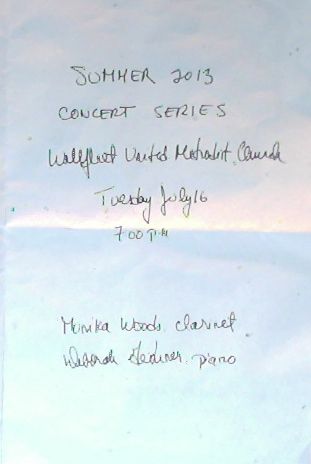
The programme yesterday evening featured Bach, Schumann, Saint-Saëns, Vaughn Williams, and Massenet. Every piece was a pleasure to hear, not something I’d say about many concerts. The feeling of a special event is enhanced by the fact that each attendee’s copy of the programme is individually penned, as is Deborah’s tradition.

The Saint-Saëns Clarinet Sonate in E-flat major, Op. 167, which he composed in his 86th and last year of life, was a highlight that elicited wows and bravos. The Allegretto first movement was especially ethereal and welcomed when its theme returns in the fourth movement. The piece as a whole was captivating.

The Sonate showed off the dialogue of clarinet and piano, as did Massenet’s Méditation from the opera Thaïs (Andante Religioso). That was another very moving selection. but it’s futile to make too much of any one piece, since every offering was excellent.programme

It was no surprise that the audience would demand an encore. The reward was Este a székelyeknél (Evening in the Village), by Béla Bartók. It’s a simple, lyrical piece, with two contrasting themes, which balance beautifully.

Drawing on elements from Transylvanian folk songs, Este a székelyeknél completed the evening’s theme of familiar, entrancing melodies, revealed by great composers and two great performers.

Monika Woods & Deborah Geithner

Monika Woods & Deborah Geithner

The concert was part of the Summer 2013 Concert Series at the Wellfleet United Methodist Church. This series has been a big plus for the community, drawing in people even while it’s still light enough for beach-going. The sanctuary last night was filled with nearly 100 concert goers.

Citizen Science in Wellfleet

Herring River estuary

Herring River estuary

The current habitat for communication between science and the public is dysfunctional. One need only look at the “debates” about climate change or disease prevention to see the problem.

Scientific findings are regularly misrepresented and sensationalized in the mass and social media. Even when well presented, those findings are ignored or distorted, attacked through faulty arguments, or tied to unsupported inferences. At its best, current science/public dialogue tends to be one-way, with the occasional enlightening article, book, or video, followed by public commentary. This rarely serves to deepen  understanding, much less lead to enhanced inquiry.

State of Wellfleet Harbor Conference 

Wellfleet marina

Wellfleet marina, note osprey nest, upper left

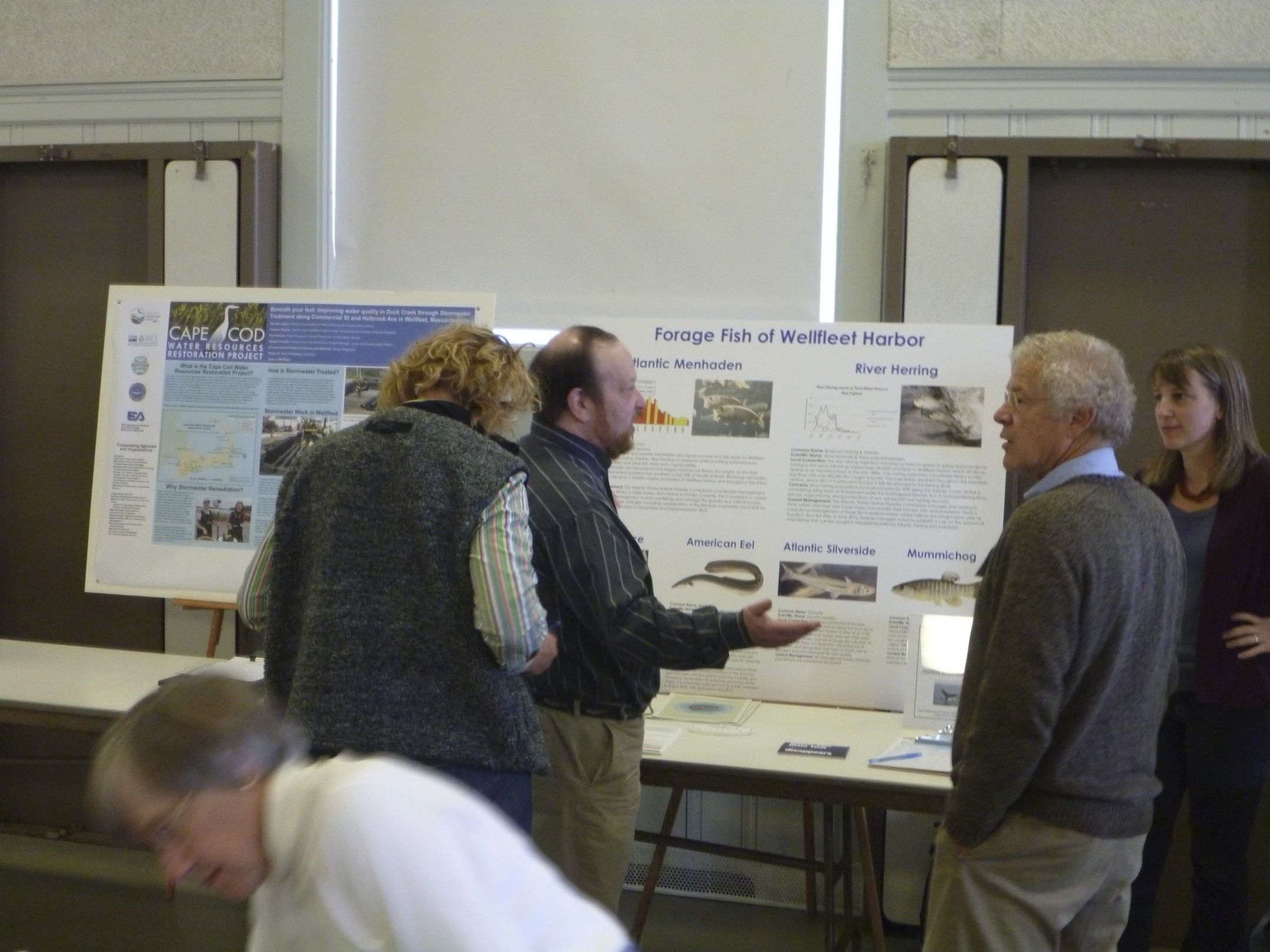
The 10th Annual State of Wellfleet Harbor Conference held yesterday at the Wellfleet Elementary School represents an alternative to that typical dysfunctional science/public relationship. One refreshing note was an effort by scientists to explain not only the results, but also the assumptions, methods, and theories behind them. People asked about the selection of factors to study, or about habitat assessment in tidal river versus bay sites, not to discredit a finding, but to understand more about how results were achieved. The conference was itself a small data point for the case that ordinary citizens can engage in science-based discussions, given enough time and well-crafted presentations, displays, videos, and other materials.

Poster session

Poster session

You can see from the schedule that there was a wide variety of presentations and posters. There was talk about dolphin mass strandings, bathymetry, auditory evoked potential, sentinel species, estuaries, cross-shore sediment transport, salt marsh backup, turtle gardens, terrapin clutches, brumation, eutrophication, cultching, winter/spring blooms, quahog seed, anoxic shellfish, temperature-dependent sex determination, anthropogenic effects, and many other topics related to the diverse ecosystems of the Outer Cape.

There were some good videos from the Friends of Herring River and the International Fund for Animal Welfare (IFAW). Brian Sharp complemented the latter with a talk and a tour of the IFAW van used for marine mammal rescues. This was especially salient given the mass strandings of dolphins in Wellfleet Bay in the early part of the year.

Mayo Beach, with groin

Mayo Beach, with groin

These presentations emphasized the interconnectedness of ecosystems, with humans as an integral part. Mark Borrelli from the Provincetown Center for Coastal Studies talked about how groins and revetments prevent local beach erosion, e.g., to protect a house, but shift the erosion elsewhere. Thus, they are simply “erosion relocation structures.” Sarah Martinez from the Mass Audubon Wellfleet Bay Wildlife Sanctuary presented a poster on the consequences for horseshoe crabs of their use as bait for conch and eels. Moreover, the revetments that relocate beach erosion also disturb the spawning, much of which occurs above the high tide mark.Vincent Malkoski from the Massachusetts Division of Marine Fisheries spoke about the data on horseshoe crab fisheries. These findings have led to harvesting closures for five days around the new and full moons in May and June to allow lunar spawning. Diane Murphy from the Cape Cod Cooperative Extension and Woods Hole Sea Grant spoke on the relation between oyster and clam growth and the wide variety of habitats they find in Cape Cod Bay.

Avoiding Either/Or Thinking 

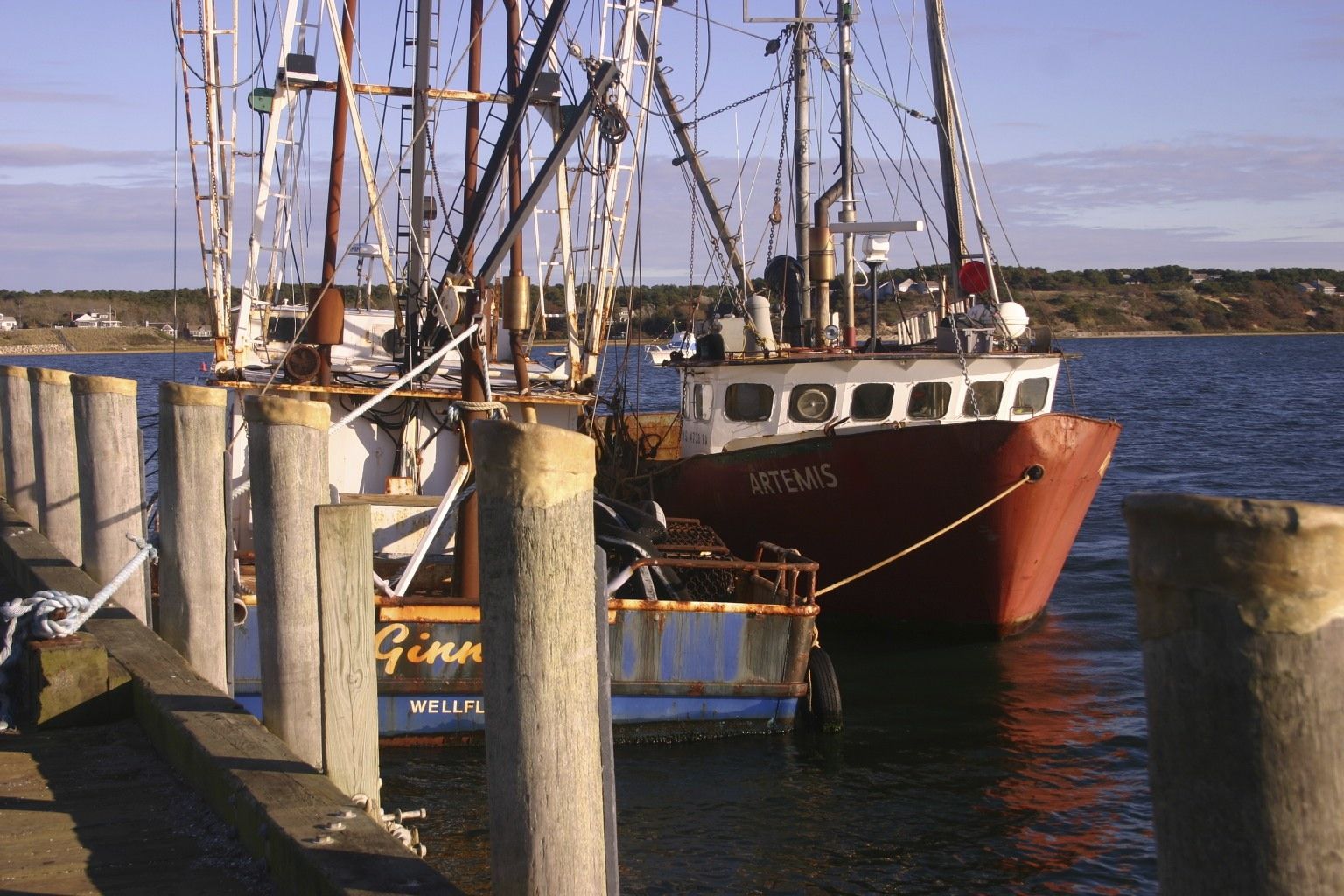
Fishing boats

Fishing boats

One consequence of creating the forum in this way was that discussions avoided the either/or kind of thinking often expressed in mainstream media. For example, although most of the participants shared deep commitments to preserving natural environments and generally opposed rampant development, I heard statements such as “you can’t say that dredging is always bad or good; the decision is about choices and values.” There would then be productive dialogue that critiqued human-made alterations of the shoreline, estuaries, ponds, and so on, but acknowledged values others might hold for commerce, recreation, or housing. Zero-based planning  is no longer an option in the Wellfleet area: Every change today, even one that seeks to undo earlier construction, interacts with a myriad of alterations over centuries and can have unintended consequences for the environment.

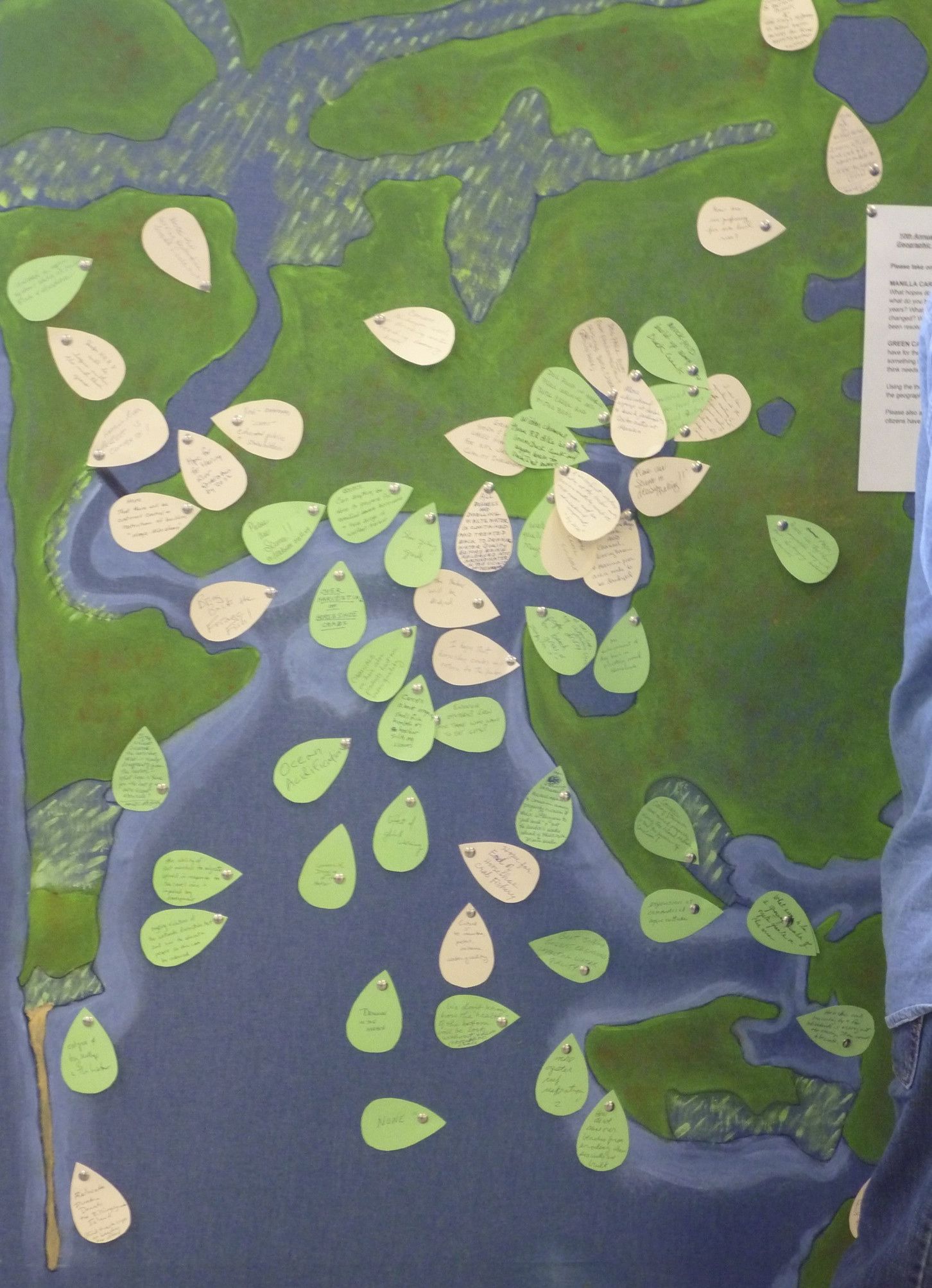
Interactive map

Interactive map

Multilogue

Through Q/A, posters, and ample time for informal discussion, the conference fostered one to many, many to one, and many to many conversations among participants including scientists in the same and other disciplines, students, and general public. There was an interactive map on which people could write their hopes and concerns and peg them to a geographic spot. The map activity will be continued at the library to solicit input from those who did not attend the conference. I saw numerous examples of scientists taking seriously the concerns or knowledge of the public.

This was perhaps enhanced by the fact that many of the projects involve direct citizen science participation , e.g., the river herring count, the horseshoe crab spawning assessment, terrapin sightings, and the dolphin rescues. Others involve coordination with local activist organizations, such as the Wellfleet Conservation Trust.

Some were of special relevance to those involved in commerce, such as oyster farmers. Jessica Smith and Barbara Brennessel from Wheaton College had an interesting poster on a study of genetic diversity among hatchery versus reef oysters, showing, as one might expect, a greater diversity for the reef oysters. This provides indirect support for seeding oyster beds with pelagic, rather than hatchery, veligers. Some oyster farmers still collect these wild larvae for seeing their beds, despite the method being considered slower, difficult, and old-fashioned. A quahog farmer of 30 years was able to add comments about changes over three decades that was missing from most of the shorter-term scientific studies.

Sustainability

IFAW van

IFAW van

Perhaps a meeting like this requires a supportive habitat such as Wellfleet in order to thrive, just as the terrapins, horseshoe crabs, eels, dolphins, ospreys, and other creatures do. Would it fail to survive elsewhere?

Richard Lewontin points out in The Triple Helix that no organism can survive without a supportive environment, but also that no living environment exists without organisms. In this case, the conference organism succeeds because of the town environment, but also shapes it to become more supportive of exactly the kind of discussion heard today.

The conference was well-organized with good snacks, including clam chowder. I came away with a renewed appreciation for the special beauty of Wellfleet, but also sadness about what we’ve done to destroy this, and so much else of the natural world. The fact that a conference such as this is so rare punctuates that sadness. How much did you hear from political candidates or mass media this year about protecting the environment we all live in and depend upon?

Small but good things are worth preserving. I hope to make the conference an annual event.

The New Jim Crow

US incarceration timeline

US incarceration timeline

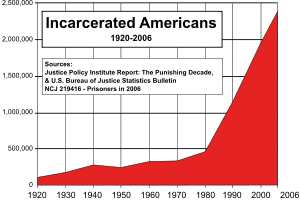
In his now classic analysis of the criminal justice system (The Crime of Punishment, 1966), Karl Menninger wrote, “I suspect that all the crimes committed by all the jailed criminals do not equal in total social damage that of the crimes committed against them.” That was at a time when the number of people in the US who were in jail or prison amounted to around 300,000. Today, that number is well over two million. The US has the highest documented incarceration rate in the world, well ahead of the #2 jailer, Russia, or that of many regimes considered to be dictatorships, police states, backward regimes, failed states, or otherwise democracy-challenged.

In a piece originally published in and recently updated for TomDispatch, “The New Jim Crow: How the War on Drugs Gave Birth to a Permanent American UndercasteMichelle Alexander writes,

The New Jim Crow

The New Jim Crow

If you take into account prisoners, a large majority of African American men in some urban areas have been labeled felons for life. (In the Chicago area, the figure is nearly 80%.) These men are part of a growing undercaste — not class, caste — permanently relegated, by law, to a second-class status. They can be denied the right to vote, automatically excluded from juries, and legally discriminated against in employment, housing, access to education, and public benefits, much as their grandparents and great-grandparents were during the Jim Crow era.

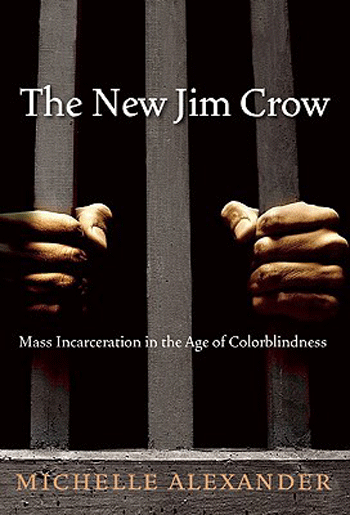
I just finished reading her book, The New Jim Crow: Mass Incarceration in the Age of Colorblindness (The New Press, 2010), which piles on the stunning and depressing statistics. But the book does much more than to amplify a sorry state of affairs that most of us know about, but rarely talk about. Several points came through strongly for me:

  • Through actual case stories, the book shows what these numbers mean for the felons for life, their families, their communities, and our democracy. In many cases the people so labeled are innocent, coerced into a plea bargain, or at most convicted of a minor crime.
  • Those who subsequently become subject to legalized second-class citizenship are disproportionately African American. Large numbers are convicted of drug crimes, even while their White counterparts are bigger users and sellers of drugs.
  • The mechanism by which this happens is a maze of laws and court rulings, which have severely compromised civil rights for all of us, even though their impact is primarily on people of color. One more item was added to the maze this week, when the Supreme Court ruled 5-4 that correctional officials may without cause, strip-search a person arrested for the most minor offense. Albert W. Florence was strip-searched twice after being wrongly detained over a traffic fine. Florence said at the time, “It was humiliating. It made me feel less than a man. It made me feel not better than an animal.”
  • The interlocking system including bias, laws, police procedures, courts, prison industry jobs and profits, has created a shameful justice system, far worse than the one lamented by Menninger.

Michelle Alexander

Michelle Alexander

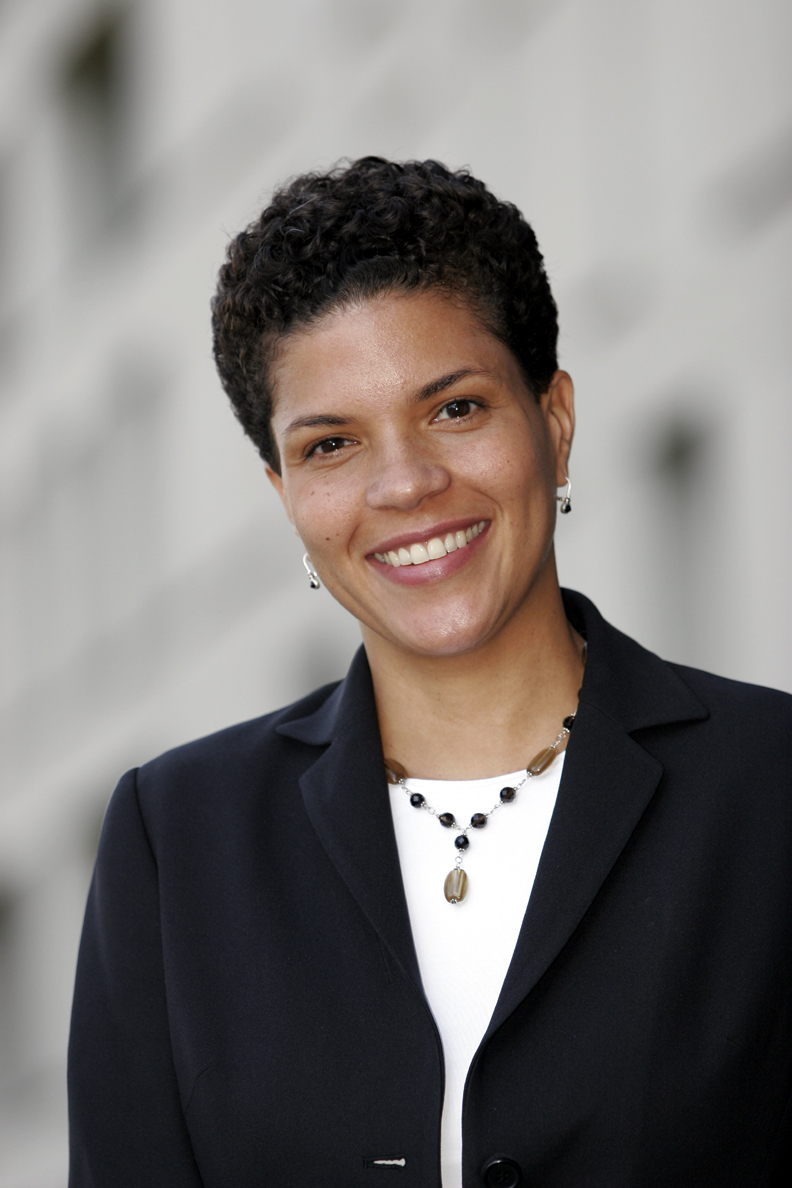
Alexander says that she had several specific audiences in mind for the book. One is “people who care deeply about racial justice, but who for any number of reasons do not yet appreciate the magnitude of the crisis faced by communities of color as a result of mass incarceration. In other words, I’m writing this book for people like me, the person I was 10 years ago.” Another was for people “lacked the facts and data to back up their claims” about how the criminal justice system was operating as a third mode of racial caste making (following first slavery, then Jim Crow). I felt I fit in both of those camps, and fortunately not in the third, that of people trapped in the system.

Following her work on an ACLU racial justice project, Alexander says “I had come to suspect that I was wrong about the criminal justice system. It was not just another institution infected with racial bias but rather a different beast entirely…Quite belatedly, I came to see that mass incarceration in the United States had, in fact, emerged as a stunningly comprehensive and well-disguised system of racialized social control that functions in a manner strikingly similar to Jim Crow.”

Coming to appreciate that system in a deeper way makes the book powerful for me. It doesn’t in any way try to excuse crime, or to lay the blame for it on lack of employment, poor education, or inadequate housing, as many liberals might do. Nor does it link the injustice of the system to individual bias per se. Furthermore, it debunks accounts of individual responsibility, moral failure, or familial inadequacy as some conservatives might propose. Instead, it shows how the system operates, how it developed and grew, and why it will be so hard to change. Yes, better Supreme Court justices matter, but they won’t dismantle the system. Affirmative action is helpful, but it’s far from a solution. All of those explanations for crime and incarceration matter, too, but they’re not the central narrative.

The book is disturbing, and depressing at times. It cannot be said to end on a happy note, but in the last section, “All of Us or None,” there is at least a vision of what could make a difference. Alexander calls for a conversation on race in which “us” means “all of us,” or as Martin Luther King said, that a shift was needed from civil rights (interpreted simply as rights for those who are dispossesed) to human rights.

This means, among other things that

Whites should demonstrate that their silence in the drug war cannot be bought by tacit assurances that their sons and daughters will not be rounded up en masse and locked away. Whites should prove their commitment to dismantling not only mass incarceration, but all of the structures of racial inequality that guarantee for whites the resilience of white privilege. (p. 244)

The book closes with an excerpt from James Baldwins’s letter to his nephew in The Fire Next Time. That entire letter is worth reading and re-reading many times, but I’ll just end here with a small excerpt from that excerpt:

this is the crime of which I accuse my country and my countrymen, and for which neither I nor time nor history will ever forgive them, that they have destroyed and are destroying hundreds of thousands of lives and do not know it and do not want to know it…It is the innocence which constitutes the crime…They are, in effect, still trapped in a history which they do not understand; and until they understand it, they cannot be released from it…those innocents who believed that your imprisonment made them safe are losing their grasp of reality…And if the word integration means anything, this is what it means: that we, with love, shall force our brothers to see themselves as they are, to cease fleeing from reality and begin to change it.  For this is your home, my friend, do not be driven from it; great men have done great things here, and will again, and we can make America what America must become.

Parallel universes

The Sunday Doonesbury strip nailed the problem:

The 400 richest families in America now hold as much wealth as the bottom 50% of the country combined!

So, in the midst of an economic crisis, how do our leaders (nearly every Republican and most of the Democrats, including the President) make use of this information?

They celebrate two things:

  1. Cut that “waste” in government, especially the bit going to spending on job training, education, food, housing, and healthcare for that no-good 150 million, and
  2. Absolutely, under no circumstances, allow any new taxes, especially on those 400 families, who provide so much for the rest of us.

There is an parallel universe, one with people just like us, an economic downturn, and people out of work. But there are two differences: People there believe that increased spending now is actually vital to get the economy going, put people to work, and in the long run actually reduce the deficit. (This by the way is the view of most economists, liberal or conservative in both of these universes.) So, point #1, austerity now, is considered an extremely dumb and ill-timed idea.

Second, those people think that the short-term deficit and the long-term debts are very real problems that need to be addressed intelligently and comprehensively. That means management of spending, but also fair contributions from all, including what middle class we have left and even those 400 families. They don’t believe that all of the economic sacrifice ought to fall on the bottom 50%. So, point #2, no new taxes ever, is also viewed as a wacky idea.

In that parallel universe, people would like to

  1. Get the economy going.
  2. Develop a thoughtful plan for revenues and spending, one that involves shared commitment from all.

Is that parallel universe possible?