Dialogues in Methods of Education (DIME)

moonSoon after arriving in Illinois in 1990, I joined the Dialogues in Methods of Education (DIME) group.

DIME members have studied together how to improve their own teaching practices through research, the sharing of ideas, and mutual support. They have also engaged in critical analysis of the disciplinary and institutional forces shaping their work.

The history of DIME shows the importance of accommodating difference in providing support for sustained community.

Reasoning Under Uncertainty

Student-created box plot

Student-created box plot

Reasoning Under Uncertainty was a project funded by the National Science Foundation under its EHR/Applications of Advanced Technology program during 1985-91. The project led to a variety a publications and presentations (e.g., Rosebery & Rubin, 2007; Rubin & Bruce, 1991). Andee Rubin and I were the PIs, but the project eventually involved many other colleagues at Bolt Beranek and Newman, MIT, and local schools in the Cambridge, Massachusetts area. Continue reading

Curriculum & Instruction

I was a Professor in the Curriculum & Instruction department, in the College of Education, at the University of Illinois at Urbana-Champaign from 1990 to 2000. I taught courses such as

  • Computer Assisted Instruction,
  • Classroom Science,
  • Inquiry Teaching and Learning,
  • Evaluation of Information Technologies,
  • Ethical & Policy Issues in Information Technology,
  • Discourses of Science,
  • Technologies for Learning,
  • Reader Response Criticism,
  • Children’s Composition,
  • Social Contexts and Functions of Writing,
  • Epistemology and Education,
  • Teacher Communities, and
  • Discourse Across the Disciplines.

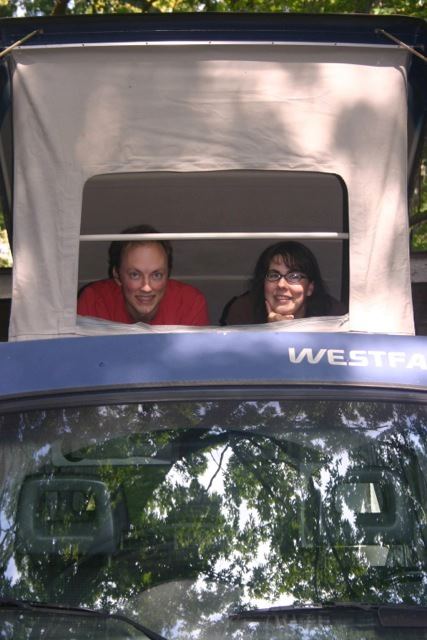
Sleeping in the new VW camper

Stephen & Emily in the VW

Stephen & Emily in the VW, some time later

From the “Kid Talk” file (June, 1990), when Emily and Stephen were 4 1/2 and 3 1/2 years old:

We just got the new VW camper. E and S wanted to sleep in it the first night.

D: The problem is, I’d have to sleep in it, too.
E: Why?
D: Because I can’t leave you guys alone.
E: We wouldn’t be alone. I’d be with Stephen and he’d be with me.

Vwayaj mwen Haiti, 1989

Diznef fevriye m’ pral Okay, Ayiti, vizitez Ecole Sainte-Famille. Lekol-sa-a lekol se Graham and Parks School nan Kambrij. M’pral ak moun ki soti Graham and Parks School e lot ki gen interes sou Ayiti. Moun-sa-yo, ki travay ak Les Cayes Children’s Fund, vle ede etidyan ayisyen nan Ecole Sainte-Famille. Etidyan-yo nan Okay bezwen plu bagay: liv, kreyon, bagay fe kreyon-yo gen pwent, plim, papye, chifon, kaye, tap, penti, penso, globe, reg. Moun-yo va pote bagay-sa-yo e va travay ak pwofeso-yo la-a.

M’ gen eksitmen sou vwayaj-la. Petet m’ kapab ede etidyan-yo e petet m’ap gen plezi. Men m’ gen pe tou. M’ konnen selman pitit ayisyen. M’ bezwen aprann kisa tout moun nan Okay abitye fe bagay-la. M’ pa vle fe pwoblem pou yo. M’ gen concern tou sou situation politik. M’ vle vwayaj-la ede moun ayisyen e pa fe situation mal. Dangeur-yo la ki le moun vizite peyi lot, espezialimen ki le peyi-la li soti gen riches e peyi-la li vizite pa gen.

Ye swa m domi

Ye swa m domi, le m ap dodo
Le m ap dodo se pa ke m ki kontan
Menaj mwen pati li fe twa mwa deyo
Le m rete sonje dlo kouri nan je m
Li rale monchwa li siye figi m
Li di yayaya cheri juska la fin du monde

Here’s a [mostly] Google translation of the report I wrote originally in Kreyol:

My trip to Haiti

On February 19th, I will go to Okay, Haiti, to visit the Sainte-Famille School. This school is [sister to] Graham and Parks School in Cambridge. I will be with people from Graham and Parks School and others who are interested in Haiti. These people, who work with Les Cayes Children’s Fund, want to help Haitian students at Ecole Sainte-Famille. The students in Okay need more things: books, pencils, things made of pencils – they have points, pens, paper, rags, notebooks, tapes, paints, brushes, globes, reg. People will bring these things and work with the professors there.

I am excited about the trip. Maybe I can help the students and maybe I will have fun. But I have [fears] too. I know only Haitian children. I need to learn what everyone in Okay is used to doing. I don’t want to cause problems for them. I am also concerned about the political situation. I want the trip to help Haitians and not harm the situation. The dangers are there when people visit other countries, especially if the country they come from has wealth and the country they visit does not.

and of the Haitian song I learned:

[Yesterday, I Slept]

[Yesterday], I [slept], [while I was sleeping]
[while I was sleeping], [my heart was not content]
My wife left three months ago
When I remember, tears flow from my eyes
I pull out my handkerchief and wipe my face
I say yayaya darling until the end of the world

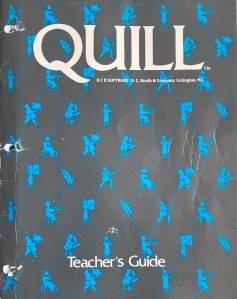
Quill teacher’s guide

Quill is a set of microcomputer programs that use the computer’s capabilities to help teachers teach writing. Students from third grade through high school have been successful with Quill, including gifted and talented, special education, and English as a second language students.

The Quill programs are tools for teachers and students. Teachers can use Quill to provide challenging, meaningful writing activities for students. Students can use the programs to practice various types of writing and produce finished products they can share with classmates and teachers. These are motivating, adaptable writing activities that supplement and enrich existing language arts curricula, and can be integrated into all content areas.

Theoretical issues in reading comprehension

trc[Reissued, Routledge, 2019]

For many years, the study of reading was taken to apply almost exclusively to the process of learning the written code. It was often assumed that once a child could recognize words in their written form, the understanding system already available from the child’s oral language experience would permit comprehension to proceed smoothly.
Continue reading