Professor, GSLIS

GSLIS

Still at the University of Illinois, I became a Professor in what was known then as the Graduate School of Library & Information Science (GSLIS) in the Spring semester of 2000. You can see what attracted me to LIS here. The School is now known as the School of Information Sciences, or simply the iSchool.

In 2004-05, I had a sabbatical in Europe, mostly around Paris, in Germany through a joint NSF/DFG project, and through Fulbright Specialist grants in Finland and Sweden.

In 2007-08 I held a Fulbright Distinguished Chair at the National College of Ireland in Dublin. At other times, I’ve had extended projects in Turkey, China, Romania, Nepal, and other places.

Emily at the nursing home

north entrance, Uni HighWhile at Uni High, Emily spent a :emester tutoring Adolph Willms and learning his life story. See this article by Mary Schenk in The News-Gazette (June 5, 1999):

Life’s work earns man his diplomas

URBANA – Adolph Willms has a lifetime of memories tucked away in his head. Some days he can summon those. Other days it’s not so easy.

With the help of an education researcher and three teen-age girls from University High School in Urbana, the 83-year-old stroke victim has been able to recall many past experiences.

Researcher Patricia Marton of Bloomington was so impressed with Willms’ life experiences as a farmer in the St. Joseph area that she persuaded local…

Beijing and Brisbane, 1996-97

family Xiao Guor
Liqian Stephen in 6th grade in Bardon, Brisbane
Sabbatical with major stays in Beijing, China and Brisbane, Australia and stops in Oklahoma, New Mexico, Arizona, Nevada, Texas, California, Indonesia, Malaysia, Singapore, Italy, and Wales along the way, 1996-1997.

See

While in Queensland, Emily and Stephen attended Rainworth State School in Bardon, Brisbane.

Discoveries

Discoveries (1995) is a series of four interactive CD-ROM programs for Grades 3-6 (ages 8-12). It includes hypertext, panoramic images, and immersive technology in a pre-web ecology.

img_3975Into the Forest (Great Smoky Mountains National Park) [ISBN 0-669-36168-2]

Editor: Grace Talusan
Designer: Angela Sciaraffa
Logo: Pamela Esty
Cover photo illustration: Daniel Derdula

Continue reading

Teacher to teacher: A professional’s handbook

Alvermann, D. E., Arrington, H. J., Bridge, C. A., Bruce, B. C., Fountas, I. C., Garcia, E., Paris, S. G., Ruiz, N. T., Schmidt, B. A., Searfoss, L. W., & Winograd, P. (1995). Teacher to teacher: A professional’s handbook for the primary classroom. Lexington, MA: D. C. Heath. [218 pp.; ISBN 0-669-35984-X]

Alvermann, D. E., Arrington, H. J., Bridge, C. A., Bruce, B. C., Fountas, I. C., Garcia, E., Paris, S. G., Ruiz, N. T., Schmidt, B. A., Searfoss, L. W., & Winograd, P. (1995). Teacher to teacher: A professional’s handbook for the intermediate classroom. Lexington, MA: D. C. Heath. [216 pp.; ISBN 0-669-35985-8]

Validity of the 1992 NAEP of reading

The National Assessment of Educational Progress (NAEP) is the only nationally representative and continuing assessment of what America’s students know and can do in various subject areas. Assessments are conducted periodically in mathematics, reading, science, writing, the arts, civics, economics, geography, and U.S. history.

Since NAEP assessments are administered uniformly using the same sets of test booklets across the nation, NAEP results serve as a common metric for all states and selected urban districts. The assessment stays essentially the same from year to year, with only carefully documented changes. This permits NAEP to provide a clear picture of student academic progress over time.

naep_chart2In the late 1980’s a plan developed for state-by-state reporting of 1992 reading data from the National Assessment of Educational Progress (NAEP). This plan was accompanied in the early 1990’s by a new framework for the assessment of reading. Jean Osborn, Michelle Commeyras, and I were asked to investigate the adequacy of the process used to develop the framework, the degree to which it represented a consensus among professionals in the reading field, and its content and curricular validity.

To conduct this investigation, we analyzed documents produced by NAEP, convened a 2-day panel of experts, held two public colloquia, conducted 50 interviews, and analyzed responses to a questionnaire completed by 627 leading educators. We found that the planning process did not include enough time to address some major concerns of the field. Despite this, there was widespread agreement that the 1992 NAEP in Reading represents important advances in reading assessment, including more open-ended responses, more authentic texts, and student choice about passages. But these very advances raise problems for test design and the interpretation and scoring of student responses.

Materials from this study are now stored in University of Illinois Archives, including trial materials (items proposed for use in the assessments), working papers, meeting minutes, and research protocols.

References

  • Bruce, Bertram C., Osborn, Jean, & Commeyras, Michelle (1993). Contention and consensus: The development of the 1992 National Assessment of Educational Progress in Reading. Educational Assessment, 1(3), 225-253.
  • Bruce, Bertram C., Osborn, Jean, & Commeyras, Michelle(1993). The content and curricular validity of the 1992 National Assessment of Educational Progress reading framework. In R. Glaser & R. Linn (Eds.), The trial state assessment: Prospects and realities (pp. 157-162). Stanford, CA: National Academy of Education.
  • Commeyras, Michelle, Osborn, Jean, & Bruce, Bertram C. (1992). Reading educators’ reactions to the Reading Framework for the 1992 NAEP. In C. K. Kinzer & D. J. Leu (Eds.), Literacy research, theory, and practice: Views from many perspectives (Forty-first yearbook of the National Reading Conference) (pp. 137-152). Chicago, IL: The National Reading Conference.
  • Commeyras, Michelle, Osborn, Jean, & Bruce, Bertram C. (1994). What do classroom teachers think about the 1992 NAEP in reading? Reading Research and Instruction, 34(1), 5-18.

Electronic Quills: A situated evaluation of using computers for writing in classrooms

Quill bookQuill was a suite of software tools designed to foster an environment for literacy in classrooms. We wrote it in Pascal for the Apple II computer. The software, teacher’s guide, and workshops were used widely, including in village schools in Alaska, which I visited three times during the project in 1983-84. Carol Barnhardt played a major role in setting up that Alaska project and in helping us understand the history and context of schooling in Alaska.
Continue reading

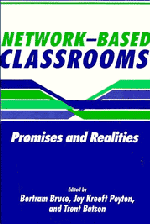
Network-based classrooms: Promises and realities

nbc-paperStudents in network-based classrooms converse in writing through the use of communications software on local-area computer networks. Through the electronic medium they are immersed in a writing community–one that supports new forms of collaboration, authentic purposes for writing, writing across the curriculum, and new social relations in the classroom. The potential for collaborative and participatory learning in these classrooms is enormous. Continue reading