Digital storytelling

Through the Digital Literacy in Irish Primary Schools (DLIPS) project, I’ve been visiting primary schools in the Liberties area of Dublin. I’m also visiting 24 infant, primary, and post-primary schools in the Docklands area through Technology in Docklands Education project. This has given me a wonderful opportunity to see a wide variety of learning technologies and ways of organizing classroom learning. Many of the most successful classroom projects have involved some version if digital storytelling (see the photo story entries).

You can get a flavor of these projects from an RTE video at the Francis St CBS (primary level), one of the schools I’ve worked in:


The Digital Hub Learning Initiative has supported this classroom and a variety of others in the area, as well as community groups. One overarching project is Digital Hub FM, a community radio station. Community members of all ages receive training in radio production and then carry out the research, broadcasting, and station management themselves. The broadcasts include music, entertainment, discussion, local history, and youth programs.

There’s a large set of videos posted on YouTube describing the Learning Initiative’s work, including this good introduction:

Miss Dierdorf and the mythology newspaper

I was asked to write about a favorite teacher for a project in a philosophy of education course. The person who asked me plans to use the lenses of John Dewey, Paulo Freire, and Pádraic Pearse to look at the responses from various people. Here’s mine:

I remember many good teachers, but no one that stands out far above the rest. But I’ll pick one: Miss Dierdorf at W. P. McLean Junior High School cared about literature and history in an infectious way. She organized a class newspaper project in which we wrote and illustrated stories from Greek (and Roman) mythology. The antics of the ancient heroes and gods became as real to us as the day-to-day events around the school.

As I recall, every student felt that he or she had a vital contribution to make to the newspaper. We designed the paper, wrote and drew, because we too cared about the stories and the characters. I think that the sense of becoming engaged with the ideas and feelings of the past or faraway has stayed with me ever since.

It was interesting to see that the majority of the responses were about English teachers.

I should add that there are many mythology newspaper curriculum units available on the web and other formats, such as Greek Mythology Newspaper, by the children’s book author, Bernard Evslin. They all seem to be more sharply defined in terms of skill development and assessment than I remember the class to be.

Earth Hour, Dublin

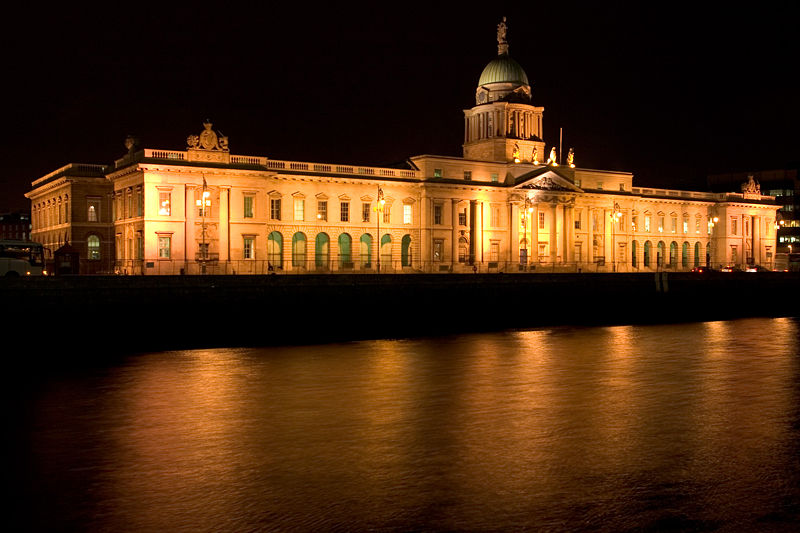
Custom HouseIn about an hour, it will be Dublin’s turn to participate in Earth Hour. The event started last year in Sydney when residents and businesses turned off their lights for one hour as a statement about global warming. This year, 28 cities will participate, each at their 8 pm on March 29. The event is described as a way to highlight “simple changes that will collectively make a difference.”

.

Dublin at nightI thought this was a good opportunity to post some Dublin at night photos before we have to turn off the lights here. They’re beautiful scenes, but also remind us of the energy demands of modern cities.

I hope that Earth Hour will live up to its expectations, but fear that it may turn out to be no more than another fun event and a way for all of us to feel good, without addressing the fundamental changes needed to treat our planet and our children more kindly.

O’Connell Street SpireThe photos are not my own, but are used under Creative Commons licenses. On the upper right is the Custom House by Jimmy Harris. It’s near to where I work. The O’Connell Street bridge at the left is by Hans-Peter Bock. And on the bottom right is the Spire of Dublin, further up on O’Connell Street, by Peter Guthrie.

Obama’s speech: A more perfect union

Barack Obama’s speech in Philadelphia yesterday (full text and video of the speech) was an historic moment, the most direct attention to race and racism from any major Presidential candidate. Speaking in the way he did was an intelligent, courageous, and moral act in an atmosphere of sound bites and back-biting. I don’t know whether it helps or hurts his campaign, but it should help the country.

I saw three main points in the speech, with my comments in brackets:

  1. “Race is an issue that I believe this nation cannot afford to ignore right now.” [Prejudices against those who speak different languages, profess different religions, have different values, or simply look different, are a major problem. However, the legacy of slavery, segregation, and continuing discrimination against Blacks has made that form of racism a defining feature of US history. It’s our biggest challenge, one no other country faces in the same way.]
  2. “Not this time.” [Racism in its historical forms not only continues to undermine our best impulses; it spreads and poisons other issues such as how we address immigration or how we interact with other countries. We need to move the discourse forward this time, to transcend race in a deep way, if we are ever to form “a more perfect union.”]
  3. “We cannot solve the challenges of our time unless we solve them together.” [We can’t do #2 if we don’t address #1.]

Some people express what they know about the pernicious effects of racism in ways that are divisive or factually wrong. In so doing, they fuel the very ignorance and hatred that underly racism. By not acknowledging the possibility of change, they effectively block it. That was Obama’s response to some of Rev. Jeremiah Wright’s comments.

Others ask, “why not just be color blind?”, essentially ignoring the reality of racism. In response to that, Obama said that race is an issue; we need to work to make it not so, but that requires understanding and facing it.

Obama’s speech wasn’t a scholarly critique, but he managed to show for those ready to listen why we need to understand and confront racism. Only then can we work together to build a different kind of society, and bring the focus to issues such as education, health care, and the economy.

Part II: Stepping out of a photo story

Be sure to read Part I: Stepping into a photo story, before this part.

Z’s story

In a recent classroom visit, I saw many of the benefits of digital storytelling: The students were active and deeply involved in learning; they were developing literacy and technology skills; they were building confidence in themselves as learners and as responsible young people. It was a contemporary version of a Froebel classroom. But something happened on one visit that’s made me think again about how we all inquire and learn.

As I described in Part I, the students were asked to write about their first memory. Their stories involved family, religion, play, travel, money, holidays, toys, and other elements of childhood today. As I went from student to student I saw some interesting variations, but nothing too surprising. Then, I encountered Z.

Who is Santa?

Whereas other students had written several lines already and eagerly allowed me to photograph their texts, Z had written nothing. I aksed her whether she had a memory to write about. My paraphrase loses the full force of her story, but perhaps conveys the spirit:

When I was four years old, I heard my parents talking about Santa, but I didn’t believe it. So the night before Christmas, I waited until they’d gone to sleep, then went downstairs. I unwrapped all of the presents, including those meant for my brothers and sisters and played with all of them. Then I took the presents upstairs and hid them in my wardrobe. The next morning my Ma and Dad came and said that Santa didn’t come because I’d been bad. “And where did you put all those presents?!”

Z went on, and I wish I could have recorded her performing. I told her she had a great story, even though I secretly thought that hers might not be as faithful to the truth as the ones her classmates were writing. So, I encouraged her to write it down as the others were doing: “Let me know when you have something written and if you like, I’ll photograph yours as well.”

As L and I went around the room, we talked with each student and photographed their writing. Meanwhile, Z seemed to do the same. She was up and about more than she was sitting writing. She’d be talking to a friend, looking at the photos on their laptop, or generally enjoying herself.

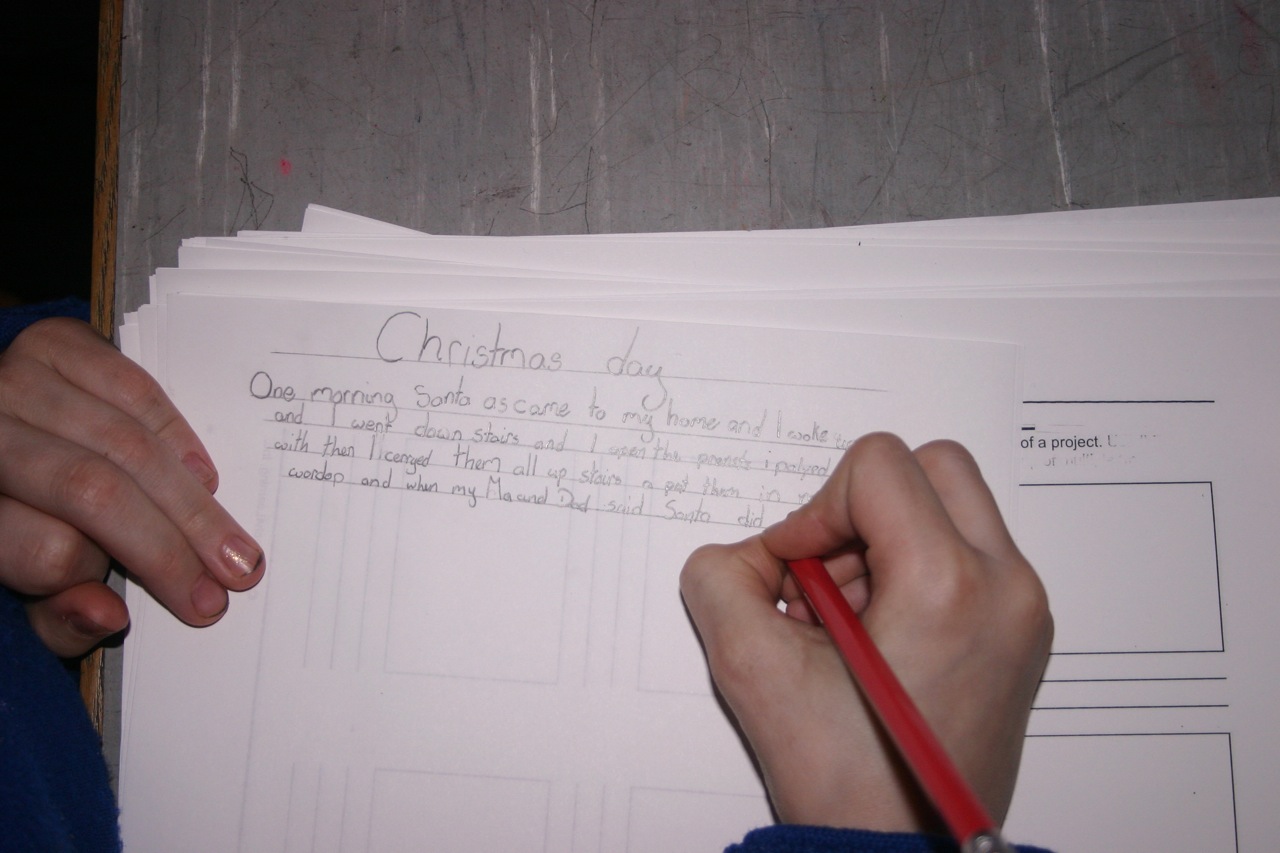
I came back to her several times to ask about her writing. She assured me that she wanted to have it photographed, and I promised that I’d do that as soon as she’d written something. But each time there was animated talk, but very little writing. By the end of the class she had written some (see photo), but it was less than that of most of her classmates and certainly didn’t do justice to the oral form.

What kind of camera is that?

One time she stopped me:

Z: What kind of camera is that?

Me: It’s a Canon. Why do you ask?

Z: My uncle has one like that. Have you seen the kind with the picture that comes out the bottom?

Me: Oh, you mean a Polaroid? Those are fun because you get the printed picture right away.

This conversation continued into different kinds of cameras, how cameras work, and why we have different buttons on the cameras. It was genuine inquiry growing out of lived experience, as Dewey might have described. But it didn’t reside in the classroom inquiry frame. The classroom story line was that students were inquiring through the photostory activity and that I was there to document what they did. They and the teacher were the performers on the classroom stage and I was the spectator, using my notepad and camera to speak to a larger audience. Our roles were clear:

students: photostory activity and materials

L and I: observing activity with notepad, camera

But Z would have none of that. She was just a sometime participant in the photostory activity and like Bertold Brecht, felt perfectly at home “breaking the fourth wall.”

What are you doing here?

Once I came back to see her and she asked:

Z: Why are you here? What are you doing here?

Even more than with the camera incident, I felt that she was challenging our assigned roles, breaking the fourth wall again. I was the spectator, the questioner. She was supposed to be the performer, the respondent. Who was she, a ten-year-old, to disrupt that established order?

But Z deliberately disrupted, albeit in a gentle way. It was genuine questioning, as Socrates or Mme. Curie might have done. No other student had questioned my presence or activity. They accepted as in the natural order of things that a stranger could be observing them and their teacher, asking questions, and taking notes or photos. Whether they didn’t think to ask or were inhibited from asking, I can’t say, but it’s interesting to note that by the age of ten, we’re nearly all so ready to accept that kind of surveillance. But not Z.

me: I’m here to look at this kind of activity and to see what children learn from doing it. Are you learning from it? What do you think you’re learning?

The standard answers to my question here are as I’ve suggested above: Becoming deeply involved in learning; developing literacy and technology skills; building confidence and learning to be responsible. Many ten-year-olds are able to articulate ideas along those lines. But Z was different.

Z: I’m learning to improve my memory.

Reading the world

Well, of course! The day’s activity was framed in terms of “your first memory.” Writing about it and looking at photographs was obviously a way to reinforce and enhance that memory. I just hadn’t thought of ten-year-olds as needing to improve their memories, even though, on reflection, I believe that being able to articulate and express memories is something we do learn how to do. Z had moved to the heart of the activity. Moreover, her compelling oral rendition was her own way to do that improvement.

The photo story activity helps fulfill Friedrich Froebel’s vision of educating the whole child by enlisting imagination, the body, and all of the senses, as well as the mind, in exploring the world. Children participating in the photo story activity did this in a way that would have pleased Froebel. But Z did it even more, by stepping out of the photo story.

Was it the fear of having more Zs enter the world that made the Prussian court in 1851 issue a ban on Froebel’s kindergarten idea?

I’m not sure what this all means. Z’s inquiry is situated, reflective, critical, and connected to experiences in her life beyond the school. It’s also rebellious. Imagine a classroom full of Z’s. Her teacher says she’s a handful. Would anything ever get done? Imagine a society of Z’s. Would so many things go unquestioned?

Ζει” in Greek means “he lives.” It’s a protest slogan referring to the democratic politician Gregoris Lambrakis, whose assassination in 1963 inspired the novel and film, Z. Whatever one might say about our Z’s writing or her ability to focus on the classroom task at hand, it’s indisputable that she lives and that her inquiry is attuned to the world in way that could be a lesson for any of us.I’m of course intrigued to see Z’s final product and wonder where she’ll go next.

Part I: Stepping into a photo story

I’ve recently observed a number of classrooms doing variants of the photo story idea, in which drawings, graphics, or photos are used as the skeleton for a digital story. Such a story may also include written text, audio narration, music, sound effects, and various visual effects. While the students are producing their individual photo stories, I feel that I’m watching the photo story of the whole classroom. I become an engaged spectator, stepping into that photo story, eager to see what they might do next.

Working on personal memoirs

You would be pleased to have your ten-year-old daughter enrolled in Ms. C’s class. The teacher was caring, there were ample resources for learning, and there was even a special teacher in the school who provided IT support and professional development (Ms. D).

On the day L and I visited, the students were working on personal memoirs in digital story form. Each student had her own project, which was built around photos, ideally including baby pictures up to the present. Students could borrow a digital camera to take additional photos at home or within the school. Each student also had the use of a laptop on which she could store photos and assemble them into a photo story with a written narrative.

The class had learned about how to tell a story using pictures, words, and music. On this day, they were working on their story boards. This involved selecting photos, sketching each one, and writing a description. There was a storyboard handout with boxes for each of six photos plus descriptions. Ms. D explained that in a later class she would record each of them reading their scripts aloud and then incorporate that recording into the photo story.

Our earliest memory

Ms. D talked about memories and what our earliest memory might be. She pointed out that we sometimes think we remember something because we’ve been told about it many times or seen a video about it, but we may not have remembered it directly. She then led the children in a brainstorming activity about their earliest memory. Students called out what they believed to be their first memory—a family holiday, First Holy Communion, a trip they took.

Each student then began writing their account of that first memory. I was impressed with how much nearly everyone seemed to be engaged with the writing and cared about getting it just right. L and I moved about the room, talking to the students about these memories and photographing their developing texts.

The texts they wrote were short, but heartfelt and entirely appropriate for the overall project. For example:

My Holy communion

I remember my first Holy communion when I went out for my dinner and went to my uncles and auntys and I got lots of money and when I came back from my auntys and uncles I went home and got dressed into a tracksuit I left my money in and I went out to play with all of my friends after I played and I went up to stay in and watch the tv and the next day I went out to get clothes and toy and I had lots of clothes and toy and I had lots of money left. and I got a cross with my first Holy communion on it

or, from another student:

I rember when I was at my aunts wedding. I was only 4 years old. We were playing chasing and we ran under the table and knock down all the drink. It was very funny but we got into trouble.

Several students had even longer reminiscences. They clearly saw the activity as a way to connect real lived experiences with a creative school project.

Froebel’s gifts and occupations

Ms. C had learned about teaching in a college whose curriculum was built on the ideas of Friedrich Froebel. This 19th-century German educator, and founder of kindergarten, believed that humans are essentially creative, able to learn through active engagement with the world and appreciation of beauty. These ideas followed from a reverence for the child and the significance of play for learning. Froebel encouraged the creation of learning environments that involved practical work, which he called occupations, and the direct use of materials (such as shaped wooden bricks), which he called gifts.

Froebel would have approved of this photo story project. He honored the capacity of people to create and learn at an early age. Here, they were also reflecting on their own earliest learning. Students were engaged with real stuff in their homes and the school. They were actively creating what would become beautiful stories of their own lives. Ms. C understood this and believes that the photo story project is beneficial for her students. She sees how they learn about how to use new technologies, such as the digital camera, the scanner, the laptop, the web, as well as develop literacy skills, such as how to devise a storyline or compose captions. Students also become successful problem solvers and learn to take responsibility for the equipment, which they can take out of the school.

I agree with Mr. F and Ms. C about this wonderful class. As I said above, I would be pleased to have my own child be a part of it. My story might end there. But something happened in that class, which made me think again about play, children, learning, teaching, and inquiry.

Stay tuned for the next installment: Part II: Stepping out of a photo story.

St. Andrew’s Resource Centre

muralWe went to the organic market at the St. Andrews Resource Centre today, to get some healthy, fresh produce. We also enjoyed a hearty lunch of lentil soup and samosas.

After several visits, I can say that the Centre is one of the best-run and most beneficial community centres that I’ve seen. In addition to the market, there are employment services, tutoring for secondary school students (grinds), adult education, computer training, parenting and young mothers programmes, and welfare rights counseling. There’s a Heritage project to record the history of the Pearse St. community and many others projects (see below).

buildingThe elegant building was opened as the St. Andrew’s School in 1895 and operated as such until 1976 due to the decline of the working docklands. A renovation began in 1985, which led to the social centre opening on Bloomsday, 1989. The structure is well-preserved and there are colorful murals in the hallways and the back courtyard.

Staff are drawn from the community, so that the centre’s work tends to directly reflect community needs. Concurrently, community members develop skills that help their own careers. The latest count is 224 staff on full or part-time status.

The Centre has learned several lessons that might be useful elsewhere:

  • Issues and programs develop out of needs identified by the community. There’s bottom-up planning rather than solutions from on high.
  • There’s a concerted effort to build capacity in the community. For individuals, there’s an advancement path through community work.
  • There’s a flat organizational structure, which allows quick and flexible response to needs. A corollary is an openness to the process. Staff learn to find workarounds to barriers.
  • cybercafeThere’s a self-sustaining budgetary model. There’s no one paymaster and staff grows in response to funding.
  • The Centre provides integrated services, a “one-stop shop.” This applies across the life cycle from the childcare center through Day Centre with meals for the elderly. Activities such as the Cyber-Links centre coordinate with others, such as the theatre project to present drama written and acted by community members.
  • figuresStaff and community members care about the Centre. Pride in the Centre is evident: There’s no grafitti and there appear to be limited security concerns. The display of figures brought in by children in the Childcare programme is just one tangible piece of evidence for this.
  • There’s a forward thinking, needs-directed process, which identifies opportunities for funding consistent with community needs, capabilities, and processes.

Feminist Walking Tour of Dublin

Yesterday was International Women’s Day. Among the many events worldwide was the Feminist Walking Tour of Dublin. It sounded interesting when I heard about it just the day before, but I was hesitant to go: It had been an exhausting week between my mom’s recovery from a hip fracture and my preparing a lecture on education and community for Wednesday evening. The weather forecast promised rain; there was a Six Nations rugby match (best not discussed after yesterday); and I wasn’t certain I’d be welcome on the tour, not knowing anyone else there.

Feminist Walking Tour of Dublin posterFortunately, and without any doubt in the end, I made the right decision. It turned out that there was not only an enlightening and enjoyable tour, but soup and sandwiches afterwards at the Teachers Club, short movies, a distro (books, zines, and other publications), music, and lots of good discussion.

I had the impression that the organizers expected 20-30 people to show up. But there were at least 120, maybe up to 150, not counting various people who joined in for brief times along the way. What was planned as one group turned into two with an impressing display of organization on the part of Choice Ireland and the RAG collective. One organizer pointed out that their non-hierarchical structure made it easier to respond to unexpected events.

My group was led by Carol Hunt, a history postgraduate student at Trinity and writer for the Irish Independent. She was an excellent guide, leading us from St Stephen’s Green, to the Mansion House, Trinity College, O’Connell St, the Garden of Remembrance, and other spots, each being important sites for women’s history in Ireland. At various stops, others presented on issues such as immigrant rights or women’s centers masquerading as offering full reproductive counseling while in fact proselytizing. I learned far too much to try to convey here, but you can see the tour map and background information in a beautiful and very well-designed booklet, which should still be available in hard copy or pdf.

The tour was bracketed by two precipitations. In the beginning, we were standing next to the seat honoring Louie Bennett and Helen Chenevix. Bennett, a novelist, pacisit, and labor organzer, helped found the Irish Women’s Suffrage Federation, played an active role in the Dublin lockout, helped found the Irish Women’s Reform League, and was active for years in the Irish Women Workers’ Union. As Carol began talking, we had a brief burst of hail. Someone called out that God was a male and He was not pleased!

Then, at our last stop, someone threw potatoes from an upper story window, injuring one of the people on the tour. It’s amazing how cowardly some people can be and how afraid they are of others simply trying to learn.

After the tour, there was a social event in the Teacher’s Club at Parnell Sq. We saw two short films, including The Future of Feminism, by Cara Holmes and Breaking the Silence, by Katie Gillum. There was good music from Heathers, some of which you can hear on their Myspace site. I’m still working to complete all of the exercises in the activity booklet for children designed by Aileen Curtin!

I include the video below only because it gives a taste of the time of Countess Constance Markievicz. I learned on the tour that of all the great women in Irish history, and of all the many statues in Dublin, she is the only woman to have one. All of the other statues of women are of fictional characters or the Virgin Mary.

Markievicz was second in command of the St Stephen’s Green Citizen Army force during the Easter Rising of 1916. Court-martialed afterwards, her potential execution was commuted to life imprisonment because of her gender. She famously replied: “I do wish your lot had the decency to shoot me.”

See more, with photos.

Re-Connecting with Community

Nick and me

On March 5, National College of Ireland hosted an event to consider the relations between third-level education and the communities around them. Emma Kytzia and Beatrice Cantalejo did a terrific job putting it all together.

Nick Rees (left) presided. I was asked to speak on “A Radical Vision for Third-Level Education Today: Re-Connecting with Community.” The lecture was followed by a panel discussion, guided by Paul Mooney, then questions from the audience, and finally, conversation over wine in the President’s office.

I drew from two examples in the Chicago area, Hull House and Paseo Boricua, to examine how educational institutions can re-connect with community. There was a little about current work with the College and the local schools in the Docklands community around widening participation in higher education.panel

The real focus of the evening was on how these experiences might inform education and community work in Dublin today. An excellent panel took up that topic:

  • Mr Ken Duggan, School Principal, Westland Row CBS
  • Prof Áine Hyland, former Professor of Education and Vice President (Academic), UCC
  • Mr Seanie Lambe, Director, Inner City Renewal Group
  • Ms Michele Ryan, Head, School of Community Studies, National College of Ireland

Further Information:presenters

    Camara in third-level education

    Camara shop We’ve recently had discussions between National College of Ireland and Camara. The Camara process involves collecting donated computers, testing and repairing them, loading software, shipping the the packages to Africa, setting up school or community technology centers, and training local residents. It also includes developing multimedia presentations and educational software, databases, networking, and a variety of software applications and system components.

    It turns out that enacting these processes addresses the learning objectives of the third-year work experience requirement, as well as major parts of courses in hardware, multimedia, networks, management technology, marketing, and other areas. Many students and staff are interested as volunteers as well.

    training At the same time, having National College of Ireland students involved meets special needs of Camara in terms of certain skills, especially hardware. College students could help with the pile of computers now waiting patiently for treatment in the Camara Computer Hospital. Some students will participate through coursework, which should help in terms of consistency of participation.

    banner This is an excellent example of the principle: The community is the curriculum. When learning grows out of concrete lived experience, learning activities start out being integrated. When it derives from real community needs those activities are automatically purposeful. They highlight independent and critical thinking, responsibility, communication, collaboration, and problem solving, not because someone decided these should be taught, but because these are needed to achieve a common purpose. All of the participants, including whether in the College, the Camara facility, or a village in Africa, become both learners and contributors.

    Second photo courtesy of the Camara Flickr site.