Education for what is real

taasaIs subject matter real? We often act in education as if the concepts and methods expressed in course materials are the reality, and the task of teaching is to help the learner from unreal understandings to the truth. But that seemingly obvious assumption is the one that is far from reality.

In Education for what is real, Earl Kelley makes the case for purposeful learning. At the core, his argument is not simply that allowing the learner to find a purpose in learning is effective pedagogy; nor is that everyone lives in a subjective universe in which no dialogue or learning is possible. Instead, it is that the the learner necessarily remakes anything a teacher says in terms of his/her own “scheme of thing.” That remaking changes the learner and can lead to growth, but not in the straightforward way imagined by a transmission epistemology.

Now it comes about that whatever we tell the learner, he will make something that is all his own out of it, and it will be different from what we held so dear and attempted to ‘transmit’. He will build it into his own scheme of things, and relate it uniquely to what he already uniquely holds as experience. Thus he builds a world all his own, and what is really important is what he makes of what we tell him, not what we intended. –Earl C. Kelley

Jeannie Austin makes a similar point in discussing her own learning in a class that allowed her to build on what she knows and cares about:

It’s allowed me to have a feeling of ownership over my education, as I’ve been able to pursue the study of things that I am passionate about and still count it toward school. I can’t tell you how much less stressful it has made my life, as I no longer have to try and balance an education that is separate from my lived reality. –Jeannie Austin

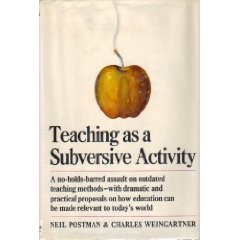
Postman and Weingartner put it this way in Teaching as a subversive activity:

In other words, you end up with a student-centered curriculum not because it is good for motivation but because you don’t, in fact, have any other choice.

References

Kelley, Earl C. (1947). Education for what is real. New York: Harper and Brothers.

Postman, Neil, & Weingartner, Charles (1969). Teaching as a subversive activity. New York: Dell.

TakingITGlobal – Inspire. Inform. Involve.

tigI heard Michael Furdyk from TakingITGlobal.org give a very interesting talk with slide show on Thursday. TakingITGlobal – Inspire. Inform. Involve. “is an online community that connects youth to find inspiration, access information, get involved, and take action in their local and global communities.”

It offers many of the features found on other social networking sites, but with a focus on social good and attention to the special needs of schools and youth leaders for protected spaces and appropriate content. Youth can share media they have produced as well as discuss projects around the world. They can participate in fully online communities or build an online community to support their face-to-face interactions. TakingITGlobal now works with 235,701 individual members and 1008 schools in 261 countries.

You can see a short CBC documentary about Michael and co-founder, Jennifer Corriero, here:

Hidden Her-story: The Top-Secret “Rosies” of World War II

leann_ericksonNorma Scagnoli referred me to a wonderful podcast by LeAnn Erickson, Associate Professor of Film and Media Arts at Temple University. Erickson is an independent video/filmmaker, whose work has appeared on public television, in galleries, and has won national and international awards.

Entitled, Hidden Her-story: The Top-Secret “Rosies” of World War II, it was recorded in January at the EDUCAUSE 2009 Mid-Atlantic Regional Conference in Philadelphia. I expected to listen for a minute and then go on to more pressing things, but after listening a little I decided that those things weren’t so pressing after all. It’s a fascinating story for anyone who has an interest in history, computers, women, education, mathematics, warfare, politics, Philadelphia, science, workplace equity, morality, or life in general.

In 1942, only months after the United States entered World War II, a secret military program was launched to recruit women to the war effort. But unlike recruiting “Rosie” to the factory, this search targeted female mathematicians who would become human “computers” for the U.S. Army. These women worked around-the-clock shifts creating ballistics tables that proved crucial to Allied victory. “Rosie” made the weapons, but the female computers made them accurate. When the first electronic computer (ENIAC) was invented to aid ballistic calculation efforts, six of these women were tapped to become its first programmers. “Top Secret ´Rosies’: The Female ‘Computers’ of WWII” is a documentary project currently in postproduction that will share this untold story of the women and technology that helped win a war and usher in the modern computer age.

Controls for the podcast appear beneath the description on the EDUCAUSE page.

Illini Summer Academies plans, 2009

isa_logoIllini Summer Academies is a three-day event providing Illinois teens opportunities to explore the University of Illinois campus, study potential careers, develop leadership skills, and meet with youth from across the state. One of the nine academies will be on Youth Community Informatics, in which youth will learn about GPS/GIS, video editing, and other digital communication tools as means for contributing to their own communities.

alumnicenterThe Academies are open to youth in grades 8-12. They take place from June 29-July 1 at the University of Illinois at Urbana-Champaign. Delegates live in college dormitories and tour the campus. Joint activities for all delegates offer opportunities to meet with those attending different academies and with youth from around the state. These include opening and closing sessions, activities every evening, and a formal banquet at the Alice Campbell Alumni Center.

The Illini Summer Academies are just one among many camps and activities for youth offered by the University of Illinois at Urbana-Champaign during 2009.

Why you should not run on the ice

humerusAre you one of the few people in the world who know enough to surf the web in order to read this blog post, but not enough to tread carefully on the ice?

If so, please note the small, line fracture of the humerus in the x-ray image on the left. That’s where the rotator cuff attaches. It’s reminded me every day for the past month why running on the ice is a bad idea.

What wealth is tangible?

"Where is the Wealth of Nations?"What wealth is tangible? “Tangible” means something you can see and touch, something real and substantial. When referring to nations, tangible assets include land, buildings, equipment, stocks, and cash. Assets such as culture, education, law, environment, and health are deemed to be “intangible” or even “invisible.” But in light of the recent collapse of world economic system, social justice and cultural/environmental well-being now appear as the far more tangible assets to me.

Various tools have been proposed to provide more complete and useful measures of wealth and productivity. Along this line, Sharon Irish recently shared what she’s learned about the American Human Development Project.

…a nonpartisan, non-profit initiative established to introduce to the United States a well-honed international approach and tool for measuring human well-being: the human development approach and the human development index. The project’s mission is to stimulate fact-based public debate about and political attention to human development issues in the United States and to empower people with an instrument to hold elected officials accountable for progress on issues we all care about: health, education and income.

via About the Project — Measure of America: American Human Development Project.

It reminds me of the World Bank’s report “Where is the Wealth of Nations?”, which shows that the generators of development are things like the rule of law and a good school system. It also explains why say, a Mexican migrant to the U.S. is five times more (economically) productive than one who stays home. See also Ronald Bailey’s commentary on the report.

Devising better tools is not easy. There are serious debates about how to factor in human capital, biodiversity, global warming, civil rights, arts, and other issues. But if anything good can come from the economic collapse, it might be a better understanding of what wealth we really do have versus that which is ephemeral. We might then realize that investing in children makes far more sense than investing in obscene bonuses for financial tycoons.

Digital literacy, what is it?

When in Dublin last year, Leo Casey, Abi Reynolds, and I led a little exercise on the question, “Digital literacy, what is it?” This simple activity led to surprisingly fruitful discussions, often extending more than an hour, although it never produced a consensus answer to the question.

We had found six definitions of digital literacy from leading organizations and then modified each of them a little so their source wasn’t easily identifiable. We then printed the modified definitions on A3 paper and hung them around the room. We asked participants to read them all, stand next to the one they agreed with the most, then discuss.

Every time we tried this, every definition had several strong advocates. One interesting phenomenon was that the Microsoft definition often drew the most supporters, which dismayed those who’d selected it. I don’t want to say more here, because I’d like people to experience the activity as our participants did. If you try it on your own, please cast your vote and justification through the comments (link above).

Here are the modified definitions we used:

  • the term multiliteracies highlights two related aspects of the increasing complexity of texts: (a) the proliferation of multimodal ways of making meaning where the written word is increasingly part and parcel of visual, audio, and spatial patterns; (b) the increasing salience of cultural and linguistic diversity characterized by local diversity and global connectedness 

  • basic computer concepts and skills so that people can use computer technology in everyday life to develop new social and economic opportunities for themselves, their families, and their communities
  • 
development of critical, socially engaged intelligence, which enables individuals to understand and participate effectively in the affairs of their community in a collaborative effort to achieve a common good 


  • the knowledge and ability to use computers and technology efficiently
  • the ability to recognize when information is needed and to locate, evaluate, and use effectively the needed information
  • a new liberal art that extends from knowing how to use computers and access information to critical reflection on the nature of information itself its technical infrastructure and its social, cultural, and philosophical context and impact

With coaxing, I’m willing to reveal the original definitions and sources.

Radoslav Lorković

radoslav11radoslav2We attended a wonderful concert at the Estabrooks’ house last Friday. Radoslav Lorković performed a wide variety of vocal and instrumental (piano and accordion) pieces, with a theme of life along the river.

His selections included songs by Tom Waits, Randy Newman, Joe Price, and George Gershwin, as well as many of Radoslav’s own compositions. I especially liked “Blues in C Minor” from his album, Clear and Cold and also a Croatian song about a fisherman mending his nets on the Dalmatian coast.

Drawing from a multitude of influences ranging from elegant classical and jazz styles to the rawest, most basic blues, country and soul, Radoslav Lorković has taken on an unusually broad musical spectrum and refined it into his distinctive piano style. His tenure on the R&B and folk circuits has culminated in five critically acclaimed solo recordings and numerous appearances on the recordings of and performances with artists including Odetta, Jimmy LaFave, Ribbon of Highway Woody Guthrie Tribute, Greg Brown, Richard Shindell, Ellis Paul, Dave Moore, Andy White and Bo Ramsey. His twenty year touring career has led him from the taverns of the upper Mississippi River to the castles of Italy, The Canary Islands, The Yup’ik villages of Alaska and Carnegie Hall.

radoslav31

via Radoslav Lorkovic – Personal Profile.

[photos by Leigh Estabrook]

Digital TV conversion

television

Digital TV conversion reminds me of Henry Wadsworth Longfellow’s poem:

There Was a Little Girl

There was a little girl,
Who had a little curl,
Right in the middle of her forehead.
When she was good,
She was very good indeed,
But when she was bad she was horrid

We’re in a very small minority of Americans who will today be banished from TV land, forced then to use our time productively, to spend time with friends and family, read books, play music, or engage in other ancient practices. We live about 280 yards outside of the city limits, so we’ve never been able to have cable TV. We have too many old oaks and hickories to get a clear line of sight on a satellite, and the combination of the trees and a concrete block house leaves us with poor broadcast reception. Between the trees, our raccoons and other creatures, we doubt that a roof antenna would work well or last long.

That leaves rabbit ears for through-the-air transmission. This works tolerably well for analog TV. Sometimes it works for digital as well. When it does, it is “very good indeed,” but more often it’s not just horrid, it’s non-existent. As I said, we may be the only household so cursed. When the great conversion comes, we’ll be exiled to the unknown land of “no TV.” I’ll make a youtube to tell you if we survive.

Simpliciter, the lobster boat

simpliciterSimpliciter, the lobster boat from Nova Scotia, arrived around 10:30 last night, carrying our good friends Brian and Gillian and their cat, Ra. It was not what we expected to appear in our wooded, inland lot.

Driving the enormous double cab pickup and boat, a 60-foot combination, up our long, curving driveway was an adventure, but it was even more fun backing it down the next day.

We had a wonderful, but all too brief visit with them. They’re heading south and west on a year-long leave, ready at any moment for a beckoning lake or coastline.

raladder