Why you should not run on the ice

humerusAre you one of the few people in the world who know enough to surf the web in order to read this blog post, but not enough to tread carefully on the ice?

If so, please note the small, line fracture of the humerus in the x-ray image on the left. That’s where the rotator cuff attaches. It’s reminded me every day for the past month why running on the ice is a bad idea.

What wealth is tangible?

"Where is the Wealth of Nations?"What wealth is tangible? “Tangible” means something you can see and touch, something real and substantial. When referring to nations, tangible assets include land, buildings, equipment, stocks, and cash. Assets such as culture, education, law, environment, and health are deemed to be “intangible” or even “invisible.” But in light of the recent collapse of world economic system, social justice and cultural/environmental well-being now appear as the far more tangible assets to me.

Various tools have been proposed to provide more complete and useful measures of wealth and productivity. Along this line, Sharon Irish recently shared what she’s learned about the American Human Development Project.

…a nonpartisan, non-profit initiative established to introduce to the United States a well-honed international approach and tool for measuring human well-being: the human development approach and the human development index. The project’s mission is to stimulate fact-based public debate about and political attention to human development issues in the United States and to empower people with an instrument to hold elected officials accountable for progress on issues we all care about: health, education and income.

via About the Project — Measure of America: American Human Development Project.

It reminds me of the World Bank’s report “Where is the Wealth of Nations?”, which shows that the generators of development are things like the rule of law and a good school system. It also explains why say, a Mexican migrant to the U.S. is five times more (economically) productive than one who stays home. See also Ronald Bailey’s commentary on the report.

Devising better tools is not easy. There are serious debates about how to factor in human capital, biodiversity, global warming, civil rights, arts, and other issues. But if anything good can come from the economic collapse, it might be a better understanding of what wealth we really do have versus that which is ephemeral. We might then realize that investing in children makes far more sense than investing in obscene bonuses for financial tycoons.

Digital literacy, what is it?

When in Dublin last year, Leo Casey, Abi Reynolds, and I led a little exercise on the question, “Digital literacy, what is it?” This simple activity led to surprisingly fruitful discussions, often extending more than an hour, although it never produced a consensus answer to the question.

We had found six definitions of digital literacy from leading organizations and then modified each of them a little so their source wasn’t easily identifiable. We then printed the modified definitions on A3 paper and hung them around the room. We asked participants to read them all, stand next to the one they agreed with the most, then discuss.

Every time we tried this, every definition had several strong advocates. One interesting phenomenon was that the Microsoft definition often drew the most supporters, which dismayed those who’d selected it. I don’t want to say more here, because I’d like people to experience the activity as our participants did. If you try it on your own, please cast your vote and justification through the comments (link above).

Here are the modified definitions we used:

  • the term multiliteracies highlights two related aspects of the increasing complexity of texts: (a) the proliferation of multimodal ways of making meaning where the written word is increasingly part and parcel of visual, audio, and spatial patterns; (b) the increasing salience of cultural and linguistic diversity characterized by local diversity and global connectedness 

  • basic computer concepts and skills so that people can use computer technology in everyday life to develop new social and economic opportunities for themselves, their families, and their communities
  • 
development of critical, socially engaged intelligence, which enables individuals to understand and participate effectively in the affairs of their community in a collaborative effort to achieve a common good 


  • the knowledge and ability to use computers and technology efficiently
  • the ability to recognize when information is needed and to locate, evaluate, and use effectively the needed information
  • a new liberal art that extends from knowing how to use computers and access information to critical reflection on the nature of information itself its technical infrastructure and its social, cultural, and philosophical context and impact

With coaxing, I’m willing to reveal the original definitions and sources.

Radoslav Lorković

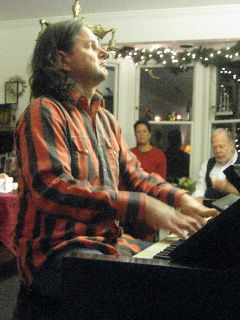
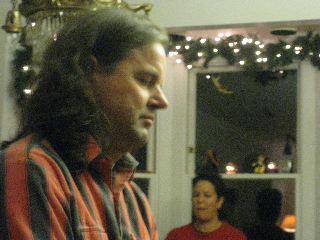
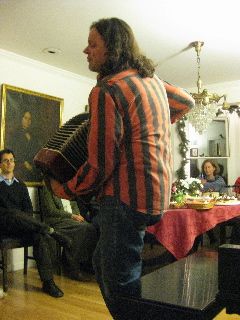
radoslav11radoslav2We attended a wonderful concert at the Estabrooks’ house last Friday. Radoslav Lorković performed a wide variety of vocal and instrumental (piano and accordion) pieces, with a theme of life along the river.

His selections included songs by Tom Waits, Randy Newman, Joe Price, and George Gershwin, as well as many of Radoslav’s own compositions. I especially liked “Blues in C Minor” from his album, Clear and Cold and also a Croatian song about a fisherman mending his nets on the Dalmatian coast.

Drawing from a multitude of influences ranging from elegant classical and jazz styles to the rawest, most basic blues, country and soul, Radoslav Lorković has taken on an unusually broad musical spectrum and refined it into his distinctive piano style. His tenure on the R&B and folk circuits has culminated in five critically acclaimed solo recordings and numerous appearances on the recordings of and performances with artists including Odetta, Jimmy LaFave, Ribbon of Highway Woody Guthrie Tribute, Greg Brown, Richard Shindell, Ellis Paul, Dave Moore, Andy White and Bo Ramsey. His twenty year touring career has led him from the taverns of the upper Mississippi River to the castles of Italy, The Canary Islands, The Yup’ik villages of Alaska and Carnegie Hall.

radoslav31

via Radoslav Lorkovic – Personal Profile.

[photos by Leigh Estabrook]

Digital TV conversion

television

Digital TV conversion reminds me of Henry Wadsworth Longfellow’s poem:

There Was a Little Girl

There was a little girl,
Who had a little curl,
Right in the middle of her forehead.
When she was good,
She was very good indeed,
But when she was bad she was horrid

We’re in a very small minority of Americans who will today be banished from TV land, forced then to use our time productively, to spend time with friends and family, read books, play music, or engage in other ancient practices. We live about 280 yards outside of the city limits, so we’ve never been able to have cable TV. We have too many old oaks and hickories to get a clear line of sight on a satellite, and the combination of the trees and a concrete block house leaves us with poor broadcast reception. Between the trees, our raccoons and other creatures, we doubt that a roof antenna would work well or last long.

That leaves rabbit ears for through-the-air transmission. This works tolerably well for analog TV. Sometimes it works for digital as well. When it does, it is “very good indeed,” but more often it’s not just horrid, it’s non-existent. As I said, we may be the only household so cursed. When the great conversion comes, we’ll be exiled to the unknown land of “no TV.” I’ll make a youtube to tell you if we survive.

Simpliciter, the lobster boat

simpliciterSimpliciter, the lobster boat from Nova Scotia, arrived around 10:30 last night, carrying our good friends Brian and Gillian and their cat, Ra. It was not what we expected to appear in our wooded, inland lot.

Driving the enormous double cab pickup and boat, a 60-foot combination, up our long, curving driveway was an adventure, but it was even more fun backing it down the next day.

We had a wonderful, but all too brief visit with them. They’re heading south and west on a year-long leave, ready at any moment for a beckoning lake or coastline.

raladder

Grandeur in this view of life

Darwin bustCharles Darwin was born 200 years ago today. In November this year it will be 150 years since he published On the origin of species.

Although others talked about evolution and natural selection before he did, his work was what made the ideas enter our collective consciousness, changing forever our views of science and life. Aside from his detailed scientific work to reveal the workings of natural laws, Darwin was able to write in an engaging way. What’s most evident in those writings is that he revered life, yet saw in death the possibilities for renewal.

The last paragraph of On the origin of species is worth quoting again on this, his birthday:

It is interesting to contemplate an entangled bank, clothed with many plants of many kinds, with birds singing on the bushes, with various insects flitting about, and with worms crawling through the damp earth, and to reflect that these elaborately constructed forms, so different from each other, and dependent on each other in so complex a manner, have all been produced by laws acting around us…

Thus, from the war of nature, from famine and death, the most exalted object which we are capable of conceiving, namely, the production of the higher animals, directly follows. There is grandeur in this view of life, with its several powers, having been originally breathed into a few forms or into one; and that, whilst this planet has gone cycling on according to the fixed law of gravity, from so simple a beginning endless forms most beautiful and most wonderful have been, and are being, evolved.

See the references for interesting stories about Darwin and the evolution of his own ideas and texts.

References

Darwin, Charles R. (1859). On the origin of species. Various publishers and editions; the link here and the quote are for the 1st edition, in Project Gutenberg.

Krulwich, Robert (2009, February 12, ). Death of child may have influenced Darwin’s work. NPR Morning Edition. speaker

Urbanowicz, Charles F. (2002). There is a grandeur In this view of life. In Amanda Chesworth et al. (eds.), Darwin Day collection one: The best single idea ever. Albuquerque, New Mexico: Tangled Bank. See also the full version: On Darwin: Countdown to 2008 / 2009!

Why I dislike “service learning”

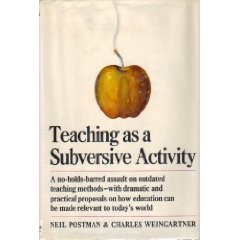
451Learn and Serve America’s National Service-Learning Clearinghouse (NSLC) defines service learning as

a teaching and learning strategy that integrates meaningful community service with instruction and reflection to enrich the learning experience, teach civic responsibility, and strengthen communities.

At its best, service learning is an integrated approach in which students are engaged with the actual life of the community around them; they learn to act in socially responsible ways; their learning has value beyond themselves; and it’s relevant to their own experiences and future. A full service learning approach involves two-way learning, in which students and community members learn from one another, recognizing that each has important resources to share.

This is in contrast to standard learning, that which we usually see in classrooms. We call that “learning,” which suggests that it’s the norm, the ordinary, the unhyphenated, the unmarked. It’s considered to be real learning, unlike the specialized, add-on, extraordinary models such as “service learning.”

But here’s my problem, and why I dislike the term “service learning”: Why do we think that learning connected to life is the marked case? Why do we give it the special designation? Why is the usual approach considered the standard?

I propose that what has up until now been called “learning,” the activity we see so often in classrooms, henceforth be called “disconnected, irrelevant, irresponsible, minimal-value learning.” Accordingly, we drop the term “service learning.” Instead, it is just “learning”; the norm is then learning that is integrated, relevant, responsible, and serves the needs of both the learner and the society.

References

Roy, Loriene, Jensen, Kelly, & Meyers, Alex Hershey (2009). Service learning : linking library education and practice. Chicago : American Library Association, 2009.

Obama upholds discrimination

Equal rights are not special rightsBarack Obama is on track to become not just a good, but one of the great US Presidents. But yesterday he made a big mistake.

Obama let stand Bush’s executive order allowing religious organizations to discriminate in hiring on the basis of faith and still receive federal funding. Discrimination on the basis of religion is a direct violation of the First Amendment. And because many faith-based organizations are 100% of one race and one language, have prescribed roles for men and women, and often exclude homosexuals and others who don’t fit their doctrines, this order means that invidious discrimination supported by everyone’s tax dollars is now enshrined in Federal policy. The Constitution protects everyone’s right to associate with those they choose, but it also forbids unequal treatment under the law.

Obama had rightly questioned this policy during the campaign, saying “if you get a federal grant, you can’t use that grant money to proselytize to the people you help and you can’t discriminate against them–or against the people you hire–on the basis of their religion.”

He was right then and wrong yesterday.

See Obama upholds Bush faith policy – Los Angeles Times.

Exploration kits

Martin Wolske has written, in Technology is NOT the focus:

we need to be developing community technology centers (CTC) differently. Right now, they are developed with the idea that people are coming to the CTC for the technology. As such, traditional desktop or tower cases and larger LCD monitors dominate. Maybe the CTC of the future instead needs to be a place with lots of tables and chairs that can easily be rearranged, and laptops for checkout.

One step in that direction is to think of a CTC as a community media lab (CML). The focus then is on the community and communication, not technology. A CML is an excellent way to promote and learn about digital media use. It also provides a venue for people from a variety of organizations and with diverse technological interests to work together.

logitech-backpackHow about complementing the CML with exploration kits? These would be available to individual youth, or to organizations such as community centers, after-school programs, boys and girls clubs, 4-H, and so on. They would allow youth to take tools into many different settings, thus promoting ubiquitous learning.

Lisa Bouillion-Diaz from Extension has suggested that the kit might take the form of a backpack, which could be easily transported. It might contain things such as:

  • GPS receiver
  • camera
  • video camera
  • audio recording equipment if higher quality is needed than on the cameras
  • physical maps, images, texts, …
  • activity guides to support community mapping, journalism, history, …
  • hands-on STEM learning objects, such as magnifying glass, weights, compass, magnets, …
  • possible: distant measuring tool (electronic or mechanical), temperature probes, motion sensor

All of this would be linked with a website, showing how to make your own kit or to modify the standard one(s) for specific purposes or groups. What else might go into such a kit?

I see kits as intermediate between the indigenous media experiences youth have through mobile phones, Facebook, video games, etc. and the formal learning that occurs (or not) in classrooms. We’re working on them for the Youth Community Informatics project, but their scope could be expanded to include learners of all ages.