Fences or webs?

old-new schools

In my last post I talked about the Eight-Year-Study, which documented the success of progressive education at fostering intellectual curiosity, cultural awareness, practical skills, a philosophy of life, a strong moral character, emotional balance, social fitness, sensitivity to social problems, and physical fitness.

I had come across materials related to the study in the Progressive Education Association Records in the University of Illinois Archives. This is a treasure-trove, not only of the Progressive Education Association per se, but also of the various social movements they were involved in. I hope to explore it more.

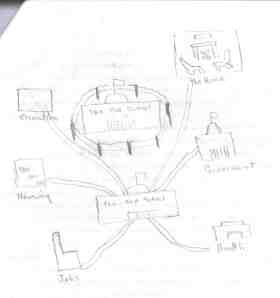
One drawing I found is shown here. It’s included in the folder for the booklet that later appeared as Dare our secondary schools face the atomic age? However, there are no images in that booklet. The drawing shows two visions for schools. In one, the “old school,” there is a fence surrounding the building; activities of the school are separate from those of the world around it, and as a result, schooling is separated from the actual life of the children.

In a second vision, the “new school,” the building is substantially the same, but it is connected to sites for recreation, housing, jobs, health, government, and by implication, all aspects of life. This idea of community-based schools was key to the Progressive Education movement, especially in its later years, as members realized they needed to do more than promote child-centered learning in an individual sense. That was true for “community schools” per se (Clapp, 1939), but actually for all schools, urban or rural, large or small, primary or secondary.

Today, many of these ideas have survived under rubrics such as “civic engagement,” “public engagement,” “community-based learning,” or “service learning.” But often those ideas are seen as one-way or very limited in scope, as in a single course. It’s worth revisiting the earlier visions to understand better how schools and universities could better fulfill the high hopes we place upon them.

References

Benedict, Agnes E. (1947). Dare our secondary schools face the atomic age?. New York: Hinds, Hayden & Eldredge.

Benedict, Agnes E. (1947). Pencil drawing, Progressive Education Association Records, 1924-1961, Record Series 10/6/20, Box 4, folder Dare the Schools Face the Atomic Age?, University of Illinois Archives.

Clapp, Elsie Ripley (1939). Community schools in action. New York: Viking.

Must we obsess about student test scores?

For too long, US education policies have defined progress in terms of student test scores, while ignoring the things that really matter. We’ve operated on the misguided belief that “learning the basics” is best accomplished by a narrow skills focus and micro-management of test scores.

This occurs despite the fact that few of us would be satisfied if our children could successfully answer multiple-choice questions, but failed to develop intellectual curiosity, cultural awareness, practical skills, a philosophy of life, a strong moral character, emotional balance, social fitness, sensitivity to social problems, or physical fitness. What a tragedy then, if the focus on skills per se (as with the failed No Child Left Behind Act) were not even necessary. What if one could help the whole child develop, including teaching basic skills? What if our current irrational obsession with testing actually stood in the way of the things we truly value?

Benedict, Schools face the atomic age?The start of a new administration in Washington is a good time to ask whether we have the schools we need. Above all, it’s not a time to seek ever-more efficient means to produce incremental gains in test scores.

We have an alternative to that in our own history. One of the best program evaluation studies ever conducted was the Eight-Year Study, research conducted between 1932 to 1940 by the Progressive Education Association (PEA). Thirty high schools participated. Instead of narrowly-defined subjects, there were broad themes of significance to the students. “The starting point of the curriculum would be life as the student saw it” (Benedict, 1947, p. 14). Moreover, the schools were community-based. “The schools believed they belonged to the citizens of the community” (ibid, p. 17).
Continue reading

David Bergman’s 1,474-megapixel photo of Obama’s inauguration

David Bergman made an amazing 1,474-megapixel panoramic photo during President Obama’s inaugural address. The detail in the image is impressive; Bergman describes how he found Yo-Yo Ma taking a picture with his iPhone.

The photo is a valuable record of the historic event as well as a technological/artistic tour de force. You can explore the photo itself online and read about how he did it on his blog.

CNN has another photosynth version of this based on photos sent in by diverse individuals at the event:

Copernicus and Erasmus

genealogy1The Mathematics Genealogy Project and its cousins, the AI [artificial intelligence] Genealogy Project, and the Philosophy Family Tree are attempts to compile information about scholars in various fields, including where they received their degrees and the titles of their dissertations. The information is organized in an academic family tree, in which one’s adviser is one’s parent.

Here’s the mission statement for the Mathematics Genealogy Project:

The intent of this project is to compile information about ALL the mathematicians of the world. We earnestly solicit information from all schools who participate in the development of research level mathematics and from all individuals who may know desired information.

Please notice: Throughout this project when we use the word “mathematics” or “mathematician” we mean that word in a very inclusive sense. Thus, all relevant data from statistics, computer science, or operations research is welcome.

I’m actually in all three of these trees. My PhD is in Computer Sciences, specifically in AI; the core of the dissertation is in mathematical logic; and my adviser, Norman Martin, was a philosopher. His work was in the area of logic, as was that of a committee member, Michael Richter, a mathematician.

One of the best Christmas presents I received was a depiction of this tree made by Emily and Stephen (above, click to enlarge). There is so much detail, that you need to see the full-scale poster to read it all, but you may be able to make out the names of my adviser, and co-adviser, Robert F. Simmons, as well as early ancestors, Copernicus and Erasmus. It’s fun to explore the connections, which ultimately show how interconnected we all are.

Today’s Front Pages: Newseum’s map of newspapers around the globe

The Newseum, at Pennsylvania Avenue and Sixth Street, NW, Washington, DC has a great, online map linking to front pages of newspapers around the globe. If you place the cursor on a city, you can see the front page in miniature; click, and it pops up in full, with a link to the newspaper website. You can also view the newspapers in Gallery or List mode. Currently, more than 575 newspapers from around the world submit their front pages to the Newseum.

Stay hungry. Stay foolish.

On June 12, 2005, Steve Jobs, CEO of both Apple Computer and Pixar Animation Studios, delivered the Stanford Commencement address on the theme of “You’ve got to find what you love.” You can see both the text and the video of the address below. It’s an excellent talk in its own right, but I thought it gave a good account of inquiry-based learning as well.

In the first part of his address, Jobs talks about dropping out of college, then taking a class in calligraphy, not because it was required, but simply because it was “beautiful, historical, artistically subtle.” He didn’t envision it as preparation for the future, but as something that had deep meaning in the present. Later, his study of calligraphy bore fruit in the design of the first Macintosh computer. As Jobs says, “you can’t connect the dots looking forward; you can only connect them looking backwards. So you have to trust that the dots will somehow connect in your future.” This is closely akin to a key element of inquiry-based learning, captured in Dewey’s famous statement that “only by extracting at each present time the full meaning of each present experience are we prepared for doing the same thing in the future.” Continue reading

Why I came to library and information science

My academic career includes degrees in biology and computer science, teaching computer science in two universities, research in a high-tech, R&D firm, teaching in a college of education, and teaching now in a school of library and information science. My dissertation adviser was in philosophy, and the dissertation itself was in mathematical logic and artificial intelligence. I’ve published in a variety of journals, including those in other fields. People have often asked: Is there any rationale for this? Were you just booted from one place to another?

I could give a practical account of why I moved to a library and information science school nine years ago, but that wouldn’t explain how I think of the field and what led me to that decision. To do that, I need to start a bit earlier…

chip54

Chip in Fort Worth, 1954

When I was three years old, I enrolled along with four other children in the Frisky and Blossom Club held at the Fort Worth Children’s Museum (now the Fort Worth Museum of Science and History). Frisky and Blossom were de-scented skunks who lived in the old house that was the Museum then. The club evolved into the Museum School, the largest in the US, with over 200,000 alums. I stayed with the school, learning about plants and animals, astronomy, history, and many other topics. Most importantly, I learned how energizing learning could be when it’s connected to what we care about and how it can grow out of things in the world around us.

That interest in informal learning bolstered by museums and libraries, continued. When I was eight years old, I never missed the bookmobile when it came by our neighborhood. I was a collector of insects, sea shells, postage stamps, books, and all sorts of other things. But reading and writing were the most important means for expanding my world. It’s sad to say, but little of this occurred for me in school, which often felt like some unjustified punishment. I learned arithmetic from card and board games outside of school, but also by counting the minutes until the end of the class, the school day, or the school year. Science was as much through a chemistry set and nature study as through classes. And so on.

These experiences led me to value inquiry-based learning. They also made it harder for me to understand knowledge as confined within static categories. When I applied to college, I considered majoring in history, geology, biology, and English, but later thought philosophy or behavioral sciences might be better. For graduate school, I chose computer sciences, not because I was so enamored of the machine, but because the field appeared the be the closest to offering a general tool for interdisciplinary inquiry. My work in artificial intelligence emphasized computer natural language understanding and reasoning. That led in a more direct way than might appear at first into education. Fortunately, working on projects such as a statistics curriculum and software for high school students, or Quill, a program for reading and writing, allowed me to create learning environments that were more integrated and connected to the life of students, something I had missed to a large extent in my own schooling.

Later, I brought those experiences to a college of education. I found many opportunities to expand on those experiences. But I also found that the means of formal schooling were sometimes disconnected from the ends I valued. The emphases on measurable learning objectives and teacher credentialing often crowded out discourse on the changing nature of literacy or the connection of learning and life. Because my work involves collaborations with those in other disciplines, I saw space for those ideas in other realms, such as writing studies, communication, occasionally in the sciences, and especially, in library and information science.

me

Chip in Dublin, 2007

As I worked with people in library and information science, I found a serious engagement with issues such as the moral and political aspects of texts and information systems, changes to literacy practices related to new technologies and globalization, distributed knowledge making, information for community needs, and new ways of organizing and providing access to information. Although not all of my colleagues would characterize it this way, I see issues of learning threaded through everything we do. Learning is the creative act of meaning making that occurs in praxis, the integration of theory and practice. More than any other discipline, library and information science provides the space to engage with that phenomenon. It brings together the informed and critical understanding of texts and information systems with serious attention to the impact on human life.

There are many other reasons I might add for my joining GSLIS per se–the high level of collegiality, the moral commitment, the respect for both the old and the new, and the sincere interest in and openness to continuing to learn. These things make coming to library and information science seem wise, in spite of myself and my meandering path.

Teaching as bringing to life

During the time of the semester when grades are due, it’s difficult to ignore the aspects of the teaching job that involve judging, ranking, sorting, and critiquing in the sense of finding and documenting fault. But these aspects have little to do with teaching, and usually stand in the way. When one is learning, it can be helpful to know where one has gone wrong, but more often the wrong is painfully obvious and what we need even more is to know what of our fragile attempts can be brought to life. For that, we need critique in another sense, one that’s a friend to the new, brings ideas to life, and makes quality vivid.

Anton Ego, Michel Foucault, and Elliot Eisner speak to this issue:

We critics risk very little, yet enjoy a position over those who offer up their work and themselves to our judgment. We thrive on negative criticism for it’s fun to write and to read. But the bitter truth we critics must face is that in the grand scheme of things, the average piece of junk is probably more meaningful than our criticism designating it so. But there are times when a critic truly risks something, and that is in the discovery and defense of the new. The world is often unkind to new talent, new creations. The new needs friends. –the critic, Anton Ego, Disney/Pixar movie Ratatouille


I can’t help but dream about a kind of criticism that would not try to judge, but bring an oeuvre, a book, a sentence, an idea to life; it would light fires, watch the grass grow, listen to the wind, and catch the sea-foam in the breeze and scatter it. It would multiply, not judgments, but signs of existence; it would summon them, drag them from their sleep. Perhaps it would invent them sometimes – all the better. All the better. Criticism that hands down sentences sends me to sleep; I’d like a criticism of scintillating leaps of imagination. It would not be sovereign or dressed in red. It would bear the lightning of possible storms.–Michel Foucault

If connoisseurship is the art of appreciation, criticism is the art of disclosure. Criticism, as Dewey pointed out in Art as Experience, has at is end the re-education of perception… The task of the critic is to help us to see. Thus…connoisseurship provides criticism with its subject matter. Connoisseurship is private, but criticism is public. Connoisseurs simply need to appreciate what they encounter. Critics, however, must render these qualities vivid by the artful use of critical disclosure. –Elliot Eisner, 1985, pp. 92-93

References

Eisner, Elliot W. (1985). The art of educational evaluation: a personal view. London: Falmer.

Foucault, Michel (1980, April). The masked philosopher. Le Monde, interview by Christian Delacampagne.

Smith, Mark K. (2005). Elliot W. Eisner, connoisseurship, criticism and the art of education. The encyclopaedia of informal education.

Stake, Robert E., & Schwandt, Thomas (2006). On discerning quality in evaluation. In Ian Shaw, Jennifer C. Greene, & Melvin M. Mark (eds.), Handbook of evaluation: Policies, programs and practices. Sage.

Appropriating technologies: Nets for fish or for mosquitoes?

Appropriating TechnologiesThe notion of “appropriate technologies” is familiar; it’s similar to saying we should use the right tool for the job. In developing countries, this usually implies that we should find tools that fit with the local culture, knowledge base, environment, and existing technologies, for example, donkeys might work better than automobiles when the roads are in poor condition or non-existent.

There’s a related idea, in which the user is not just a passive recipient of some technology, but an active (re-)creator of it. People can actively appropriate technologies, interpret, use, and even re-design them to fit their needs. An excellent example of this is the alternate uses people have found for insecticide-treated nets:

Insecticide-treated nets (ITNs) are a simple, cost-effective way to fight malaria and are distributed to pregnant women and children in Kenya, often for free. But when Noboru Minakawa of the Institute of Tropical Medicine in Nagasaki, Japan, and colleagues surveyed villages along Lake Victoria, they found people were using the nets for fishing or drying fish, because the fish dry faster in the nets than on papyrus sheets, and the nets are cheaper (Malaria Journal, DOI: 10.1186/1475-2875-7-165).

In Zambia too, ITNs are being used for fishing, straining fruit and even for wedding dresses, says Todd Jennings of non-profit health group PATH in the capital Lusaka. “An ITN in the water is one not hanging in the fisherman’s home protecting his children,” he says.

It would be tragic if these uses of the nets mean that children are unprotected. Can we imagine a day come when people are not forced to choose between providing food and preventing disease?

References

Bruce, B. C., & Rubin, A. D. (1993). Electronic Quills: A situated evaluation of using computers for writing in classrooms. Hillsdale, NJ: Lawrence Erlbaum. See especially Chapter 9.

Eglash, Ron, Croissant, Jennifer L., Di Chiro, Giovanna, & Fouché, Rayvon (Eds.) (2004). Appropriating technology: Vernacular science and social power. Minneapolis: University of Minnesota Press.

New Scientist (2008, December 23). Malaria bed nets’ usefulness is their downfall..

The hidden race war after Katrina

when_the_levees_brokeRebecca Solnit describes her discovery of the Katrina shootings in a recent Mother Jones article and audio interview. She points out that the hidden race war was never really hidden, but it was conveniently ignored, even today, despite Spike Lee’s award-winning documentary and excellent investigative reports, such as as A. C. Thompson’s in The Nation. I suspect the story would still surprise many people and challenge their image of the Katrina aftermath. It should also cause all of us to become more critical of media reports and our own reactions to those:

While the national and international media were working themselves and much of the public into a frenzy about imaginary hordes of murderers, rapists, snipers, marauders, and general rampagers among the stranded crowds of mostly poor, mostly black people in New Orleans during Hurricane Katrina, a group of white men went on a shooting spree across the river.

Their criminal acts were no secret but they never became part of the official story. The media demonized the city’s black population for crimes that turned out not to have happened, and the retractions were, as always, too little too late. At one point FEMA sent a refrigerated 18-wheeler to pick up what a colonel in the National Guard expected to be 200 bodies in New Orleans’s Superdome, only to find six, including four who died naturally and a suicide. Meanwhile, the media never paid attention to the real rampage that took place openly across the river, even though there were corpses lying in unflooded streets and testimony everywhere you looked—or I looked, anyway.

The widely reported violent crimes in the Superdome turned out to be little more than hysterical rumor, but they painted African-Americans as out-of-control savages at a critical moment. The result was to shift institutional responses from disaster relief to law enforcement, a decision that resulted in further deaths among the thirsty, hot, stranded multitude. Governor Kathleen Blanco announced, “I have one message for these hoodlums: These troops know how to shoot and kill, and they are more than willing to do so if necessary, and I expect they will.” So would the white vigilantes, and though their exact body count remains unknown, at least 11 black men were apparently shot, some fatally.

In his excellent report, A. C. Thompson presents a frightening and dismaying picture of the response in Algiers Point:

Facing an influx of refugees, the residents of Algiers Point could have pulled together food, water and medical supplies for the flood victims. Instead, a group of white residents, convinced that crime would arrive with the human exodus, sought to seal off the area, blocking the roads in and out of the neighborhood by dragging lumber and downed trees into the streets. They stockpiled handguns, assault rifles, shotguns and at least one Uzi and began patrolling the streets in pickup trucks and SUVs. The newly formed militia, a loose band of about fifteen to thirty residents, most of them men, all of them white, was looking for thieves, outlaws or, as one member put it, anyone who simply “didn’t belong.”

References

Lee, Spike (2006). When the levees broke: A requiem in four acts. [TV mini-series].

Solnit, Rebecca (2008, December 22). The grinning skull: The homicides you didn’t hear about in Hurricane Katrina. Mother Jones. Audio interview

Solnit, Rebecca (in press). A paradise built in Hell.

Thompson, A. C. (2008, December 17). Katrina’s hidden race war. The Nation.