Daniel Dejean, cartoonist extraordinaire

Daniel Dejean

Daniel Dejean

Daniel Dejean, a Wellfleet artist, is best known for his acrylic or oil paintings. These have been shown in galleries around Cape Cod and exhibited at a wide array of venues over 25 years, including recently at the Éspace Croix Baragnon in Toulouse and the Galerie Charlotte Norberg in Paris. See http://www.danieldejean.com and below.

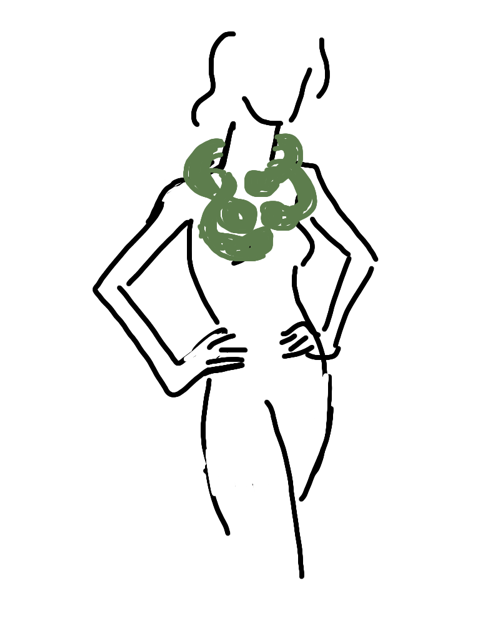
Squash fashion

Squash fashion

Daniel’s paintings are often stunning, and always interesting. Like the best contemporary conceptual art, they invoke inversions of our usual ways of thinking. But whereas that art is sometimes thin to the point of obviousness, Daniel’s paintings are rich and generative. They invite repeated viewing and study.

One might instead think of the traditional style of art prevalent in Cape Cod galleries–seascapes and boats, wildflowers and ponds, portraits and houses. Daniel’s work then appears anarchic, conversing in some of the same language, but with an exotic dialect and a unsettling vocabulary.

New directions

Mozart on a snowy evening

Mozart on a snowy evening


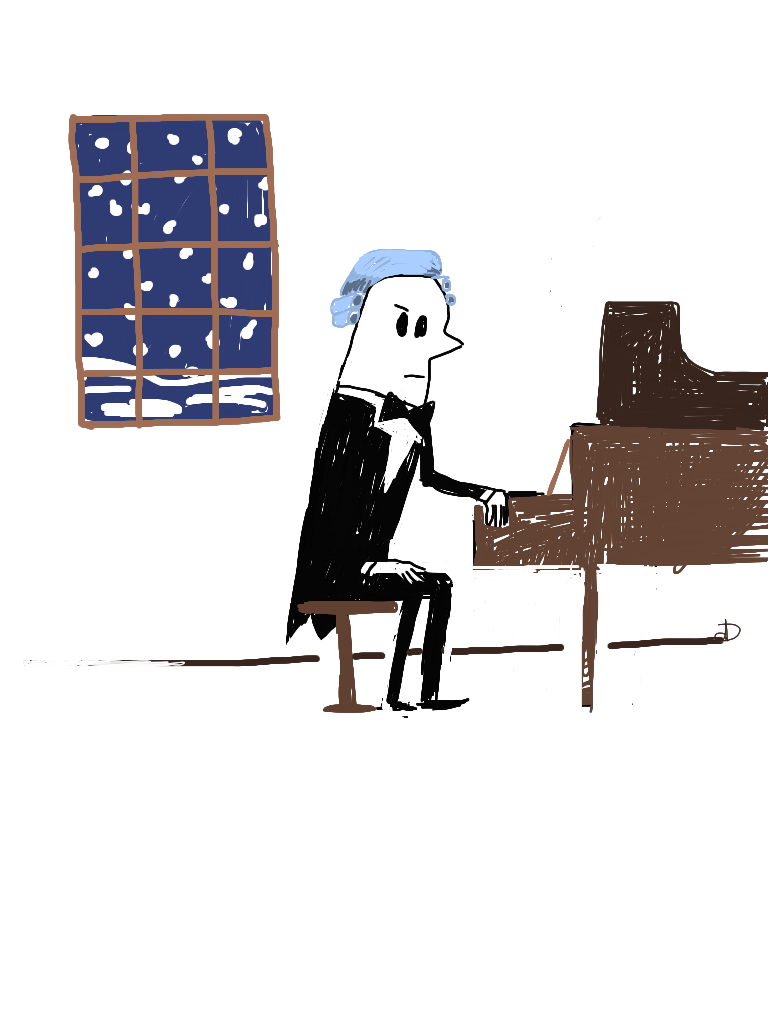
Daniel’s artistry has recently expanded into what appears to be a new and growing venture, cartooning. I first became aware of this when his tromboncino cartoons, such as “Squash fashion” (above), began spreading uncontrollably across the ether. Whatever the topic, DeJean cartoons began to capture the essence of what was happening, bringing together humor, critique, and insight. I especially like his “Mozart on a snowy evening,” but also a new one about the major sport on Cape Cod this winter.

Skiing on the backside

Skiing on the backside

Some of Daniel’s graphic art has assumed a programmatic direction. For example, Women Directors: Navigating The Hollywood Boys’ Club, developed by Maria Giese and Heidi Honeycutt, is a website for people to share experiences with discrimination and explore strategies to create gender equity among directors of film, television and new media. It is “the world’s foremost website to explore, expose and remedy discrimination against women directors – because global culture depends on who tells the stories.” Daniel has created a wonderful series of graphic representations that tell the story in a succinct and memorable way.

Where are the women directors?

Where are the women directors?

Women directors: The coming tsunami

Women directors: The coming tsunami

Restoring the Chestnut

The Chestnut canoe company of Fredericton, New Brunswick, was a preeminent producer of wood and canvas canoes. Teddy Roosevelt purchased their canoes for his South American expedition. Before aluminum, fiberglass, ABS, Kevlar, and other synthetic materials, Chestnut used wood to make canoes for every purpose.

Around 1954, they produced a green Prospector Garry, serial number CHN47317M75J, 8770HF. I don’t know all the waters that boat traveled, but somehow it wound up as a display item at Wilderness House, an outfitter on Commonwealth Avenue in Boston. Hanging from the rafters as a signature trophy was some kind of honor, I suppose.

However, Prospectors were canoes made to be used–for work and expeditions. They had no keel, high gunwales, and wide ribs and other features to make them whitewater capable. They could carry a half ton of people and cargo. Unlike canoes made from most of the new materials, wood-and-canvas canoes are infinitely varied, beautiful, quiet, repairable, and sensual.

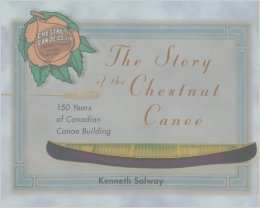
The Story of the Chestnut Canoe

The Story of the Chestnut Canoe

Three decades after it was made, my friend Brian Smith called from Wilderness House. He said that WH had decided to sell the Prospector and that he was waiting in line to buy it for me. There was a clear assumption that I would come up with the cash. His action was simply to make sure I didn’t lose the opportunity, not a major gift. And Brian already had a Chestnut himself. So, shortly before Emily and Stephen were born I adopted a 30 year-old canoe.

It’s an oxymoron today to say “whitewater, wood-and-canvas canoe.” But before the 1950s, wood-and-canvas was the material of choice. We took this particular canoe on some rough waters, including the Oxtongue River in Ontario, although to be honest, we didn’t run Ragged Falls.

The canoe performed well in every setting, in salt water, ponds, and rivers; in wind and rain, carrying four people or one. But like everything it aged. There were some small dings from expeditions; the paint faded and peeled; the canvas sagged; some gunwales had separated; and two ribs broke, probably during our move to Massachusetts. It was time for a makeover, for what was now a 60 year-old canoe.

Walter Baron, a neighbor and expert boat builder, agreed to take on the task. In the photos below you can see some steps in the process. Walter removed the canvas and stripped the inside.

I asked him to add a beautiful new portage yoke I purchased from Essex Industries in New York. Essex is a sheltered workshop, which unfortunately is facing difficult times. It seems to be one of the success stories for that type of facility.

Today, we took final delivery on the rejuvenated and now, brick red, Chestnut Prospector. I wanted to try it out, even in the cold, but the local ponds are covered in 14″ of ice. So it now hangs in our garage. much as it did at WH, but knowing that its true destiny is to be loaded with gear, carrying its passengers silently and safely wherever their adventure leads them.

This slideshow requires JavaScript.

The Chestnut family started marketing canvas canoes in the late 1890′s in Fredericton, New Brunswick. The early Chestnut canoes were modeled after a canoe built by B. N. Morris, and indeed, these early canoes clearly show the influence of Morris canoes. . . The Chestnut factory burned down in December of 1921, and was quickly rebuilt. Chestnut Canoe Company and Peterborough Canoe Company merged under the holding company Canadian Watercraft Limited. Canadian Canoe Company joined them in 1927. . . Chestnut shipped its last canoes in early 1979, then closed. Most of the Chestnut molds survive, and are being used in several wooden canoe shops in Canada. For more details about the history of the Chestnut Canoe Company, see Roger MacGregor’s book When the Chestnut was in Flower. via Chestnut Canoe Company.

Frozen

“The snow glows white on the mountain tonight.”

We and all our neighbors have given up on seeing an end to this winter. The mail is no longer delivered because the mailbox is encased somewhere within a large snowbank, well packed by the city snowplow. We know that the days are few until everything will be covered in snow and ice. We resist through cross-country skiing, sledding, or sculpting snow, but we know that those efforts are futile.

Most of the garden plants are deeply buried, but an hydrangea pokes its branches up only to be ice wrapped. What we used to call the front entrance has become a pile of snow. The propane tank is hardly uncovered and accessible as the supplier requires, but our iron sculpture marks where we remember it being. The deck looks like a comfy pillow, rather than a site for cook-outs.

One massive icicle comes off the back roof, drops down eight feet to connect with an ice-encased iron fish, then continues three feet below the deck. It must weigh over 50 pounds.


Canoe sculpture

Monochrome for Austin, Nancy Rubins

Monochrome for Austin, Nancy Rubins

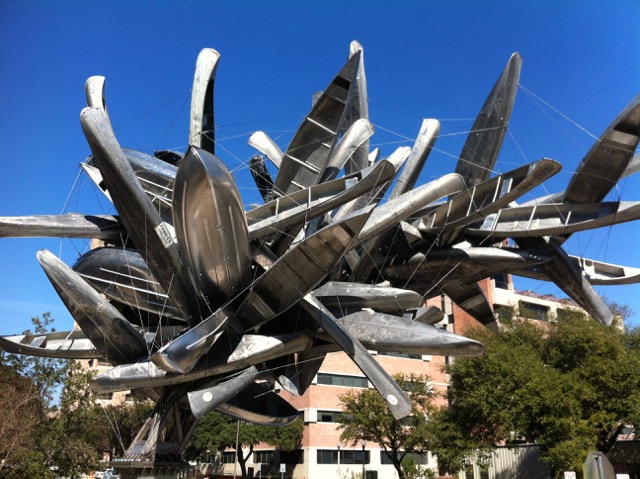
While we were in Austin last week we saw a dramatic 50-foot diameter structure composed of roughly 75 canoes and a few rowboats jutting out at various angles. The boats are suspended from a steel framework by cables, with a design claimed to withstand Austin’s winds.

Some of the boats are damaged boats donated by canoe rental companies, still showing their logos. I tried to imagine the rapids that could lead to such a massive, beautiful disaster. The structure represents the far end of a spectrum that has my wood and canvas canoe quietly plying a Wellfleet pond at the other end.

A few students, assuming that the sculpture was funded through tuition, started a change.org petition asking the University to return their tuition money.

Unveiled on January 17, the canoe nest is the newest piece in the Landmarks collection, the University’s public art program. It sits in front of the Hackerman Building at the corner of Speedway and 24th Street. Eventually it will be part of a larger outdoor art project stretching a half dozen blocks along Speedway, with a pedestrian walkway.

New 50-foot-tall sculpture makes waves on campus | The Daily Texan.

Scleral lenses

Scleral and corneal RGP lenses

Scleral and corneal RGP lenses

It’s not a serious health problem, but it has been annoying. About eight months ago I injured my left cornea, down to the limbal stem layer, which ordinarily can regenerate the rest. It was slow to heal because of a variety of conditions whose very existence or the treatment of interacted in unfortunate ways.1

There was a little pain, poor vision, and light sensitivity. I couldn’t wear the contact lenses that were the only way to correct my vision and had trouble finding a glaucoma treatment that my eye could tolerate. During this time, I had many appointments with various specialists, and tried a variety of topical medications and an oral one that made me ill.

Scleral lens in my eye

Scleral lens in my eye

But now, a solution is in sight. Despite some last-minute delays, including one caused by the Blizzard of 2015, I just got a scleral lens for each eye. My lenses are new, so it’s too early to say for sure, but my eyes already feel better than they did with ordinary contacts or nothing at all. And I can see again.

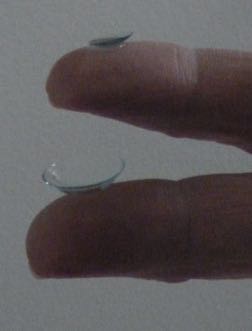
A scleral lens is a large contact lens that rests on the sclera, the white portion of the eye, rather than on the cornea. The lenses bulge outward, creating a tear-filled vault which protects the cornea and allows it to heal. You can see in the photo how it compares to the regular gas permeable (hard) contacts I had been using. Prototype scleral lenses were made in the late 1800’s. Lenses would be shaped to conform to a mold of the eye. But without oxygen permeability they weren’t very practical. The modern lenses are made possible by the development of a highly oxygen permeable polymer for the lens itself and digital imaging techniques (including optical coherence tomography) to record the shape of the eye’s surface. That information allows creation of a virtual 3D scleral lens design.

Because the lenses are rigid and fluid-filled the correction can be better than with glasses or various kinds of contact lenses. That fluid, and the fact that the lenses don’t touch the cornea, means that they feel better and can help the cornea to heal. I’ll have to allow some time to see whether those promises hold true. There’s also some work involved in learning how to insert and remove the lenses.

Sclera lenses

Sclera lenses

A scleral lens is not the same as a sclera lens (see left). Either might invite thoughts of extraterrestrials.

Notes

(1) Keratoconus, glaucoma, dry eye, astigmatism, etc.

Ballston Beach breakthrough, 2015

Ballston Beach in Truro had another breakthrough with this recent storm, effectively making North Truro and Provincetown into an island at high tide.

You can see some photos we took at low tide yesterday afternoon (click to enlarge) and below that a dramatic video taken by Bobby Rice of Truro.


The blizzard of 2015

View from our bedroom this morning

View from our bedroom this morning

I had convinced myself that buying new X-C skis last fall was going to prevent us from ever seeing snow again on Cape Cod. The ski god must have relented. We may get as much as two feet.

Susan took some photos through the blowing snow. The photo at left shows the view from our bedroom this morning. That light blue is the wall of the small deck, and you can faintly see the metal table and chair.

The garage door to the front porch is the only one we can safely open. But one of the geraniums in the music room is still blooming.

In a few hours a neighbor will come and do a preliminary plow of our driveway. We arranged that in case my eye doctor could set me up with my new, much needed scleral lenses. That’s now postponed until Thursday.

Since you’re getting this, you know we still have power. That may not last all day, since there’s a lot more snow and wind to come. The UPS unit has been clicking on and off as the power fluctuates. Coffee is ground for tomorrow, in case we have to use a camping stove for breakfast. And we can melt snow to flush toilets.

In the meantime, we can ski, if we don’t sink too much into the powder snow.

A non-selfie: the Andromeda Galaxy

On January 5 this year, NASA released an image of a portion of Andromeda (aka M31), the nearest galaxy to our Milky Way. It’s the largest picture ever taken, a 1.5 billion pixel image (69,536 x 22,230) requiring 4.3 GB disk space. The full image is made up of 411 images captured by the NASA/ESA Hubble Space Telescope. 

The largest NASA Hubble Space Telescope image ever assembled, this sweeping bird’s-eye view of a portion of the Andromeda galaxy (M31) is the sharpest large composite image ever taken of our galactic next-door neighbor. Though the galaxy is over 2 million light-years away, The Hubble Space Telescope is powerful enough to resolve individual stars in a 61,000-light-year-long stretch of the galaxy’s pancake-shaped disk. It’s like photographing a beach and resolving individual grains of sand. And there are lots of stars in this sweeping view–over 100 million, with some of them in thousands of star clusters seen embedded in the disk. (via Hubble’s High-Definition Panoramic View of the Andromeda Galaxy | NASA)

A video http://youtu.be/udAL48P5NJU takes you through the photo (thanks to Chuck Cole for spotting this). Andromeda probably has a trillion stars, ten thousand times what is shown in the photograph.

Andromeda and the Milky Way will collide in about 4 billion years. Although more than a trillions stars are involved, the distances between them are so great that it is unlikely that any of them will individually collide.

Walk to Ptown

Ever since moving to the Cape, I’ve wanted to walk to Provincetown. It wasn’t because of the Wampanoag people, or other early explorers and settlers who wrote about the area, such as Gosnold, Champlain, the Pilgrims, or Thoreau. It was simply that I wanted to connect with the land and sea in a way that walking does, more than riding in a car or bus, or even on a bicycle.

Yesterday, Emily, Stephen, and I managed to do it–what turned out to be 35,000 of my steps.

We walked out the front door, down the hill to Wellfleet center, across route 6, past the ponds of Herring, Williams, Higgins, Slough, Horse Leach, and Round. Then we split up, with Stephen taking the beach walk along the Cape’s backside while Emily and managed the brambles on the dune ridge. We met up again at Ballston Beach, where Emily took a break, having carried the pack the entire way. Stephen and I continued on the beach past Long Neck Beach to a spot between the abandoned North Truro Air Force station and Highland Light. At that point we turned west to cross the Cape to the Bay side. From there it was a straight shot north to Provincetown, where we met up with Emily and Susan and had a lovely early dinner.

This slideshow requires JavaScript.

2014 in review

The WordPress.com stats helper monkeys prepared a 2014 annual report for this blog.

Here’s an excerpt:

The concert hall at the Sydney Opera House holds 2,700 people. This blog was viewed about 14,000 times in 2014. If it were a concert at Sydney Opera House, it would take about 5 sold-out performances for that many people to see it.

Click here to see the complete report.