

Dhumbahal stupa, Patan
My apartment is on the second floor (US, third) near Kumbeshwar Temple complex in Patan. It’s in one of several 4-6 story buildings surrounding a small courtyard, called Dhumbahal Square.
Thus far, it’s similar to the courtyard behind the flat in London where we stayed with our good friend Jane on the way to Nepal. That courtyard had well-groomed bushes and trees, walkways, and convenient benches. It offered a peaceful respite from city life.
Objects

Family across the way
The one in Patan is a different story entirely. It’s 100 feet square, about the same size as the average US suburban lot–1/4 acre. But in that 1/4 acre there’s more to see than anyone can absorb.
There’s a Buddhist stupa in the middle. Around the perimeter one finds a communal water source, a small Hindu mandir, a tiny shop that miraculously produces any item you can name, a beauty parlor (and training center), a (motor)bike wash and repair center, a small convenience store, a weather station on top of one of the buildings, and other establishments I haven’t identified yet.
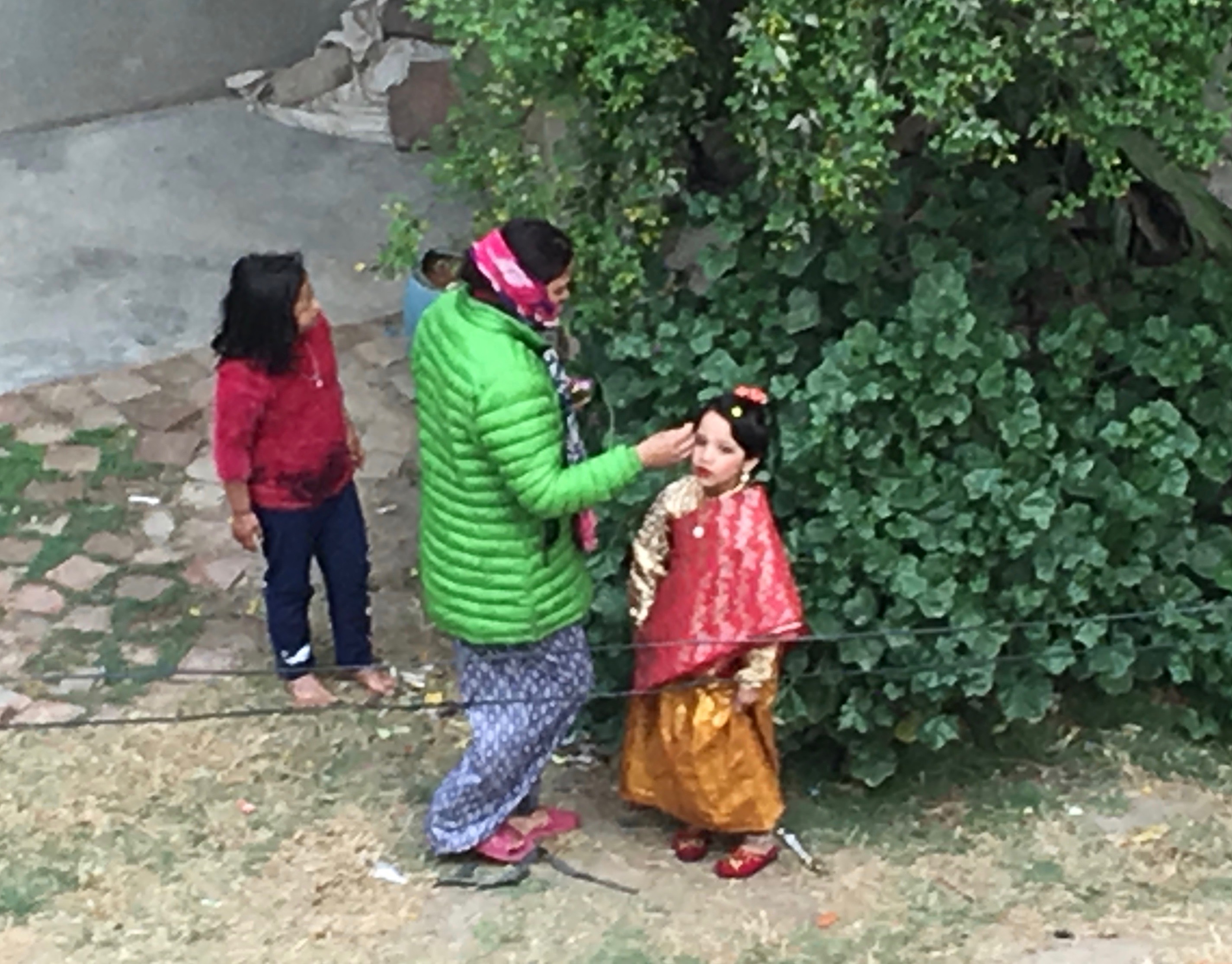
Tree blossoms for her hair
Water is brought by truck to fill large, black plastic tanks on the top of each building. That water becomes the tap water, getting its pressure from the height of the tanks. It’s filtered, but most people drink bottled water for safety. Mine comes in 20 liter clear plastic jugs, which fit into a dispenser tank.

Small mandir
The ground is covered about a third with bricks. Some of those form a sort of patio, others are arranged in a curving pattern as if they knew exactly where most people would like to walk. There’s also a slate paved area, some concrete, lots of bare ground, and amazingly, a little grass. I haven’t figured out why one surface is one place rather than another, but it all seems to work.
Activities

The mystery hole
As remarkable as some of these objects may be, it is the activities around them that cause one to sit mesmerized on the balcony, just watching.

Baby photos
A woman tosses millet in the air to remove chaff; another takes an offering with candles and flowers to the temple; a man splashes water on the ground to reduce the dust; boys roll an abandoned motorcycle tire around the stupa, as two girls walk around the same monument turning the prayer wheels; a young man washes his motorcycle; an older man gets an open-air shave and haircut; a young couple take endless photos of their young child; women hang laundry and water flower pots; children play rock pitching games. It’s notable how often fathers are caring for children. One older boy (12) runs to pick up a younger one (6) who’s fallen. He comforts him and brushes the dust off his pants. The children also sing and dance.
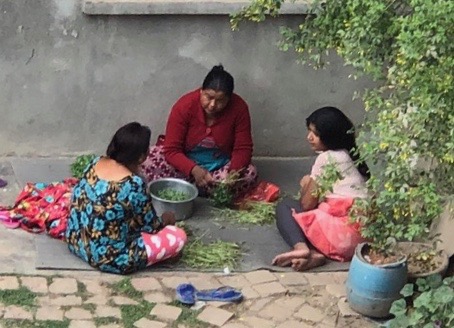
Preparing vegetables
Meanwhile, there’s construction. Although Patan may be the oldest city in the Kathmandu Valley, dating back more than two millennia, and the courtyard is in one of its oldest parts, there’s a feel of new building everywhere.

The wedding party
Some of this is needed re-construction after the damage of the 2015 earthquake. But workers are building new apartments, too, reflecting early gentrification of the area. One man digs a mysterious hole that ends up being 8 feet deep with surprisingly straight sides. Later, small boys use the dirt from the hole as a site for play and the uncovered rocks for their pitch & toss games. A small crew puts up a cell tower, without using any harnesses or visible safety equipment. The construction goes on amidst the young children playing, older ones coming and going from school, adults working and relaxing.

Installing the cell antenna
Observing all of this is like a watching a complex movie, except it’s one that is showing 360° around, with sights and sounds, but also with tastes and smells, touch, heat and cold.
Schedule
There is no beginning to the courtyard’s day; one moment segues into the next 24/7. A dog may start barking at 2 in the morning and soon have dozens of others to talk with. I can’t give a full account of the day, as I’m mercifully learning to sleep through most of it. But sometime around 5 in the morning is an important inflection point.

Morning rituals
That’s when I hear the first temple bells–one is deep and loud, two are middle volume, but one of those is high pitched. There are several smaller ones, too. If the dogs weren’t already going they soon make up for lost time. Motorcycles start up. Human voices come in, conversing rapidly or yelling. Before long children are running and squealing about. In little gaps, one can hear pigeons cooing, crows cawing, and songbirds singing. The roosters manage to make themselves heard above it all.
This continues throughout the day, although each hour has its distinctive character. There are sounds of children laughing, singing, and squealing at play from the nearby school. There’s even a time in the afternoon when all but one dog decides it’s too much trouble to bark anymore. That one gives a few desultory yaps, but I can tell that his heart isn’t in it. In the evening, there’s the dinnertime chatter all around, and later, Nepali pop music.
One day, the signature event was a wedding. Although it seemed to involve most of the courtyard and many visitors, it didn’t stop all the other activities. We saw a 50 foot long tent being erected and red plastic chairs being set up in rows. Soon, a 14-piece band appeared. There were of course many photos, of babies and children and women in beautiful saris. There were also a number of young men in what must be called dandy outfits and poses.
Chaos and peace
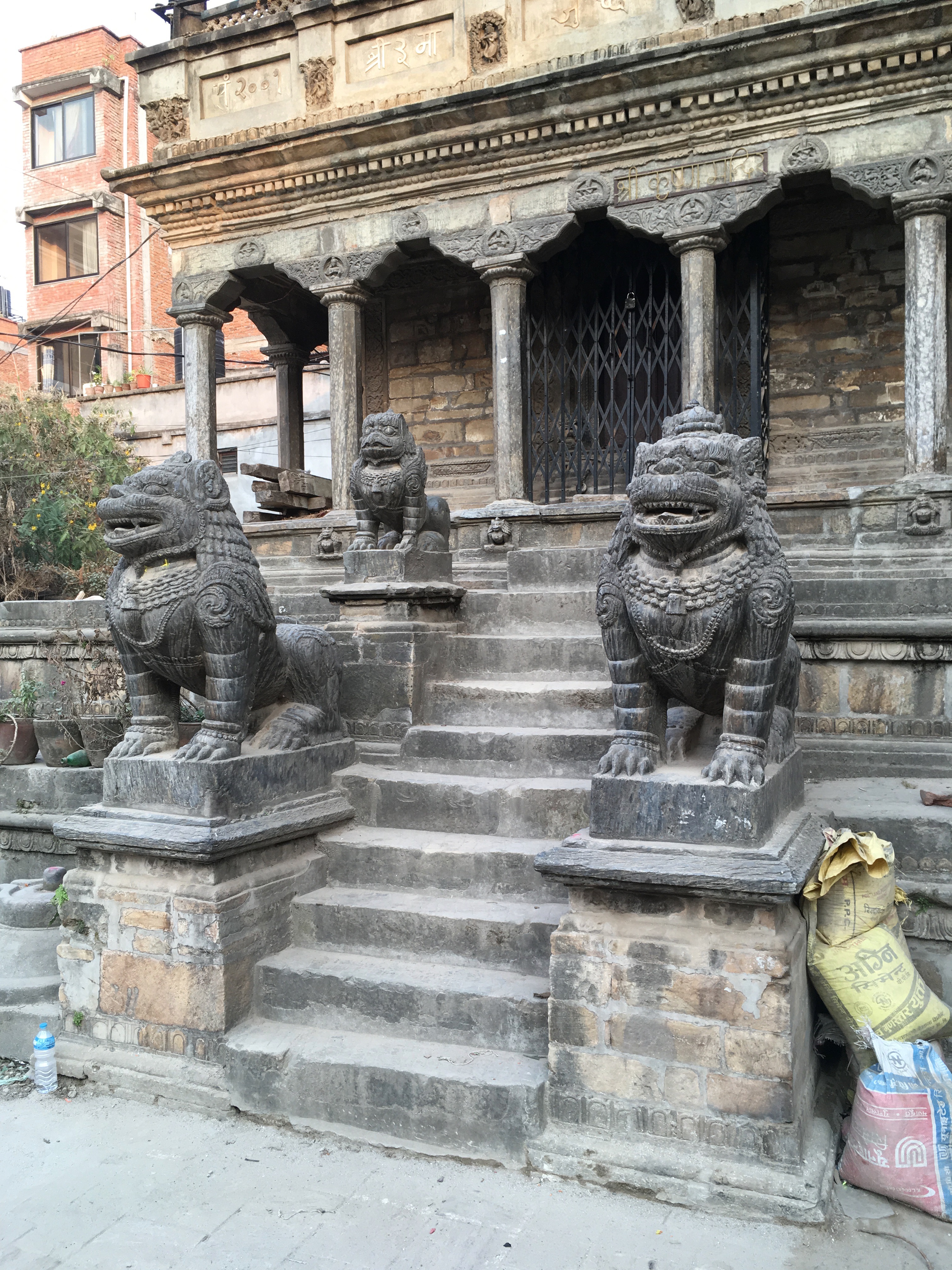
Lions signaling the turn into the courtyard
On first encounter, the chaos of the courtyard is disturbing–too many scary dogs snarling, too much noise, too many strange sights, sounds, and smells, too many chances to trip on rocks or broken pavement.
But the courtyard is actually a very safe place, away from the street traffic and noise, and where people know one another.
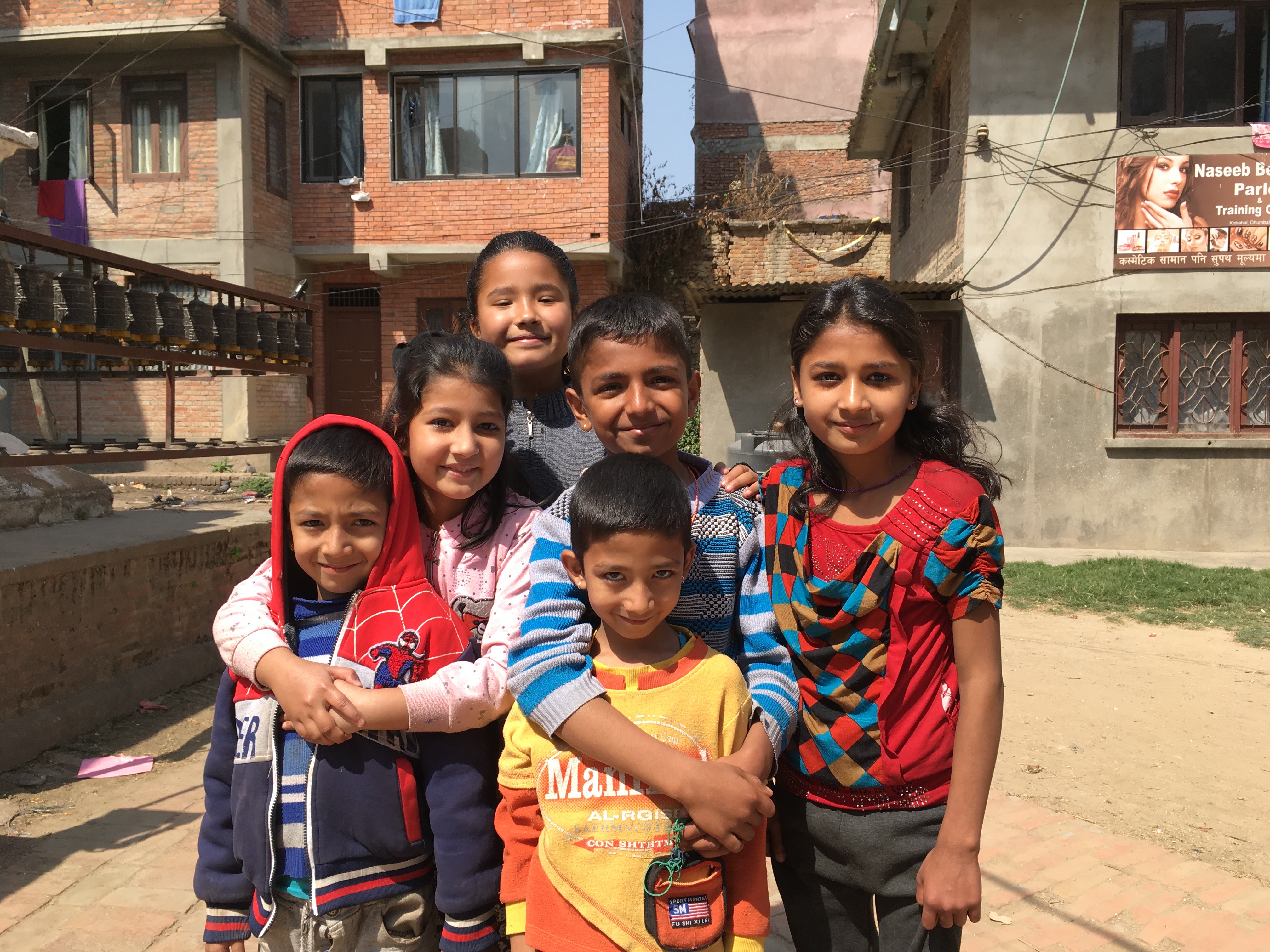
After a while it all, or most of it anyway, begins to make sense. There are patterns and relations that fit into a larger whole. I begin to recognize faces and they mine. One child loves to talk in broken Nepali/English; another seems too shy to say anything. The apparent chaos is actually welcoming, enriching, overcoming difference. There’s peace in the bustle that is less apparent in quiet solitude.
Peace does not mean to be in a place where there is no noise, trouble, or hard work. It means to be in the midst of those things and still be calm in your heart.










 Chip's journey