Quake in Nepal

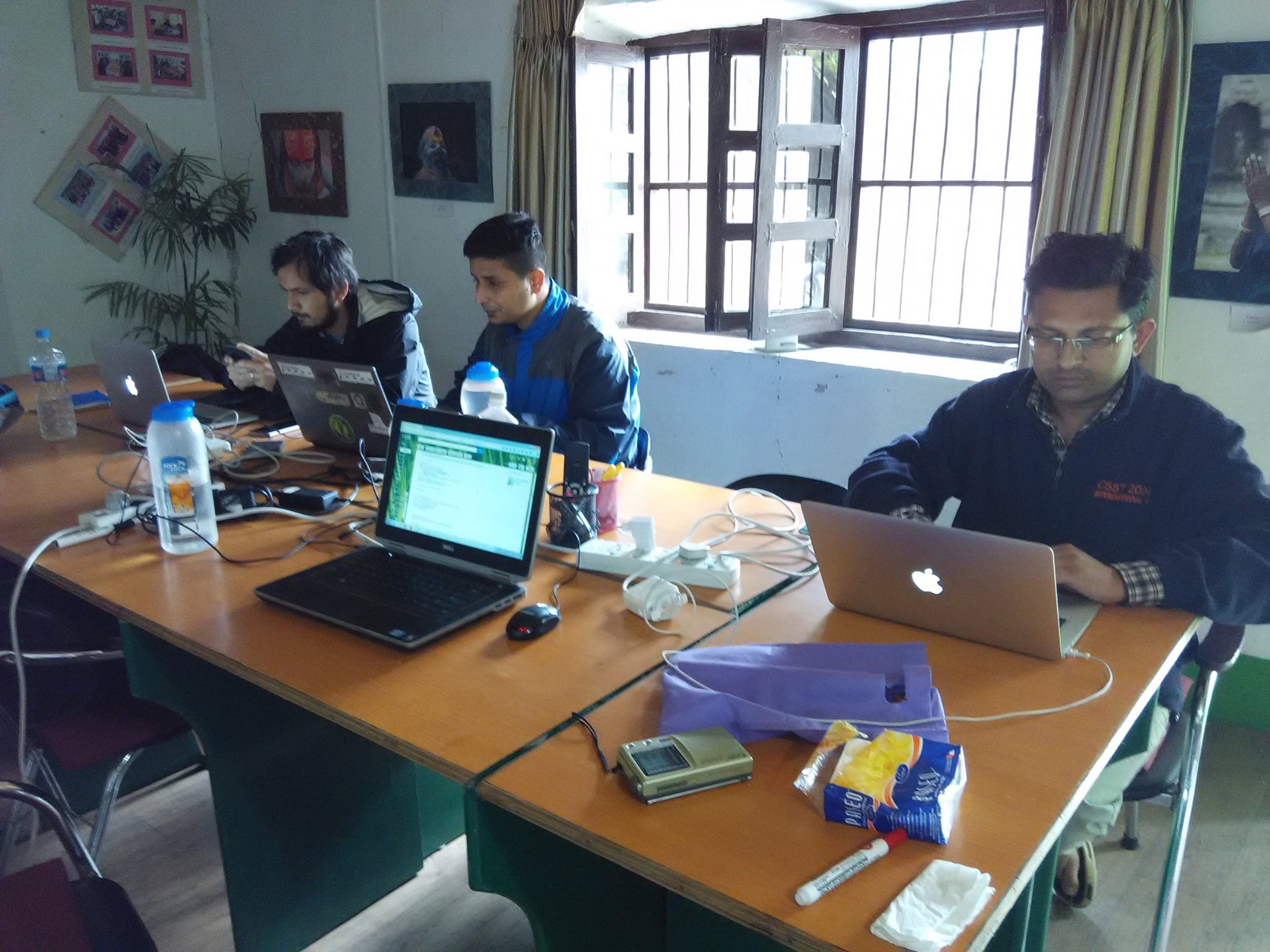
KLL situation room

KLL situation room

A growing sense of despair spread through Katmandu on Sunday as the devastated Nepali capital was convulsed by aftershocks that sent residents screaming into the streets, where they were pelted by heavy rain. via Nepal Terrorized by Aftershocks, Hampering Relief Efforts – NYTimes.com.

The situation in Nepal sounds awful. Nature in the form of aftershocks and rain, is conspiring with poverty and political discord to make a dire situation.

I know several people there, including some former students, and am relieved that so far they’re doing OK.

I’ve also been impressed with the work of the Humanitarian OpenStreetMap Team [HOT], which acts as a bridge between the traditional humanitarian responders and the OpenStreetMap community. Nama Budhathoki, a former student and friend, works with Kathmandu Living Labs and HOT to provide vital information, first about the road network and then about buildings. The Tasking Manager is a tool they designed to coordinate these efforts. It helps to divide up a mapping job into smaller tasks that can be completed rapidly.

The photo, taken from the KLL Facebook page, shows the situation room with Nama on the right.

Who invented the amazing paper bag?

Luther Childs Crowell

Luther Childs Crowell

Envision, if you can, a technology that sharply improves the efficiency with which goods can be delivered to the consumer; that, in the view of one prominent economist, is the ”most effective innovation during the preceding decade in speeding up American retail sales”; that within only a few years of its introduction becomes a pervasive feature of American life.

Such a technology, according to the historian Daniel J. Boorstin, was the square-bottomed paper bag, invented circa 1870 by one Luther Childs Crowell. –Krugman, 1997, “Technology makes us richer; the paper-bag revolution”

It doesn’t take long in Wellfleet to be impressed with the local lore. There’s a lot to learn, about native peoples, Pilgrims, pirates, psychiatrists, and painters. We hear about Baker inaugurating the banana trade, Marconi sending the first trans-Atlantic wireless, and Crowell inventing the paper bag. There is a little truth in this lore. However, as with any item in history, there’s more to the story than often claimed.

Kraft paper bag

Kraft paper bag

One widely held idea, as evident in the quote above and some of the citations below, is that without Luther Childs Crowell of Wellfleet we’d never have the square-bottomed paper bag that makes shopping so convenient (and competes with the ubiquitous plastic ones). That’s an appealing story, especially for a small town that was in the doldrums during much of the industrial revolution.

Although he wasn’t born in Wellfleet, Crowell became a prominent, long-time resident. He’s considered the third most prolific American inventor of the 19th century. Among his inventions were an aerial machine (helicopter), a double supplement printing press, and a bottle-labeling machine. He’s a figure to remember.

Margaret E. Knight

Margaret E. Knight

Moreover, Crowell did play a role in the development of machines to make paper bags. He received one patent for this in 1867. Five years later he devised a machine to make square-bottomed paper bags, and later, the side-seam paper bag.

But the story is a bit more complicated than one inventor working alone to develop his brilliant idea. Paper bags were manufactured commercially in Bristol, England, starting in 1844. In 1852, Francis Wolle, of Bethlehem, Pennsylvania patented and built a  “Machine for Making Bags of Paper” (15 years before Crowell’s first bag patent). In 1869 Wolle and others founded the Union Paper Bag Machine Company. Many people consider Wolle to be “the” inventor. However, Wolle’s was an envelope-shaped bag, which was limited in terms of durability and interior space.

About then the plot thickens. In 1870, Margaret Knight designed a machine to cut, fold and paste paper bag bottoms. This meant that she could produce flat/square-bottomed paper bags, a great improvement on the earlier envelope-style bag design. Her work clearly preceded Crowell’s square-bottomed paper bag machine.

Knight became the first woman to achieve a U.S. patent in her own name, one of 89 in all. She held patents for improvements to automobile engines, for a window frame and sash, and for a shoe-sole-cutting machine. Almost immediately, she became the first woman to suffer patent infringement. Charles Annan filed a patent application making use of her design. Knight then filed a patent interference suit. In the trial, Annan argued that Knight could not have been the inventor. As a woman, she “could not possibly understand the mechanical complexities of the machine.” But Knight had full documentation, with drawings, paper patterns, diary entries, and more, demonstrating the complex and detailed work she had done over two years. She prevailed in court.
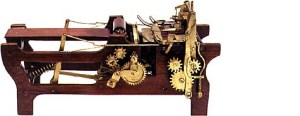
Patent model of Knight's machine for making paper bags, 1879

Patent model of Knight’s machine for making paper bags, 1879

A decade later, in 1883, Charles Stilwell was awarded a patent for making a “Square-Bottom Paper Bag w/ pleated sides.” His design was nicknamed “S.O.S.” (self-opening-sack), and provided the model for the mass-produced paper bags we know today. William Purvis and others received paper bag patents, with improvements such as the thumb cut to ease opening, serrated tops, and handles.

Crowell was an important player in this mix, but hardly the sole inventor. He actually acknowledged Knight as the true inventor, but declared that he had rights to make and sell the bag. Henry Petroski, who has one of the most thoroughly researched accounts of the paper bag development (see also Aidan O-Connor’s blog post), writes

The invention of the familiar square- or flat-bottomed paper bag–the “grocery bag”–is commonly but incorrectly attributed to Luther Childs Crowell, of Boston, Massachusetts, who in 1872 received a patent for an “Improvement in Paper-Bags.”

Note the use of the word, “improvement,” a sure sign that Crowell knew that he was helping the bag design to evolve, not inventing de novo. Crowell added several important features such as a bag top with unequal front and back sides. This made it easier to open the bag. He is thus rightly recognized as a major inventor, one who contributed to the design of paper bag we use today.

Stillwell patent, 1889

Stillwell patent, 1889

Knight’s contributions were for a long time under-appreciated, no doubt in part because she was a woman. But now, there are scholarly articles, museum exhibits, PBS shows (“History Detectives: Women inventors”) and children’s books about her: Margaret Knight: Girl inventor, In the bag!: Margaret Knight wraps it up, and Marvelous Mattie: How Margaret E. Knight became an inventor.

It’s impossible to identify the top paper bag inventor. Francis Wolle started on the path to mechanized production of the bags, but his envelope design had limited usefulness. Margaret Knight arguably made the biggest jump up from that with her machine for making flat-bottomed paper bags. But Stilwell’s significant addition of the accordion pleats on the sides made the bags much more useable, easier to store and access.

Luther Crowell, William Purvis, and others also made important contributions. A search for “paper bag” in the title of US patents yields 212 since 1920, including the most recent to Noe Yanez Castro, Guadalupe Acevedo, and Cipriano Hinojos for a “clampless bar mechanism” for “paper bag bottoming.”

Crowell’s work was important and still worth sharing. But the fuller story involving the first major US woman inventor, paper bags in different countries, patent battles, and the evolution of design for multiple purposes makes a truer and far more interesting account.

References

Embracing vInes

Celastrus orbiculatus (Oriental bittersweet)

Celastrus orbiculatus (Oriental bittersweet)

When Celastrus orbiculatus grows by itself, it forms thickets; when it is near a tree or shrub, the vines twist themselves around the trunk. The encircling vines have been known to strangle the host tree to death … All parts of the plant are poisonous. –Wikipedia, Celastrus orbiculatus

Oriental bittersweet continues to spread on Cape Cod, along with poison ivy, Virginia creeper, and English ivy. We now have kudzu, which used to be primarily in the American South.

Climate change is making poison ivy grow faster, bigger and meaner. Rising atmospheric levels of carbon dioxide and higher temperatures are to poison ivy what garbage is for rats, dormant water is for mosquitoes and road kill is to buzzards. –Templeton (2013)

Vines are spreading everywhere–lianas in Panama and air potato in Texas, which grows 8 inches a day. New York is releasing thousands of harmful Asian weevils as the only way to combat the relentless mile-a-minute vine. It’s happening all over the planet. Whether we like it or not, vines are embracing us, our walls and fences, and our trees.

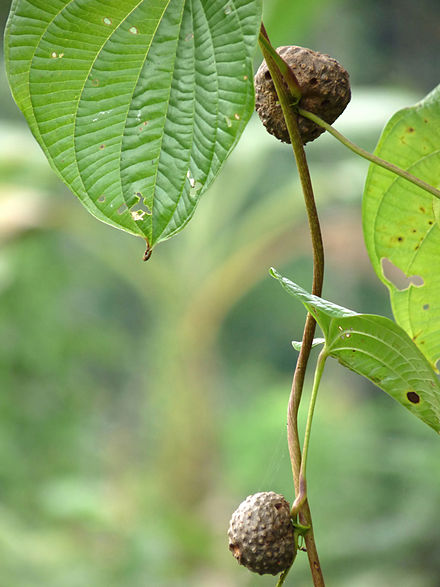
Dioscorea bulbifera (air potato)

Dioscorea bulbifera (air potato)

Vines are increasing in many places because of forest fragmentation and habitat destruction. They’re also benefitting globally from increased CO2 in the atmosphere and global warming. Since they sequester less carbon than the trees they replace do, they then contribute to the growth of CO2. It’s a vicious cycle. Trees, but also ferns and other plants are at risk.

If you’ve ever walked through the jungle, you’ll know it can be surprisingly dark down on the forest floor. You see trees soaring up all around. You’re creating a dense canopy overhead. And climbing toward that canopy, snaking up the trees are the vines.

Now it may seem peaceful in there, but what you’re witnessing in very slow motion is a fight to the death: a fight between the trees and their old rivals, the vines. It’s a battle as old as the forests themselves. Now, scientists say the vines are winning. –Science Friday, NPR

Toxicodendron radicans, poison ivy

Toxicodendron radicans, poison

Vines can be quite beautiful. Grape vineyards have developed on the Cape, to what I’d consider to be a good end. BougainvilleaCampsis (trumpet vine), Wisteria can be beautiful. Lathyrus odoratus (sweet pea) and Passiflora edulis (passionfruit) have delicious fruits. Even poison ivy provides forage for many animals and the fruits are popular with birds (who help spread it around).

Vines aren’t all bad, Maybe we should embrace them back.

But we may have to say good bye to the trees. And they were nice to have around, too.

References

Reverse silhouettes

And the end of all our exploring
Will be to arrive where we started
And know the place for the first time.

T.S. Eliot — “Little Gidding”

This slideshow requires JavaScript.

I knew the name, György Kepes, mostly because he’s one of those notable Wellfleetians, but I can’t say that I knew much about him until recently.

My exploration started with a “Picture of the Day” in New Scientist, showing one of his reverse silhouettes, and describing an exhibition of his works at Tate Liverpool. More images are shown in the slide show above, on the website of the new Kepes Institute, Museum, and Cultural Center in Eger Hungary, and at Hommage à György Kepes.

Cape Cod Modern,  Peter McMahon, Christine Cipriani

Cape Cod Modern, Peter McMahon, Christine Cipriani

I looked up Kepes in the wonderful new book by Peter McMahon and Christine Cipriani, Cape Cod modern: Midcentury architecture and community on the Outer Cape. There are interesting stories and photos there about the house that Marcel Breuer designed for the Kepes family on Long Pond, and about their interesting relationship with Wellfleet and Cambridge, Mass, including living in Wellfleet without a car. There is some about his wife, Juliet Kepes, who has had considerable accomplishments of her own, including winning the Caldecott Award for Five little monkeys. They had met in London when she was then 17-year-old Juliet Appleby.

I then started examining more of the Kepes art, writings, and history.

The Wellfleet library may be small, but it’s an excellent source for this kind of investigation. It has many books by György Kepes, including his Vision + value series. As I read through the contributors, I couldn’t believe what I saw.

Kepes (1906-2001) was a Hungarian-born painter, photographer, designer, filmmaker, educator, and art/design theorist. As a young artist, he was concerned about the relation between art and social justice, seeking to alleviate “the inhumane conditions of the Hungarian peasantry.” He followed László Moholy-Nagy to London, and later, to teach design at the New Bauhaus in Chicago and later founded the Center for Advanced Visual Studies at MIT.

Five Little Monkeys, Juliet Kepes

Five Little Monkeys, Juliet Kepes

Kepes promoted an idealistic conception of visual communication as a universal language that could enhance communication and social relations:

Visual communication is universal and international; it knows no limits of tongue, vocabulary, or grammar, and it can be perceived by the illiterate as well as by the literate (Language of Vision, p. 13).

There are many reasons to question that bold statement, and Kepes must have done so as well. While at New Bauhaus he developed ideas about design theory, form in relation to function, and the “education of vision.” This implies that although visual communication may be universal it is not immediately apprehended. Kepes’s teaching and writing, including the anthologies he edited argue for it as something to be studied and learned. Kepes goes on to say: “Visual language must be adjusted, however, to meet its historical challenge.” This challenge is to reunite people and knowledge, to establish a more integrated being in a changing world.

What especially struck me about Kepes’s work was how much it tied together disparate threads in my own life. He saw fundamental connections between people in fields that are often considered to be far apart. In exploring his work I felt that I was getting know a new friend, but also, as Eliot suggests, getting to know myself better as well.

Kepes’s Bauhaus strand is strong in Wellfleet, including in the life and work of friends Ati Gropius and John Johansen, Marcel Breuer, Walter Gropius, Serge Chermayeff, Paul Weidlinger, and others. He worked with science educators, such as Gerard Holton and Philip Morrison. He was involved in the development of computer sciences, especially regarding data visualization, and worked with Norbert Wiener and Jerome Wiesner. He worked with psychologists, including Rudolf Arnheim and Erik Erikson, mathematicians–Stanislaw Ulam, biologists–C. H. Waddington, communications theorists–Marshall McLuhan, artists–Piet Mondrian, Mark Rothko. And he is most strongly identified with designer/theorists such as Christopher Alexander, Buckminster Fuller, and Charles Eames. Thus, the worlds of art, science, education, technology, and social justice were in the same mix. This can be seen in his exhibition/book, The new landscape in art and science, in which artwork was interlaced with images from x-rays, stroboscopes, electron microscopes, sonar, radar, telescopes, and infrared sensors.

Some more examples are his reverse silhouettes. Using a technique that has become a children’s museum staple, Kepes made “photograms” by arranging objects directly on top of light-sensitive paper and illuminating them. I wish I could see the new display in Liverpool, but in lieu of that am enjoying the art and ideas in his many books. These ideas are still fresh and have inspired many others, including the whole field of computational aesthetics (see for example, Form + code)

References

  • Kepes, György (1995/1944). Language of vision. New York: Dover.
  • Kepes, György (1949). Graphic forms: The arts as related to the book. Cambridge MA: Harvard University Press.
  • Kepes, György (1956). The new landscape in art and science. Chicago: Paul Theobald.
  • Kepes, György (1965-66). Vision + value [series] (The education of vision; Structure in art and science; The nature and art of motion; Module, symmetry, proportion, rhythm; Sign, image, symbol; and The man-made object). New York: George Braziller.
  • Kepes, György (1966). The visual arts today. Wesleyan University Press.
  • Kepes, György (1972). Arts of environment. New York: George Braziller.
  • McMahon, Peter, & Cipriani, Christine (2104, Spring). Cape Cod modern: Midcentury architecture and community on the Outer Cape. New York: Metropolis.
  • Picture of the day (2015). Reverse silhouettes capture the beauty of nature. New Scientist.
  • Rawsthorn, Alice (2010). A master of image and information. The New York Times.
  • Reas, Casey; McWilliams,Chandler; LUST (2010). Form + code: In design, art, and architecture. Princeton, NJ: Princeton Architectural Press.

Light from the Castagna

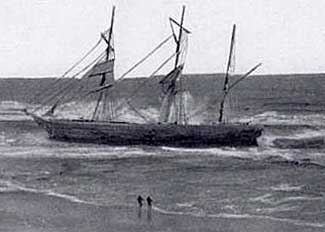
Castagna

Castagna

Over a century ago, on February 17, 1914, the Italian bark Castagna was thrown on the backside of Cape Cod near the Marconi Lifesaving Station. See Italian bark Castagna comes a cropper on the Marconi Station beach and Shipwrecks on South Wellfleet’s Shore.

There’s a large photo of the Castagna in the Wellfleet Post Office and the general story is well known. But there’s a side to it that not many people know.

The Castagna was bound from Montevideo for Weymouth loaded with guano. It struck ground during a blinding snowstorm and northwest gale. Lifesaving crews shot three lines for breeches buoys across the Castagna’s deck, but the sailors were so cold that they were unable to handle the tackle. The skipper of the Castagna was washed overboard, four men froze to death in the rigging and one died in the lifeboat on the way to shore. The loss of life was the largest in a wreck on Cape Cod in 12 years.

The Life Line, Winslow Homer, 1884

The Life Line, Winslow Homer, 1884

My Great Uncle Jack Whorf, had just turned 13 years old. When he heard about the ship going aground, he and a friend decided that going to see the wreck would be more interesting than whatever was planned for school that day. When they arrived at the ocean, they saw the crews from the Nauset and Cahoon’s Hollow stations set up with their beach gear.

The crews had managed to rescue the ship’s cook with a breeches buoy. Presumably he had survived in part from being in the warm galley, rather than up in the rigging. He was set up in a chair on the beach. Jack and his friend were told to rub his arms to keep him alive.

The next day, Jack and his friend scavenged some teak from the wreck and made a desk lamp from the wood. A Wellfleet lampshade maker painted a Cape Cod map and a picture of the ship on the shade. He and Great Aunt Polly used that lamp in their den. For them it was a quite ordinary fixture; for me, it was a talisman to adventure and tragedy.

Ripley, RIP

Rainer Maria Rilke, Sonnets to Orpheus, XXVII [Book Two], (tr. Cliff Crego)

Does Time the Destroyer really exist?
When, on the mountain, will it bring /
down the fortress?
When will the demiurge overpower this heart
that belongs to the infinity of the gods?

Are we really so frightfully fragile
as Fate would have us believe?
Does the promise of childhood, the depths,
remain later quiet in the roots?

Ah, the ghost of that which is transient;
it passes through the guileless receptive ones
as if it were but a bit of smoke.

As that which we are, the driving ones,
still we are considered a custom of the divine
by the powers which do not change.

Ripley, the snow dog

Ripley, the snow dog

About two weeks ago, Ripley, the snow dog, came into being through an act of love and homage, only to be destroyed shortly after. The destruction was obviously part of the artwork, representing something about the fragility of existence. But “are we really so frightfully fragile as Fate would have us believe?” (Ripley is named after Ellen Ripley, who is Sigourney Weaver’s character in the Alien films.)

A three-year-old, one of snow Ripley’s co-creators, leaped into her, exploding her material being into a flurry of snow. This took what I estimate as somewhere between 7.5 and 9.5 seconds, just long enough for the horror to sink in, but not long enough to prevent it: A snow dog, who should live a week or two, lasted but a human breath. The demiurge had won.

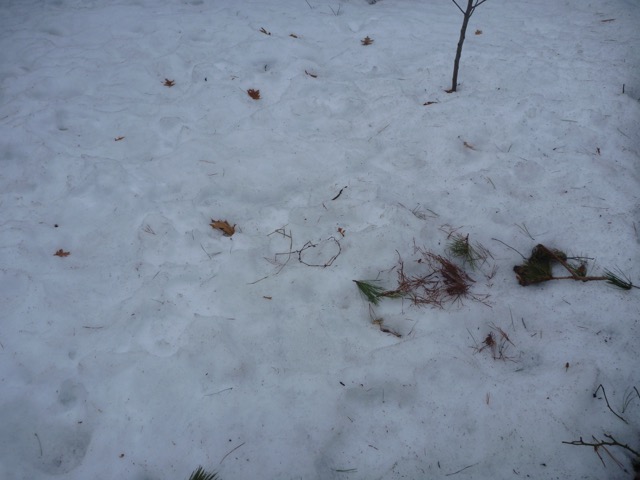
Ripley's defiance of Time the Destroyer

Ripley’s defiance of Time the Destroyer

Later, however, when I went out to check on the diminishing snow, I looked to where Ripley had once proudly stood. I saw her ears, her nose, her eyes, and her collar. There was even the slightest mound of snow from her fragile body.

Time the Destroyer may yet win this one in the end. But Ripley, the snow dog, lives on the soil and the plants attempting to break out of winter. The “promise of childhood … remains later quiet in the roots.” His spot in the yard will not disappear and his memory is now part of Ripley himself. Perhaps Rilke is right that “the ghost of that which is transient; it passes through the guileless receptive ones as if it were but a bit of smoke.”

The ants are coming

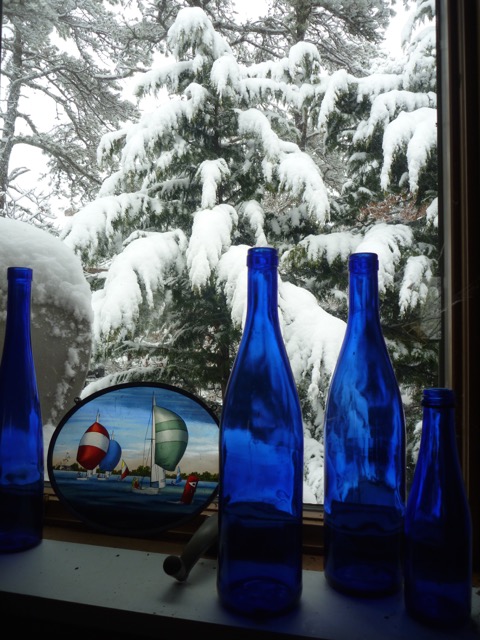
Today, Susan saw our first ant in a while, a sure sign that spring is coming, even if the snow hasn’t heard the news yet.

Then, I saw the New Scientist article, 3D-printed bionic ants team up to get the job done. Festo, the company featured in the article was perhaps thinking that there aren’t enough ants in the world. They probably know that it was once claimed that ants collectively weighed as much as all the humans. However, while that was possibly true in the past, human size has expanded both collectively and individually, putting us well in the mass lead.


Perhaps to remedy that situation, Festo is creating artificial ants about the size of a human hand. They make individual decisions that result in cooperation to achieve a common goal, which they couldn’t accomplish alone. Using a GoPro-like head-mounted camera and floor sensors, they develop a sense of their surroundings, then communicate using a wireless network. Their bodies are 3D-printed with electronic circuits overlaid. When they need to recharge they can go automatically to a charging station to be ready for more work.

This is not a far-out experiment, but an example of how assembling various state-of-the-art technologies can lead to impressive, sometimes surprising results.

The ants remind me of the “brownies” in The Mote in God’s Eye (Larry Niven and Jerry Pournelle, 1974). These were small, dextrous beings who could build or repair anything in an efficient, organic way. They also reproduced at an explosive rate. The Brownies seemed to help humans in many ways. In the early days of their interactions, humans developed an affection for them. But later they discovered that the Brownies posed a dire threat.

Our Wellfleet Public Library now has a MakerBot 3D printer. Maybe we can make our own bionic ants.

First encounters with snow

Preparing to face the snow

Preparing to face the snow

OK, I confess.

All those about me were complaining about the never-ending snow and what accompanied it: bitter winds coming off the ocean ice, people trapped in their homes, snowplows closing off newly shoveled driveways, while burying or knocking over mailboxes, falling on the ice, roofs collapsing, and such. Meanwhile, I prayed for it to continue. I wanted it to be here for my family from Austin who were to visit during spring break.

Front yard

Front yard

They had never seen snow before, at least not of this magnitude. But they prepared as well as they could.

We prepared for the visitors as well. I had stored some clean snow in the freezer for making snow ice cream, just in case the outside quality wasn’t up to standard. We had sleds, extra hats and mittens, and topped off the propane tank. We’d also made a list of indoor activities–the Brio train, the dollhouse, piano, rummy for indoors for inside the house; the visitor centers at the National Seashore’s Salt Pond site and at the Audubon sanctuary, to get out in case of freezing rain.

Out the garage window

Out the garage window

When they came, we took full advantage of the snow. we had snow ice cream in the classic vanilla as well as the maple syrup varieties. We made snow angels and devilish snow balls.

We made a snow dog (aka Ripley), when our planned snow man didn’t cooperate. We also got to see how much fun it is for a three-year-old boy to jump on top of a snow dog and scatter the snow in all directions. And how annoyed his six-year-old sister can be whenever he does something like that.

Frozen Ripley

Frozen Ripley

And we went sledding. There were awards for being the first to go beyond the end of the run into the sand road, for going furthest off the main track, for unintentionally going down backwards, for getting buried the deepest in a drift, and for screaming the loudest.

The visit was wonderful for me, although way too short.

Testing out the equipment

Testing out the equipment

Now that we’ve completed it, I’d like to amend my earlier call for lots of snow. It’s still beautiful to see, but it makes it hard to walk in the woods without snowshoes or skis. I’m starting to tire of putting out a special bin for mail with the mailbox packed in ice. I sympathize with the friend who’s decided to move after five weeks of being shut in. So, let’s have a few more days of sledding or skiing, then move on to another season.

Daniel Dejean, cartoonist extraordinaire

Daniel Dejean

Daniel Dejean

Daniel Dejean, a Wellfleet artist, is best known for his acrylic or oil paintings. These have been shown in galleries around Cape Cod and exhibited at a wide array of venues over 25 years, including recently at the Éspace Croix Baragnon in Toulouse and the Galerie Charlotte Norberg in Paris. See http://www.danieldejean.com and below.

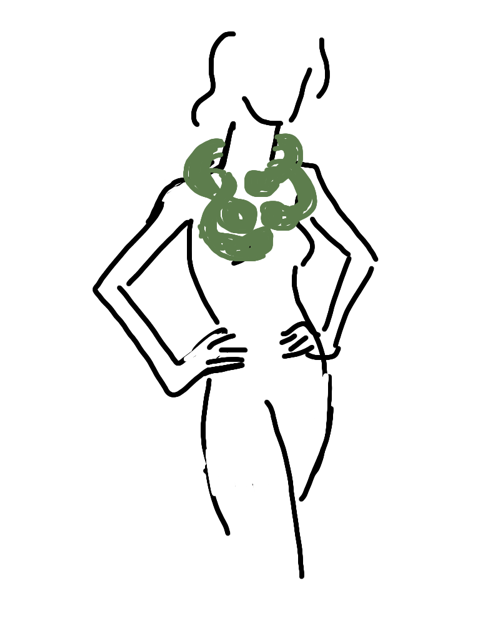
Squash fashion

Squash fashion

Daniel’s paintings are often stunning, and always interesting. Like the best contemporary conceptual art, they invoke inversions of our usual ways of thinking. But whereas that art is sometimes thin to the point of obviousness, Daniel’s paintings are rich and generative. They invite repeated viewing and study.

One might instead think of the traditional style of art prevalent in Cape Cod galleries–seascapes and boats, wildflowers and ponds, portraits and houses. Daniel’s work then appears anarchic, conversing in some of the same language, but with an exotic dialect and a unsettling vocabulary.

New directions

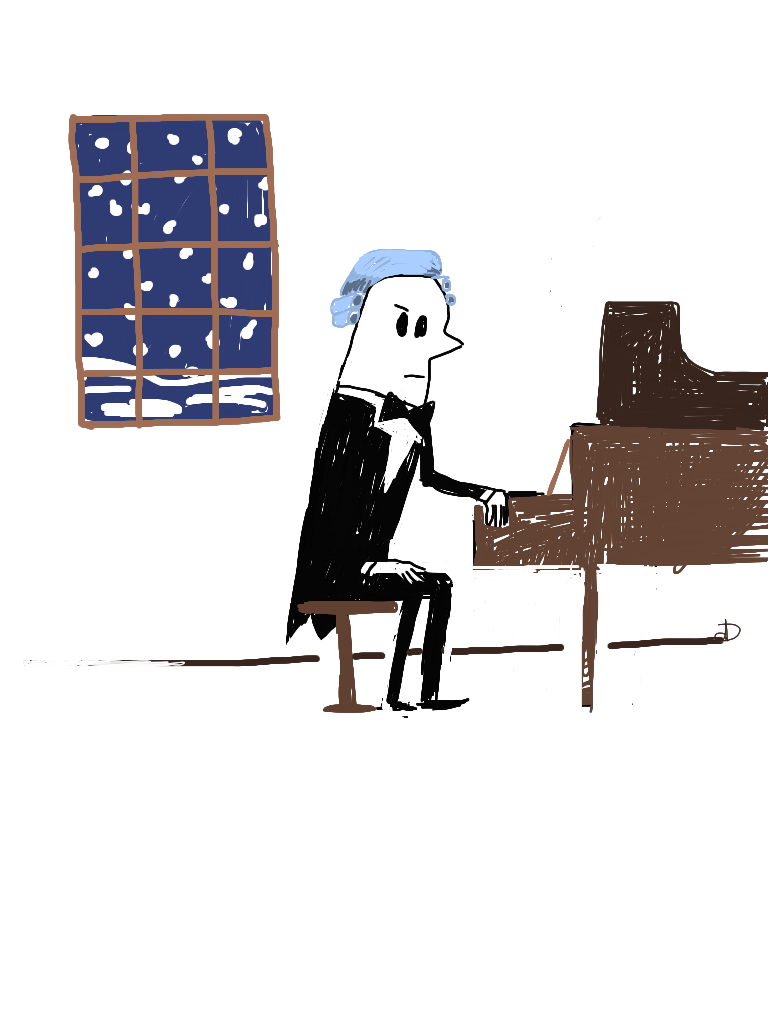
Mozart on a snowy evening

Mozart on a snowy evening


Daniel’s artistry has recently expanded into what appears to be a new and growing venture, cartooning. I first became aware of this when his tromboncino cartoons, such as “Squash fashion” (above), began spreading uncontrollably across the ether. Whatever the topic, DeJean cartoons began to capture the essence of what was happening, bringing together humor, critique, and insight. I especially like his “Mozart on a snowy evening,” but also a new one about the major sport on Cape Cod this winter.

Skiing on the backside

Skiing on the backside

Some of Daniel’s graphic art has assumed a programmatic direction. For example, Women Directors: Navigating The Hollywood Boys’ Club, developed by Maria Giese and Heidi Honeycutt, is a website for people to share experiences with discrimination and explore strategies to create gender equity among directors of film, television and new media. It is “the world’s foremost website to explore, expose and remedy discrimination against women directors – because global culture depends on who tells the stories.” Daniel has created a wonderful series of graphic representations that tell the story in a succinct and memorable way.

Where are the women directors?

Where are the women directors?

Women directors: The coming tsunami

Women directors: The coming tsunami

Restoring the Chestnut

The Chestnut canoe company of Fredericton, New Brunswick, was a preeminent producer of wood and canvas canoes. Teddy Roosevelt purchased their canoes for his South American expedition. Before aluminum, fiberglass, ABS, Kevlar, and other synthetic materials, Chestnut used wood to make canoes for every purpose.

Around 1954, they produced a green Prospector Garry, serial number CHN47317M75J, 8770HF. I don’t know all the waters that boat traveled, but somehow it wound up as a display item at Wilderness House, an outfitter on Commonwealth Avenue in Boston. Hanging from the rafters as a signature trophy was some kind of honor, I suppose.

However, Prospectors were canoes made to be used–for work and expeditions. They had no keel, high gunwales, and wide ribs and other features to make them whitewater capable. They could carry a half ton of people and cargo. Unlike canoes made from most of the new materials, wood-and-canvas canoes are infinitely varied, beautiful, quiet, repairable, and sensual.

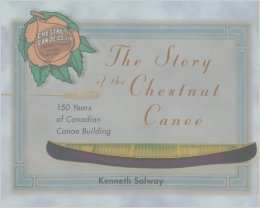
The Story of the Chestnut Canoe

The Story of the Chestnut Canoe

Three decades after it was made, my friend Brian Smith called from Wilderness House. He said that WH had decided to sell the Prospector and that he was waiting in line to buy it for me. There was a clear assumption that I would come up with the cash. His action was simply to make sure I didn’t lose the opportunity, not a major gift. And Brian already had a Chestnut himself. So, shortly before Emily and Stephen were born I adopted a 30 year-old canoe.

It’s an oxymoron today to say “whitewater, wood-and-canvas canoe.” But before the 1950s, wood-and-canvas was the material of choice. We took this particular canoe on some rough waters, including the Oxtongue River in Ontario, although to be honest, we didn’t run Ragged Falls.

The canoe performed well in every setting, in salt water, ponds, and rivers; in wind and rain, carrying four people or one. But like everything it aged. There were some small dings from expeditions; the paint faded and peeled; the canvas sagged; some gunwales had separated; and two ribs broke, probably during our move to Massachusetts. It was time for a makeover, for what was now a 60 year-old canoe.

Walter Baron, a neighbor and expert boat builder, agreed to take on the task. In the photos below you can see some steps in the process. Walter removed the canvas and stripped the inside.

I asked him to add a beautiful new portage yoke I purchased from Essex Industries in New York. Essex is a sheltered workshop, which unfortunately is facing difficult times. It seems to be one of the success stories for that type of facility.

Today, we took final delivery on the rejuvenated and now, brick red, Chestnut Prospector. I wanted to try it out, even in the cold, but the local ponds are covered in 14″ of ice. So it now hangs in our garage. much as it did at WH, but knowing that its true destiny is to be loaded with gear, carrying its passengers silently and safely wherever their adventure leads them.

This slideshow requires JavaScript.

The Chestnut family started marketing canvas canoes in the late 1890′s in Fredericton, New Brunswick. The early Chestnut canoes were modeled after a canoe built by B. N. Morris, and indeed, these early canoes clearly show the influence of Morris canoes. . . The Chestnut factory burned down in December of 1921, and was quickly rebuilt. Chestnut Canoe Company and Peterborough Canoe Company merged under the holding company Canadian Watercraft Limited. Canadian Canoe Company joined them in 1927. . . Chestnut shipped its last canoes in early 1979, then closed. Most of the Chestnut molds survive, and are being used in several wooden canoe shops in Canada. For more details about the history of the Chestnut Canoe Company, see Roger MacGregor’s book When the Chestnut was in Flower. via Chestnut Canoe Company.