My blog now has a new address: chipbruce.net. The old address, chipbruce.wordpress.com, should continue to work as well, just redirecting to the new one.
Author: chipbruce
Inquiry-based learning concepts
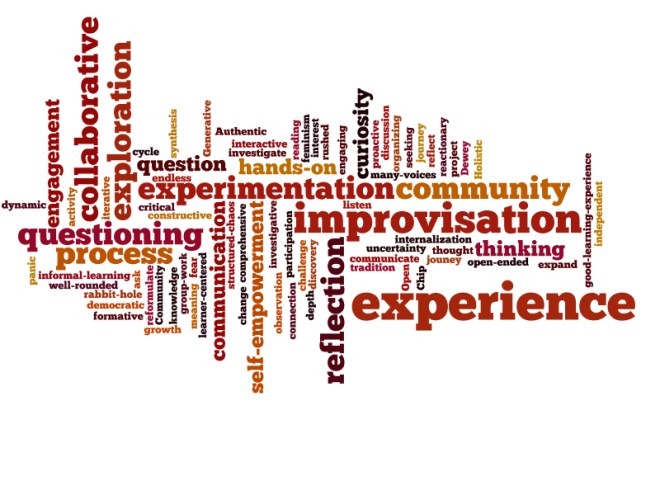
We talked in my class Monday about the terms that help us describe inquiry-based learning, or that derive from thinking about it. Students made their individual lists, then shared those with a partner, then in the group as a whole. There was to me a surprising diversity of responses, but with a sense that the different clusters of words were mutually reinforcing.
Below is a tag cloud we made of the terms. We could have added “fallibilism,” “adventure,” “moral,” “trust,” “dialogue,” “reciprocity,” and others. We also agreed that it’s the connections among the terms that really matter. Nevertheless, it was interesting to turn this mirror on our class dialogue over the semester.

Technologies to improve the quality of life
Gary McDarby was one of many very impressive people I met during my stay in Ireland during 2007-08. If you watch this short video, I think you’ll understand why.
It’s amazing how he manages to introduce several important projects in a short time, including Camara, SMART, and the Computer Clubhouse.
Prepare yourself for some tears.
Gary writes:
as many of you know, on the 7th of August 2009 Stuart Mangan and Robert Stringer passed away. I had been working with Stuart on technologies to help improve his quality of life (he had suffered a severe spinal injury in 2008) and Robert Stringer had been taking a holiday after volunteering with Camara in Tanzania when he was killed. In a strange twist of fate they died on the same day.
I have been giving a series of talks on these events with the sole of intention of trying to create something positive out of what was a very sad and challenging time. First and foremost I want to pay tribute to these two wonderful young men.
Recently I gave an IGNITE talk in the Science Gallery on what happened. It’s a short, 5 minute format which is quite a challenge to do, especially if the subject matter is non trivial.
I wanted to try and create something meaningful in this short format so it could be passed around in the viral ways we are all so used to. Its by no means perfect but please feel free to pass it on. The talk is here:
GSLIS gardens

Thanks to Mojgan Momeni, a garden is emerging this Spring at GSLIS.
As you can see in these photos (also by Mojgan), there are begonias, some perennials and annuals, hostas, and flowers of various kinds. There’s even a small tree.


Dorothy Height, Unsung Heroine of Civil Rights
Dorothy Height, a leader of the African-American and women’s rights movements died on Tuesday at age 98. Her obituary in the New York TImes is a tribute to a courageous and powerful figure in American history, who did enough to fill several ordinary lifetimes:
Dorothy Height, Unsung Heroine of Civil Rights Era, Is Dead at 98 – Obituary (Obit) – NYTimes.com.
Inquiring and acting
John Dewey makes an interesting distinction between understanding and information:
An individual may know all about the structure of an automobile, may be able to name all the parts of the machine and tell what they are there for. But he does not understand the machine unless he knows how it works and how to work it; and, if it doesn’t work right, what to do in order to make it work right…Understanding has to be in terms of how things work and how to do things. Understanding, by its very nature, is related to action; just as information, by its very nature, is isolated from action or connected with it only here and there by accident. (Dewey, 1937, p. 184)
If we line up “how things work” with inquiry and “how to do things” with action, we have a good summary of the
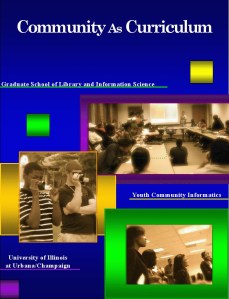
Youth Community Informatics activity guide, Community as Curriculum. It’s set up with units on Youth as Inquirer and Youth as Activist.
An example might be to study the problem of alcoholism in your community (Inquirer), then make a book about it, such as This is the Real Me (Activist). Several thoughts occur to me:
- The inquire/act distinction is not absolute; it’s hard to come up with a good example in which the two roles are not blended and mutually supportive. But it can still be useful for reflecting on our work, and thinking about future directions for community informatics.
- The Inquirer part goes well beyond what usually happens in school in terms of relevance, connectedness, community base, and so on. But the Activist part rarely happens at all.
- Much of the research in social informatics, and even community informatics, which studies community use of ICTs, digital divide, or demographic patterns, tends to “name all the parts of the machine and tell what they are there for.” That can be useful, just as it would be for an automobile.
- But, if we seek understanding in Dewey’s sense, we need more of a community inquiry approach.
References
Dewey, John (1937). The challenge of democracy to education. In The collected works of John Dewey, 1882-1953. Electronic edition. The Later Works of John Dewey, 1925-1953. Volume 11: 1935-1937, Essays, Liberalism and Social Action. [First published (February 1937) in Progressive Education 14, 79-85, from a transcript of an address on November 13, 1936 at the Eastern States Regional Cnference of the Progressive Education Association in New York City.]
Inquiry-based community engagement
Melissa Pognon just alerted me to an interesting article by David Low, on university-community engagement. It presents a dialogical, or inquiry-based, view of engagement, drawing from communication theory and Perice’s theory of inquiry. Low emphasizes that
we do not ‘transfer’ or ‘transmit’ knowledge between social systems, but, rather, we engage a method that enables the recognition of a shared object of enquiry – its entelechy (Nicholls 2000) (p. 108).
This shared enquiry must not only tolerate dissent or difference, it actually depends on dissent to function at all. Such a view is radically different from the dominant university discourse around topics such as “knowledge transfer,” “public outreach,” or “service learning.”
Low writes,
without a method to nurture and reveal dissent, universities would be unable to even recognise different ways of being in the world, and enquiry would be rendered impossible (Hawes 1999, p. 235) (p. 111).
I find myself drawn initially to 2×2 tables such as the one Low presents in his grid-group, then later becoming frustrated with all that they obscure as well as reveal. But the article as a whole has many useful insights.
References
Hawes, L. (1999). The dialogics of conversation: Power, control, vulnerability. Communication Theory, 9(3), 229–264.
Low, David (2008). University-community engagement: A grid-group analysis. Gateways: International Journal of Community Research and Engagement, 1, 107-127.
Nicholls, A. (2000, September). The secularization of revelation from Plato to Freud. Contretemps, 1, 62–70.
Peirce, Charles S. (1877, November). The fixation of belief. Popular Science Monthly, 12, 1-15.
Outside lies magic, Part 2
I wrote most of my last post while flying from San Francisco to Chicago. Flipping through the airline magazine, the essay by Gerard J. Arpey, “The world is a book” caught my eye. It’s from St. Augustine: “The World is a book, and those who do not travel read only a page.” That seemed to be the message of Stilgoe’s Outside lies magic.
But on reading the essay, I encountered another quote that seemed hugely at odds with my own experience at the time. It’s from Antoine de Saint-Exupery’s Wind, sand, and stars, writing about airplanes:
The central struggle of men has ever been to understand one another, to join together for the common weal. And it is this very thing that the machine helps them to do! It begins by annihilating time and space.
Yes, the machine, the airplane, was annihilating time and space, but it was doing so by destroying my connection to the world around me. Instead of seeing more deeply as Stilgoe recommends, I found myself seeking ways to ignore the drone of the engines and the constant pressure on my knees from the seat in front of me. Saint-Exupery’s means for promoting our common humanity has become a factory ship processing fish.
Outside lies magic, Part 1
Gesa Kirsch recently pointed me to John R. Stilgoe’s, Outside lies magic: Regaining history and awareness in everyday places. It’s a refreshing call for becoming more aware of the ordinary world around us. Stilgoe urges us not only to walk or cycle more, but also to use the advantages of those modes of transport to see the world that we usually ignore.
I finished the book, and am writing now, in the antipode of his call to walk and observe. I’m cramped in an airplane seat near the end of a four and a half hour flight. Stilgoe would say that I should still take the opportunity to observe, to learn, and to make sense of my surrounding, but instead I’m counting down the minutes until we land.
The chapters—Beginnings, Lines, Mall, Strips, Interstate, Enclosures, Main Street, Stops, Endings—lie somewhere between prose poems, history lessons, and sermons about the everyday. They remind me of John McDermott’s summary that John Dewey “believed that ordinary experience is seeded with possibilities for surprises and possibilities for enhancement if we but allow it to bathe over us in its own terms” (1973/1981, p. x).
To appreciate the book, you need to follow Stilgoe as he discovers nature, history, urban planning, ethics, social class, and more through cracks in the pavement, vegetation, telephone poles, roadside motels, angle parking, and other seemingly forgettable objects. The real point is not his own findings, but the demonstration that slowing down to look can open up worlds of understanding.
He shows the value of a camera, despite the lament that “ordinary American landscape strikes almost no one as photogenic” (p. 179). He recognizes the dread of causal photography (‘why are you photographing that vacant lot?’), but ties it to “deepening ignorance” (p. 181). This ignorance makes asking directions dangerous: People question us back, ‘Why do you want to know?’

Stilgoe says, “discovering the bits and pieces of peculiar, idiosyncratic importance in ordinary metropolitan landscape scrapes away the deep veneer of programmed learning” (p. 184). Unprogrammed exercise and discovery leads to a unified whole that reorients the mind and the body together. Someone else may own the real estate, but “the explorer owns the landscape” (p. 187).
Stilgoe’s prescription is simple:
Exploration encourages creativity, serendipity, invention.
So read this book, then go.
Go without purpose.
Go for the going.
See Outside lies magic, Part 2.
References
- McDermott, John J. (1981). The philosophy of John Dewey: Two volumes in one. Chicago: University of Chicago Press. (Originally published 1973)
- Stilgoe, John R. (1998). Outside lies magic: Regaining history and awareness in everyday places. New York: Walker.
Youth planners in Richmond, CA
I was fortunate to have a visit with youth planners at the Kennedy High School in Richmond, CA on Wednesday this week. These were students studying their own community and developing plans to improve it. They’ll be presenting these plans to the Mayor next month.
What I saw is part of Y-PLAN (Youth — Plan, Learn, Act, Now), a city planning program run by UC Berkeley’s Center for Cities & Schools. Deborah McKoy is the creator of Y-PLAN and the center’s founder and executive director.
Sarah Van Wart from the UC Berkeley I School was my guide. She and two undergrads, Arturo and Sarir had been leading the high school students in a community planning exercise. They first examined their current situation, using dialogue, photos, and data. They then considered alternatives and how those might apply to a planned urban development project.
The development will include schools, housing, a park, and community center, but the questions for city planners, include “How should these be designed?” “How can they be connected?” “How can they be made safe, useful, and aesthetically pleasing?”
On the day I visited, the youth had already developed general ideas on what they’d like to see in the development. Now they were to make these ideas more concrete through 3-D modeling. Using clay, toothpicks, construction paper, dried algae, stickers, variously colored small rocks, and other objects, they constructed scale models of the 30 square block development. One resource they had was contact sheets of photos of other urban environments. They could select from those to include as examples to emulate or to avoid.
I was impressed with the dedication and skill of the leaders of the project, including also the teacher, Mr. G. But the most striking thing was how engaged the young people were. I heard some healthy arguing about design, but I didn’t see the disaffection that is so common some high schools today.
My only regret is that I wasn’t able to follow the process from beginning to end. But from the rich, albeit limited, glimpse I had, the project is an excellent way to engage young people in their own communities, to use multimedia for learning and action in the world, and to learn how to work together on meaningful tasks. It’s a good example of community inquiry.
Sara Bernard has a more detailed article on the project on Edutopia, which includes an audio slide show:
References
Bernard, Sara (2008, October). Mapping their futures: Kids foster school-community connections.
Bierbaum, Ariel H., & McKoy, Deborah L. (2008, Spring). Y-PLAN: A tool for engaging youth and schools in planning for the future of their communities. IMPACT: A Multidisciplinary Journal Addressing the Issues of Urban Youth, 2(1).
McKoy, Deborah, & Vincent, J. 2007. Engaging schools in urban revitalization: The Y-PLAN (Youth-Plan, Learn, Act, Now). Journal of Planning Education and Research, 26, 389-403.