Voyages with the Rob Roy

rob_royI had shoulder surgery on August 18, so my days of paddling through rapids or hoisting a canoe on my shoulders need to be postponed. As a substitute, I’ve been reading A thousand miles in the Rob Roy canoe on rivers and lakes of Europe (1866), by John Macgregor (1825-1892).
singers_wagonMacGregor himself led a life that sounds like an overdone adventure yarn. At the age of three months, he was rescued from a burning ship whil een route to India with his parents. At the age of 12, he helped launch a rescue boat for a ship in distress off Belfast, then slipped aboard secretly a the last moment to help out. He grew up sailing, boat-building, riding, reading, and experimenting with home-made steam engines, batteries, and chemicals that led to several major explosions. He attended seven schools before graduating from Trinity College, Dublin in mathematics. He traveled throughout the world, fighting Greek pirates and crocodiles, climbing Mont Blanc, Etna, and Vesuvius. He won awards for sharpshooting, drew for Punch and illustrated books, and wrote his own books on marine propulsion, patent law, travel, and transcriptions of Syrian and Egyptian melodies he had heard in his travels.

MacGregor built a hybrid canoe / kayak with a sail and a double-bladed, kayak paddle which he named the “Rob Roy”. He then paddled through the rivers, lakes and canals of Germany, France and Switzerland, portaging between waterways on a cart or on trains. His account of the journey became a best seller and was the beginning of the recreational canoeing movement. His trip inspired many, including Robert Louis Stevenson, who made his own voyage in a Rob Roy, and then wrote about it in his first published book, An inland voyage.

morningMacGregor’s account portrays a Europe with only distant resonance to today. Instead of shopping centers and freeways, there were people cutting hay with hand tools. Instead of the Web, there were newspapers, 3241 in Germany alone.

A thousand miles displays a buoyant optimism and refreshing sense of discovery. MacGregor talks of “a strange feeling of freedom and novelty which lasted to the end of the tour,” (p. 15), and throughout, of a reverence for the canoe, which I share:

Something like it is felt when you first march off with a knapsack ready to walk anywhere, or when you start alone in a sailing-boat for a long cruise.

But then in walking you are bounded by every sea and river, and in a common sailing-boat you are bounded by every shallow and shore; whereas, I was in a canoe, which could be paddled or sailed, hauled, or carried over land or water to Rome, if I liked, or to Hong-Kong. (p. 15)

digueI also like his descriptions of wildlife, for example of herons “wading about with that look of injured innocence they put on when you dare to disturb them.” (p. 35) Later, he refers to a gathering including the

long-necked, long-winged, long-legged heron, that seems to have forgotten to get a body, flocks by scores with ducks of the various wild breeds, while pretty painted butterflies and fierce- looking dragon-flies float, as it were, on the summer sunbeams, and simmer in the air. (p. 71)

At the village of Geisingen it was discovered that the boiler of my engine needed some fuel, or, in plain terms, I must breakfast. (p. 59)
meuseMacGregor’s challenges along the way become not discouragements, but the very stuff of the journey. He  reminds me that a broken shoulder is just a toss on the billows, one that can be an opportunity to learn:

It is, as in the voyage of life, that our cares and hardships are our very Mentors of living. Our minds would only vegetate if all life were like a straight canal, and we in a boat being towed along it. The afflictions that agitate the soul are as its shallows, rocks, and whirlpools, and the bark that has not been tossed on billows knows not half the sweetness of the harbour of rest. (p. 37)

Which side of the road do they drive on?


Map of the world showing the driving directions for all countries and any changes that have occurred, beginning with Finland’s change in 1858
     drives on right      drove on left, now drives on right      drives on left      drove on right, now drives on left      had different rules of the road within borders, now drives on right

[Map from Right- and left-hand traffic]

While working at the National College of Ireland, I got into a lunchtime discussion about driving, in particular, about why some countries, such as Ireland, drive on the left and others, such as the US, drive on the right. None of us could even say with much certainty how many people in the world did it one way or the other. Seemingly simple questions led to many jokes, confident pronouncements, and further questions about changeovers, what boats and planes do, and so on.

As I began to look into it more, I realized this was yet another example of how simple questions can lead to interesting inquiries without end. One of the most interesting sources I came across was a website, Which side of the road do they drive on?, edited by Brian Lucas, and based in large part on The Rule of the Road: An International Guide to History and Practice by Peter Kincaid. Here’s an excerpt from the site:

The side of the road one drives on seems to be one of those mundane details of everyday life which people take for granted and never bother to write down. In his book, Kincaid comes up with a blank: “I have been unable to discover any firm evidence as to what the rule of the road was in any part of the ancient civilizations in Greece, Rome, or Assyria. It seems inconceivable that there was not one.” We have found, however, evidence that the ancient Romans drove on the left.

In late 1998, the remains of a Roman quarry was discovered at Blunsdon Ridge, near Swindon, England. It is one of the largest and best-preserved Roman quarries known. Ruts in the road leading to this quarry are much deeper on one side of the road than on the other. If it can be assumed that the side of the road with deeper ruts was the side used by loaded carts leaving the quarry, while the side with shallow ruts indicates empty carts arriving, then we can conclude that at this particular location, at least, the Romans drove on the left. (Sources: a web page in the SwindonWeb Local News Archives for October 1998 which has since disappeared, and an article by Gwynne Dyer, Is driving on the right right or wrong?, from 1999.)

Another piece of evidence comes from a Roman coin. Robert Pease writes that he has seen a picture of a denarius from between 50 BC and 50 AD showing two horsemen riding past each other, right shoulder to right shoulder (i.e. each keeping to the left side of the road).

It was amazing to me to learn how this simple practice connects with our physical characteristics, modes of transportation, revolution and empire, warfare, commerce, and many other aspects of daily life.

Nea, neo: losing planes and finding museums

I’m now completing a wonderful, two-week trip to Turkey and Cyprus. Unfortunately, the return journey isn’t uniformly wonderful.

I arrived in Athens, from Larnaca, Cyprus, following a drive from Limassol to Larnaca. I’d been up since 3 am and it was now 9 am.  I anticipated a 4-hour layover, with nothing much to report. But a delay on the Athens-Philadelphia segment turns that into a 10-hour layover, which causes me to miss the flight to Indianapolis. USAir has booked me for a 10:30 am flight from Philadephia tomorrow. This means the 27-hour travel time I had braced myself for is turning into 44 hours, assuming that everything from here on goes well.

airplaneI considered going into Athens for the day, but between the lack of sleep and my carry-on stuff, I decided to stay at the airport. Unfortunately, it’s hot and humid, so walking around isn’t a great option. Moreover, it’s very crowded and there are no places left to sit.

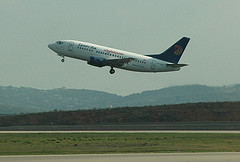
I’m sitting on the floor at this moment, both to get away from all the smoke and to take advantage of one of the few electrical outlets. People walking by give me amused looks, undoubtedly out of jealousy for the great spot I found. They know that the hard floor is still much better than the cramped seating that USAir offers on its 11-hour flight. All in all, the situation offers an ideal opportunity to be annoyed. (Photo shows some plane actually taking off from Venizelos airport&mdash:it’s not my plane, which is lost somewhere).

It’s probably an indication of fatigue and sleep deprivation that I’ve begun noticing odd connections. My flight is marked as Νέα, which I think is short for “nea hora” or new hour/time. Upstairs the Νέο McCafe offers surprisingly the most attractive option for sitting.

And then I discovered a new Airport Museum, which helped me forget the travel vagaries. It chronicles the history of the Spata area, where the airport is built.

Things To Do [when your plane is delayed six hours]: Visit the airport mini museum. Athens International Airport “Airport Museum” presents the continuity of life in the rural Messogia plains and its evolution through 172 archaeological findings discovered in the excavations undertaken during airport construction, and dating from the Neolithic and Early Helladic through the Post-Byzantine period.

I’m using Otenet, which claims to offer many Νέο features. So I feel I’m being immersed in neo/nea-ness, even though I’m not sure I understand exactly what’s new and what’s late, other than my plane.

I also discovered a separate exhibit on Eleftherios Venizelos, for whom the airport is named. He was a prominent statesman of the early 20th century, who helped to create the Νέο Greece we know today.

What we do not know: The betrayal of our values

I returned to the US in June after living a year living in Ireland. Many people have naturally asked, “What was it like? How was it different? What did you learn?”

It’s hard to know where to begin. I may have learned as much about myself and my home country as about Ireland, or other countries I’ve visited. And, mostly, if I learned anything, it was how much I don’t know about other people and places. As Confucius says: “To know that we know what we know, and that we do not know what we do not know, that is true knowledge.”

Our Hollywood Self-Image

But one specific thing I’ve become more aware of is a gap between what most Americans conceive as their moral stance on the world and what many abroad see as our actual practice. I suspect that many of us in the US identify with Jefferson Smith in Mr. Smith Goes to Washington. He’s decent, naive, idealistic, earnest, fair, caring, and above all honest, embodying all the American small town values. He’s not sophisticated or slick, but he’s the kind of person you’d like to have as a friend or trust for political leadership. Mr. Smith asks us to adhere to “just one, plain, simple rule: Love thy neighbor” and reminds us that “there’s no compromise with the truth.”

What’s interesting today is that many abroad would also identify with Mr. Smith. And they admire the US for modeling his values, offering hope for other countries. They recall our promotion of the Kellogg-Briand pact, the struggle against authoritarian regimes, the Nuremburg trials, the United Nations, the Geneva Conventions, as concrete examples of how we have stood for truth, peace, courage, and justice, just as Mr. Smith might have wanted. Their values are our values; their people are our people.

But then, we part ways, because of something many Americans do not know. Continue reading

Reading versus first-hand experience

Three thoughts regarding reading and first-hand experience:

MUCH have I travell’d in the realms of gold,
And many goodly states and kingdoms seen;
Round many western islands have I been
Which bards in fealty to Apollo hold.
Oft of one wide expanse had I been told
That deep-brow’d Homer ruled as his demesne:
Yet did I never breathe its pure serene
Till I heard Chapman speak out loud and bold:
Then felt I like some watcher of the skies
When a new planet swims into his ken;
Or like stout Cortez, when with eagle eyes
He stared at the Pacific—and all his men
Look’d at each other with a wild surmise—
Silent, upon a peak in Darien.
—John Keats, “On first looking into Chapman’s Homer”

No book or map is a substitute for personal experience; they cannot take the place of the actual journey. The mathematical formula for a falling body does not take the place of throwing stones or shaking apples from a tree.
—John Dewey, Schools of tomorrow

There are some who say that sitting at home reading is the equivalent of travel, because the experiences described in the book are more or less the same as the experiences one might have on a voyage, and there are those who say that there is no substitue for venturing out in the world. My own opinion is that it is best to travel extensively but to read the entire time, hardly glancing up to look out of the window of the airplane, train, or hired camel.
—Lemony Snicket, Horseradish: Bitter truths you can’t avoid

Dodder birds

Dodder walkFor much of my time here in Dublin, I’ve walked to work alongside waterways. First, it was the Liffey River. Then for a long time it was the Dodder, the second large, remaining, and still aboveground river in Dublin. Sometimes, it has been the Grand Canal. Each of the waterways has its collection of birds, the best being those along the Dodder.

I would often see a grey heron just downstream from the bridge near our apartment. There is also a pair of mute swans, who swim almost always close together, but every few weeks they have a day when they separate by a half mile. There are two main types of gulls, one I think being a Galway gull. swan in DodderThey’re fond of standing on the walkway’s stone railing, until I’d get with 44.5 inches, or was it 46.3?

Near where the Dodder joins the Liffey, I occasionally see cormorants. Further upstream mallards are very common and also moorhens, but they’re a little harder to see because they hang out below the brush near the bank. Magpies will also come down to the water at times.

mallardNote: The distant, red cranes in the photo of the walkway aren’t the feathered kind.

Earth Hour, Dublin

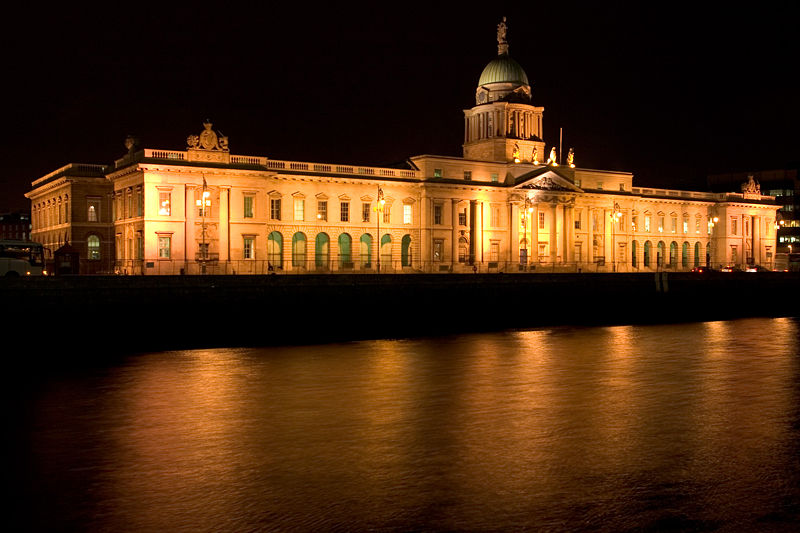
Custom HouseIn about an hour, it will be Dublin’s turn to participate in Earth Hour. The event started last year in Sydney when residents and businesses turned off their lights for one hour as a statement about global warming. This year, 28 cities will participate, each at their 8 pm on March 29. The event is described as a way to highlight “simple changes that will collectively make a difference.”

.

Dublin at nightI thought this was a good opportunity to post some Dublin at night photos before we have to turn off the lights here. They’re beautiful scenes, but also remind us of the energy demands of modern cities.

I hope that Earth Hour will live up to its expectations, but fear that it may turn out to be no more than another fun event and a way for all of us to feel good, without addressing the fundamental changes needed to treat our planet and our children more kindly.

O’Connell Street SpireThe photos are not my own, but are used under Creative Commons licenses. On the upper right is the Custom House by Jimmy Harris. It’s near to where I work. The O’Connell Street bridge at the left is by Hans-Peter Bock. And on the bottom right is the Spire of Dublin, further up on O’Connell Street, by Peter Guthrie.

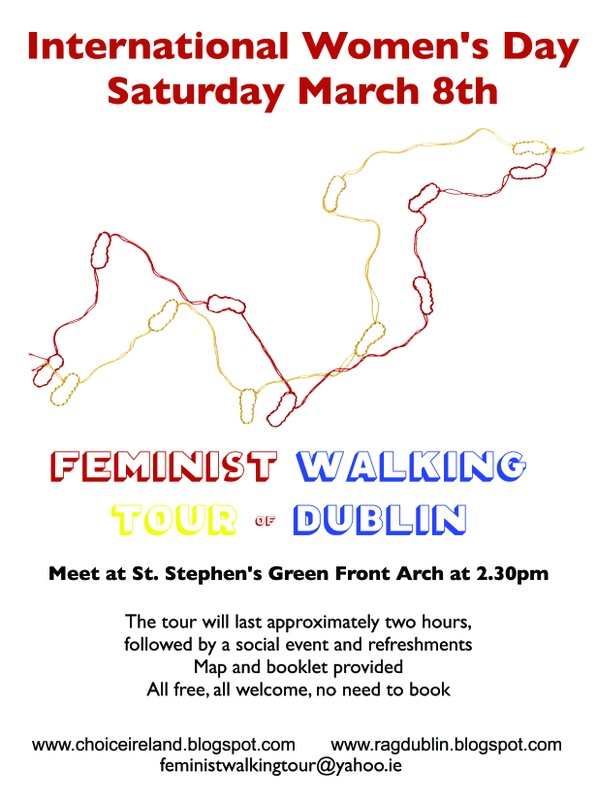
Feminist Walking Tour of Dublin

Yesterday was International Women’s Day. Among the many events worldwide was the Feminist Walking Tour of Dublin. It sounded interesting when I heard about it just the day before, but I was hesitant to go: It had been an exhausting week between my mom’s recovery from a hip fracture and my preparing a lecture on education and community for Wednesday evening. The weather forecast promised rain; there was a Six Nations rugby match (best not discussed after yesterday); and I wasn’t certain I’d be welcome on the tour, not knowing anyone else there.

Feminist Walking Tour of Dublin posterFortunately, and without any doubt in the end, I made the right decision. It turned out that there was not only an enlightening and enjoyable tour, but soup and sandwiches afterwards at the Teachers Club, short movies, a distro (books, zines, and other publications), music, and lots of good discussion.

I had the impression that the organizers expected 20-30 people to show up. But there were at least 120, maybe up to 150, not counting various people who joined in for brief times along the way. What was planned as one group turned into two with an impressing display of organization on the part of Choice Ireland and the RAG collective. One organizer pointed out that their non-hierarchical structure made it easier to respond to unexpected events.

My group was led by Carol Hunt, a history postgraduate student at Trinity and writer for the Irish Independent. She was an excellent guide, leading us from St Stephen’s Green, to the Mansion House, Trinity College, O’Connell St, the Garden of Remembrance, and other spots, each being important sites for women’s history in Ireland. At various stops, others presented on issues such as immigrant rights or women’s centers masquerading as offering full reproductive counseling while in fact proselytizing. I learned far too much to try to convey here, but you can see the tour map and background information in a beautiful and very well-designed booklet, which should still be available in hard copy or pdf.

The tour was bracketed by two precipitations. In the beginning, we were standing next to the seat honoring Louie Bennett and Helen Chenevix. Bennett, a novelist, pacisit, and labor organzer, helped found the Irish Women’s Suffrage Federation, played an active role in the Dublin lockout, helped found the Irish Women’s Reform League, and was active for years in the Irish Women Workers’ Union. As Carol began talking, we had a brief burst of hail. Someone called out that God was a male and He was not pleased!

Then, at our last stop, someone threw potatoes from an upper story window, injuring one of the people on the tour. It’s amazing how cowardly some people can be and how afraid they are of others simply trying to learn.

After the tour, there was a social event in the Teacher’s Club at Parnell Sq. We saw two short films, including The Future of Feminism, by Cara Holmes and Breaking the Silence, by Katie Gillum. There was good music from Heathers, some of which you can hear on their Myspace site. I’m still working to complete all of the exercises in the activity booklet for children designed by Aileen Curtin!

I include the video below only because it gives a taste of the time of Countess Constance Markievicz. I learned on the tour that of all the great women in Irish history, and of all the many statues in Dublin, she is the only woman to have one. All of the other statues of women are of fictional characters or the Virgin Mary.

Markievicz was second in command of the St Stephen’s Green Citizen Army force during the Easter Rising of 1916. Court-martialed afterwards, her potential execution was commuted to life imprisonment because of her gender. She famously replied: “I do wish your lot had the decency to shoot me.”

See more, with photos.

Aughavannagh and Glenmalure

Aughavannagh cottage

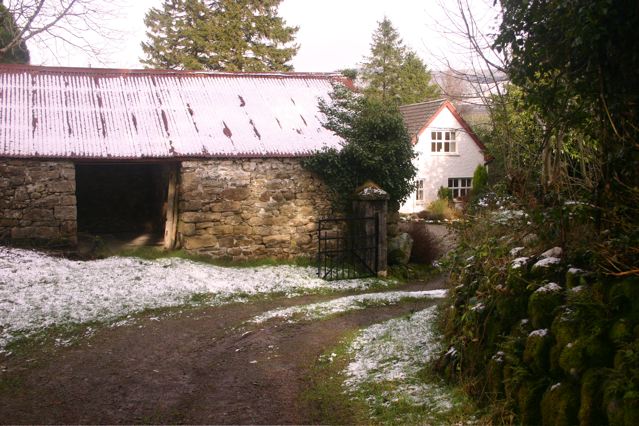
Our Ballsbridge apartment lease ran out at the end of January and the new apartment wasn’t available until 3 February. That meant that aside from badly needing a break, we were also homeless for three days. It became clear that this was a time to turn crisis into opportunity. We chose to make a long weekend of it, going to stay in a cottage in Aughavannagh in the Wicklow Mountains south of Dublin. You can see the cottage behind the shed, in the first photo.

Glenmalure mtns

Being in a valley, there was no mobile phone access, much less internet. As our rental car was not designed for the snow in the mountains, so we were about as isolated as one could be just 50 kilometers or so by air south of Dublin.

Glenmalure waterfall

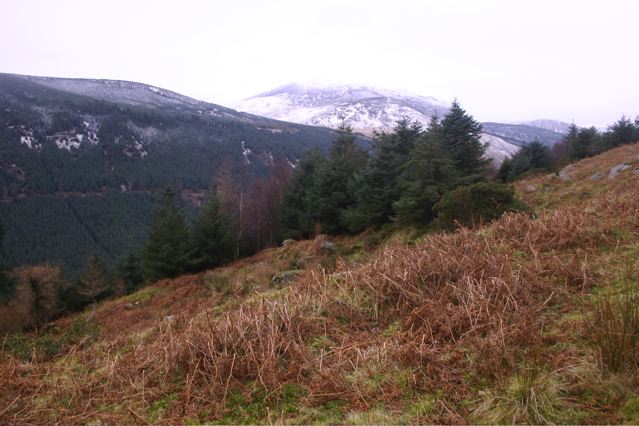
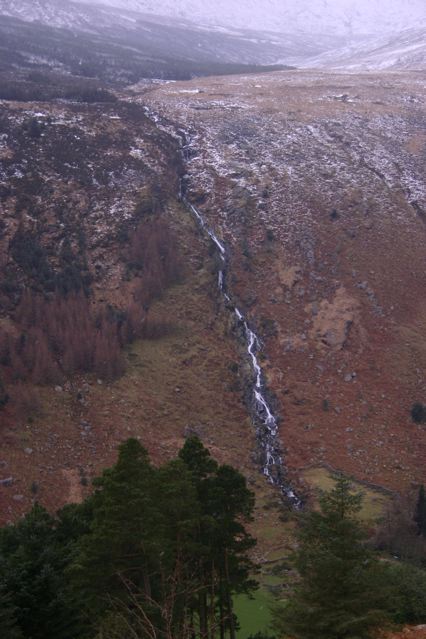
The weekend was cold, with light snows, rain, and ferocious winds at times. But we had a fireplace and plenty of fuel. At times the weather cleared enough for walks. One very delightful one was at Glenmalure, the longest glacial valley in Ireland and UK. It’s just east of Luqnaquilla, Wicklow’s highest mountain at 925m. There’s also the impressive Carrawaystick waterfall, down to the Avonbeg River (see left).

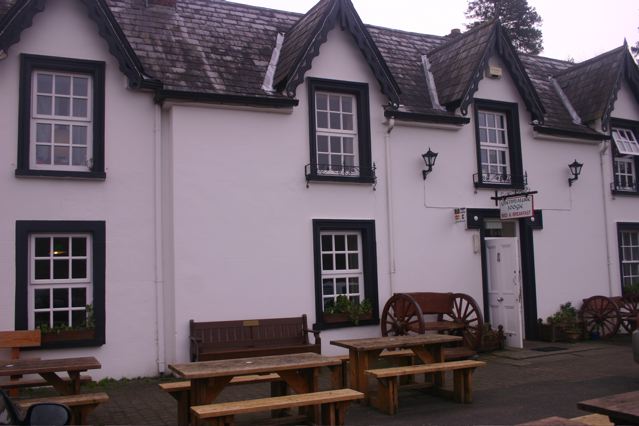
Glenmalure is not far south from Glendalough, an equally beautiful spot, but one that’s more heavily traveled. At the end of the walk we had an excellent pub lunch at the Glenmalure Lodge, where we had parked our car. That allowed us time to get back to watch Ireland v. Italy (rugby) on the telly. (We weren’t totally out of touch with the modern world!) Glenmalure Lodge

The radio museum in Howth

This could have been a post about a walk on the Cliffs of Howth, a small seaside town north of Dublin. Yesterday was a beautiful day, with a brisk wind and light cirrus clouds–a great day for a cliff walk if you don’t stand too close to the edge and if you watch your footing on the muddy track and wet rocks.

Pat and EmilyBut before we began the walk, we happened upon a wonderful small museum about the development of radio: Ye Olde Hurdy-Gurdy Museum of Vintage Radio. It’s in the Martelo Tower above the harbor, at one end of the cliff walk. Pat Herbert, the founder, is passionate about what he’s learned about radio, and communications in general, drawing everyone else into it. Susan adds:

Pat played a tape on which a group of amateur radio enthusiasts had recorded a conversation with the Space Shuttle Columbia during the few minutes it was over Ireland in 1983, 20 years prior to its tragic crash over Texas. One of the astronauts at the time was an amateur radio enthusiast, and Irish amateur radio people had spent hours trying to contact him. A visitor to the museum gave Pat the tape, which he owned only because his brother had been one of the 1983 radio buffs. The entire visit was like that, just one story after another… He had many stories, mostly directed at Emily. And, typically, at about 1:00, announced that it was about time for a cup of tea and biscuits. So we sat around and talked for a good while.

Howth cliffPat said that not many school groups come to the museum. That’s a shame, because the exhibits could be fascinating to young people as well as to those who lived through some of the times presented there. I think especially of young people in transition year programs (age ~15), who are doing new media projects, such as at the Suas Foundation’s excellent Bridge to College (B2C) programme . The museum would introduce interesting technologies as well as add an historical perspective.

Susan and EmilyWhen we did manage to set off on the hike we had a wonderful windy time, circling a good part of the Howth peninsula with grand views of the Ireland’s Eye and the Dublin harbor, and then making it up to the Ben of Howth. Eventually returned to the port in time for early dinner at The Oar House.