Creative democracy: Yes we can!

Yesterday’s election of Barack Obama as President of the United States was not only promising for our future, but was also a moving reaffirmation of all that America can be.

His Presidency may not fulfill all the dreams that the candidacy inspired; some things may not change at all. But it reminds me of what Thurgood Marshall said after the Brown v. Board of Education decision in 1954, which outlawed segregated schools. When asked what the Supreme Court ruling really meant, Marshall, said that in fact nothing had changed, except that henceforth, repeating the civil rights mantra, “the law is on our side”. In a similar way, Obama’s Presidency offers no guarantees, but does offer exciting possibilities in terms of uniting Americans and restoring America’s role in the community of nations.

The election of Obama is also a reminder that democracy is not a static system, but a process in need of continual renewal by all. Dewey (1976/1939, p. 230) expresses this in his essay, “Creative democracy: The task before us”:

Democracy as compared with other ways of life is the sole way of living which believes wholeheartedly in the process of experience as end and as means; as that which is capable of generating the science which is the sole dependable authority for the direction of further experience and which releases emotions, needs and desires so as to call into being the things that have not existed in the past. For every way of life that fails in its democracy limits the contacts, the exchanges, the communications, the interactions by which experience is steadied while it is also enlarged and enriched. The task of this release and enrichment is one that has to be carried on day by day. Since it is one that can have no end till experience itself comes to an end, the task of democracy is forever that of creation of a freer and more humane experience in which all share and to which all contribute.

Let’s have the audacity to hope that we are capable of creating of “a freer and more humane experience in which all share and to which all contribute.” I might add that John McCain’s concession speech was a gracious and thoughtful step in that direction.

References

Dewey, John (1976). Creative democracy: The task before us. In J. Boydston (Ed.), John Dewey: The later works, 1925-1953, volume 14 (pp. 224-230). Carbondale: Southern Illinois University Press. (Original work published 1939)

Kluger, Richard (1977, 1975). Simple justice. The history of Brown v. Board of Education and Black America’s struggle for equality. New York: Vintage Books.

LIS 590 IBL, Inquiry-Based Learning, Spring 2009

We’ve changed the format for my spring course, Inquiry-Based Learning. It was originally scheduled as a LEEP (online) offering, LIS 590 IBO, but will now instead be offered on campus as LIS 590 IBL. Please share this description with anyone who may be interested.

  • Course: LIS 590 IBL, Inquiry-Based Learning (CRN: 36880)
  • Instructor: Bertram (Chip) Bruce
  • Semester: Spring, 2009
  • Prerequisites: Graduate student status
  • Schedule: Mondays, 9:00-11:50 am, 109 LISB
  • Website: http://illinois.edu/goto/ibl

Inquiry-based learning is a powerful way of thinking about learning as it occurs in libraries, museums, community centers, homes, workplaces, or online, as well as in formal settings, such as schools and universities. It implies the creation of environments in which learners are actively engaged in making meaning through personal and collaborative inquiry. It does not ignore the usual focus on content/skills: “What should be taught?,” or method: “How should we teach?” but begins with even more basic questions about the nature of learning and life.

Because of this, considerations of inquiry-based learning lead directly to issues of lifelong learning, the nature of knowledge, purpose, social justice, and democracy. This broad sweep makes it impossible to encapsulate inquiry-based learning in a simple framework or method. But it is also an indication of its importance in defining ways of thinking about the meaning of community, the roles of teachers and students, the relations between school and society, and how learning and life go together.

In the course we will examine the nature of inquiry and of inquiry-based learning, drawing on philosophical, historical, and critical sources such as Jane Addams, John Dewey, Paolo Freire, and Myles Horton. We’ll read about, observe, and engage in inquiry-based learning. In the course of this, we’ll also consider challenges to inquiry-based learning, including those related to management, assessment, basic skills, cultural differences, and pedagogical goals.

John Dewey in Turkey: Lessons for today

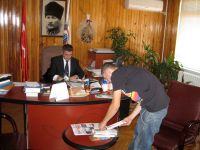
The Republic of Turkey was proclaimed on October 29, 1923. As its first President, Mustafa Kemal Atatürk (photo below) sought to establish the modern Turkey as a “vital, free, independent, and lay republic in full membership of the circle of civilized states.” He recognized the need for “public culture,” which would enable citizens to participate fully in public life, and saw the unification and modernization of education as the key. Accordingly, one of his first acts was to invite John Dewey, who arrived in Turkey just nine months after the proclamation.

In this endeavor, the ideas of Atatürk and Dewey were consonant. Dewey’s words above (“vital, free, …”) could have been written by Atatürk, just as Dewey might have talked about “public culture.” Both recognized the need to institute compulsory primary education for both girls and boys, to promote literacy, to establish libraries and translate foreign literature into Turkish, and to connect formal schooling, the workplace, and government.

Today is John Dewey’s 149th birthday. Back in 1924, he was nearing the age of 65, when many people think of retiring. But his three-month-long study in Turkey was an ambitious project. He addressed issues of the overall educational program, the organization of the Ministry of Public Instruction, the training and treatment of teachers, the school system itself, health and hygiene, and school discipline. Within those broad topics, he studied and wrote about orphanages, libraries, museums, playgrounds, finances and land grants for education, and what we might call service learning or public engagement today.

He laid out specific ideas, such as how students in a malarial region might locate the breeding grounds of mosquitoes and drain pools of water of cover them with oil. In addition to learning science they would improve community health and teach community members about disease and health. Workplaces should offer day care centers and job training for youth. Libraries were to be more than places to collect books, but active agents in the community promoting literacy and distributing books. In these ways, every institution in society would foster learning and be connected to actual community life. As Dewey (1983, p. 293) argued,

The great weakness of almost all schools, a weakness not confined in any sense to Turkey, is the separation of school studies from the actual life of children and the conditions and opportunities of the environment. The school comes to be isolated and what is done there does not seem to the pupils to have anything to do with the real life around them, but to form a separate and artificial world.

Atatürk saw the need to unify Turkey into a nation state, despite its great diversity. Dewey supported that but emphasized that unity cannot come through top-down enforcement of sameness (p. 281):

While Turkey needs unity in its educational system, it must be remembered that there is a great difference between unity and uniformity, and that a mechanical system of uniformity may be harmful to real unity. The central Ministry should stand for unity, but against uniformity and in favor of diversity. Only by diversification of materials can schools be adapted to local conditions and needs and the interest of different localities be enlisted. Unity is primarily an intellectual matter, rather than an administrative and clerical one. It is to be attained by so equipping and staffing the central Ministry of Public Instruction that it will be the inspiration and leader, rather than dictator, of education in Turkey.

This was realized in many ways. For example, the central ministry should require nature study, so that all children have the opportunity to learn about and from their natural environment, but it should insist upon diversity in the topics, materials, and methods. Those would be adapted to local conditions, so that those in a coastal village might study fish and fishing while those in an urban center or a cotton-raising area would study their own particular conditions.

Many of Dewey’s ideas were implemented and can be seen in Turkey today, as we come upon its 85th birthday next week. What’s even more striking to me is how relevant they are to the US today. Many of our problems can be traced to the “separation of school studies from the actual life of children and the conditions and opportunities of the environment,” but also to the separation of work from learning, of health from community, of libraries from literacy development, or of universities from the public. Dewey would be the first to argue that we need to re-create solutions in new contexts, but his report from long ago and far away still provides insights for a way forward today.

References

Ata, Bahri (2000). The influence of an American educator (John Dewey) on the Turkish educational system. Turkish Yearbook of International Relations (Milletlerarası Münasebetler Türk Yıllığı), 31. Ankara: Ankara Üniversitesi.

Bilgi, Sabiha, & Özsoy, Seckin (2005). John Dewey’s travelings into the project of Turkish modernity. In Thomas S. Popkewitz (ed.), Inventing the modern self and John Dewey: Modernities and the traveling of pragmatism in education (pp. 153-177). New York: Palgrave Macmillan.

Dewey, John (1983). Report and recommendations upon Turkish education. In Jo Ann Boydston (ed.), The Middle Works: Essays on Politics and Society, 1923-1924. Vol. 15 of Collected Works. Carbondale: Southern Illinois Press.

Wolf-Gazo, Ernest (1996). John Dewey in Turkey: An educational mission. Journal of American Studies of Turkey, 3, 15-42.

Lecture and class at Çanakkale Onsekiz Mart Üniversitesi

I recently went to Çanakkale Onsekiz Mart Üniversitesi (the 18th of March University in Çanakkale, Turkey) on a trip arranged by Prof. Mustafa Yunus Eryaman. The faculty there were wonderful hosts and showed me many excellent projects, including international connections, in this rapidly growing university.

While in Çanakkale, I lectured on Learning at the Border, presented in a doctoral seminar on Integrating Technology with Literacy, and visited Children’s House (Çocuklar Evi), a preschool.

There was much interest at Çanakkale Onsekiz Mart Üniversites in our community informatics work, in part because John Dewey had played such an important role in establishing education in the new Turkish nation. In the summer of 1924, Mustafa Kemal (Ataturk) had invited Dewey to advise him on modernizing the Turkish educational system, including instituting compulsory primary education for both girls and boys. Reforms were intended to enhance literacy and thus to raise a generation able to participate in what Ataturk called the public culture.

What we do not know: The betrayal of our values

I returned to the US in June after living a year living in Ireland. Many people have naturally asked, “What was it like? How was it different? What did you learn?”

It’s hard to know where to begin. I may have learned as much about myself and my home country as about Ireland, or other countries I’ve visited. And, mostly, if I learned anything, it was how much I don’t know about other people and places. As Confucius says: “To know that we know what we know, and that we do not know what we do not know, that is true knowledge.”

Our Hollywood Self-Image

But one specific thing I’ve become more aware of is a gap between what most Americans conceive as their moral stance on the world and what many abroad see as our actual practice. I suspect that many of us in the US identify with Jefferson Smith in Mr. Smith Goes to Washington. He’s decent, naive, idealistic, earnest, fair, caring, and above all honest, embodying all the American small town values. He’s not sophisticated or slick, but he’s the kind of person you’d like to have as a friend or trust for political leadership. Mr. Smith asks us to adhere to “just one, plain, simple rule: Love thy neighbor” and reminds us that “there’s no compromise with the truth.”

What’s interesting today is that many abroad would also identify with Mr. Smith. And they admire the US for modeling his values, offering hope for other countries. They recall our promotion of the Kellogg-Briand pact, the struggle against authoritarian regimes, the Nuremburg trials, the United Nations, the Geneva Conventions, as concrete examples of how we have stood for truth, peace, courage, and justice, just as Mr. Smith might have wanted. Their values are our values; their people are our people.

But then, we part ways, because of something many Americans do not know. Continue reading

“The Monastery: Mr. Vig and the Nun”

I walk by a wonderful video rental store, called That’s Rentertainment, on my way to and from work. It has an amazing collection of foreign and independent films, anime, TV, and documentaries, as well as knowledgeable staff. The prices are good, too, so it often makes sense to take a chance on a movie I’ve never heard about before. One of these was director Pernille Rose Grønkjær’s, The Monastery: Mr. Vig and the Nun (Slottet, or The Castle in Danish).

The description won’t appeal to everyone, and at times it may seem slow or disjointed. But it’s an unexpectedly good movie.

The true story is about Jørgen Laursen Vig, who lives alone in the derelict Hesbjerg Castle near Odense. His lifelong dream has been to create a monastery. Nearing the end of his life he turns to Russia and invites the Russian Patriarchate to use his castle as the site. They send Nun Amvrosija and a few others to assess the situation and begin the process of creating the monastery. As anyone might suspect, there are good intentions in the beginning, but problems arise as it becomes more a reality.

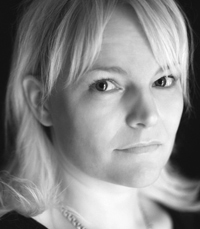
Through these events the film explores friendship, and what Allan Berg Nielsen describes in an excellent essay as The Manifold Nature of Love. It’s about life dreams, loss, and the challenge of opening up to others. Grønkjær (see photo), the director, is the interviewer, and becomes entwined at times in these questions.

At one point, Vig becomes frustrated with Nun Amvrosija. They argue about trivial things, while not addressing the larger issues. Perhaps he feels he’s losing control of the project. Referring to her, he says:

Vig: It’s hard to argue with people who are always right. Who don’t …
Grønkjær (interviewing): What if she came here just as much for you as for the monastery?
Vig: For me? I don’t know how to react to that. It’s the project we’re talking about, not me. Because that’s not what is needed.

A little later he grows discouraged, and puzzled:

Vig: I can’t solve all the problems.
Grønkjær: It’s not a problem, Vig.
Vig: Perhaps they’re problems you women have.
Grønkjær: We haven’t any problems.
Vig: You have feelings, or whatever. Things like that are not my business. I stay out of it.

That excerpt suggests the movies is about gender. It is, but one could also say that it’s about age, religion, nationality, language, and more than anything, about people trying to come together about things they both want, but struggle to achieve.

Nun Amvrosija writes to Mr. Vig:

Dear Mr. Vig, We were together for almost five years. We were very different, yet we were doing the same thing. We often disagreed with each other. But the Lord directs everything in His wisdom. Our Lord laid this gift in your hands. A gift which I believe opened the gates of paradise to you. I wish for the kingdom of heaven and eternal peace. Dear Mr. Vig, servant of Our Lord.

Vig is not only a fascinating character in the movie, but must have been throughout his life as well. See his East-West Seminar at Hesbjerg, 1995.

Today the monastery is run by Nun Amvrosija. A Russian Orthodox priest comes from Copenhagen to carry out the services. The Russian Patriarchate and the Hesbjerg Foundation now set the future plans for the monastery.

“The Cucumber Season”

Just read an amusing, and ironically, informative essay in ACM Ubiquity, called “The Cucumber Season: Reflections on the Nature of Information When There Isn’t Any,” by Espen Andersen:

I would like to introduce a new term to the English language: “Cucumber season”. The term, from Norwegian, refers to the period from sometime in early June, when Parliament and the public schools recess, until mid-August when the schools start up again and people return from their summer holidays. The name of this season comes from the observation that during this period, newspapers have little to write about – since nothing much happens – and so are forced to report on non-news, such as outsized and/or weirdly shaped vegetables such as cucumbers. By extension, the term refers to newspaper articles as well – a padded-out news item of dubious importance and inflated headline is referred to as a cucumber.

ACM Ubiquity – The Cucumber Season: Reflections on the Nature of Information When There Isn’t Any.

Living teaching: The genius loci

My most memorable moments in Dublin came through encounters with living people, the many warm individuals who introduced me to life in the city and country, and from all the enriching, direct experiences, some of which I’ve tried to recount here.

But oddly enough, I also value the encounters I had with people who live on only in their writings or institutions. I say “oddly,” because I could easily have come to know them somewhat without being physically present in Ireland, and yet I seemed to need the tradition of place, or genius loci, to open the book.

One of these is Cardinal John Henry Newman. I didn’t know much about his work, other than valuing the many Newman Centers on university campuses. Frankly, I had a negative view, that his focus was on education for “gentlemen,” and that he held an elitist and sectarian approach to learning. At best, his ideas were locked away in 19th-century Ireland and unlikely to be relevant to my world today.

Cardinal John Henry NewmanFortunately, a colleague, Leo Casey, was able to gently point out that my conception was based on not knowing anything, and to suggest that if I did open a book, I might learn something.

In this case, the book was Cardinal Newman: The Catholic University, which contains a selection of his writings. University College Dublin, which he presided over, published it in 1990, to commemorate the century after his death. One of the essays in the collection is entitled “Living Teaching rather than passive reception of facts.” It’s from his The Idea of the University, and introduced me among other things to the term, genius loci.

Newman writes about “young men,” but I believe that today he’d quickly revise his essay to include all people. He asks a provocative question: Suppose we

had to choose between a so-called University, which dispensed with residence and tutorial superintendence, and gave its degrees to any person who passed an examination in a wide range of subjects, and a University which had no professors or examinations at all, but merely brought a number of young men together for three or four years, and then sent them away…[which of these would be] more successful in training, moulding, enlarging the mind, which sent out men the more fitted for their secular duties, which produced better public men, men of the world, men whose names would descend to posterity

Newman is quick to say, in his 19th-century style, that he can’t fully endorse the second model, as he considers “idleness an intolerable mischief.” But he has “no hesitation in giving the preference to that University which did nothing, over that which exacted of its members an acquaintance with every science under the sun.” He explains as follows:

When a multitude of young men, keen, open-hearted, sympathetic, and observant, … come together and freely mix with each other, they are sure to learn one from another, even if there be no one to teach them; the conversation of all is a series of lectures to each, and they gain for themselves new ideas and views, fresh matter of thought, and distinct principles for judging and acting, day by day…students come from very different places, and with widely different notions, and there is much to generalize, much to adjust, much to eliminate, there are inter-relations to be defined, and conventional rules to be established, in the process, by which the whole assemblage is moulded together, and gains one tone and one character…

that youthful community will constitute a whole, it will embody a specific idea, it will represent a doctrine, it will administer a code of conduct, and it will furnish principles of thought and action. It will give birth to a living teaching, which in course of time will take the shape of a self-perpetuating tradition, or a genius loci

Here then is a real teaching…it at least recognizes that knowledge is something more than a sort of passive reception of scraps and details; it is a something, and it does a something, which never will issue from the most strenuous efforts of a set of teachers, with no mutual sympathies and no inter-communion, of a set of examiners with no opinions which they dare profess, and with no common principles, who are teaching or questioning a set of youths who do not know them, and do not know each other, on a large number of subjects, different in kind, and connected by no wide philosophy

Newman recognizes the limits of such self-education, but nevertheless argues, the result is better than for

those earnest but ill-used persons, who are forced to load their minds with a score of subjects against an examination, who have too much on their hands to indulge themselves in thinking or investigation, who devour premiss and conclusion together with indiscriminate greediness, who hold whole sciences on faith, and commit demonstrations to memory, and who too often, as might be expected, when their period of education is passed, throw up all they have learned in disgust…they leave their place of education simply dissipated and relaxed by the multiplicity of subjects, which they have never really mastered, and so shallow as not even to know their shallowness.

How much better, he says,

to eschew the College and the University altogether, than to submit to a drudgery so ignoble, a mockery so contumelious! How much more profitable for the independent mind, after the mere rudiments of education, to range through a library at random, taking down books as they meet him, and pursuing the trains of thought which his mother wit suggests! How much healthier to wander into the fields…

[or from] the beach, and the quay, and the fisher’s boat, and the inn’s fireside, and the tradesman’s shop, and the shepherd’s walk, and the smuggler’s hut, and the mossy moor, and the screaming gulls, and the restless waves, to fashion for himself a philosophy and a poetry of his own!

Newman’s style is dated, but his questions are more relevant today than when he wrote. Our university education, indeed formal education at all levels in both the US and Ireland, often strives to do little more than load minds against examinations. We run from the idea of genius loci and see no need for living teaching.

Meanwhile, university administrators worldwide now measure success against a benchmark of mechanization. Efficient, modular, and uniform delivery of certifications is the goal. Newman reminds us that achieving that goal means not only that students will “throw up all they have learned in disgust,” but that society will ultimately throw up the university in disgust as well.

Reading versus first-hand experience

Three thoughts regarding reading and first-hand experience:

MUCH have I travell’d in the realms of gold,
And many goodly states and kingdoms seen;
Round many western islands have I been
Which bards in fealty to Apollo hold.
Oft of one wide expanse had I been told
That deep-brow’d Homer ruled as his demesne:
Yet did I never breathe its pure serene
Till I heard Chapman speak out loud and bold:
Then felt I like some watcher of the skies
When a new planet swims into his ken;
Or like stout Cortez, when with eagle eyes
He stared at the Pacific—and all his men
Look’d at each other with a wild surmise—
Silent, upon a peak in Darien.
—John Keats, “On first looking into Chapman’s Homer”

No book or map is a substitute for personal experience; they cannot take the place of the actual journey. The mathematical formula for a falling body does not take the place of throwing stones or shaking apples from a tree.
—John Dewey, Schools of tomorrow

There are some who say that sitting at home reading is the equivalent of travel, because the experiences described in the book are more or less the same as the experiences one might have on a voyage, and there are those who say that there is no substitue for venturing out in the world. My own opinion is that it is best to travel extensively but to read the entire time, hardly glancing up to look out of the window of the airplane, train, or hired camel.
—Lemony Snicket, Horseradish: Bitter truths you can’t avoid

The fountain of knowledge

Edessa waterfallsWhereas many Greek towns might be dusty and dry, Edhessa (Έδεσσα) is lush and wet. Much of it is free of cars as well. The reason is a river cascading down from the mountains to the north. It flows through the town, allowing park spaces along the banks and a complex array of paths and bridges crisscrossing the waters. Then, at the edge of the old town (Varossi), the river descends rapidly, culminating in two large waterfalls, which I came to see as fountains of knowledge.

Following the Networked Learning Conference earlier last week in Halkidiki, Greece, we had headed west through Thessaloniki to the region around Edessa. This is where Alexander the Great was born and where his father, Phillip II and Aristotle went to to school together. It includes what are now the major archaeological sites of Vergina, the site of the ancient Macedonian royal city of Aegae, and Pella, the later capital. Alexander, of course, was the one whose conquests spread Hellenistic culture throughout Asia Minor, Syria, Egypt, and eventually the entire Persian Empire, going as far as India. Supposedly, he slept with a copy of the Iliad under his pillow throughout the campaign. His exploits might not represent the origin of the knowledge, but they certainly helped it flow and created an early version of a global culture.

The oracles of Delphi and other sites might allow Greeks to claim the fountain of knowledge. Towns with names like Grammatico make one feel that love of knowledge is intrinsic to daily life. Add in the beginnings of Western science and philosophy and the whole nation would seem to be a bubbling fountain of knowledge, if it just weren’t so sunny and dry!

Edessa libraryI thought we might be approaching the fountain when we came to Meixa, the location of Aristotle’s school (from the Greek schole), where Alexander had studied. But it was just north of there in Edessa, that the fountain revealed itself.

The pleasure of experiencing the water town was only enhanced for me when we visited the wonderful town library. Staff there helped us access the internet and told us more about Edessa.

The library has a unique logo combining two of my favorite things, books and water. It suggests that the ideas of Plato, Sophocles, Hippocrates, Thucydidies, Heraclitus, and all the rest flow from the library, providing pleasure for the mind as the cataracts do for both body and mind. I like the way the logo incorporates the @ sign, too. Fortunately, knowledge is never owned by any one time, place, or people, but Edessa and its library make as good a claim as any to being its source.