Banning books

The always controversial Texas State Board of Education added to its tragicomic history with a confusion over Martins:

Brown Bear, Brown Bear, Why Were You Banned?

Bill Martin is a philosophy professor at DePaul University who has written a book called Ethical Marxism: The Categorical Imperative of Liberation.

Bill Martin Jr., who died in 2004, was a children’s author who wrote Brown Bear, Brown Bear, What Do You See? The men are not related.

Last week, the two Martins were briefly fused into one persona by Pat Hardy, a member of the Texas State Board of Education, who moved that Bill Martin be removed from a suggested revision of the state’s third-grade social-studies curriculum. The Fort Worth Star-Telegram quoted Ms. Hardy as saying that his books for adults contain “very strong critiques of capitalism and the American system.” –Don Troop

The  issue might be simply amusing, except that the Texas State Board of Education decides what will be taught in Texas public schools. Because the Texas market drives what publishers sell in other states, it plays an extraordinary role in defining American public education.

Recently, the Board has considered reviving the reputation of Senator Joseph McCarthy, to portray him as an American hero. They also debate the Biblical underpinnings of the nation’s founding, the superiority of America, and its divine ordination.

Pat Hardy, is from my hometown of Fort Worth. Unlike many others on the Board, she’s actually an educator. Although she’s a conservative Republican, she’s been attacked in elections to the Board by social conservative groups, who criticize her insufficient support of creation science and lack of solidarity with the social conservative bloc on the board.

Much of the commentary on this incident has focused on its silliness, on the apparent confusion of such different authors and books. But for me, it raises some important questions about the Board, and by extension, American education:

  • What if Bill Martin Jr. (the children’s book author) had written a book on ethics? Would that be a bad thing? Would that justify banning his beloved book for children?
  • Must we agree with Bill Martin (the philosopher) about vegetarianism and animal rights in order to read his book? Is it wrong to read a book that critiques and extends Marxism?
  • Should the role of the Board, or the role for any of us as educators and citizens, be to weed out books with ideas we don’t accept (or perhaps, understand)?
  • Do we want students to grow up unquestioning, and safe from bad ideas only when we diligently purge them from their world?
  • Might we do better to “teach the controversy,” as Gerald Graff says, to open up the world of books, ideas, and learning, rather than to try to shut it down?

Reality and the third rail

The Reading Terminal Holiday Railroad Photos by G. Widman for GPTMC

When I was last in Philadelphia I walked through the Reading Terminal Holiday Railroad and Train Display.

This is a giant model railroad layout (1/3 mile of tracks) at the Reading Terminal Market. There’s a detailed, interactive display featuring historic scenes of Philadelphia and rural Pennsylvania. Trolleys and Reading Railroad trains pass through City Hall and travel over the Schuylkill River.

I couldn’t help noticing that these were Lionel trains, the sign being the characteristic third rail. I remember as a boy having mixed feelings about that third rail.

On the one hand, it was a reminder that my model train layout wasn’t reality. Of course, a cynic might have pointed out that my mountain was a clearer giveaway, since it scaled to 25 feet high, not to mention that the entire world fit within a 4′ x 8′ rectangle with abrupt declivities on each edge. Yet I could somehow overlook those signs and still be bothered by the third rail.

On the other hand, the third rail was a reminder that I didn’t have the less realistic American Flyer train that my friend Jeff had. My locomotive and cars, as well as my accessories, were all more real, and the third rail spoke to that. In a practical sense, the third rail also permitted more “realistic” wiring of the tracks and switches.

One might say that the third rail marked a gateway between reality and fantasy. It was an icon, drawing me into the model railroad world. I spent hours and hours in that world, which felt more real than many other parts of my life. At other times, though I would look at it and be reminded that that world wasn’t as real as I hoped.

Now, as an adult, rushing to catch the “real” train to the airport, I had the opposite reaction. The beautiful train layout caught my eye, and I immediately wished there was more time to study it. But there was easily enough time to notice a key feature, that characteristic third rail.

This time I knew. That third rail told me that this was a real Lionel train, not some second-rate substitute. This train layout was a real world, with City Halls and rivers, trolleys and people. It was a place I’d once again be happy to lose myself within, as opposed to the false world outside, with all its fake products, commercialism, planned obsolescence, and unkept promises, not to mention the wars, institutional violence, and injustice that belie its values.

Schopenhauer’s porcupines

Several years ago, I read Schopenhauer’s porcupines: Dilemmas of intimacy and the talking cure: Five stories of psychotherapy, by Deborah Anna Luepnitz.

It’s a fascinating book, and you don’t need to be a Schopenhauer scholar, a zoologist, or a psychotherapy patient to get a lot out of it. The entry card instead is being someone who relates to others or would like to do so.

It was there that I encountered Schopenhauer’s parable of the porcupines, the last of many from his Studies in pessimism:

A number of porcupines huddled together for warmth on a cold day in winter; but, as they began to prick one another with their quills, they were obliged to disperse. However the cold drove them together again, when just the same thing happened. At last, after many turns of huddling and dispersing, they discovered that they would be best off by remaining at a little distance from one another. In the same way the need of society drives the human porcupines together, only to be mutually repelled by the many prickly and disagreeable qualities of their nature. The moderate distance which they at last discover to be the only tolerable condition of intercourse, is the code of politeness and fine manners; and those who transgress it are roughly told—in the English phrase—to keep their distance. By this arrangement the mutual need of warmth is only very moderately satisfied; but then people do not get pricked. A man who has some heat in himself prefers to remain outside, where he will neither prick other people nor get pricked himself.

Schopenhauer presents his parables as telling us just how life is, but Luepnitz takes this one in a constructive way. She shows through five case studies how we all have simultaneous needs and fears for intimacy, thus creating a dilemma for full living. As she puts it (p. 19):

Psychotherapy cannot make us whole, but it does allow us to transform suffering into speech and, ultimately, to learn to live with desire.

I was impressed with the book. Coincidentally, shortly after reading it, I had dinner in Philadelphia with a couple, one of whom was her patient.

References

  • Luepnitz, Deborah Anna (2002). Schopenhauer’s porcupines: Dilemmas of intimacy and the talking cure: Five stories of psychotherapy. New York: Basic Books.
  • Schopenhauer, Arthur (1891). The essays of Arthur Schopenhauer; Studies in pessimism (tr. Thomas Bailey Saunders). London: Swan Sonnenschein.

John Dewey and Daisaku Ikeda

ikeda-headshotI attended the 6th Annual Ikeda Forum for Intercultural Dialogue yesterday at the Ikeda Center for Peace, Learning, and Dialogue in Cambridge. The topic was John Dewey, Daisaku Ikeda, and the Quest for a New Humanism. The occasion was the 150th Anniversary of John Dewey’s birth.

Although Ikeda’s Nichiren Buddhism, a form of Mahayana Buddhism, may at first seem far removed from Dewey’s American pragmatism, the speakers found many areas of consonance between the work of the two. I was pleased to see that Jane Addams was brought into the conversation, too.

Ikeda CenterNichiren was a 13th century Buddhist reformer, who based his teachings on the Lotus Sutra and its  message of the dignity of all life. Like Dewey’s pragmatism, Nichiren Buddhism is grounded in the realities of daily life. It promotes “human revolution,” in which individuals take responsibility for their lives and help to build a world in which diverse peoples can live in peace.

Ikeda is the founder of the Soka Gakkai International, a movement characterized by its emphasis on value creation (soka). This implies that each individual needs the opportunity to find value in their unique path while contributing value to humanity. Soka schools have much in common with the kinds of schools Dewey envisaged (but rarely saw enacted).

At the Ikeda Forum discussions focused on connections and divergences between Dewey’s naturalistic humanism and Ikeda’s Buddhist humanism. Presentations examined how their work can be used as resources for individual and social change.

How useful is the concept of community?

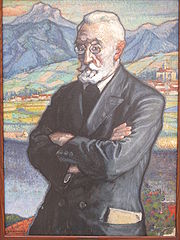
de_UnamunoMiguel de Unamuno says that anyone who invents a concept takes leave of reality. I like that statement both for its literal meaning that reality can nver be fully captured by a single concept, and in the suggestion that concepts imply a kind of madness.

Unamuno’s dictum applies to the question “How useful is the concept of community?”, because community designations betray the individual in two senses. One is that every community designation necessarily strips away the uniqueness of the individuals within. A term such as “immigrants” is clearly impoverished with respect to the many reasons, origins, and experiences of immigrants.

But a community designation can not only strip away individual meaning; it can attach wrong, or even contradictory meanings. For example, if we say that someone is a member of the “elderly community,” we impute a large set of attributes that may be totally off. She might be 90 years old, but rather than suffering “elderly decline,” she might be longing for that iPod we had provided to the “youth community” to share the latest music. There’s even some evidence that the very old are healthier than the somewhat old, because they were the ones who survived past critical health hurdles.

What makes this all even more interesting is that we can’t think without concepts, and we do better when we make use of even faulty information. A member of the “library patron community” may come to the library to get warm, to order some coffee (as at Urbana Free Library), to get a date, to sleep, or a host of other reasons.

Nevertheless, it’s helpful to know that many visitors seek information. Similarly, many immigrants may need help dealing with often absurd regulations that don’t apply to citizens in a country. Many elderly people have special physical or mental challenges well beyond those faced by most younger people.

These thoughts keep bringing me back to the need for dialogue. In so many cases, well-intentioned people make judgments and decisions without really listening to those they’re trying to help. Most examples of community designations betraying the individual, could at least be better addressed by starting with the idea of listening to each others’ experiences first.

References

Philosophy reading group

Here are the readings for our philosophy reading group this year (2009-2010). There’s a general emphasis on practice-based theories:

Other possibilities:

Bernstein, Beyond Objectivism and Subjectivism
Michel de Certeau, Practice of Everyday Life
Joe Dunne, Back to the Rough Ground
Bent Flyvbjerg, Making Social Science Matter
Ian Hacking, The Social Construction of What?
Bruno Latour, Reassembling the Social (or one of his others)
Jonathan Lear, Therapeutic Action
Alasdair MacIntyre, Dependent Rational Animals
Theodore Schatski, Social Practices
Richard Sennett, The Craftsman
Charles Taylor, Modern Social Imaginaries
Leslie Paul Thiele, The Heart of Judgment
Stephen Turner, The Social Theory of Practices
Victor Turner, The Ritual Process (or From Ritual to Theater)
and/or modern classics such as Arendt, Collingwood, Gadamer, Goodman, Oakeshott, Wittgenstein.

Neither mock it nor lament it

spinoza1aEmily sent me a postcard from Germany with a quote from Baruch de Spinoza: “Man soll die Welt nicht belachen nicht beweinen sondern begreifen,” which could be translated as “one should neither laugh at nor lament the world, but only understand it.” I like the sentiment, which reminds us to avoid the tendency to categorize and judge other people or ideas. Instead, it calls for an openness to learning, akin to what Jane Addams calls “affectionate interpretation” in A modern Lear.

I’ve admired Spinoza since being introduced to him by Radoslav Tsanoff, a professor at Rice. Spinoza also inspired Marx, Wittgenstein, Einstein, and many others. His rejection of dogma and insistence on reason set the stage for the Enlightenment. Thinking about the quote sent me off to learn a bit more.

The quote (originally in Latin) is from his Tractatus theologico-politicus, but the general idea recurs throughout his Ethics. It’s actually not so much a “should” as it is Spinoza’s attempt to describe his own method–what he’s endeavored to do through his philosophy.

Friedrich Nietzsche picks up on Spinoza’s method in The joyful wisdom (La gaya scienza). He emphasizes that the issue is not to replace emotions with reason, but actually to build reason upon the emotions:

What does Knowing Mean? Non ridere, non lugere, neque detestari, sed intelligere! says Spinoza, so simply and sublimely, as is his wont. Nevertheless, what else is this intelligere ultimately, but just the form in which the three other things become perceptible to us all at once? A result of the diverging and opposite impulses of desiring to deride, lament and execrate? Before knowledge is possible each of these impulses must first have brought forward its one-sided view of the object or event.

This is consistent with Spinoza’s own rejection of the mind-body dualism of René Descartes. Much later, John Dewey proposes a related notion, that inquiry is reconstructive experience: The experiences, and our emotional responses, come first, but knowing is the reflection and articulation of those experiences, which leads away from simple judging.

This post necessarily glosses over the sublteties in the “sed intelligere” idea. But even so, I think it’s a useful phrase to remember, particularly as we encounter unfamiliar people or ideas.

References

Education for what is real

taasaIs subject matter real? We often act in education as if the concepts and methods expressed in course materials are the reality, and the task of teaching is to help the learner from unreal understandings to the truth. But that seemingly obvious assumption is the one that is far from reality.

In Education for what is real, Earl Kelley makes the case for purposeful learning. At the core, his argument is not simply that allowing the learner to find a purpose in learning is effective pedagogy; nor is that everyone lives in a subjective universe in which no dialogue or learning is possible. Instead, it is that the the learner necessarily remakes anything a teacher says in terms of his/her own “scheme of thing.” That remaking changes the learner and can lead to growth, but not in the straightforward way imagined by a transmission epistemology.

Now it comes about that whatever we tell the learner, he will make something that is all his own out of it, and it will be different from what we held so dear and attempted to ‘transmit’. He will build it into his own scheme of things, and relate it uniquely to what he already uniquely holds as experience. Thus he builds a world all his own, and what is really important is what he makes of what we tell him, not what we intended. –Earl C. Kelley

Jeannie Austin makes a similar point in discussing her own learning in a class that allowed her to build on what she knows and cares about:

It’s allowed me to have a feeling of ownership over my education, as I’ve been able to pursue the study of things that I am passionate about and still count it toward school. I can’t tell you how much less stressful it has made my life, as I no longer have to try and balance an education that is separate from my lived reality. –Jeannie Austin

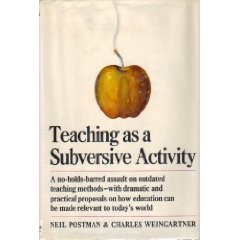
Postman and Weingartner put it this way in Teaching as a subversive activity:

In other words, you end up with a student-centered curriculum not because it is good for motivation but because you don’t, in fact, have any other choice.

References

Kelley, Earl C. (1947). Education for what is real. New York: Harper and Brothers.

Postman, Neil, & Weingartner, Charles (1969). Teaching as a subversive activity. New York: Dell.

Copernicus and Erasmus

genealogy1The Mathematics Genealogy Project and its cousins, the AI [artificial intelligence] Genealogy Project, and the Philosophy Family Tree are attempts to compile information about scholars in various fields, including where they received their degrees and the titles of their dissertations. The information is organized in an academic family tree, in which one’s adviser is one’s parent.

Here’s the mission statement for the Mathematics Genealogy Project:

The intent of this project is to compile information about ALL the mathematicians of the world. We earnestly solicit information from all schools who participate in the development of research level mathematics and from all individuals who may know desired information.

Please notice: Throughout this project when we use the word “mathematics” or “mathematician” we mean that word in a very inclusive sense. Thus, all relevant data from statistics, computer science, or operations research is welcome.

I’m actually in all three of these trees. My PhD is in Computer Sciences, specifically in AI; the core of the dissertation is in mathematical logic; and my adviser, Norman Martin, was a philosopher. His work was in the area of logic, as was that of a committee member, Michael Richter, a mathematician.

One of the best Christmas presents I received was a depiction of this tree made by Emily and Stephen (above, click to enlarge). There is so much detail, that you need to see the full-scale poster to read it all, but you may be able to make out the names of my adviser, and co-adviser, Robert F. Simmons, as well as early ancestors, Copernicus and Erasmus. It’s fun to explore the connections, which ultimately show how interconnected we all are.

Stay hungry. Stay foolish.

On June 12, 2005, Steve Jobs, CEO of both Apple Computer and Pixar Animation Studios, delivered the Stanford Commencement address on the theme of “You’ve got to find what you love.” You can see both the text and the video of the address below. It’s an excellent talk in its own right, but I thought it gave a good account of inquiry-based learning as well.

In the first part of his address, Jobs talks about dropping out of college, then taking a class in calligraphy, not because it was required, but simply because it was “beautiful, historical, artistically subtle.” He didn’t envision it as preparation for the future, but as something that had deep meaning in the present. Later, his study of calligraphy bore fruit in the design of the first Macintosh computer. As Jobs says, “you can’t connect the dots looking forward; you can only connect them looking backwards. So you have to trust that the dots will somehow connect in your future.” This is closely akin to a key element of inquiry-based learning, captured in Dewey’s famous statement that “only by extracting at each present time the full meaning of each present experience are we prepared for doing the same thing in the future.” Continue reading