I was asked to write about a favorite teacher for a project in a philosophy of education course. The person who asked me plans to use the lenses of John Dewey, Paulo Freire, and Pádraic Pearse to look at the responses from various people. Here’s mine:
I remember many good teachers, but no one that stands out far above the rest. But I’ll pick one: Miss Dierdorf at W. P. McLean Junior High School cared about literature and history in an infectious way. She organized a class newspaper project in which we wrote and illustrated stories from Greek (and Roman) mythology. The antics of the ancient heroes and gods became as real to us as the day-to-day events around the school.
As I recall, every student felt that he or she had a vital contribution to make to the newspaper. We designed the paper, wrote and drew, because we too cared about the stories and the characters. I think that the sense of becoming engaged with the ideas and feelings of the past or faraway has stayed with me ever since.
It was interesting to see that the majority of the responses were about English teachers.
I should add that there are many mythology newspaper curriculum units available on the web and other formats, such as Greek Mythology Newspaper, by the children’s book author, Bernard Evslin. They all seem to be more sharply defined in terms of skill development and assessment than I remember the class to be.
Barack Obama’s speech in Philadelphia yesterday (full text and video of the speech) was an historic moment, the most direct attention to race and racism from any major Presidential candidate. Speaking in the way he did was an intelligent, courageous, and moral act in an atmosphere of sound bites and back-biting. I don’t know whether it helps or hurts his campaign, but it should help the country.
I saw three main points in the speech, with my comments in brackets:
“Race is an issue that I believe this nation cannot afford to ignore right now.” [Prejudices against those who speak different languages, profess different religions, have different values, or simply look different, are a major problem. However, the legacy of slavery, segregation, and continuing discrimination against Blacks has made that form of racism a defining feature of US history. It’s our biggest challenge, one no other country faces in the same way.]
“Not this time.” [Racism in its historical forms not only continues to undermine our best impulses; it spreads and poisons other issues such as how we address immigration or how we interact with other countries. We need to move the discourse forward this time, to transcend race in a deep way, if we are ever to form “a more perfect union.”]
“We cannot solve the challenges of our time unless we solve them together.” [We can’t do #2 if we don’t address #1.]
Some people express what they know about the pernicious effects of racism in ways that are divisive or factually wrong. In so doing, they fuel the very ignorance and hatred that underly racism. By not acknowledging the possibility of change, they effectively block it. That was Obama’s response to some of Rev. Jeremiah Wright’s comments.
Others ask, “why not just be color blind?”, essentially ignoring the reality of racism. In response to that, Obama said that race is an issue; we need to work to make it not so, but that requires understanding and facing it.
Obama’s speech wasn’t a scholarly critique, but he managed to show for those ready to listen why we need to understand and confront racism. Only then can we work together to build a different kind of society, and bring the focus to issues such as education, health care, and the economy.
Yesterday was International Women’s Day. Among the many events worldwide was the Feminist Walking Tour of Dublin. It sounded interesting when I heard about it just the day before, but I was hesitant to go: It had been an exhausting week between my mom’s recovery from a hip fracture and my preparing a lecture on education and community for Wednesday evening. The weather forecast promised rain; there was a Six Nations rugby match (best not discussed after yesterday); and I wasn’t certain I’d be welcome on the tour, not knowing anyone else there.
Fortunately, and without any doubt in the end, I made the right decision. It turned out that there was not only an enlightening and enjoyable tour, but soup and sandwiches afterwards at the Teachers Club, short movies, a distro (books, zines, and other publications), music, and lots of good discussion.
I had the impression that the organizers expected 20-30 people to show up. But there were at least 120, maybe up to 150, not counting various people who joined in for brief times along the way. What was planned as one group turned into two with an impressing display of organization on the part of Choice Ireland and the RAG collective. One organizer pointed out that their non-hierarchical structure made it easier to respond to unexpected events.
My group was led by Carol Hunt, a history postgraduate student at Trinity and writer for the Irish Independent. She was an excellent guide, leading us from St Stephen’s Green, to the Mansion House, Trinity College, O’Connell St, the Garden of Remembrance, and other spots, each being important sites for women’s history in Ireland. At various stops, others presented on issues such as immigrant rights or women’s centers masquerading as offering full reproductive counseling while in fact proselytizing. I learned far too much to try to convey here, but you can see the tour map and background information in a beautiful and very well-designed booklet, which should still be available in hard copy or pdf.
The tour was bracketed by two precipitations. In the beginning, we were standing next to the seat honoring Louie Bennett and Helen Chenevix. Bennett, a novelist, pacisit, and labor organzer, helped found the Irish Women’s Suffrage Federation, played an active role in the Dublin lockout, helped found the Irish Women’s Reform League, and was active for years in the Irish Women Workers’ Union. As Carol began talking, we had a brief burst of hail. Someone called out that God was a male and He was not pleased!
Then, at our last stop, someone threw potatoes from an upper story window, injuring one of the people on the tour. It’s amazing how cowardly some people can be and how afraid they are of others simply trying to learn.
After the tour, there was a social event in the Teacher’s Club at Parnell Sq. We saw two short films, including The Future of Feminism, by Cara Holmes and Breaking the Silence, by Katie Gillum. There was good music from Heathers, some of which you can hear on their Myspace site. I’m still working to complete all of the exercises in the activity booklet for children designed by Aileen Curtin!
I include the video below only because it gives a taste of the time of Countess Constance Markievicz. I learned on the tour that of all the great women in Irish history, and of all the many statues in Dublin, she is the only woman to have one. All of the other statues of women are of fictional characters or the Virgin Mary.
Markievicz was second in command of the St Stephen’s Green Citizen Army force during the Easter Rising of 1916. Court-martialed afterwards, her potential execution was commuted to life imprisonment because of her gender. She famously replied: “I do wish your lot had the decency to shoot me.”
On March 5, National College of Ireland hosted an event to consider the relations between third-level education and the communities around them. Emma Kytzia and Beatrice Cantalejo did a terrific job putting it all together.
Nick Rees (left) presided. I was asked to speak on “A Radical Vision for Third-Level Education Today: Re-Connecting with Community.” The lecture was followed by a panel discussion, guided by Paul Mooney, then questions from the audience, and finally, conversation over wine in the President’s office.
I drew from two examples in the Chicago area, Hull House and Paseo Boricua, to examine how educational institutions can re-connect with community. There was a little about current work with the College and the local schools in the Docklands community around widening participation in higher education.
The real focus of the evening was on how these experiences might inform education and community work in Dublin today. An excellent panel took up that topic:
Mr Ken Duggan, School Principal, Westland Row CBS
Prof Áine Hyland, former Professor of Education and Vice President (Academic), UCC
Mr Seanie Lambe, Director, Inner City Renewal Group
Ms Michele Ryan, Head, School of Community Studies, National College of Ireland
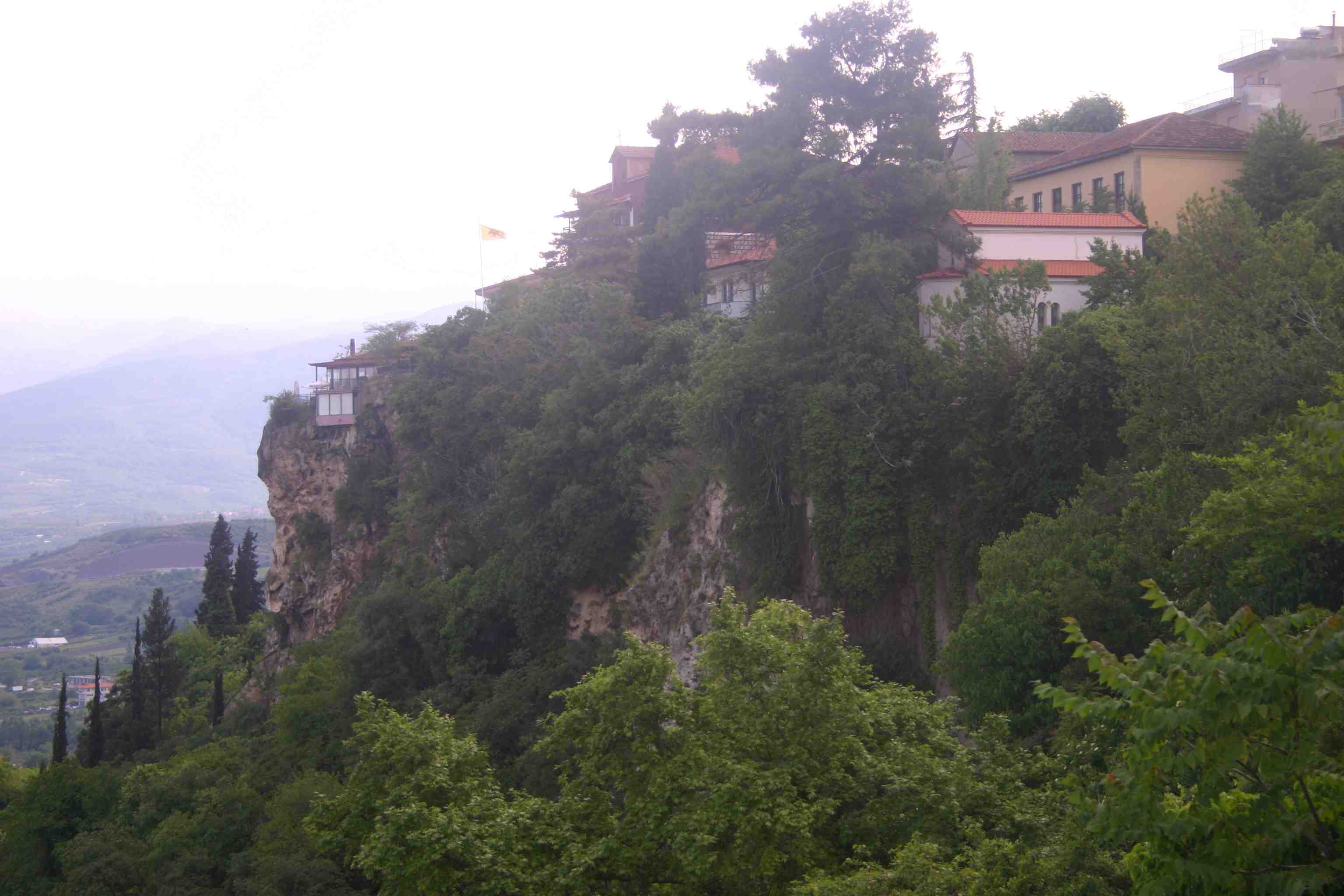
This could have been a post about a walk on the Cliffs of Howth, a small seaside town north of Dublin. Yesterday was a beautiful day, with a brisk wind and light cirrus clouds–a great day for a cliff walk if you don’t stand too close to the edge and if you watch your footing on the muddy track and wet rocks.
But before we began the walk, we happened upon a wonderful small museum about the development of radio: Ye Olde Hurdy-Gurdy Museum of Vintage Radio. It’s in the Martelo Tower above the harbor, at one end of the cliff walk. Pat Herbert, the founder, is passionate about what he’s learned about radio, and communications in general, drawing everyone else into it. Susan adds:
Pat played a tape on which a group of amateur radio enthusiasts had recorded a conversation with the Space Shuttle Columbia during the few minutes it was over Ireland in 1983, 20 years prior to its tragic crash over Texas. One of the astronauts at the time was an amateur radio enthusiast, and Irish amateur radio people had spent hours trying to contact him. A visitor to the museum gave Pat the tape, which he owned only because his brother had been one of the 1983 radio buffs. The entire visit was like that, just one story after another… He had many stories, mostly directed at Emily. And, typically, at about 1:00, announced that it was about time for a cup of tea and biscuits. So we sat around and talked for a good while.
Pat said that not many school groups come to the museum. That’s a shame, because the exhibits could be fascinating to young people as well as to those who lived through some of the times presented there. I think especially of young people in transition year programs (age ~15), who are doing new media projects, such as at the Suas Foundation’s excellent Bridge to College (B2C) programme . The museum would introduce interesting technologies as well as add an historical perspective.
When we did manage to set off on the hike we had a wonderful windy time, circling a good part of the Howth peninsula with grand views of the Ireland’s Eye and the Dublin harbor, and then making it up to the Ben of Howth. Eventually returned to the port in time for early dinner at The Oar House.
After being inspired by George Reese’s work with Buffon’s needle, then seeing the movie,Le Pacte des loups (Brotherhood of the Wolf), then Buffon’s statue in the Jardin des Plantes, I’ve kept an eye out for Georges-Louis Leclerc, Comte de Buffon. He did amazing work in natural history, mathematics, biology, cosmology, translation, and essays. He also examned alleged specimens for the beast of Gévaudan, which provided the basis for the movie.
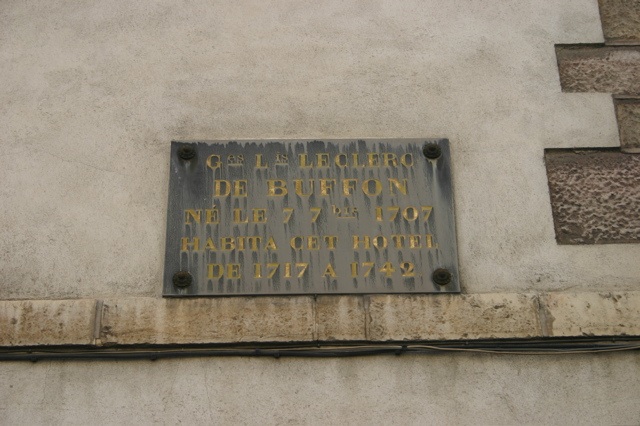
On Sunday we saw his house in Dijon (where he lived from 1717 to 1742), on naturally, rue Buffon.
From his Wikipedia entry you can follow links to Buffon’s needle.
Today, I saw the monument to Aristide Briand on the Quai d’Orsay in Paris, where on August 27, 1928, fifteen nations signed the Pact of Paris, or Kellogg-Briand Pact, renouncing war. Briand won the Nobel Peace Prize in 1926, just five years before Jane Addams did.
There’s a story that he
attended a dinner in Geneva where the guests were given menu cards on which was printed a cartoon depicting the statesmen of the world smashing a statue of Mars while Briand, alone, talked to the god of war trying to convince him to commit suicide. The cartoon caught not only Briand’s main objective in public life – the elimination of war in international relations – but also his method: his penchant for personal diplomacy, his renowned persuasiveness, and his habit of attacking the heart of a problem rather than its symbols or symptoms
The first article of the Kellogg-Briand pact states: “The High Contracting Parties solemly declare in the names of their respective peoples that they condemn recourse to war for the solution of international controversies, and renounce it, as an instrument of national policy in their relations with one another.” Should the US now formally renounce its signing of the pact or just pretend that what it’s doing in Afghanistan and Iraq isn’t war?
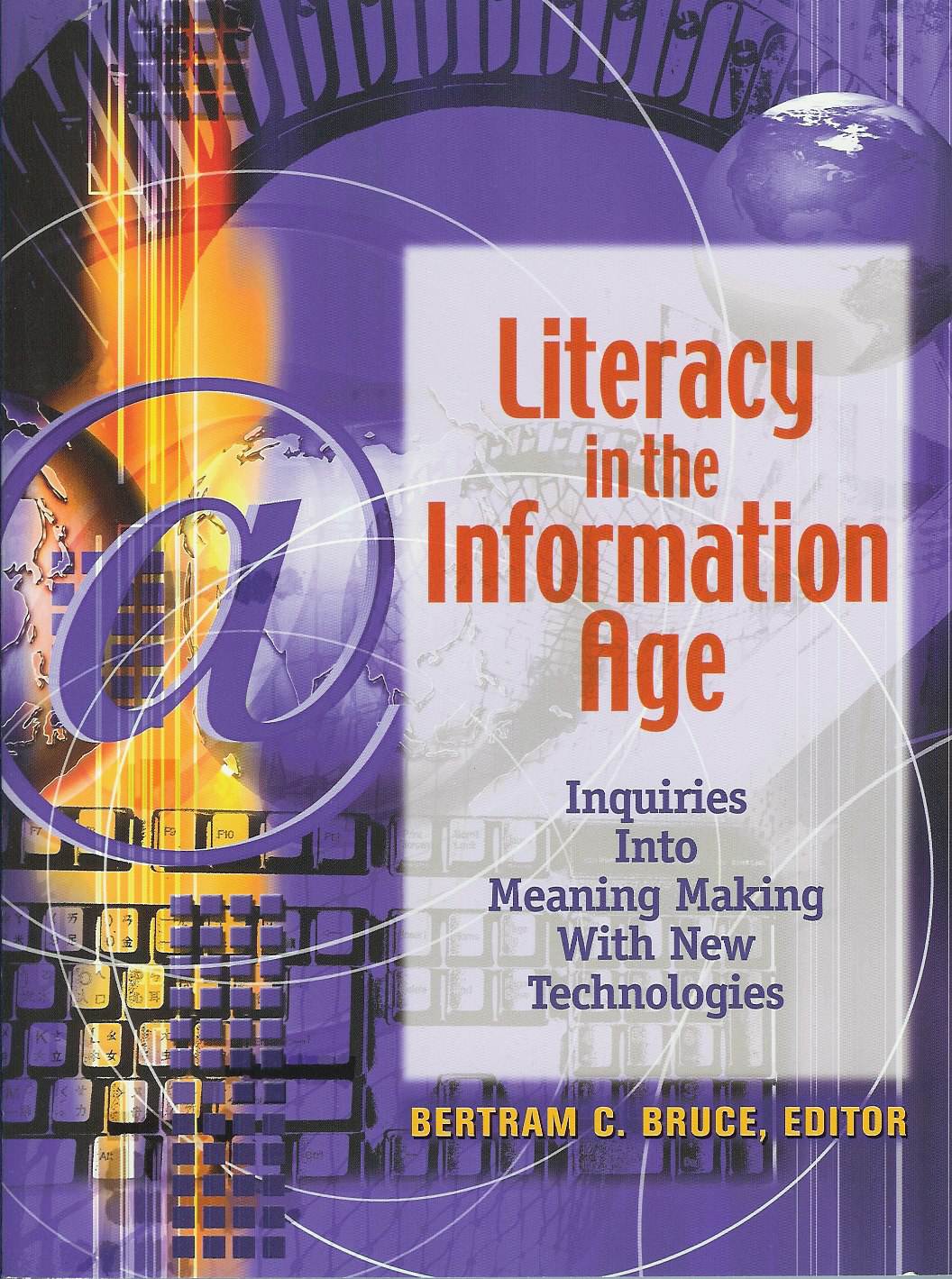
Educators today want to go beyond how-to manuals and publications that merely celebrate the many exciting new technologies as they appear in schools. Students are immersed in an evolving world of new technology development in which they are not passive recipients of these technologies but active interpreters of them. How do you help learners interpret these technologies as we all become immersed in the new information age? Continue reading →
The ultimate weakness of violence is that it is a descending spiral, begetting the very thing it seeks to destroy. Instead of diminishing evil, it multiplies it… Through violence you may murder the hater, but you do not murder hate. In fact, violence merely increases hate…. Returning violence for violence multiplies violence, adding deeper darkness to a night already devoid of stars. Darkness cannot drive out hate; only love can do that. –Martin Luther King, Jr., “Where Do We Go from Here: Chaos or Community?”, 1967
Last September I was struck by what seemed to be universal support for the US government actions against terrorism. It seemed to me that many of these actions were unlikely to achieve their stated goals and might even be counterproductive. The pain I felt and saw around me only heightened my concern that these actions weren’t addressing the problem.
When I questioned these actions, a common response was “but, we have to do something!” My feeling then, and now, was not to doubt that some action was needed, but that the US response was both wrong-headed in many ways, and not nearly enough. Even the idea of a “war on terror” seemed to reflect a lack of understanding of what terrorism is, how it arises, and the opportunities to do something about it.
I jotted down then a set of actions, which I thought would actually hold more hope of reducing terrorism. In an effort to keep this relatively brief, I hope I didn’t make the items too cryptic. It’s a very incomplete list; I might add tolerance education, anti-racism, comparative religions, health care, libraries and schools, infrastructure development, and a number of other things, but doing even what’s listed below would be a start. I’d welcome any questions, reactions, suggestions.
Are bombings and restriction of civil liberties all we can do to combat terrorism? Here are a dozen other ideas for things the USA could be doing, none of which are being implemented today:
Educate: Institute major formal and informal education programs aimed at global understanding: history that is more than European and American experiences; investigations of the relations among globalization, new technologies, and economic development; dissemination of scholarship on world religions, economies, and cultures. Our lack of understanding makes it difficult to combat terrorism, and worse, serves as fuel for the hatred behind it.
Establish proactive diplomacy: Concentrate on improved relations with among others, Muslim and Arab countries and peoples, not only when oil interests are concerned.
Stop arms sales: Reduce, if not eliminate, global arms production and sales. The US supplies over half of the new weapons in the world today, and 2/3 of those sold to developing countries (see http://salt.claretianpubs.org/sjnews/2001/09/sjn0109d.html).
Cooperate with the international community: Become a full partner in international efforts to improve the environment, reduce disease, and protect human rights. The US go-it-alone approach after 9/11 is exactly what infuriates many around the world. Very few of those people would condone, or even consider, terrorist acts, but the response to terrorism would be greatly aided if the US were viewed more as a partner, and less as an overlord.
Support democracy: Establish a priority of supporting democratic governments and democracy movements. Where in the Middle East have we done that? Where in Africa? Asia? the Americas? All too often, the US sides with autocratic regimes, thus allying itself with the enemy of ordinary people.
Alleviate poverty: Poverty, especially in contrast to conspicuous consumption, provides a fertile ground, if not justification, for a violent response. The US has the lowest percentage of GDP going to foreign aid of any industrialized nation in the world, currently 1/7 of the already low OECD target (see http://www.globalissues.org/TradeRelated/Debt/USAid.asp). What counts as foreign aid rarely goes to the areas of greatest need and allocations are often earmarked for buying military equipment from US manufacturers.
Open dialogues: The opportunities for communication across countries, religions, and ethnicities, or even within communities, are limited by governments and the concentration of media control in a few corporations. The US could lead the way in promoting new and improved channels for communication, especially for groups that have little voice today.
Conserve: The US foreign policy is inordinately shaped by our dependence on foreign oil. Even modest conservation efforts would reduce that dependence and allow a focus on other considerations for the long-term interests; this, in addition to the beneficial environmental effects.
Improve literacy: Most people in every region of the world are against violence and seek similar goals related to family, culture, economic survival, and personal fulfillment, but their participation in decision-making is limited, because they lack the basic literacy needed for written communication and access to information. The US possesses the tools and resources to have an enormous, positive impact on world literacy development, which would, in turn, facilitate democratic and economic development, and lessen the support for terrorist responses to desperate conditions.
Resolve conflicts: Not every conflict can be resolved easily, but the US has the stature, the political and economic clout, and in many cases the neutrality to play a major role in resolving conflicts before they become disasters. In Kashmir, Rwanda, Bosnia, East Timor, Sudan, and many other regions, we could engage as mediators and perhaps lessen the violence. Very often, conflicts far away are treated as irrelevant to USA interests, until they become all-too-relevant and nearly impossible to address.
Protect the rights of women: When women’s rights to health care, education, and political participation are ensured, most societies show economic development, population control, reduced disease, and reduced violence. Aside from the intrinsic justice issue, culturally-sensitive support for progress in women’s rights will also protect against terrorism. In the long run, this will do far more than hiring more armed guards.
Learn languages: It is difficult to do any of the items above without full communication, attentive to the nuances of culture and politics. The US educational system, which strives for monolingual learning, is swimming against history. Although English is used widely in the world today, there is evidence that other spoken languages are growing faster than English and writing in the thousands of world languages is expanding with the support of new digital technologies.
During 1997-2002, I edited the Technology Department in the International Reading Association’sJournal of Adolescent and Adult Literacy (JAAL). The columns were intended to promote dialogue about new communication and information technologies and to explore what these media mean for literacy and literacy educators. Each had several distinct sections, including an “email” message from me, an “issue of the month,” often written by a guest author, descriptions of selected websites, and a glossary. In addition to the print version, each column appeared in the Electronic Classroom section of Reading Online.