Olivia De Havilland

We just watched the DVD version of Captain Blood, the 1935 adventure movie based on Rafael Sabatini’s novel.

Except for the numerous comments from the female members of the audience about Errol Flynn (“Oh! He is rather dashing, isn’t he?” “He has such a wonderful smile!” “Well, I have to admit, he is handsome!”), it was very entertaining. Captain Blood is a great movie, the forerunner of the eight films co-starring Olivia De Havilland and Flynn, as well as a major shaper of the whole adventure genre.

For our family, any movie starring Olivia De Havilland is special. In case you don’t know, we go way back.

In grammar school, Olivia was just a year ahead of Susan’s mother, Rhoda, who was in the same grade as Jane Eyre (I mean, Olivia’s sister, Joan Fontaine). They’ve maintained a connection ever since. On the other side, my mother feels a special connection, because she went to college in Milledgeville, Georgia, the home of Margaret Mitchell, who wrote Gone with the Wind, starring Olivia as Melanie.

Throughout her career, Olivia has always exemplified both excellent acting and the highest moral standards. She sought roles that expanded artistic limits, but  also promoted social good. She was successful in a lawsuit to secure greater creative freedom for performers. This led to the De Havilland law, which imposes a seven-year limit on contracts for service. She was the lead in The Snake Pit, one of the earliest films to attempt a realistic portrayal of mental illness. In 2008, she was awarded the US National Medal of Arts.

More (password protected)

My father’s birthday

My father, Bertram Camp Bruce, was born on November 19, 1915. Had his heart been healthier, he might have lived until his birthday today, but instead he died on December 12, 1969, almost 40 years ago. His death punctuated a tumultuous decade, for the world, for the country, and for my family and me.

This week I’ve been hearing 60’s music everywhere–Ray Charles, Joan Baez, Bob Dylan, The Supremes. There’s no need to make that time more vivid, but the music amplifies it for me. My father loved opera, musicals, symphony, classical and romantic chamber music, big band, jazz, and popular singers of the 30’s, 40’s, and 50’s. But his wide-ranging love of music didn’t extend to 60’s pop and folk. He enjoyed talking with the young people who visited Bruce Piano Co., and was of course happy to sell guitars or amps, as long as he didn’t have to attend the next concert using them.

I enjoyed, and still do, 60’s music. I even listened to it while working in the shop during the summer at Bruce Piano Co., since Fred, the technician, liked it too. But I’m very glad that my father taught me to enjoy other kids of music as well.

I wish we could listen to music together again.

Elizabeth McMaster

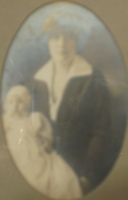
Elizabeth McMaster lived a short life that was filled with music and art, and she brought two beautiful daughters into the world. She was born in Atlanta, Georgia cc. 1897 and died there in October, 1931. At the time of her death, her daughter Betty was 12 and her daughter Catherine was 10.

Elizabeth was a talented singer. Among her favorites were “Ah! Sweet Mystery of Life” and “Charmaine.” She also painted in oils (see first photo below).

In 1917(?), she married Charles Whitfield Holloway in Atlanta. He was two years younger. Betty was born while they lived there. The family then moved to Chattanooga, where Catherine was born. Charles’s sister Pauline and her mother lived with the family there after her father died. They then moved to Lakeland, Florida, and later to Richmond, Virginia, then back to Atlanta, where they first lived in an apartment on Ponce de Leon street. These moves were due to Charles’s work as a salesman for the B. F. Goodrich Rubber Co.

Elizabeth’s mother felt that Charles was too young and wouldn’t amount to much. Because of this, Charles and Elizabeth had eloped. Despite the estrangement of Charles and her mother, Elizabeth and her daughters kept in close touch with her. However, they didn’t hear from her again after Elizabeth’s funeral.

Elizabeth suffered from nocturnal epilepsy. It was her daughters who discovered her death. Catherine was asked to go outside while others removed the body. After her death, Betty and Catherine went to live with Charles’s brother Emmett and his wife in an apartment in Decatur, Georgia. After a few months they all moved to a house in Atlanta.

Charles then married Eva Lassiter (aka Sugy) and was chosen to manage a Goodrich store in Augusta, where the family moved next. Betty and Catherine were then in high school. He later proved his mother-in-law wrong with the building of the very successful Holloway Tire Co., which sold tires and recapped truck tires. He was also a partner with Ralph Snow in Southeastern Rubber Manufacturing Co. Near the end of the War or possibly shortly afterwards, they went to Washington and received an allotment of rubber and started a company to make camelback for tire recapping (or retreading). Eventually the Holloways built a house at 2727 Hillcrest Avenue and moved there for the remainder of the lives of Charles and Eva.

See more on the Hall and Holloway families.

Christmas in Kilcrohane

sheep on Sheepshead Wayme in KilcrohaneWe had a wonderful Christmas in Kilcrohane on the Sheepshead Peninsula in West Cork. We went with Stephen, over from St. Petersburg, Russia; Emily, from Minneapolis; and Matt, one of their friends, from Saint-Raphael, France. Our week included a visit to Fitzpatrick’s one evening, several to the O’Mahony store, and stops in Durrus, Bantry, Ahakista, and other charming towns.

swan lakeWe also had winds, fog, sleet, and torrential rain. Locals call it “rain,” even though it blows horizontally, rather than falling sensibly from the top down. There were several terrific gales (or was it one long one?), which made us thankful for the stone walls of Betsy and Michael’s cottage. Sitting by a warm fire, we could look out on gorgeous Dunmanus Bay with sunny skies one time and am awesome storm the next.

Lough HyneDespite the general theme of winter storm, we had frequent sun and glorious skies. That allowed us to manage several good walks. One was in the ancient forest above Glengariff; another around Lough Hyne south of Skibbereen; and others on the Sheepshead Way. We made good use of Kevin Corcoran’s West Cork Walks.Mizen peninsula

Emily was a writing dervish, thus missing some of the walks. Her friend Matt played his guitar, while posed on the large window seat. Stephen had a swim down at the end of the road. He was inspired in part by Frank O’Mahony, who had done the St Stephen’s Day charity swim at the pier. Perhaps it was warmer for the swimmers to be in the water than in the air, given the sleet and winds. And we played a fair bit of bridge.

Photos by Susan Porter Bruce.

Sleeping in the new VW camper

Stephen & Emily in the VW

Stephen & Emily in the VW, some time later

From the “Kid Talk” file (June, 1990), when Emily and Stephen were 4 1/2 and 3 1/2 years old:

We just got the new VW camper. E and S wanted to sleep in it the first night.

D: The problem is, I’d have to sleep in it, too.
E: Why?
D: Because I can’t leave you guys alone.
E: We wouldn’t be alone. I’d be with Stephen and he’d be with me.

How Bruce Piano Co. nearly lost, then saved Elvis’s career

In the dark recesses of the Bruce Piano Company archives lies a story about a daring rescue of the equally renowned career of Elvis Presley. We can thank this event for the perpetuation of the late Elvis as the King, and led to many Elvis impersonators for years afterwards.

Bertram Camp Bruce

Bertram Camp Bruce (Sr.)

Background

To understand this story you’ll need some background. My father, who founded the piano store, loved music––classical, jazz, big band, solo pop of the Ella Fitzgerald or Bing Crosby varieties––but most assuredly not rock music, country, or Elvis in particular. I imagine much grave-spinning around the thought that his company was to play such a crucial role for Elvis. 

My Dad, however, did not live to see this disturbing event. He died in late 1969. His brother Don, whom he had invited into the business shortly before, took over. But then he died just two years later. Both men were in their early 50’s. My mother remained as the owner of what was by then a struggling business. The growth of electronic entertainments, such as TV and hi-fi, the advent of big box stores, smaller families, and other large societal changes meant that the image of a piano in every middle-class home was fading away.

Although my mother would have been a very good business person (as this story will demonstrate), her upbringing in Georgia nearly a century ago told her that this was not a role for a lady. The same logic would extend to her daughters, who were also busy with family and work. Her son was far away, doing something or another.

A sale of the business seemed to be the obvious path. But there was no willing buyer. Rather than having a distress sale, which would have yielded little, we worked out a deal whereby the manager, Harvey, would buy the store over time, using the revenues the business would generate. Harvey couldn’t have been guaranteed a very good salary. This way he could establish his own pay based on the success he could generate, and in the end, he’d own a business. My mother would be able to draw something from the business that had been the center of the family for many years. The arrangement wasn’t ideal, but was probably the best solution all around. 

Ultimately the broader changes in society did the business in. But for a while, Harvey did his best and Bruce Piano Co. was a going concern. Harvey tried to follow my father’s model, offering a range of instruments, working with piano teachers, assisting the local concert scene, and participating in music conventions. A conflict between the last two of these was what put Elvis’s career in jeopardy. (My children say that I’m prone to exaggerate, but you may rest assured that that is the greatest falsity ever uttered.)
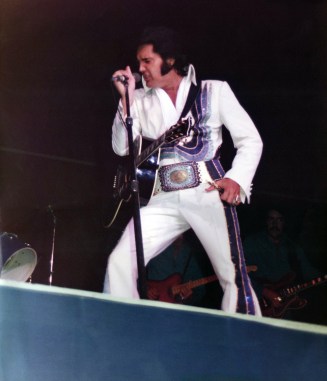
June 15, 1974, Fort Worth, ©James W. Stout

June 15, 1974, Fort Worth, ©James W. Stout

Elvis’s concerts in Fort Worth

The problem was that Harvey had agreed that the store would supply a piano for Elvis’s concerts in Fort Worth. There were to be four productions at the Tarrant County Convention Center. Although Elvis was near the end of his career, and life, and his audience had aged along with him, there was still excitement and adoration for the idol. Fans didn’t mind the $10 ticket price for an hour-long concert, and would love even the shortened versions of his big hits, including “Love Me Tender,” “Fever,” “Why Me Lord,” “Houn’ Dog,” and “Suspicious Minds.”

But then Harvey left for the music convention, without arranging to fulfill the promise to deliver a piano. Elvis’s manager was understandably upset when he discovered that there was no piano on hand. He called the store, only to learn that Harvey was away and unreachable in those pre-cell days. He called Don’s wife Nancy, who didn’t know how to help. He finally called Bert’s wife and my mother, Catherine, the one who claimed that she didn’t know anything about business. 

Obtaining the piano

Catherine began to problem solve. She contacted the piano movers, but they had gone fishing. She pointed out that she had a key to the store, as the still current, if somewhat removed, owner. If Elvis’s team could come up with movers, she could get them in to the piano. 

They met at the store. Elvis sent three bodyguards, who, while not expert in piano moving, were at least strong and committed. But they didn’t know which piano had been ordred. Catherine decided that they wouldn’t go wrong with a concert grand, the biggest model. She found the wooden boxing that was needed to transport a grand piano safely. The team boxed the piano and carried it to the concert venue. After the four weekend concerts the piano was returned safely and Bruce Piano Co, could chalk up another successful service.

Conclusion

Could Elvis have found another piano, or performed without one? Could his career have survived a busted Fort Worth concert? Was the near disaster a sign of the end of both the piano store and Elvis? You’ll have to be the judge of that.

I can say that my mother proved that she could solve a business problem in a difficult and time-pressured circumstance. And I think that my father would have been proud that his company fulfilled its commitment, as long as he didn’t have to go to hear Elvis himself.