Journal series on progressive education

The International Journal of Progressive Education (IJPE) has now published a series of three special issues on “Progressive Education: Past, Present and Future”:

  1. Progressive Education: Antecedents of Educating for Democracy (IJPE 9.1, February 2013)
  2. Progressive Education: Educating for Democracy and the Process of Authority (IJPE 9.2, June 2013)
  3. What’s Next?: The Future of Progressivism as an “Infinite Succession of Presents” (IJPE 9.3, October 2013)

I worked on these journal issues with John Pecore, Brian Drayton, and Maureen Hogan, as well as article contributors from around the world. We’re now exploring options for developing some of the articles along with some additional material into a handbook. The series is timely given current debates about the purpose and form of education in an era of rapid technological change, globalization, demographic and political shifts, and growing economic inequities. It asks, “What have we learned about pedagogy that can support democratic, humanistic, and morally responsible development for individuals and societies?”

Progressive education is a pedagogical movement that emphasizes aspects such as learning by doing, student-centered learning, valuing diversity, integrated curriculum, problem solvingcritical thinking, collaborative learning, education for social responsibility, and lifelong learning. It situates learning within social, community, and political contexts. It was promoted by the Progressive Education Association in the US from 1919 to 1955, and reflected in the educational philosophy of John Dewey.

But as an approach to pedagogy, progressive education is in no way limited to the US or the past century. In France, the Ecole Moderne, developed from the work of Célestin Freinet, emphasizes the social activism side of progressive education. Loris Malaguzzi and the Reggio Emilia approach to early childhood education demonstrates the importance of art in learning, a key element of the holistic approach in progressive education. Paulo Freire’s work in Brazil on critical literacy, highlights the link between politics and pedagogy. Similarly, influenced by his experiences in South Africa, Mahatma Gandhi’s conception of basic education resonates with progressive ideals of learning generated within everyday life, cooperation, and educating the whole person, including moral development.

It is worth noting that progressive education invariably seeks to go beyond the classroom walls. Thus, the work of Jane Addams and others at Hull House with immigrants fits, even if it is not situated within a traditional school. Myles Horton and the Highlander Folk School focused on social activism with adults, exemplifying the progressive education ideals. So too is the Escuela Nueva in Spain, Colombia, and elsewhere. The informal learning in museums, libraries, community and economic development, and online may express progressive education more fully than what we see in many schools today.

We hope that these issues will prove to be a useful resource for anyone interested improving education for a healthier world.

Bow Trip

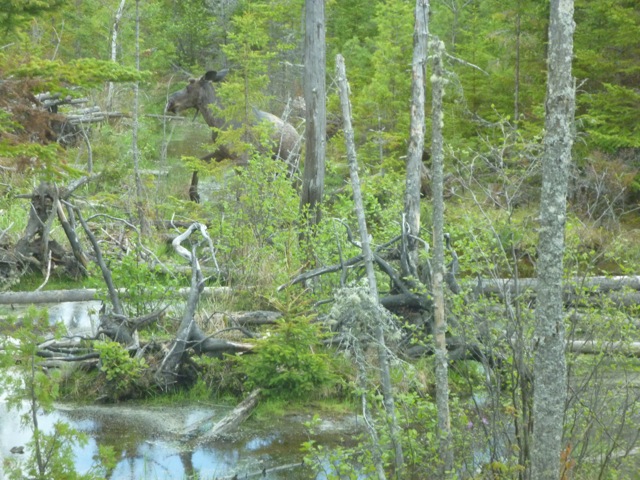
The Bow Trip, near Jackman, Maine, has to be near the top of any list of great canoe adventures. It’s usually completed in only three days, or just one without camping gear, but it packs in lakes dotted with islands, hidden bays, squiggly peninsulas, and watchful mountains, balsam fir forest with beech and birch tree stands, bogs, wildflower gardens, and giant boulders. There are loons, cormorants, moose, and bears. At this time, the white trillium is in bloom, along with many other wildflowers.Image

We just finished the circuit, starting from the outlet of the Moose River on Wood Pond, crossing Attean Pond, portaging to Holeb Pond, then down Holeb Stream to the Moose again, and back to Attean. A nice feature is that one can put in at various places and return to the starting point, in our case, a rustic cabin on Wood Pond.

The Bow Trip calls for flatwater river and lake paddling, rips and falls, lining, carries, eddy turns, and even sliding canoes down an incline or pushing under fallen trees. We had a scare when we rounded a turn under the one bridge, an old railroad trestle, to discover a downed power line. Parts of it were in the water, and it rose up to ensnare canoes.

Image

There are always surprises on a trip like this. We timed ours to be at the cusp of the transition from black fly to mosquito season, managing to have plenty of both. But they had to wait their turn behind the gnats and midges.Image

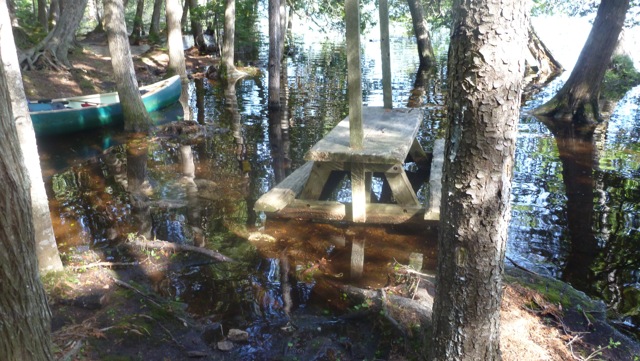
In our case, the big surprise was the high water. It made pull-outs and camping challenging. The portage trails looked more like streams than pathways. Our Tripper canoe has somehow gained weight over the years so that flipping it overhead while standing in muck and swatting flies seemed less fun than it once did. Because of the high water, we managed to run Camel Rips without noticing it and Attean Falls, which usually requires a carry.Image

We heard and saw birds everywhere. I unwound a little, floating down the lovely river, rediscovering muscles and bones I’d forgotten about. The clouds were a fantastic and ever-changing background to the lush Maine forest. The rips and falls were exhilarating. Image

The Bow Trip is a special treat, a highlight of the Northern Forest Canoe Trail. We were alone most of the way, seeing a friendly group from the Maine School of Science and Mathematics at a couple of points, but mostly enjoying alone a precious resource that some people know well, but most will never experience.

See additional photos from our Bow Trip.

Progressive Education: Past, Present and Future

I’ve agreed to serve as guest editor for a Special Issue of the International Journal of Progressive Education (February, 2013, Vol 9 – No 1). Here’s the Call for Manuscripts:


The International Journal of Progressive Education (IJPE) plans a special issue on “Progressive Education: Past, Present and Future.” We invite submissions of proposals for articles.

This issue is timely given current debates about the purpose and form of education in an era of rapid technological change, globalization, demographic and political shifts, and growing economic inequities. It asks, “What have we learned about pedagogy that can support democratic, humanistic, and morally responsible development for individuals and societies?”

Background and Scope

Progressive education is a pedagogical movement that emphasizes aspects such as learning by doing, student-centered learning, valuing diversity, integrated curriculum, problem solvingcritical thinking, collaborative learning, education for social responsibility, and lifelong learning. It situates learning within social, community, and political contexts.

In the US, progressive education is often seen as beginning with the work of Francis Parker. It was promoted by the Progressive Education Association from 1919 to 1955, and reflected in the educational philosophy of John Dewey. The movement has continued through efforts to promote project-based learning, whole language, hands-on learning in mathematics and science, and by organizations such as the Progressive Education Network (PEN). More broadly, it is linked with efforts to promote critical pedagogy and democratic education. Recently, the core ideas appear in the social justice youth development model.

But as an approach to pedagogy, progressive education is in no way limited to the US. The ideas grew out of work in other countries, and can be traced back to the earliest theories of teaching and learning. Some other examples may be useful to consider: In France, the Ecole Moderne, developed from the work of Célestin Freinet, showing how to realize the social activism side of progressive education. Loris Malaguzzi and the Reggio Emilia approach to early childhood education are another manifestation, demonstrating among other things the importance of art in learning. Paulo Freire’s work in Brazil on critical literacy, later extended to many other countries, is another contemporary example, one that emphasizes the political as well as the pedagogical. Similarly, influenced by his experiences in South Africa, Mahatma Gandhi developed a conception of basic education that resonates with progressive education. It was concerned with learning generated within everyday life, relied on cooperation among individuals, and aimed at educating the whole person, including moral development.

It is worth noting that progressive education invariably seeks to go beyond the classroom walls. Thus, the work of Jane Addams and others at Hull House to work with new immigrants might be considered as progressive education, even if it is not situated within a traditional school. Myles Horton and the Highlander Folk School focused on social activism with adults, but a case can be made for their work as exemplifying the progressive education ideals. Similarly, there is much work in museums, libraries, community and economic development, online collaboration, and other areas of informal education that may express progressive education more fully than what we see in schools today. The issue is not restricted to any one educational level, e.g., K-12 or university. Articles may focus on formal or informal learning in any setting, including online.

Themes for the Special Issue

The special issue will develop these and related ideas, considering both the past successes and failures of progressive education, as well as current work and future possibilities. Authors are invited to develop and justify their own definitions for progressive education and not to be limited by official statements.

Articles that show how ideas have evolved will fit well the purpose of the special issue: What has progressive education been? What is it today? What could it become? However, some articles may focus on particular approaches as exemplars of challenges or opportunities for progressive education. Others may focus on the historical or philosophical basis for progressive education. Critiques of progressive education in general, or of particular efforts to realize it are welcome.

There are no limitations regarding age or grade level, or area of the curriculum. To the contrary, articles that can develop connections across the curriculum, across ages or settings, may fit best with the progressive education spirit.

Articles should include the author(s) conception of progressive education as well as a justification for why the particular examples or issues chosen fit within that conception. Some articles may focus on progressive education as it was enacted in early 20th century US, but those that broaden that view in productive ways are strongly encouraged as well.

Schedule and Submission Guidelines

The issue will contain:

  • An editorial highlighting key themes and briefly summarizing the articles;
  • Six-eight articles (~6000 words each) incorporating a range of perspectives on progressive education;
  • Reviews of recent books on progressive education (~600 words each).

Submission of proposals for articles: March 15, 2012. These should consist of a proposed title and a synopsis of no more than 200 words.  The proposals will be considered by the editorial board, and a selection made to ensure a balanced range of content.

Invitation to submit full article: April 15, 2012. A limited number of articles will be commissioned by this date.

First submission by selected authors: June 22, 2012. All submissions will be subject to a review by the editorial board. Submissions should follow the guidelines at http://www.inased.org/ijpesi.htm.

Feedback and requests for revisions:  September 15, 2012. The editorial board will request any needed revisions by this date.

Final submissions:  November 20, 2012.

Final copy to press: January 6, 2013.

Publication: The special issue will appear in IJPE on February 2, 2013, Volume 9 – Number 1. We are also planning a book publication.

The International Journal of Progressive Education (IJPE) (ISSN 1554-5210) is a peer reviewed journal sponsored by the International Association of Educators and in part by the Graduate School of Library and Information Science at the University of Illinois. It is published three times a year: February, June, and October, in both print and online versions.

All submissions and questions should be directed to:

Bertram (Chip) Bruce
Professor Emeritus, Library & Information Science
Email: chip@illinois.edu
Post: 130 Daniels Drive, Wellfleet, MA 02667, USA

Why is there such tax phobia?

I’ve never met anyone who wishes their taxes were higher. Some taxes are a nuisance, like the few cents extra on a cup of coffee, and some are burdensome, like the Social Security tax on low wage earners. But most of us recognize that national defense, health care, good schools, roads, and parks, and so on, are accomplished best when we pull together.

Taxes are a means to enable our Nation to work for a common good, for widely shared goals. So, why is there is a phobia today about any tax increase? Part of the explanation may lie in a major misunderstanding about wealth in the country.

Most people believe that Warren Buffet should pay more in taxes than his receptionist does. Even he thinks that he should pay more (in fact, he pays less). People support that position even if it effectively redistributes wealth. In fact, most of us believe that we’d all be slightly better off if poor people and middle-class people had more money, even if that meant that the very rich had a little less.

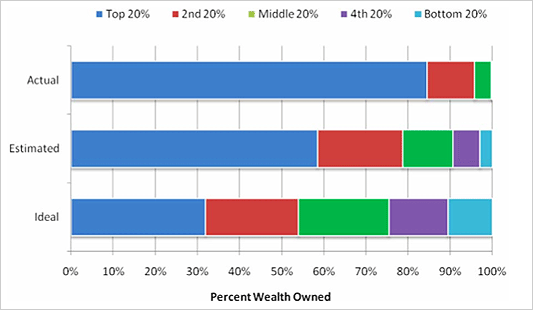
Michael Norton and Dan Ariely have done some research on these issues. They found that Americans drastically underestimate the level of wealth inequality in the US. Americans know that there’s a range of wealth, but they don’t realize just how rich the rich really are, and how poor the poor really are. So, they think that the wealth distribution is more even, or equitable, than it really is. Not only that, their ideal would be even more equitable than the current situation, imagined or real.

Norton and Ariely’s data indicate that the richest quintile of Americans own 84% of all wealth, while people in their survey estimated that the top quintile owns just 59%. Conversely, they think that the low income groups have more wealth, when in fact the wealth of the bottom two quintiles doesn’t even register on the chart.

Distribution of wealth in the US

Distribution of wealth in the US

Putting this another way, no group (Democrats, Republicans, rich, poor, men, women) wants a country as unjust as the one they think we have. But the one they think we have is at least more just than the one that we do have. Some think we should have total equity; some want a wealth distribution more like Sweden’s. Only 10% want what we actually have. And yet, we’re willing to risk a default and economic catastrophe in order to make the US even more unjust.

Modest changes in income and estate tax rates and closing of tax loopholes would go a long way toward addressing the National budget deficit and reducing the debt. We’d still have a wealth distribution more unequal than that of other first world nations and more unequal than we really want. But it would be a step towards making everyone pay their fair share.

Not doing that doesn’t mean that we all walk away to tax-free heaven. Instead, it means that the lower quintiles bear an even larger burden through reduction in social services and regressive taxes, such as local sales taxes and social security taxes on wages (which are designed to tax low wage earners the most).

It’s clear why there’s a phobia about tax increases. It’s not about any tax, but about the type of tax and who should pay. The people pulling the strings are the ones who like the fact that they control most of the wealth and are quite happy to keep the burden on those least able to pay. They’re afraid that they might have to pay their share.

The real question is why everyone else seems content to go along.

References

Norton, Michael I., & Ariely, Dan (forthcoming). Building a better America – one wealth quintile at a timePerspectives on Psychological Science.


Tau Day, 2011

Happy Tau Day! Today is June 28, or 6/28 in the US date format, and τ = 6.283185307179586…

There’s a movement of sorts to use τ (which is equal to 2π), instead of the more familiar π. π is the ratio of the circumference, C, of a circle to its diameter, D.

π = C / D

τ proponents say that since a circle is defined as the set of points a fixed distance (the radius, r) from a given point, a more natural definition for the circle constant would use r:

τ = C / r

This of course makes τ equal exactly to 2π. One might well ask, “What’s the big difference?” τ advocates say simply, “π is wrong.” By this, they don’t mean that it’s wrong to say:

C / D = 3.14

That equation is wrong mathematically, just as any calculating device is wrong because it has to approximate π. Neither π, nor τ can be expressed as a simple fraction (or as a terminating or repeating decimal). But the argument here is not about approximations. It’s that π is wrong pedagogically: π is a confusing and unnatural choice for the circle constant. The confusions run through all sorts of statements about circles, angles, statistical and physical relationships.

The full reasons for using τ are explained in Bob Palais’s article P Is Wrong and in Michael Hartl’s The Tau Manifesto, which is

dedicated to one of the most important numbers in mathematics, perhaps the most important: the circle constant relating the circumference of a circle to its linear dimension. For millennia, the circle has been considered the most perfect of shapes, and the circle constant captures the geometry of the circle in a single number. Of course, the traditional choice of circle constant is π—but…π is wrong. It’s time to set things right.

Michael Blake has created a musical interpretation of τ up to 126 decimal places. It maps τ to musical notes, and sounds quite nice:

A rebus baby announcement

In these times, we hear about family events through cell phones, Facebook, Twitter, and for a few old-timers, email. I got to meet a new grand-nephew that way just last week.

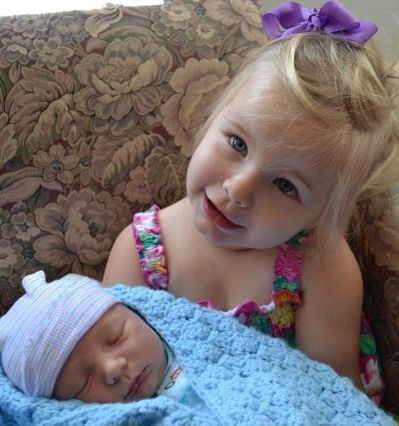
Chloe & Bishop

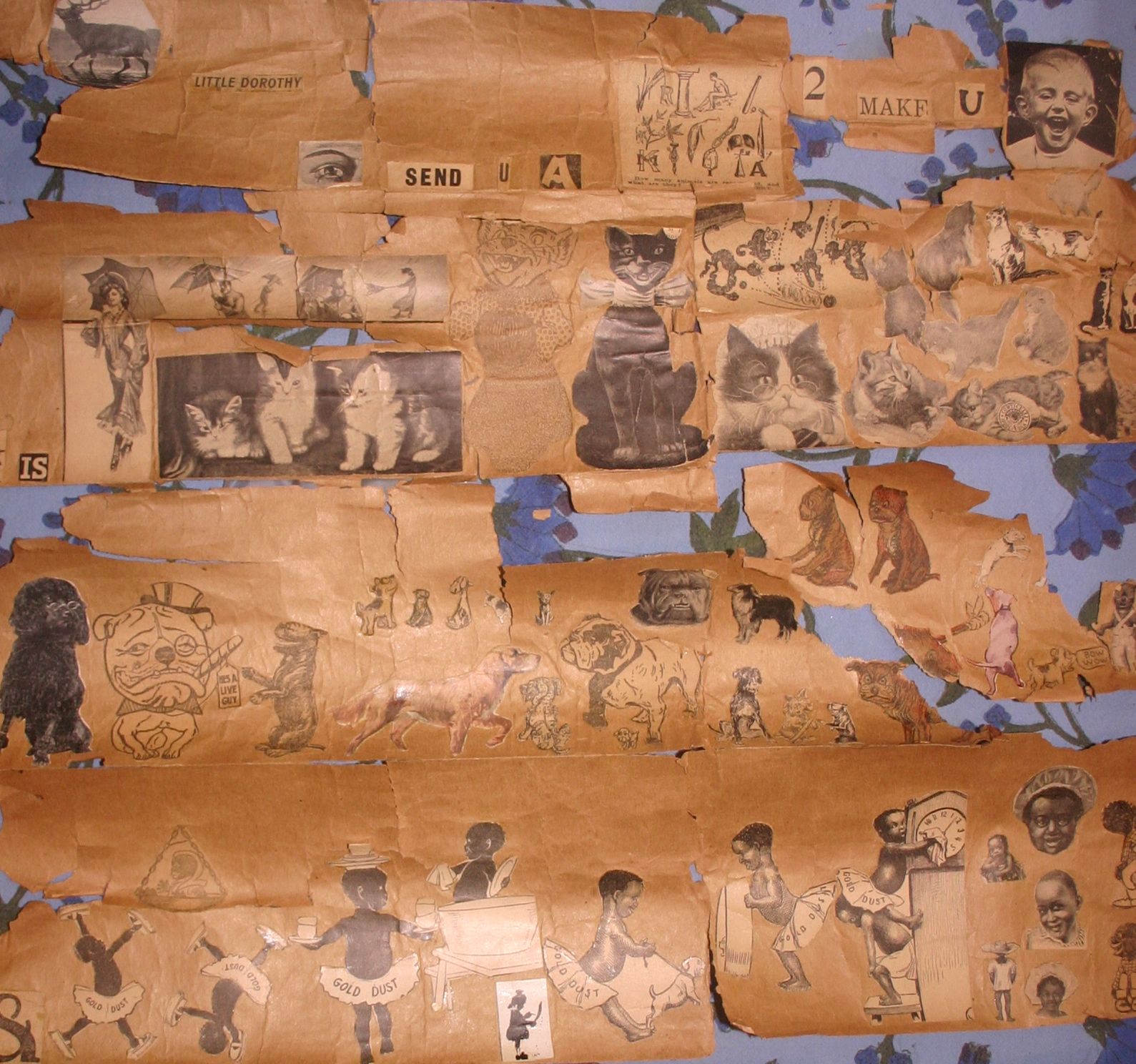
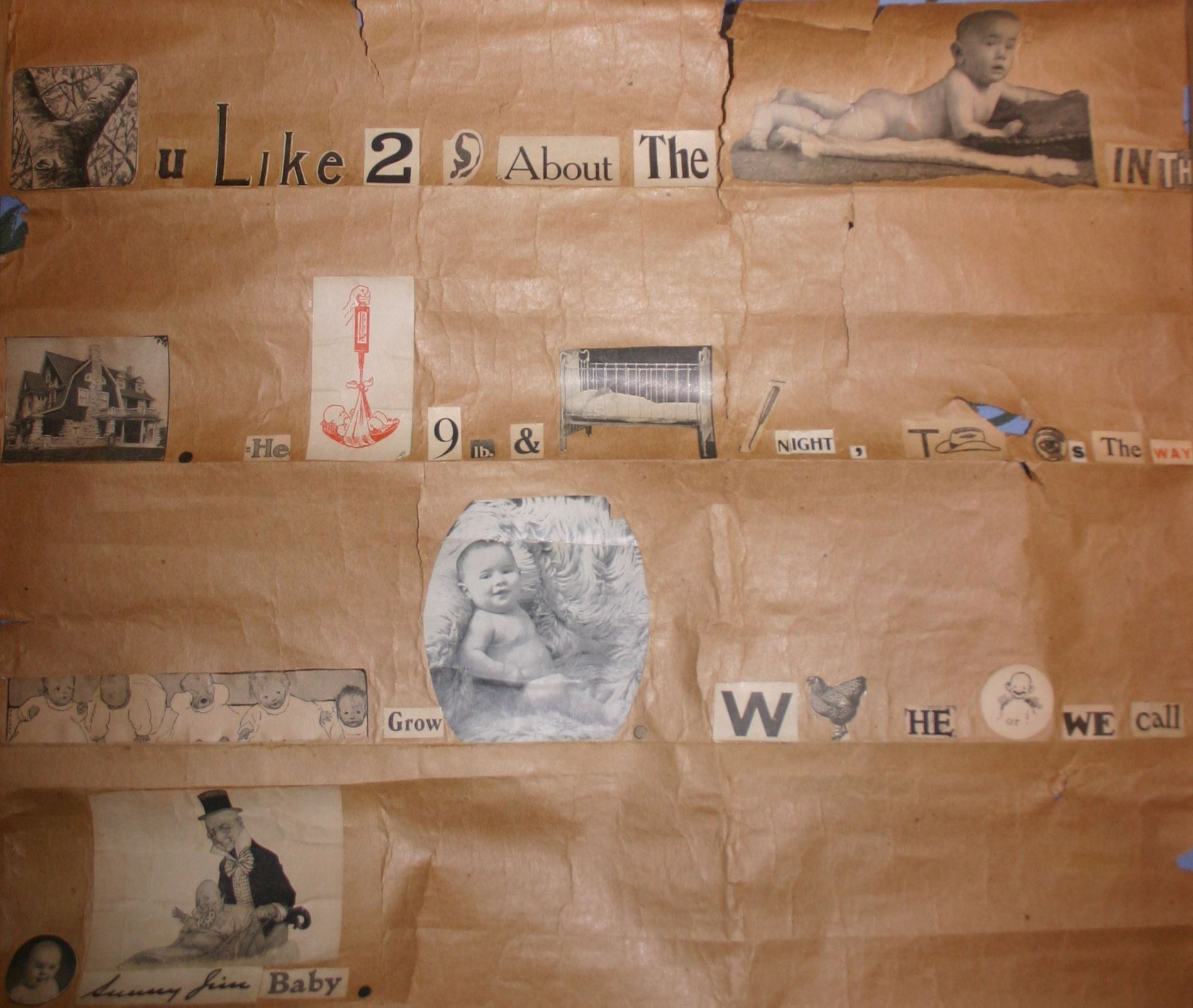
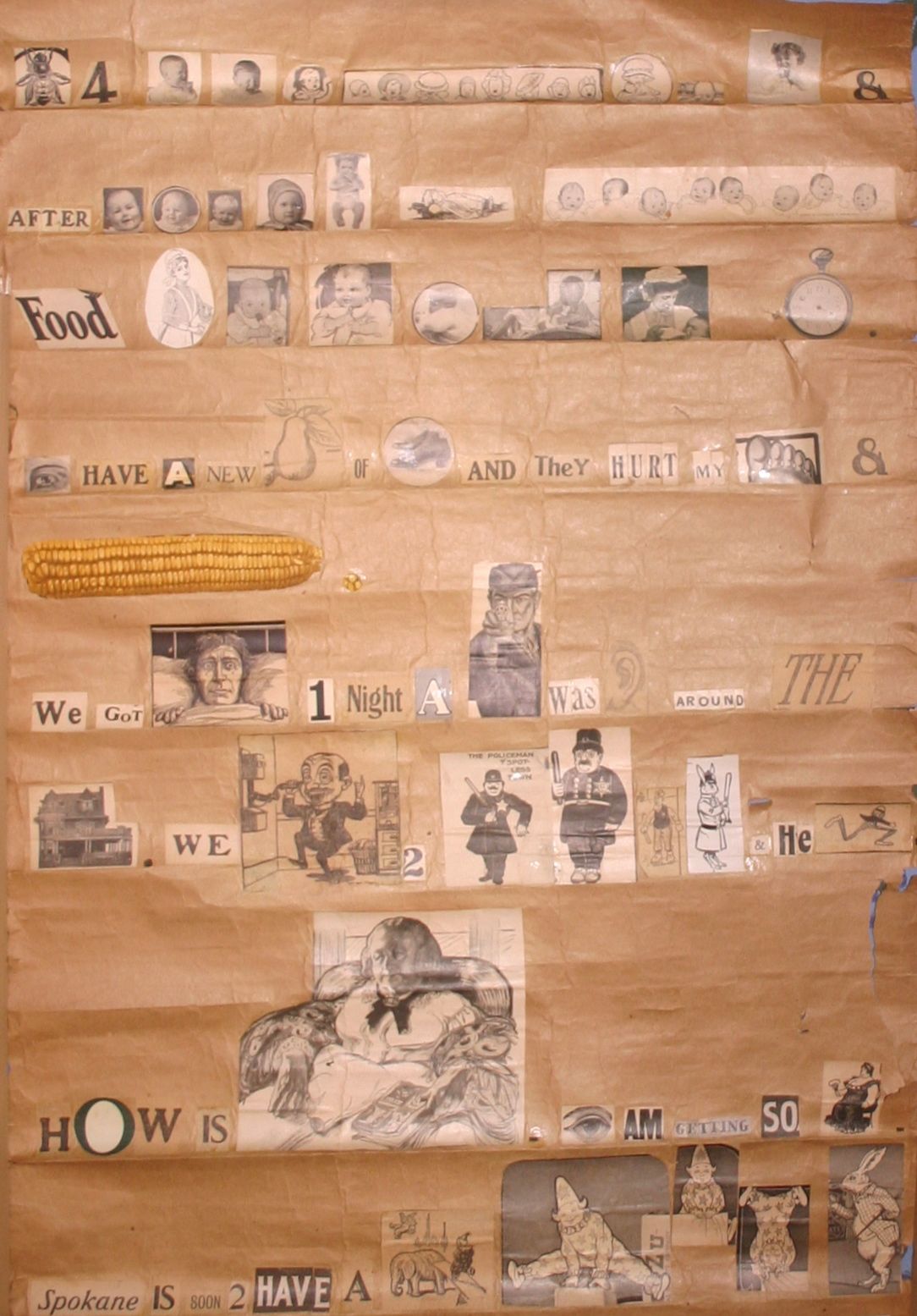
But that wasn’t always so. I came across an older technology while we were cleaning up our attic. It’s a rebus announcing Sunny Baby Jim, with at least 230 cut-outs from newspapers and magazines pasted onto a continuous roll of brown wrapping paper. It not only announces the baby, but also provides a glimpse into life in the US in 1905.

The paper for the rebus has become brittle and is starting to crumble. Some of the cut-outs are faded.I decided I should photograph it and decode it before it disintegrates completely.

It’s probably from my Great-Great-Aunt Fanny in Spokane, writing to my Grandmother, Dorothy in 1905. See whether you can decode it. The images aren’t very clear in the small versions, but should be more readable if you click each one to enlarge it.

There’s a scrap cityscape of Spokane, which probably came first. So, I think the first part says,

Spokane

Dear Little Dorothy,

I send you a puzzle to make you laugh.

It is raining cats, dogs, and babies.

The babies shown include the Gold Dust Twins, mascots for Gold Dust Washing Powder. Those racial caricatures were wisely phased out, but not for another 50 years.

Aunt Fanny goes on to ask:

Would you like to hear about the new baby in this house? He weighs nine pounds and sleeps all night, that’s the way babies grow. When he smiles we call him Sunny Jim Baby.

Then, there’s a comment about babies in general, and some local news:

Before babies sleep and after babies sleep, they eat, all the time.

I have a new pair of shoes and they hurt my feet and corns.

We got awakened one night. A shot was heard around the house. We called two policemen and he ran away.

How is Grandmother? I am getting so fat.

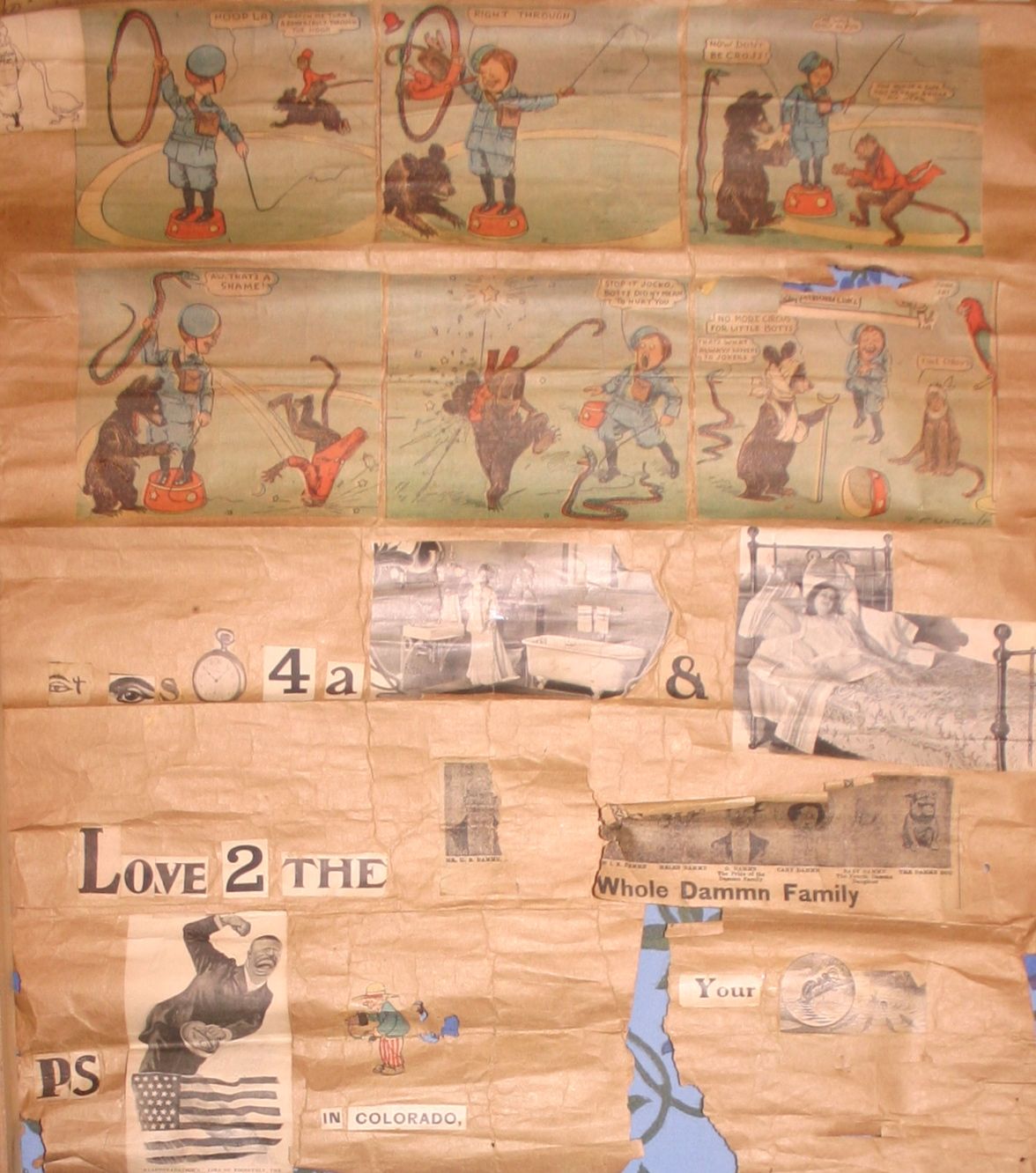
Spokane is soon to have a circus. [There’s then a six-frame comic strip set in a circus ring.]

While looking up information on that circus, I learned that a steel bridge with power wires for streetcars and overhead lighting was constructed over the Spokane River Gorge after the wooden bridge burned in 1890. The new bridge vibrated badly, and in 1905 the National Good Roads Association declared it unsafe. The Ringling Brothers Circus elephants refused to cross it. It was replaced in 1911.

The closing of the rebus reports some national news:

It is time for a bath and bed.

Love to the whole damn family.

PS: Teddy Roosevelt is in Colorado. [He went bear hunting there in 1905.]

Your Aunt [Fanny]

I don’t know how long we can keep the original of the rebus, thus this post to preserve it in a limited way. But it’s held up surprisingly well after 106 years, especially since it had not been cared for, just tossed into boxes in attics or garages. Will we be able to read this blog post as well in the year 2117?

Thanks, Aunt Fanny for your fascinating artwork. I suspect that few aunts (or uncles) today could or would invest the time to make such a detailed token of love for their niece.

A view on learning in Go:

My meetings here at Göteborg University have been held in the School of Pedagogy, which sits in three buildings, labeled, fittingly for an education school, as A-B-C.

But someone showed some imagination, and managed to start my brain spinning, by giving each hus a more lyrical name. I know the dictionary definitions, but I still can’t quite pull these names into a unified whole. Perhaps a Swedish colleague can help?

Hus A, the largest, is named Utsikten, which means “view.” That’s very appropriate, as its windows look out on the beautiful canal with its trees and walkways. The building is trilobite shaped. Its curves mean that each window has a different view. I think of the label as suggesting that we need to look out at the world.

Hus B is named Åsikten. This can also be translated as “view,” but here, I think it means point of view, or opinion. It reminds us that when we examine the world, we all see different things.

Finally, Hus C is named insikten, meaning “insight.” So, we have a view, a point of view, and an insight. Is it saying that as we consider our own view, then that of others, as in Peirce’s community of inquiry, that we develop insight? Or, does it mean that learning involves looking both outward and inward, then recognizing the fallibility of all knowledge? Does insight here really mean reflection, as we find in the water of the canal?

Or, is all of this just playing with the root sikt, and the untranslateablity in order to drive English speakers crazy? I suspect the latter, as I see Göteborg becoming Go:teborg on street signs, and then just Go:. But regardless of the deeper meanings I’m missing, this is just one of the many charming things I’m finding everywhere we look in Go:.

Turkey’s Village Institutes

One of the goals I had for my recent trip to Turkey was to learn more about the Village Institutes (Köy Enstitüleri) there. I knew that they represented an innovative approach to expanding opportunities for learning, but that they had come to an abrupt end in the late 1940’s.

I’d read several articles about the Institutes (see below), and also knew that they had been influenced by John Dewey’s report on the Turkish educational system, but I wanted to hear firsthand from Turkish people who had been involved with the Institutes, or had studied them from a Turkish perspective.

The Village Institutes were created to meet a serious educational need. In 1928 (the year of the introduction of the Latin script in Turkey), 82.5 per cent of men and 95.2 per cent of women were illiterate. For 13.6 million people, there were only 4,894 elementary schools and most of those were in the towns, not the villages where most of the people lived (Vexliard & Aytac, 1964).

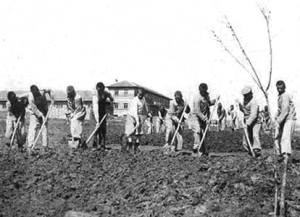
Between 1939 and 1946 twenty-one co-educational boarding schools were built to prepare primary school teachers. Much of the construction work was done by pupils and teachers. Youth of both sexes, aged twelve to sixteen, who had completed a five-year village primary school, qualified for admission. Their education was free following a pledge to teach in an assigned village for twenty years after graduation.

The duties of the new teachers included:

  • primary education
  • adult education in the villages
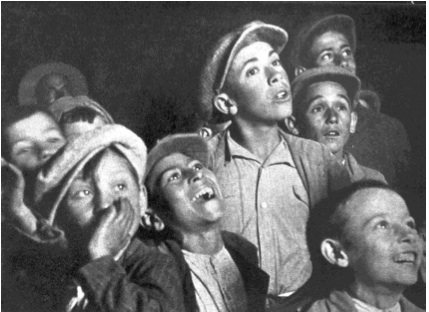
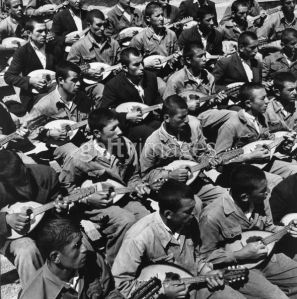
  • raising the cultural level of the villages through the distribution of books, educational programs, radio, and vocal, dance, & instrumental music education; the photo above (by George Pickow/Three Lions/Getty Images), shows Turkish teenagers in an Institute presenting a mass concert on the saz, the Turkish national instrument
  • promoting progressive agricultural techniques in the fields, the orchards, and kitchen gardens; the raising of  livestock; rural handicrafts such as ironwork, carpentry, leather work, mechanics, and electricity
  • instruction for adults in child-rearing, housekeeping, needlework
  • the creation and development of rural cooperatives

The graduates of the Institutes were to return to their villages as leaders and reformers. Teachers, students, and villagers in general were to learn practical skills, mostly related to their agricultural economy, new tools for life, and general education.

The Institute approach embodied ideas of Ataturk, Dewey, and others such as integrating theory and practice, focusing on the underserved, working across institutions, and a systemic approach to building a stronger society. Classical education was to be combined with practical abilities and applied to local needs.

The Institutes had a major impact, and many people regret that they were shut down. But there was resistance against this secular and mixed education. Some feared that it would educate ‘the communists of tomorrow,’ a damning statement during the Cold War. Traditionalists questioned the coeducational and secular aspects. Powerful landlords did not appreciate the goal of educating children who could ask “Why?” questions. There were also questions about the organization and preparation of the teachers. By 1953 the Village Institutes had been completely shut down.

I heard strong statements from people who knew about the Institutes and decried their closing. An artist we met, who had been born during the Institute period, said “They killed the Turkish children! They murdered Turkey’s future!”

Others were more reserved, but still felt that a crucial opportunity had been lost. There are estimates of major losses for Turkey in terms of general literacy and economic development still being felt today because of the closings.

From the little I know, it appears that the Village Institutes demonstrated a successful model for education that could be applied anywhere after suitable adjustment for local needs. I’d like to learn more, and have many questions.

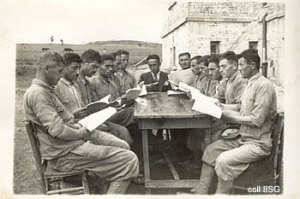
For example, all the photos I’ve seen show only (or mostly) young men, even though the Institutes were coeducational. How did the young men and women get along? How did they each experience the Institutes? The graduates would now be in their 80’s. How do they think about that experience today? What did their training mean for the villages where they went to teach?

How do the Village Institutes compare to other grassroots, community-based education initiatives, such as the school at Weedpatch Camp in California, Foxfire, the Misiones Pedagogicas (village literacy program in Spain, which was shut down by Franco), Paulo Freirean projects in many countries, Paseo Boricua, the Reggio Emilia Approach, or the school set up by the schoolboys of Barbiana?

Perhaps most importantly, could or should the Institutes be revived? Or, are there principles we can derive from them that would be valuable for the more urban populations of today?

References

Ata, Bahri (2000). The influence of an American educator (John Dewey) on the Turkish educational system. Turkish Yearbook of International Relations (Milletlerarası Münasebetler Türk Yıllığı), 31. Ankara: Ankara Üniversitesi.

Bilgi, Sabiha, & Özsoy, Seckin (2005). John Dewey’s travelings into the project of Turkish modernity. In Thomas S. Popkewitz (ed.), Inventing the modern self and John Dewey: Modernities and the traveling of pragmatism in education (pp. 153-177). New York: Palgrave Macmillan.

Dewey, John (1983). Report and recommendations upon Turkish education. In Jo Ann Boydston (ed.), The Middle Works: Essays on Politics and Society, 1923-1924. Vol. 15 of Collected Works. Carbondale: Southern Illinois Press.

Eğrikavuk, Işil (2010, April 9). Anniversary marks unfinished story of Turkish village schools. Hürriyet Daily News.

Stirling, Paul (1965, 1994). Turkish village. Canterbury, UK: Centre for Social Anthropology and Computing, University of Kent at Canterbury.

Stone, Frank A. (1974). Rural revitalization and the Village Institutes in Turkey: Sponsors and critics. Comparative Education Review, 18(3), 419–429.

Uygun, Selçuk (2008, November). The impact of John Dewey on the teacher education system in Turkey. Asia-Pacific Journal of Teacher Education, 36(4), 291–307.

Vexliard, Alexandre, & Aytac, Kemal (1964). The Village Institutes in Turkey. Comparative Education Review. 8(1), 41-47.

Wolf-Gazo, Ernest (1996). John Dewey in Turkey: An educational mission. Journal of American Studies of Turkey, 3, 15-42.

Yılmaz, Omer (1977). Schools for developing countries: The Turkish Village Institutes. Educational Planning, 3(4), 72–80.

World Universities Congress, Çanakkale

Last week I attended the World Universities Congress in Çanakkale, Turkey, organized by Çanakkale Onsekiz Mart University. The theme was new aims and responsibilities of universities in the context of globalization.

It was a fascinating and worthwhile event. Conferences like this are intrinsically interesting because of the venue and the assemblage of attendees from around the world.

The sessions highlighted the special role that Turkey plays in the world today, as a bridge between East and West, Christianity and Islam, modern and traditional, Europe and Asia. When you consider Turkey’s neighbors (Greece, Bulgaria, Georgia, Armenia, Iran, Iraq, Syria, and just across the water, Romania, Ukraine, Russia, Lebanon, Cyprus, Israel, Egypt, Libya), it’s clear that Turkey’s success is essential for all of us.

But there were also a number of excellent sessions and discussions interesting in purely academic terms. For example, in a panel I was on, I learned about a community/university project led by Arzu Başaran Uysal (stage right in the photo) to build playgrounds in Çanakkale. Although the setting was quite different, the course of the project reminded me of many of ours in community informatics. I presented on Youth Community Informatics and co-presented on our GK-12 project.

Çanakkale Onsekiz Mart University, or ÇOMÜ, went all out, offering cultural events including music, dancing, tours to Troy and Gallipoli, just across the straits, and a dinner where we saw börek made.

Börek is a baked or fried filled pastry, made of thin flaky yufka dough and filled with cheese, meat, or vegetables. Originating in Central Asia, it’s become popular every place we went in Turkey.

We stayed at ÇOMÜ’s beautiful Dardanos guest house, situated on the shore of the Dardanelles, the straits that connect the Black Sea to the Mediterranean. We could watch the sun setting over Gallipoli every evening, as in the photo above.

[Thanks to Del Harnisch for the second and third photos here.]