
Today, April 9, there will be an attempt at the world’s largest lesson. The UN’s Literacy Decade has just begun and today they want people all over the world to teach a lesson about literacy, which focuses on facts such as that nearly a billion adults are illiterate, most non-literate people are women, and 100 million children don’t even go to school. They hope to have thousands of students thinking about these issues all on the same day. The idea of record setting seems a little silly, but the campaign for global literacy is very serious, addressing a problem that stands in the way of solving almost any problem one can name, whether that’s about healthcare, the environment, economic development, social welfare, or conflict resolution.
education
Literacy in the information age: Inquiries into meaning making with new technologies
 Educators today want to go beyond how-to manuals and publications that merely celebrate the many exciting new technologies as they appear in schools. Students are immersed in an evolving world of new technology development in which they are not passive recipients of these technologies but active interpreters of them. How do you help learners interpret these technologies as we all become immersed in the new information age? Continue reading
Paseo Boricua
 Paseo Boricua has become the center of the Chicago Puerto Rican community. It’s a place where Puerto Ricans can learn about their heritage through the culture center and where the Pedro Albizu Campos High School provides an alternative school setting to help young people succeed. Puerto Rican restaurants and night life have developed along with commerce. Inquiry Project members have bcome active in working with the Paseo Boricua community.
Students using Biology Workbench
UI Scientists Head Back to School [article in the Champaign-Urbana News-Gazette]
“Students at Danville High School built their own molecules last year.
“Obviously, this is the kind of thing you can’t do with a textbook. Not surprisingly, it doesn’t yield typical textbook answers from the kids, which are more likely to be a recitation of facts from the book than a real understanding of how molecules work, says Shelley Barker, a Danville biology teacher and department chair.”
JAAL Technology Department
During 1997-2002, I edited the Technology Department in the International Reading Association’s Journal of Adolescent and Adult Literacy (JAAL). The columns were intended to promote dialogue about new communication and information technologies and to explore what these media mean for literacy and literacy educators. Each had several distinct sections, including an “email” message from me, an “issue of the month,” often written by a guest author, descriptions of selected websites, and a glossary. In addition to the print version, each column appeared in the Electronic Classroom section of Reading Online.
The columns have now been collected into a book, Literacy in the Information Age: Inquiries into Meaning Making with New Technologies (2003, Newark, DE: International Reading Association).
- Bruce, B. C., & Bishop, A. P. (2002, May). Using the web to support inquiry-based literacy development. Journal of Adolescent and Adult Literacy, 45(8), 706-714.
- Bruce, B. C. (2002, April). A friendly, welcoming attitude toward change. Journal of Adolescent and Adult Literacy, 45(7), 590-595.
- Brunelle, M. D. (2002, March). Why free software matters for literacy educators. Journal of Adolescent and Adult Literacy, 45(6).
- Jungwirth, B., & Bruce, B. C. (2002, February). Information overload: Threat or opportunity? Journal of Adolescent and Adult Literacy, 45(5), 400-406.
- Wielansky, Marc D. (2001-02, December/January). Internationalized domain names. Journal of Adolescent and Adult Literacy, 45(4), 302-308.
- Thakkar, U., Bruce, B. C., Hogan, M. C., & Williamson, J. (2001, November). Extending literacy through participation in new technologies. Journal of Adolescent and Adult Literacy, 45(3), 212-219.
- Hinn, M., Leander, K., & Bruce, B. C. (2001, October). Case studies of a virtual school. Journal of Adolescent and Adult Literacy, 45(2), 156-163.
- Lunsford, K. J., & Bruce, B. C. (2001, September). Collaboratories: Working together on the web. Journal of Adolescent and Adult Literacy, 45(1), 52-58.
- Bruce, B. C. (2001, May). Constructing a once and future history of learning technologies. Journal of Adolescent and Adult Literacy, 44(8), 730-736.
- Mishra, P., Nicholson, M., & Wojcikiewicz, S. (2001, April). Seeing ourselves in the computer: How we relate to technologies. Journal of Adolescent and Adult Literacy, 44(7), 634-641.
- Myers, J., & Beach, R. (2001, March). Hypermedia authoring as critical literacy. Journal of Adolescent and Adult Literacy, 44(6), 538-546.
- Kapitzke, C. (2000-01, February). Information literacy: The changing library. Journal of Adolescent and Adult Literacy, 44(5), 450-456.
- Zhao, Y., Tan, H. S., & Mishra, P. (2000-01, December/January). Teaching and learning: Whose computer is it? Journal of Adolescent and Adult Literacy, 44(4), 348-354.
- Bruce, B. C. (2000, November). Access points on the digital river. Journal of Adolescent and Adult Literacy, 44(3), 262-267.
- Kehus, M. (2000, October). Opportunities for teenagers to share their writing online. Journal of Adolescent and Adult Literacy, 44(2), 130-137.
- Bruce, B. C. (2000, September). The work of art in the age of digital reproduction. Journal of Adolescent and Adult Literacy, 44(1), 66-71.
- Bruce, B. C. (2000, May). Open source: Everyone becomes a printer. Journal of Adolescent and Adult Literacy, 43(8), 766-770.
- Leander, K. (2000, April). Laboratories for writing. Journal of Adolescent and Adult Literacy, 43(7), 662-668.
- Hawisher, G. (2000, March). Constructing our identities through online images. Journal of Adolescent and Adult Literacy, 43(6), 544-552.
- Bishop, A. (2000, February). Communities for the new century. Journal of Adolescent and Adult Literacy, 43(5).
- Bruce, B. C. (1999-2000, December/January). Searching the web: New domains for inquiry. Journal of Adolescent and Adult Literacy, 43(4), 348-354.
- Blanton, W., Greene, M., & Cole, M. (1999, November). Computer mediation for learning and play. Journal of Adolescent and Adult Literacy, 43(3).
- Sharples, M. (1999, October). Electronic publication: Writing for the screen. Journal of Adolescent and Adult Literacy, 43(2), 156-159.
- Bruce, B. C. (1999, September). Educational reform: How does technology affect educational change? Journal of Adolescent and Adult Literacy, 43(1), 42-47.
- Bruce, B. C. (1999, May). Education online: Learning anywhere, anytime. Journal of Adolescent and Adult Literacy, 42(8), 662-665.
- Bruce, B. C. (1999, April). Digital content: The babel of cyberspace. Journal of Adolescent and Adult Literacy, 42(7), 558-563.
- Bruce, B. C. (1999, March). Challenges for the evaluation of new information and communication technologies. Journal of Adolescent and Adult Literacy, 42(6), 450-455.
- Bruce, B. C. (1999, February). How worldwide is the web? Journal of Adolescent and Adult Literacy, 42(5), 382-385.
- Bruce, B. C. (1998-1999, December/January). Learning through expression. Journal of Adolescent and Adult Literacy, 42(4), 306-310.
- Bruce, B. C. (1998, November). Dewey and technology. Journal of Adolescent and Adult Literacy, 42(3), 222-226.
- Bruce, B. C. (1998, October). Mixing old technologies with new. Journal of Adolescent and Adult Literacy, 42(2), 136-139.
- Bruce, B. C. (1998, September). New literacies. Journal of Adolescent and Adult Literacy, 42(1), 46-49.
Validity of the 1992 NAEP of reading
The National Assessment of Educational Progress (NAEP) is the only nationally representative and continuing assessment of what America’s students know and can do in various subject areas. Assessments are conducted periodically in mathematics, reading, science, writing, the arts, civics, economics, geography, and U.S. history.
Since NAEP assessments are administered uniformly using the same sets of test booklets across the nation, NAEP results serve as a common metric for all states and selected urban districts. The assessment stays essentially the same from year to year, with only carefully documented changes. This permits NAEP to provide a clear picture of student academic progress over time.
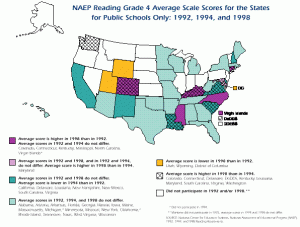 In the late 1980’s a plan developed for state-by-state reporting of 1992 reading data from the National Assessment of Educational Progress (NAEP). This plan was accompanied in the early 1990’s by a new framework for the assessment of reading. Jean Osborn, Michelle Commeyras, and I were asked to investigate the adequacy of the process used to develop the framework, the degree to which it represented a consensus among professionals in the reading field, and its content and curricular validity.
To conduct this investigation, we analyzed documents produced by NAEP, convened a 2-day panel of experts, held two public colloquia, conducted 50 interviews, and analyzed responses to a questionnaire completed by 627 leading educators. We found that the planning process did not include enough time to address some major concerns of the field. Despite this, there was widespread agreement that the 1992 NAEP in Reading represents important advances in reading assessment, including more open-ended responses, more authentic texts, and student choice about passages. But these very advances raise problems for test design and the interpretation and scoring of student responses.
Materials from this study are now stored in University of Illinois Archives, including trial materials (items proposed for use in the assessments), working papers, meeting minutes, and research protocols.
References
- Bruce, Bertram C., Osborn, Jean, & Commeyras, Michelle (1993). Contention and consensus: The development of the 1992 National Assessment of Educational Progress in Reading. Educational Assessment, 1(3), 225-253.
- Bruce, Bertram C., Osborn, Jean, & Commeyras, Michelle(1993). The content and curricular validity of the 1992 National Assessment of Educational Progress reading framework. In R. Glaser & R. Linn (Eds.), The trial state assessment: Prospects and realities (pp. 157-162). Stanford, CA: National Academy of Education.
- Commeyras, Michelle, Osborn, Jean, & Bruce, Bertram C. (1992). Reading educators’ reactions to the Reading Framework for the 1992 NAEP. In C. K. Kinzer & D. J. Leu (Eds.), Literacy research, theory, and practice: Views from many perspectives (Forty-first yearbook of the National Reading Conference) (pp. 137-152). Chicago, IL: The National Reading Conference.
- Commeyras, Michelle, Osborn, Jean, & Bruce, Bertram C. (1994). What do classroom teachers think about the 1992 NAEP in reading? Reading Research and Instruction, 34(1), 5-18.
Electronic Quills: A situated evaluation of using computers for writing in classrooms
 Quill was a suite of software tools designed to foster an environment for literacy in classrooms. We wrote it in Pascal for the Apple II computer. The software, teacher’s guide, and workshops were used widely, including in village schools in Alaska, which I visited three times during the project in 1983-84. Carol Barnhardt played a major role in setting up that Alaska project and in helping us understand the history and context of schooling in Alaska.
Continue reading
Dialogues in Methods of Education (DIME)
 Soon after arriving in Illinois in 1990, I joined the Dialogues in Methods of Education (DIME) group.
DIME members have studied together how to improve their own teaching practices through research, the sharing of ideas, and mutual support. They have also engaged in critical analysis of the disciplinary and institutional forces shaping their work.
The history of DIME shows the importance of accommodating difference in providing support for sustained community.
Connecting learning and life
Bruce, B. C. (2003, Summer). Connecting learning and life. Frontiers!: Official publication of the Fort Worth Museum of Science and History, p. 7.
Frisky and Blossom are long gone now, and I wouldn’t recognize them if they showed up today. But they taught me more about life than many people I’ve known. They were de-scented skunks who lived at the Fort Worth Children’s Museum (now the Fort Worth Museum of Science and History). I met them when my mother enrolled me, as a three-year-old, in the Frisky and Blossom Club held at the Museum.
The Frisky and Blossom Club was the first class of what later became the Museum School, now one of the largest museum school programs in the world, having served over 200,000 children. It was one of the first museum preschools to be accredited by the National Association for the Education of Young Children. But in 1950, the Club had only five members, Ben Hulsey, his younger brother Price, Gary Rall, Doug Wiley, and me.
Mr. and Mrs. Bigelow ran the Frisky and Blossom Club out of an old house on Summit St. We started in the summer of 1950, and came several times a week. There were outdoor benches where we sat for activities. We played with Frisky and Blossom, learned about rocks and fossils, and other artifacts the Museum offered. We also talked about things we liked to do and the Bigelows helped us connect those interests to each other’s and to the larger worlds of science and nature.
Museum School
 Later, I took other classes from the Museum School. These included Insects, Rocks & Fossils, and Astronomy. I joined the Astronomy Club, run by Mary Charlie Noble, the namesake of the Noble Planetarium. I still have my notebook from the Astronomy Club. It has issues of Sky and Telescope from 1956, diagrams of constellations, and notes from our classes. It also describes our wonderful field trips, in which we sat on a hillside watching for meteors, or studying the Milky Way (a stupendous sight available to anyone on earth to see in the days before we polluted the skies). I also participated in a program to spot enemy aircraft, presumably Russian bombers that had somehow missed being seen on their way to Fort Worth. I don’t know whether I helped save the Nation, but I remember being excited about a chance to contribute, and learning how to identify planes by their sound and silhouette. I still have a book Astronomy, which I won for spotting the most planes.
Although my writing in that notebook seems primitive compared to that of the nine- and ten-year-olds I see today, it recalls for me the joy I felt in expanding my imagination. I listed distances of planets, not because I was to be tested on it, or because it was good preparation for middle school, but because the Museum classes had awakened my senses. They concocted a living organism out of the natural curiosity of a child, knowledgeable and caring adults, interesting books, charts, and images, and the clear Texas skies.
What emerged from the Astronomy Club can be said about the other activities as well. I’ll never forget searching for insects in the Fort Worth Botanical Gardens or making boxes for mounting them. I can still identify insects by their order and was interested to read about the recent discovery of a new order, Mantophasmatodea. In fact, a characteristic of all the experiences I had at the Museum School is that they didn’t stop when the class or club ended. Instead of covering a topic and moving on, the Museum School caused me to open up, to seek to extend and enhance those experiences.
Another characteristic of these experiences was that they were never just, say “rocks & fossils” or “insects.” Through the insects class, I learned about cigar boxes (to hold the mounted insects), carbon tetrachloride (now banned as unsafe!), painting and homasote, the Greek language, flowers in the Botanical Gardens, diseases, history, and much more. Through “rocks & fossils” I learned about plaster of paris, two-D and three-D representations, dinosaurs, evolution, geology, oil exploration, and the age of the Earth. In contrast to some of the formal instruction I had received, this was a living process, a statistically unpredictable one, in which each experience led to learning and in turn to new experiences.
What It Meant to Me
It’s impossible to identify all the ways the Museum School affected me. The fact that I married Susan, who was working then at the Boston Children’s Museum, seems too obvious to say. Perhaps it’s all the little things, reading a biography of Roy Chapman Andrews as a teenager and fantasizing about exploring the world, loving to canoe and to hike in the mountains to this day, choosing to major in biology in college, being a regular reader of Scientific American, Natural History, Smithsonian, and National Geographic, participating in Science for the People, wanting to share a love of science with my children.
The most pervasive effect for me is how it has shaped the way I think about learning and life. In school we sometimes experience learning as a negation of life (“sit down and finish your workbooks!” “that doesn’t belong in the classroom!” “what were you doing instead of your homework?”). The testing mania of today only exacerbates that tendency.
When learning is separated from life, it becomes sterile: How many hours did all of us spend doing calculations in math classes and how many of us feel confident in math, care about it, spend time thinking about it? If the sterile approach helped develop people with a lifelong passion for learning, critical social engagement, and caring for others, I’d reconsider my views about it, but from where I stand those qualities emerge in spite of the sterility of much of formal instruction. Much of my work today is aimed at making learning come alive by connecting it to what matters in each learner’s ordinary experience.
The Museum School taught me a lot about the world. To this day, I can tell you the difference between diplodocus, diptera, and dipper (and I’m probably less afraid of skunks than I should be!). But more importantly, it taught me that the process of learning and growing is both challenging and energizing. The energizing aspect comes because the learning is connected to things the child cares about. That caring in turn is what makes it possible to for the child invest deeply in what would otherwise be daunting tasks. In the end, the learning becomes deeply embedded.
I mentioned above the joy I felt in expanding my imagination. I think many of us identify museum learning with joy, or simply with fun or play. In so doing, we risk conceiving it as un-serious, as inconsequential, as peripheral to real learning that can be organized into the scope and sequence of a curriculum or assessed on a standardized test. But my experiences with Frisky and Blossom, and yes, the people, too, taught me that joy means being connected to what matters, to being deeply engaged in life, and that joy in one’s experiences is the only real source for lifelong learning.

