The Quill greenhouse project in Hartford

Tending the plants Tending plants in the greenhouse Writing at the one Apple II computer Writing at the one Apple II computer

The images here are from 25-year-old 35 mm slides, so they’re not very clear, but the story is still relevant.

In 1982-84 I did some work with the Mary Hooker elementary school in Hartford, CT. We had developed a computer program called Quill, which allowed children to write and send email. Our test classroom at the school was taught by Jim Aldridge, who learned a week before classes started that he was to teach 6th, not 3rd, grade, was to work with the local garden club on a greenhouse project, and was to be a test site for Quill.

Jim’s class had 35 students, all from Puerto Rican, Cuban, and African-American backgrounds. There was a high level of transiency. Some students spent large portions of the winter in Puerto Rico; others simply didn’t come to school. The school was under-resourced and had policies such as requiring students to specify in advance how many sheets of toilet paper they needed for a bathroom trip, since students weren’t trusted with full paper rolls.

As a fairly new teacher, Jim was naturally a bit concerned. We worked out a way to use the Quill Planner feature for students to do lab reports on the plants in the greenhouse. This at least made the innovations more manageable. As things settled down, we found that the greenhouse became a focal point for learning. Several students who were on the verge of dropping out stayed in the class so they could work with the greenhouse and the computer. Some of this work is described in Electronic Quills: A Situated Evaluation of Using Computers for Writing in Classrooms (B. C. Bruce & A. Rubin; pub: Erlbaum, 1993).

It’s exciting to see how far we’ve come with similar projects today, such as Urban Agriculture in the Context of Social Ecology at the Pedro Albizu Campos High School in Chicago, which exemplifies the idea of the school as social center.
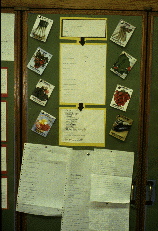
Seed packets and Planner notes
GreenhouseGreenhouse

Writing for a Change

As you all may know, the campus has an effort, led by Libbie Morley, to establish a National Writing Project site here. There will be an opening reception at Levis Faculty Center on April 3.

Among the materials we’re reviewing prior to submitting a proposal for the site is a new book, Writing for a Change: Boosting Literacy and Learning Through Social Action, edited by Kristina Berdan et al. (Jossey-Bass, 2006). It reflects a collaboration between the National Writing Project and the Centre for Social Action at De Montfort University in Leicester, England. I was struck in reading it how close the goals of an NWP site could be to what we’re doing with Community Informatics.

Below is an abstract, although it doesn’t do justice to the social action dimension as shown in the book:

Writing for a Change shows teachers how to engage students in “real world” problem-solving activities that can help them to acquire voice, authority, and passion for both reading and writing practice. Written in collaboration with the Center for Social Action in England, the book describes the innovative Social Action process for encouraging students to collaborate on problems of their own choosing—to analyze options, develop action plans, discover solutions, and finally to reflect on their work. Featuring stories by teachers who have successfully used the method, the book shows that first graders as well as high-school students can enjoy this exciting and educational process. Practical guidance for applying the process to any curricular area is provided along with an extensive list of classroom activities.

We Make the Road by Walking

I’ve been reading We Make the Road by Walking: Conversations on Education and Social Change, by Myles Horton & Paulo Freire (Temple University Press, 1990). I was reminded of it by Patrick Berry. If you haven’t read it, I recommend it highly. Meeting at a conference in 1987, Freire had invited Horton to join with him in “speaking a book.” The result is essentially a transcript of their lively and provocative conversations.

One section especially caught my interest. It’s called “Is it possible just to teach biology?” As Freire asks, “Is it possible to discuss, to study the phenomenon of life without discussing exploitation, domination, freedom, democracy, and so on?” As I expected, neither one answers “yes”; they reject the idea of neutrality in teaching anything. Many people might read that as advocating the imposition of one’s own ideas on others. But both Horton and Freire talk about sharing their ideas in a way that shows how they actually create more space for students to disagree, or to find their own path to greater understanding. They create a space in which everyone comes to a richer understanding of the subject at hand.

Tour of Paseo Boricua during AERA

speaker

John Dewey Society Sponsored Off-Site Program

Date: Wednesday, April 11

Time: 4:30 p.m. – 9:30 pm

Location: Puerto Rican Cultural Center, 2739-41 W. Division Street

Cost: $30 (includes bus transportation, program, and dinner)

Transportation: A bus will collect participants from the front of the Fairmont Chicago hotel at 4:30 p.m. and return there at 9:30 p.m.

Paseo Boricua, with its motto of ‘live and help others to live’ is renowned for its multigenerational and holistic community activism around human rights and social change and, in particular its model of learning in which ‘the community is the curriculum.’ With its many academic partnerships, Paseo Boricua also provides an outstanding example of university-community collaboration in research, teaching and public engagement.

The one-hour tour will visit the Puerto Rican Cultural Center and key organizations in the neighborhood, including the community library and media center, the Family Learning Center, Café Teatro Batey Urbano, and the Dr. Pedro Albizu Campos Puerto Rican High School. The tour is followed by dinner and a program presented by the National Boricua Human Rights Network: “Political Repression and Human Rights in the Puerto Rican Context.” Special speakers at the program include Dr. Luis Nieves Falcon, noted sociologist and educator who has played a leading role in the campaign to free Paseo Boricua’s political prisoners.

Organizers: Bertram (Chip) Bruce, University of Illinois at Urbana-Champaign, chip@uiuc.edu; Laura Ruth Johnson, Northern Illinois University (lrjohnson@niu.edu); Alejandro Luis Molina, National Boricua Human Rights Network and Dr. Pedro Albizu Campos Puerto Rican High School (alejandro@prcc-chgo.org); and José E. López, Executive Director, Puerto Rican Cultural Center.

Please RSVP to Chip Bruce: chip@uiuc.edu; 217.244.3576

Libr@ries: Changing information space and practice

Libr@ries examines the social, cultural, and political implications of the shift from traditional forms of print-based libraries to the delivery of online information in educational contexts. Despite the central role of libraries in literacy and learning, research of them has, in the main, remained isolated within the disciplinary boundaries of information and library science.


Continue reading →

Planetariums: education or entertainment?

As you know, two of the major functions of museums are education and entertainment. David Leake, who is director of the Staerkel Planetarium (and a former student), asked an interesting question about planetariums, which are akin to museums, or include museums, depending on how you look at it:

Why do some planetariums focus on education while others focus on entertainment?

Before reading what he found, you have to know that astronomers study circles. The objects–stars, planets, galaxies, etc–are roughly circular and so are the ways they move in orbits. Diameter then becomes a very important thing to know. So, for example the sun is 100 times the diameter of the earth and as a result 1 million times as massive.

It turns out that planetariums are also circular. As their diameter doubles, their volume and hence cost go up 8-fold. Dave found that planetariums smaller than 75 feet in diameter are low-budget operations, which focus on education. They open up as needed, host school groups, and have programs designed to teach. Above 75 feet they shift to a focus on entertainment. There are high-interest shows (Harry Potter recently) with stiff admission charges.

Dave’s study (a masters thesis) is so beautiful, not only because it provides a plausible and empirically-supported account of a major divide in the field, but also because the account itself (in terms of diameter) is so well-suited to the object of study.

The closest analogy I can come up with for other types of museums is that museums for young people focus on both education and entertainment. They’re all about exploring what’s new, especially through all the senses. As the audience ages the museums gradually shift the emphasis to preserving artifacts. There’s less attention to employing all the senses, and more on conveying the needed information. Is that because the older folks become more conscious of preservation? Or have their senses dulled, so they just want to get the answer in the least amount of time?

Lycksele learning centers

On October 21, while I was in Sweden, I spent a day in Lycksele. There, I learned about an innovative organization called Akademi Norr from Regis Cabral, their EU coordinator. The organization emerged as the result of cooperation among 13 municipalities in four counties in northern Sweden. It initiates, coordinates, and implements higher education programs and courses for people in the north, in order to meet needs for both education and development.

Each of the 13 municipalities has its own learning center, typically housed with the community library. Akademi Norr works with the center, a local industry, community members, and a university to devise a specialized higher education program. The center offers meeting spaces, ICTs, local tutoring, and other services. Their program shares many similarities with the GSLIS Chicago program in LIS education.

For example, I visited one of these learning centers, Lycksele lärcentrum. Most of their website is in Swedish, but you can see a little bit more in English on education in Lycksele. They’ve set up several programs. One currently underway leads to a BS in Engineering, with a focus on GIS; another is for a BS in Nursing, with an emphasis on ICTs.

Students who have completed these programs have easily found jobs in their region, because the program is designed from the start to make that possible. This is especially important in a region with strong ties to the land and community. The program is also designed to meet the needs of local industries, which might otherwise have dfficulty finding qualified workers in such a sparsely-populated area (3.8 people/sq-mi in Lapland versus 223.4 people/sq-mi in Illinois)

The staff in the Lycksele lärcentrum as well as at Akademi Norr are very open to having people visit or study what they are doing. There are possibilities for funding through iorganizations such as the American-Scandinavian Foundation . We could learn a great deal about community work, meaningful learning, ICTs in education, and more, through a better understanding of the learning centers programs.

Fulbright trip to Umeå and Göteborg, Sweden

I’ve been selected for a Fulbright Senior Specialists award to Sweden, during the second half of October. My first week will be at the Department of Informatics at Umeå University. I’ll visit with Ulf Hedestig, who works in computer support for collaborative learning, and Victor Kaptelinin, who works in human computer interaction and activity theory. Victor is from Russia and had worked with A. N. Leont’ev at Vygotsky’s institute in Moscow, but he also has strong interests in John Dewey’s work. I’ll be giving a major talk on learning there, as well as leading a discussion on the Schools of Information movement in the US.

During the second week, I’ll go to the IT-University at Göteborg, where they’ve been using my situated evaluation approach. I’ll see Marisa Ponti, who works on in the area ICT and Learning, as well as others. There’s a half-day seminar, “Supporting Distributed Collaboration in Science: Reflections from Experiences”, which I’ll present along with Diane Sonnenwald, from the University College of Borås. Later that week, I’ll teach a two-day short course on Pragmatic Design of Information and Communication Technologies, and then on Friday give a lecture on inquiry-based learning.

On Tuesday of that week, I’ll go to the Swedish School of Library & Information Science in Borås to give talks on our distributed knowledge project and the information school movement. In addition to Diane Sonnenwald, I hope to meet with there with Olof Sundin, who has done recent work on pragmatism and sociocultural theory, and also with Louise Limberg, who work in information literacy. She and I are both involved with an information literacy project directed by Eero Sormunen in the Department of Information Studies at the University of Tampere, Finland.

Somewhere in there, I plan to teach my classes in Champaign using Flashmeeting (web-based, video conferencing). We may have links from the various Swedish universities in addition to the class in LIS 109 and me.

Prolearn Summer School: Usability Panel

The first PROLEARN Summer School was held September 5-9, 2005 at Isik University in Sile, Turkey. The objective was “to contribute to the creation of an institutional culture, integrating distributed researchers across Europe into one community. It provides a framework for structuring a number of on going research, training, and scientific leadership activities.”

This slideshow could not be started. Try refreshing the page or viewing it in another browser.

LEEP

  • online professional development program
  • library & information science
  • 10 units, leading to a masters degree
  • ~100 Ss/year

challenges

  • low expertise, high resistance among Ss and Ts
  • low-end equipment
  • courses incompatible with online

outcomes

  • 100% retention
  • faculty choose
  • now larger than on-campus
  • students around world
  • model for others
  • WISE consortium (13 unis)

approach

  • low-end tech
  • tech support
  • faculty buy-in
  • cohort model
  • coordination with library, advising, etc
  • blended learning
  • mix sync & async

inquiry model

  • appropriate tech for each course
  • participatory design
  • diversity as a resource
  • Learning, culture and community in online education: Research and practice
  • LEEP Virtual Reunion

Quill, revisited

Quill iLab As an experiment to test iLabs version 3, and also to satisfy a long-standing impulse of mine to resurrect Quill, I created a Quill iLab (click on the image to see more).

This iLab combines information that used to be on basic html pages regarding the book, Electronic Quills: A Situated Evaluation of Using Computers to Teach Writing, and new interactive features, which emulate what Quill did on Apple II computers many years ago. The example texts are taken directly from the book, and represent examples actually written by students during the Quill project.

I was pleased to see that iLabs could do much of what Quill did, and in a much easier way than writing in Pascal on the Apple, with its 64KB memory. I was also reminded that we had some good ideas for promoting writing and collaboration, even with that primitive equipment.

Check it out and let me know what you think. If you’d like to be authorized as a member so you can see how entering texts work, just let me know.