Faubourg Tremé

Just to the Northwest of the French Quarter lies a neighborhood that few tourists visit, and many have never heard of, called Faubourg Tremé. Much of the area now appears bleak with Interstate Highway 10 bisecting it, industrial yards, and boarded up buildings. But it’s one of the most important neighborhoods in American history, and still has meaning for today. There are efforts to restore Faubourg Tremé and to learn what it has to tell us.
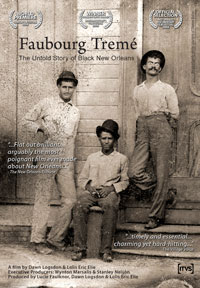
faubourg_tremeA recent, award-winning documentary tells the fascinating story, made all the more compelling by relating it to the life of a young reporter for the Times-Picauyune. The film is Faubourg Tremé: The Untold Story of Black New Orleans. Reporter Lolis Eric Elie leads us in his discoveries about his own city. He and director Dawn Logsdon show the relation between the city’s present and its rich past, enlivened throughout by music, including Derrick Hodge’s original jazz score, the Tremé Song by John Boutté, and a century of New Orleans music.

Viewers also meet Irving Trevigne, Elie’s seventy-five year old Creole carpenter, who descends from over two hundred years of skilled craftsmen, as well as Paul Trevigne, editor of L’Union, the first black newspaper in the US. L’Union and later, the Tribune, were strong advocates for the abolition of slavery, but beyond that, for full citizenship and social equality for all blacks, something most northern abolitionists shied away from. They hear from Louisiana Poet Laureate Brenda Marie Osbey, musician Glen David Andrews, and historians John Hope Franklin and Eric Foner as well.
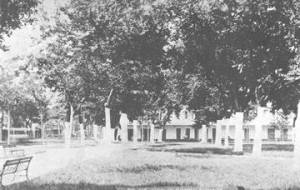
armstrong_park_Congo Squre cFaubourg Tremé was home to the largest community of free black people in the Deep South during slavery, where they published poetry and wrote and conducted symphonies. It was a racially-integrated community, a model for our own future. It as also possibly the oldest black neighborhood in America, the home of the Civil Rights movement and the birthplace of jazz. (See Congo Square to the right.)

Long before Rosa Parks, Tremé residents organized sit-ins on streetcars leading to their eventual desegregation. But on June 7, 1892, Homer Plessy from Tremé deliberately challenged the Louisiana 1890 Separate Car Act, by insisting on sitting in a whites-only car on a commuter train. He was arrested, tried, and convicted and eventually lost in the infamous Supreme Court decision of Plessy v. Ferguson. The resulting “separate-but-equal” decision legitimized segregation throughout the US for the next 62 years, and was a major blow to Tremé.

Following later assaults from urban renewal, Interstate Highway 10, and then Hurricane Katrina, it’s surprising that anything remains in Tremé. But one thing that has survived is a sense of history, embedded deep in the music, dance, architecture, social relations, and stories of the community. It is this history which holds a promise for the renewal of Tremé and perhaps of the larger US Society.

The film is a must-see, telling a story that is simultaneously informative, uplifting, and disturbing.


How to behave at the final defense

While cleaning out 30 boxes of files accumulated over many years, I came across an article by Neil Postman, which though long-misplaced, was fondly remembered. Postman  provides a humorous, but all too true account of the doctoral oral examination.

As he says, he rarely pays attention to “the content of an Oral – for example, what the dissertation is about or what idea the candidate is defending. [His] attention is always directed toward what the Oral is really about, namely, the conduct of relationships, obedience to authority.”

Here are a few excerpts, but I recommend reading the whole piece:

  • When the Orals begin, the door to the room is closed…like the closing of the main hatch of a submarine. Those inside are sealed off…from the rest of the world.
  • Eating during an orals is a breach of the system in that it not only dilutes the solemnity of the occasion but it reminds people that there are needs in life other than the passing of orals… [One candidate] brought with him a styrofoam cupful of chocolate ice cream which he sensuously engulfed as if he were replaying a scene from Tom Jones…it was a symptom of a general insensitivity to the nature of the occasion, and he was flunked without regret.
  • an attitude which combines concentration with slight bewilderment is about perfect.
  • leaning one’s elbows on the table, with fingers resting on one’s temples is very good, especially when accompanied by an intense frown.
  • Those who ask convergent questions are usually interested in the dissertation. Those who ask divergent questions are usually interested in the candidate. With the exception of very few of my colleagues, no one is much interested in ideas. (Those who are, of course, have never really understood the functions of an oral examination.)
  • questions [from the candidate] such as, “Why do you want to know that?” or “Are you quite sure you have your facts right?” are monstrous, and will bring down upon the candidate the full weight of the combined insecurities of the professors.
  • professors not only ask questions; they also make little speeches as prefaces to their questions…From the candidate’s point of view, these speeches are of no consequence since they are designed for the attention of other professors…The candidate would do well to appear interested but can put the time to good use by relaxing and trying to order his thoughts.
  • the oral examination is a serious test of how well a young scholar understands the structure of this and, by extension, other academic situations.

References

Postman, Neil (1978). Final orals: In defense of a thesis. The Gadfly, pp. 2-5. (the Littoral Press, iSSN 0160-1237)

The story of stuff

home-diggerAnnie Leonard has created an excellent, 20-minute video+animation that calls for creating a more sustainable and just world: The Story of Stuff with Annie Leonard

The story is told in an engaging, even funny, way, very accessible to children, as it addresses serious environmental and social issues. It discusses the inadequacies of the linear model for the materials economy, which conceives stuff in terms of extraction, production, distribution consumption, and disposal. Annie shows how these mostly hidden processes affect communities in the US and abroad. It’s lively, informative, humorous, and makes us think of the stuff in our lives in a new way.

The story of stuff website has additional resources, and the book will be available March 9, 2010

The origins of mobile phone and email

atsignMartin Cooper and Raymond S. Tomlinson have just been granted the 2009 Prince of Asturias Award.

Cooper invented “the first handheld mobile telephone and supervised the ten years that were necessary to commercialize the product. He … formulated the Law on Spectrum Efficiency, also known as Cooper’s Law, which states that the maximum amount of information that is transmitted over a given amount of radio spectrum doubles every 30 months.”

tomlinsonTomlinson worked at Bolt Beranek and Newman (now BBN Technologies). He helped develop the TENEX operating system, which had several innovative features, including a full virtual memory system, a user-oriented command line interpreter, and a command escape recognition system. In 1971 he developed the ARPANet’s first application for email by combining the SNDMSG and CPYNET programs so messages could be sent to users on other computers. He selected the @ sign to identify the user’s computer. Before long, that sign became the icon of the digital era.

Ray and I were colleagues at BBN, and teammates on the Great Swamp Volleyball Team, but I was just an ordinary user of that ground-breaking operating system and that early form of email.

References

Kapitzke, Cushla, & Bruce, Bertram C. (2005). The arobase in the libr@ary: New political economies of children’s literature and literacy. Computers and Composition: Special Issue on the Influence of Gunther Kress’ Work, 22(1), 69-78. [doi:10.1016/j.compcom.2004.12.014]one of

A new beginning against extremism

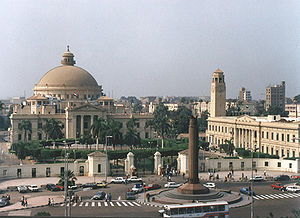
300px-CairoUnivObama’s speech yesterday at Cairo University (photo at left) was beautiful. It represents a new beginning against extremism both in the US and abroad. Even Osama Bin Laden recognized that it challenges a linchpin of al-Qaida’s message.

I don’t agree with many of the current Administration’s foreign policies (escalation of the Afghanistan-Pakistan war, inadequate engagement with the Caribbean, especially with respect to Cuba, and not doing more for Haiti, failure to close Guantanamo and re-establish justice following years of officially sanctioned torture and renditions, etc.), but opening dialogue is a first step towards a rational, humane, and effective foreign policy.

The ending of the speech is classic Obama:

89px-A_Boat_in_the_Nile_RiverIt’s easier to start wars than to end them. It’s easier to blame others than to look inward. It’s easier to see what is different about someone than to find the things we share. But we should choose the right path, not just the easy path. There’s one rule that lies at the heart of every religion — that we do unto others as we would have them do unto us. This truth transcends nations and peoples — a belief that isn’t new; that isn’t black or white or brown; that isn’t Christian or Muslim or Jew. It’s a belief that pulsed in the cradle of civilization, and that still beats in the hearts of billions around the world. It’s a faith in other people, and it’s what brought me here today.

We have the power to make the world we seek, but only if we have the courage to make a new beginning, keeping in mind what has been written.

The Holy Koran tells us: “O mankind! We have created you male and a female; and we have made you into nations and tribes so that you may know one another.”

The Talmud tells us: “The whole of the Torah is for the purpose of promoting peace.”72px-Barack_Obama_at_Cairo_University_cropped

The Holy Bible tells us: “Blessed are the peacemakers, for they shall be called sons of God.”

The people of the world can live together in peace. We know that is God’s vision. Now that must be our work here on Earth.

Thank you. And may God’s peace be upon you. Thank you very much. Thank you.

See Obama hits a home run, by Robert Dreyfuss.

Community as Intellectual Space, 2009

CI_2008The fifth annual Community as Intellectual Space Symposium will be held on June 12-14 at La Estancia on 2753 W. Division Street, Paseo Boricua, Chicago, Illinois.

The theme of the symposium is Critical Pedagogy: Community Building as Curriculum. As professionals and institutions are engaging with communities to enhance the life chances and well-being of residents, the conference examines how community-building and critical pedagogy can offer effective and sustainable change, locally and among collaborators as well.

BateyThe keynote speaker this year is Antonia Darder, a Professor at the University of Illinois in Educational Policy Studies and Latino/a Studies. There will be presentations and workshops on

The conference also offers Batey Urbano‘s production of Crime against Humanity, screenings of original documentaries filmed on Paseo Boricua, community tours, and art exhibits.

Community as Intellectual Space is co-organized by the Juan Antonio Corretjer Puerto Rican Cultural Center (Chicago) and the University of Illinois Graduate School of Library and Information Science. Continuing Professional Development Units (CDPUs), academic course credit for those who enroll in UI’s LIS590 CIO, and registration scholarships available.

Minority youngsters dying weekly on Chicago’s streets

So far this school year, 36 children and teens have been murdered–more than one a week–and [Rev. Michael] Pfleger at St. Sabina Church] is among a chorus of weary Chicagoans who say the slayings aren’t getting the attention they deserve.

Had 36 kids died of swine flu this year, “there would be this great influx of resources that say, ‘Let’s stop this, lets deal with this,'” Pfleger said.

via Minority youngsters dying weekly on Chicago’s streets – CNN.com.

As Bob Herbert says,

why overlook the humanity of so many others because of their ethnic background or economic circumstances? Surely the slaughter of dozens of Chicago schoolchildren is worthy of wide national coverage. CNN has covered the story, but there has been precious little coverage elsewhere.

via ‘What Color Is That Baby?’, The New York Times, May 11, 2009.

Visual literacy in the information age

ching-chiu1Ching-Chiu Lin is a founding member of the Youth Community Informatics project. Her work with Timnah, Lisa, and Karen at the Urbana Middle School integrated art, music, story-telling, cultural heritage, and multimedia in an after-school program. That’s one of the models for our current work.

michoacanChing-Chiu’s dissertation, A qualitative study of three secondary art teachers’ conceptualizations of visual literacy as manifested through their teaching with electronic technologies, analyzed similar arts and new media projects in three schools. I’ve learned a little while ago that it was awarded second place for the 2008 Eisner Doctoral Research award. This was officially announced at the National Art Education Association (NAEA) convention in Minneapolis this month.

Congratulations, Ching-Chiu!

Fondation Connaissance et Liberté (FOKAL)

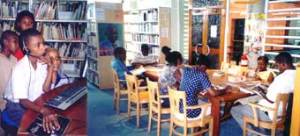
accueil_biblio1 I was very fortunate to hear Elizabeth Pierre-Louis speak yesterday.

Elizabeth was on campus to accept the 2008 Young Humanitarian Award. As Director of the Library Program at Fondasyon Konesans Ak Libète (FOKAL) in Haiti, she helped to set up 45 community libraries across the country. She coordinates the training and management of these libraries, which are improving the quality of live for the people there. Elizabeth described a wide variety of programs of FOKAL, including projects on supplying running water, developing basic literacy, supporting the visual arts, dance and music, debate, and economic education.

Throughout these many programs, there is an emphasis on participatory democracy, including organization and responsibility of citizens, leadership, financial and technical management, resolving conflicts, and collective decision making. Elizabeth’s work is just part of an amazing organization helping people work together toward common purposes.

The photo, of the Monique Calixte Library in FOKAL’s Cultural Center, and this text below are from the FOKAL site.

The Fondation Connaissance et Liberté / Fondasyon Konesans Ak Libète (FOKAL) Cultural Center, built in 2003 in the center of Port-au-Prince thanks to funding from the Open Society Institute (OSI) and support from George Soros, is designed for meetings, training, reading, debates, recreation and discovery.

The center is comprised of a public library, with a membership of over 5,000 where children and youths from the poor neighborhoods of Port-au-Prince have access to reading materials in optimal conditions, a small auditorium, a café-terrasse and a cybercafé. The UNESCO auditorium is a hall designed for conferences, debates, meetings, audio-visual presentations, films, concerts and theatre. The center also includes a large atrium where one can discover the works of both Haitian and foreign painters, writers, and sculptors; and a sound and video production studio, a training hall and gardens…

FOKAL’s cultural center offers a place, eminently rare in Haiti, where peasants, women, children and youths from poor neighborhoods have a chance to interact with each other and with representatives of all sectors of society on subjects which concern education, the environment, culture, and democracy…

How Europe underdeveloped Africa

how_europe_underdevelopedAmita’s interesting post, Education for Liberation…., and the materials she cites (Challenging White Supremacy workshop), reminded me of a book that had a big influence on me. I read it shortly before the author, Walter Rodney, was assassinated, in 1980, at the age of 38.

The book, How Europe Underdeveloped Africa, is now available online.

Rodney presents a new way of thinking about Africa’s so-called “underdevelopment.” The question was “why are some areas of the world rich and others poor?” I had been taught many reasons for this—that successful countries had better inventions, more adventurous explorers, greater natural resources, geographical advantages, better climate, less corruption, or just good fortune. The implication was that they mostly deserved their status as did the less successful ones. Africa’s underdevelopment was thus to a large extent Africa’s fault. Of course, a generous impulse might lead us to help those less fortunate to develop and share the goods of the world, maybe not to achieve full equality, but at least enough to meet their minimal needs.

Rodney challenges that entire view. He describes an Africa that is more developed than Europe in most ways except military conquest. When Europe fails to compete on even terms with Africa and Asia it turns to war and colonization to take by force what it cannot achieve through fair trade. Africa is then consciously exploited by European imperialists, leading directly to the modern underdevelopment of most of the continent. Thus, “underdeveloped” is an active verb, with an agent who does the underdeveloping; it’s not just a descriptive adjective.

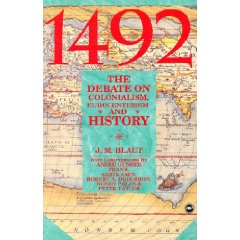
1492Rodney’s thesis was highly influential. James M. Blaut’s works, The Colonizer’s Model of the World: Geographical Diffusionism and Eurocentric History (Guilford, 1993) and 1492: The Debate on Colonialism, Eurocentrism, and History (Africa Research & Publications, 1993) extends the basic thesis, with more detailed economic analyses.

Other writers have criticized aspects of Rodney’s work, but the general idea seems even more salient in an era of neocolonialism. For example, Haiti today struggles under a crushing external debt. Nearly half of that was incurred under the Duvaliers, puppet dictators of the US. The Duvaliers stole the resources of the Haitian people, then assumed debts that oppress their children and grandchildren. Debt service, a burden essentially imposed by the US, makes economic growth nearly impossible. Yet commonplace accounts would say that “they” (the Haitian people) can’t manage finances, don’t know how to protect their natural resources, have a corrupt economy, lack creativity or initiative, or otherwise are to blame for their fate.

For many countries in Africa, for Haiti, and for other colonized areas, the forcible appropriating of indigenous human and natural resources means underdeveloping those areas. When we turn “underdevelop” into a past participle, “underdeveloped,” we make it easy to forget how that happened. Rodney puts it this way:

The question as to who, and what, is responsible for African underdevelopment can be answered at two levels. Firstly, the answer is that the operation of the imperialist system bears major responsibility for African economic retardation by draining African wealth and by making it impossible to develop more rapidly the resources of the continent. Secondly, one has to deal with those who manipulated the system and those who are either agents or unwitting accomplices of the said system. The capitalists of Western Europe were the ones who actively extended their exploitation from inside Europe to cover the whole of Africa. In recent times, they were joined, and to some extent replaced, by the capitalists from the United States; and for many years now even the workers of those metropolitan countries have benefited from the exploitation and underdevelopment of Africa. (§1.2)

Rodney’s account of Africa, written 37 years ago, is still relevant for Africa today. But it extends to other international regions and even to communities within so-called “developed” countries. When we see, and label, communities as underdeveloped, low-resource, impoverished, disadvantaged, economically depressed, troubled, or marginalized, we follow the lead of the 1965 Moynihan report, which described a “tangle of pathology,” locating problems within the community with causes in the distant past.

We should ask not only how these communities compare to privileged ones, or even what useful things we might do to help them. We need to look first at the structures and mechanisms of power that caused these conditions in the first place, and now, continue to maintain them. This means turning from the conceit that underdevelopment just happens, that an appropriate and full response is to “give” to those less fortunate. It requires collaborative struggle in which all participants are willing to examine the roots of oppression and to engage in the practice of freedom.