Juanita Goggins

[Note: This post was written five months ago, but I must have forgotten to click “publish”. I’d like to have it on the blog, even though her death is now old news, if only to help record a courageous life.]

I was saddened to learn about the lonely death of Juanita Goggins, a great leader and educator. Her life is a reminder of both the possibilities we have and the great challenges we still face around race in America.

Goggins was the daughter of a sharecropper in rural South Carolina, the youngest of 10 children, and the only one to earn a four-year college degree, from what was then all-black South Carolina State College. She taught in South Carolina’s segregated schools, and then went on to a number of major achievements.

In 1972, she became the first black woman to represent the state as a delegate to the Democratic National Convention. Two years later, she became the first black woman appointed to the U.S. Civil Rights Commission and the first black woman elected to the South Carolina Legislature. She was responsible for funding sickle-cell anemia testing in county health departments and sponsored key legislation on school funding, kindergarten, and class size.

One indication of the world she had to navigate was the Orangeburg Massacre. In February, 1968, students from Goggins’s alma mater attempted to bowl at Charlotte’s only bowling alley. The owner refused. Tensions rose and two days later violence erupted. The Orangeburg Massacre resulted in injury to 28 students and the death of three.

Sadly, by the early 1980’s, Goggins had developed mental illness and in later life became increasingly reclusive. She froze to death at age 75, living alone in a rented house not far from the Statehouse in Charlotte, where she had served.

See Once-revered lawmaker freezes to death alone (Associated Press, March 10, 2010).

My retirement plans

It’s with satisfaction, relief, anticipation, and a tinge of sadness, that I submitted my intention to retire in August of this year. I will have been with the University of Illinois for twenty years, half of those in the College of Education and half in the Graduate School of Library and Information Science. The retirement means that I’ll be changing my mode of work, with more attention to writing and more international projects.

I’ve enjoyed and benefitted greatly from my time here, and even more from working with you all. I can’t think of another group anywhere with such high collegiality, dedication, moral perception, and responsible leadership. The scholarship, teaching, and learning have always been outstanding and there’s been a lot of fun on top of it all.

I expect to continue working part-time on the Youth Community Informatics and Community Informatics Corps grants through June, 2011, and perhaps do other work after that, so this is not a good-bye, just an announcement about a new role for me.

Best wishes and enjoy all the snow,

Chip

Evangelicals attack Voudo practitioners in Haiti

As if people in Haiti haven’t faced enough problems already, Christians, many from outside Haiti, have begun attacking people there who are simply praying or singing.

PORT-AU-PRINCE, Haiti – Angry crowds in a seaside slum attacked a group of Voodoo practitioners Tuesday, pelting them with rocks and halting a ceremony meant to honour victims of last month’s deadly earthquake.

Voodooists gathered in Cite Soleil where thousands of quake survivors live in tents and depend on food aid. Praying and singing, the group was trying to conjure spirits to guide lost souls when a crowd of Evangelicals started shouting. Some threw rocks while others urinated on Voodoo symbols. When police left, the crowd destroyed the altars and Voodoo offerings of food and rum.

Some groups use an interesting method to convince Haitians to abandon their beliefs. Quoted in the same article, Pastor Frank Amedia of Miami-based Touch Heaven Ministries says:

“We would give food to the needy in the short term but if they refused to give up Voodoo, I’m not sure we would continue to support them in the long term because we wouldn’t want to perpetuate that practice. We equate it with witchcraft, which is contrary to the Gospel.”

Does this mean that pelting worshipers with rocks, urinating on their sacred symbols, and withholding food from hungry people is the modern Christian way? Aren’t those acts themselves “contrary to the Gospel”? Why do outsiders, in this case mostly Americans, think that violence is the path to rebuilding a nation? When will we learn that acting responsibly in the world doesn’t mean insisting that we are always right and that our way is the only way?

See the photo in the Associated Press report at Voodooists attacked at ceremony for Haiti victims.

Civil rights for the LGBT community, and for all

In his ‘Letter from the Birmingham jail‘, Martin Luther King placed the struggle against injustice in Birmingham in a larger context:

Moreover, I am cognizant of the interrelatedness of all communities and states. I cannot sit idly by in Atlanta and not be concerned about what happens in Birmingham. Injustice anywhere is a threat to justice everywhere.

While those lines are often quoted, they’re more often ignored. For many people, injustice means what happens to them directly, not what happens to others.

Countering that passivity, and calling on progressives allies to stand up, is a video made by one of my students, Phil Reese. It’s an excellent message about civil rights for all, including the LGBT community. In addition to conveying an important message, it’s done in a creative way, reminding us of the many silenced voices around us.

Progressives can’t sit by while Civil Rights are taken away from Americans–help us and become a true ally in the fight for Equality! -HEY #p2 We’re talking to you! AFTER THE VID VISIT http://bit.ly/HEYP2ALLY for more!

Moving the world: A celebration of writing and community

Parc de la Tête d'Or, Lyon, Sergio Canobbio

Last Wednesday, I was fortunate to attend a significant literary event, called Moving the World: A Celebration of Writing and Community.

Over a three-hour period, I heard essays, letters, poems, and collaborative writing, but also saw drawings and paintings. I got to meet with the artists and to ask them questions about their work. The intellectual and artistic quality as well as the variety of the works were outstanding. The program was beautifully organized by Patrick Berry and Cory Holding.

An event such as this one is not uncommon; what made this one special was that it was held in the chapel of the Danville Correctional Center, and the artists were all inmates. They showed off the work they’ve done through courses offered by the Education Justice Project (EJP), led by Rebecca Ginsburg. EJP is a response to the abundant evidence showing that

College-in-prison programs reduce arrest, conviction, and reincarceration rates among released prisoners. Evidence has also linked the presence of college-in-prison programs to fewer disciplinary incidents within prison, finding that such programs produce safer environments for prisoners and staff alike. College-prison programs also have benefits for inmates’ families and, hence, their communities.

Captured Potential, Larry Brent

The EJP is an outstanding effort to help young men who want to become better family and community members. If you had experienced Moving the World, you’d at least have seen inmate-students focusing their energies on reading and writing, on reflecting about their lives, families, and communities, and perhaps most significantly, engaged in how they can make positive contributions to the world both inside and outside the prison.

As I said, the quality of the writing and the oral performances was superb. I was impressed with nearly all of the works. One, entitled “Progressive tears: A prisoner’s retrospective cry for Dewey’s help,” asked the philosopher John Dewey whether his progressive vision was still relevant today. Do we as a people still believe in equality and justice? Do we still see education as a means for building a better society? One may wonder, since the use of Pell Grants for prisoners was eliminated in 1994, and most prison college programs have closed.

Another essay asserts “We all want the same things.” It shows that both prisoners and ordinary people on the outside want prisoners to turn from crime to productive citizenship. Other works included letters to family members, poems, reflections on life. The painting, “Captured potential,” and its accompanying text, express well both the tragedy of prison and the possibilities. I doubt whether anyone made it through the event with dry eyes.

You can see some of the writing itself in the National Gallery of Writing.

An event like Moving the World makes the drudgery and nonsense of many other parts of life much more bearable. I not only enjoyed it in the sense of savoring, rather than counting, the moments, I was also impressed by the obvious thoughtfulness, organization, and high standards that went into it. I now understand why one instructor said that her participation has raised the standards back at the university.

References

Schopenhauer’s porcupines

Several years ago, I read Schopenhauer’s porcupines: Dilemmas of intimacy and the talking cure: Five stories of psychotherapy, by Deborah Anna Luepnitz.

It’s a fascinating book, and you don’t need to be a Schopenhauer scholar, a zoologist, or a psychotherapy patient to get a lot out of it. The entry card instead is being someone who relates to others or would like to do so.

It was there that I encountered Schopenhauer’s parable of the porcupines, the last of many from his Studies in pessimism:

A number of porcupines huddled together for warmth on a cold day in winter; but, as they began to prick one another with their quills, they were obliged to disperse. However the cold drove them together again, when just the same thing happened. At last, after many turns of huddling and dispersing, they discovered that they would be best off by remaining at a little distance from one another. In the same way the need of society drives the human porcupines together, only to be mutually repelled by the many prickly and disagreeable qualities of their nature. The moderate distance which they at last discover to be the only tolerable condition of intercourse, is the code of politeness and fine manners; and those who transgress it are roughly told—in the English phrase—to keep their distance. By this arrangement the mutual need of warmth is only very moderately satisfied; but then people do not get pricked. A man who has some heat in himself prefers to remain outside, where he will neither prick other people nor get pricked himself.

Schopenhauer presents his parables as telling us just how life is, but Luepnitz takes this one in a constructive way. She shows through five case studies how we all have simultaneous needs and fears for intimacy, thus creating a dilemma for full living. As she puts it (p. 19):

Psychotherapy cannot make us whole, but it does allow us to transform suffering into speech and, ultimately, to learn to live with desire.

I was impressed with the book. Coincidentally, shortly after reading it, I had dinner in Philadelphia with a couple, one of whom was her patient.

References

  • Luepnitz, Deborah Anna (2002). Schopenhauer’s porcupines: Dilemmas of intimacy and the talking cure: Five stories of psychotherapy. New York: Basic Books.
  • Schopenhauer, Arthur (1891). The essays of Arthur Schopenhauer; Studies in pessimism (tr. Thomas Bailey Saunders). London: Swan Sonnenschein.

The Fun Theory

My sister, Susan, just sent a link to the Piano Staircase, which combines health, music, and fun, three of my favorite things:

Take the stairs instead of the escalator or elevator and feel better” is something we often hear or read in the Sunday papers. Few people actually follow that advice. Can we get more people to take the stairs over the escalator by making it fun to do? See the results here.

The Piano Staircase is from the Fun Theory, which

is dedicated to the thought that something as simple as fun is the easiest way to change people’s behaviour for the better. Be it for yourself, for the environment, or for something entirely different, the only thing that matters is that it’s change for the better.

The site has all sorts of clever ideas, many of which have been realized, and some with videos.

John Dewey and Daisaku Ikeda

ikeda-headshotI attended the 6th Annual Ikeda Forum for Intercultural Dialogue yesterday at the Ikeda Center for Peace, Learning, and Dialogue in Cambridge. The topic was John Dewey, Daisaku Ikeda, and the Quest for a New Humanism. The occasion was the 150th Anniversary of John Dewey’s birth.

Although Ikeda’s Nichiren Buddhism, a form of Mahayana Buddhism, may at first seem far removed from Dewey’s American pragmatism, the speakers found many areas of consonance between the work of the two. I was pleased to see that Jane Addams was brought into the conversation, too.

Ikeda CenterNichiren was a 13th century Buddhist reformer, who based his teachings on the Lotus Sutra and its  message of the dignity of all life. Like Dewey’s pragmatism, Nichiren Buddhism is grounded in the realities of daily life. It promotes “human revolution,” in which individuals take responsibility for their lives and help to build a world in which diverse peoples can live in peace.

Ikeda is the founder of the Soka Gakkai International, a movement characterized by its emphasis on value creation (soka). This implies that each individual needs the opportunity to find value in their unique path while contributing value to humanity. Soka schools have much in common with the kinds of schools Dewey envisaged (but rarely saw enacted).

At the Ikeda Forum discussions focused on connections and divergences between Dewey’s naturalistic humanism and Ikeda’s Buddhist humanism. Presentations examined how their work can be used as resources for individual and social change.

How useful is the concept of community?

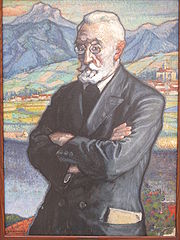
de_UnamunoMiguel de Unamuno says that anyone who invents a concept takes leave of reality. I like that statement both for its literal meaning that reality can nver be fully captured by a single concept, and in the suggestion that concepts imply a kind of madness.

Unamuno’s dictum applies to the question “How useful is the concept of community?”, because community designations betray the individual in two senses. One is that every community designation necessarily strips away the uniqueness of the individuals within. A term such as “immigrants” is clearly impoverished with respect to the many reasons, origins, and experiences of immigrants.

But a community designation can not only strip away individual meaning; it can attach wrong, or even contradictory meanings. For example, if we say that someone is a member of the “elderly community,” we impute a large set of attributes that may be totally off. She might be 90 years old, but rather than suffering “elderly decline,” she might be longing for that iPod we had provided to the “youth community” to share the latest music. There’s even some evidence that the very old are healthier than the somewhat old, because they were the ones who survived past critical health hurdles.

What makes this all even more interesting is that we can’t think without concepts, and we do better when we make use of even faulty information. A member of the “library patron community” may come to the library to get warm, to order some coffee (as at Urbana Free Library), to get a date, to sleep, or a host of other reasons.

Nevertheless, it’s helpful to know that many visitors seek information. Similarly, many immigrants may need help dealing with often absurd regulations that don’t apply to citizens in a country. Many elderly people have special physical or mental challenges well beyond those faced by most younger people.

These thoughts keep bringing me back to the need for dialogue. In so many cases, well-intentioned people make judgments and decisions without really listening to those they’re trying to help. Most examples of community designations betraying the individual, could at least be better addressed by starting with the idea of listening to each others’ experiences first.

References