John Dewey is not even mentioned in the Wikipedia article on Logic. That’s an oversight that I’m tempted to remedy, but it also reflects the fact that the 20th century development of logic in the tradition of Frege, (early) Wittgenstein, Russell, Gödel, and Tarski has largely ignored Dewey’s work, conceiving it in various ways, but above all, as not part of Logic. His idea that logic is the theory of inquiry is deemed to be a non-starter.
Dewey’s new logic
Bertrand Russell, in particular, took pains to explain why Dewey’s logic (1938) was not real logic, how it failed to address the fundamental questions of truth conditions or the relation between propositions and meaning, an idea that Tarksi had already developed in his model theory. Logicians should focus on concepts such as truth conditions, consistency of logical systems (that not all statements are provable), and completeness (that true statements are provable).
The development of model theory as a basis for semantics meant that the direct connection with the world was severed; logicians could now focus on the structure and operation of logical systems per se, without concern for real world consequences. In the terms of academic logic, it’s clear that Russell won the battle; Dewey’s “new logic” as Russell demeaned it, especially with its insistence on connection to lived experience, is now judged irrelevant by virtually all mathematical logicians, and most philosophical logicians.
 However, despite the great achievements of Tarski and others to follow, the standard account of logic has encountered obstacles. Kurt Gödel proved that any effectively generated theory capable of expressing elementary arithmetic cannot be both consistent and complete. For most systems of greater complexity, it’s not possible to say what consistency and completeness even mean.
Logicians began to see that formal logic was inadequate for the goals that David Hilbert, Russell and Whitehead, and others had proposed. Moreover, it was completely inadequate for that part of the universe that isn’t elementary arithmetic, i.e., social relations, history, culture, language, art, learning, nature, and all the other things that most people care about.
 In recent years, these inadequacies of the formal semantics approach have led to a reconsideration of Dewey’s theories. Thomas Burke, among others, has called for a critical, re-examination of logic as the theory of inquiry. In Dewey’s new logic: A reply to Russell, he analyzes the debate between Russell and Dewey that followed the publication of Dewey’s Logic: a theory of inquiry in 1938. He concludes that although Russell won the battle, Dewey won the war, in the sense that his logic holds more promise for the future, especially as a a logic for work in the social sciences and humanities, or for practical concerns.
Dewey’s unread book
In the preface to his 1938 book on logic, Dewey says,
This book is a development of ideas regarding the nature of logical theory that were first presented, some forty years ago, in Studies in Logical Theory; that were somewhat expanded in Essays in Experimental Logic and were briefly summarized with special reference to education in How We Think.
There are many proposed encapsulations of Dewey’s vast body of work. If I had to choose one, it might be logic, which Dewey himself saw as a 40-year project. His early training, an academic context that sought a logical basis for knowing and life, and the ways in which his logic integrates across his ideas in art, education, political theory, morality, and other areas, suggests to me that logic could be the strongest connective thread.
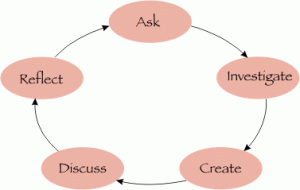 As he develops his logic, one can see the core behind many of Dewey’s major ideas, such as warranted assertions, situation, ends-in-view, habits, the continuum of inquiry, facts and meanings, and the relation between natural and social science. He also confronts major issues in logic as they are conceived by Russell et al., but always with a twist, which not surprisingly, makes his views unacceptable to that community. Nevertheless, I agree with Burke et al. that Dewey offers us the best option for a usable logic for the problems of today.
Reading Dewey’s Logic: A theory of inquiry
 Some of Dewey’s Logic: a theory of inquiry can be a slow read. Published 71 years ago, the style is often pedantic. Dewey’s characteristic lack of references, diagrams, compelling metaphors, and good examples doesn’t help. His attempts to speak to the world of Russell and Tarski often get in the way. Nevertheless, the ideas are powerful, and deserve the reconsideration mentioned above.
Much of the book can seen as explaining one of the few definitions Dewey ever provides:
Inquiry is the controlled or directed transformation of an indeterminate situation into one that is so determinate in its constituent distinctions and relations as to convert the elements of the original situation into a unified whole.
The book is 556 pp. (my copy), divided into four parts. Part I is probably the most useful for most readers. It’s here that he provides the rationale for conceiving logic as inquiry, and discusses topics such as common sense in relation to scientific inquiry.
Part II defines inquiry and explores the construction of judgments. Part III on propositions and terms is a shorter section, and probably the most technical in the book. It’s also the one that speaks most to Tarski, although in a way that I suspect he rejects. Part IV focuses on mathematics and science. I found it to be the most interesting, especially as it deals with scientific methods, scientific laws, theories of knowledge, and social inquiry.
My recommendation on reading is to slow-read Part I, in order to understand what Dewey is trying to do. Use Part II as a way to see how the theory plays out, but devoting effort to chapters differentially, e.g., I find chapter 8 on understanding and inference to be especially good. Part III could be left for a more advanced read. Part IV is very good, especially the last three chapters.
Table of Contents
Here is the TOC for Logic: a theory of inquiry. The links are to the Past Masters collection at the University of Illinois (login required).
References
- Burke, F. Thomas (1994). Dewey’s new logic: A reply to Russell. Chicago: University of Chicago Press.
- Burke, F. Thomas; Hester, D. Micah; Talisse, Robert B. (Eds.) (2002). Dewey’s logical theory: New studies and interpretations. Nashville: Vanderbilt University Press.
- Dewey, John (1938). Logic: a theory of inquiry. New York: Henry Holt.
- Talisse, Robert T. (2002). Two concepts of inquiry. Philosophical Writings, 20, 69-81.
- Tarski, Alfred (1983). Logic, semantics, metamathematics: Papers from 1923 to 1938 (2nd ed.). Hackett, Indianapolis: Hackett.

 There’s more than corn and beans in the farmland here. Last Sunday, we visited an apple farm/orchard in Monticello, Illinois, which had 17 varieties.
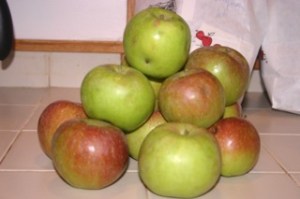 Fortunately, one is a long-keeper, Buff, which is supposed to last until late winter if it stays cold.
 If we don’t eat them all, we can feed them to our deer. See this backyard scene, where we played boule at the potluck in honor of John Dewey’s 150th birthday on Tuesday.